

Today, Statistics Canada is releasing an update to its Quality of Employment in Canada publication. Articles entitled "Average earnings, 2024," "Employees with low pay, 2024," and "Training participation, 2024," have been updated with recent data from the Labour Force Survey (LFS), including additional insights on quality of employment for racialized groups and Indigenous people. This release also includes new articles entitled "Perceived job security, 2025," "Paid leave entitlement, 2024," and "Medical or dental benefits coverage, 2024." Results are based on information collected in the LFS and in the LFS supplements.
Average hourly wages grew faster among women than men from 2006 to 2024
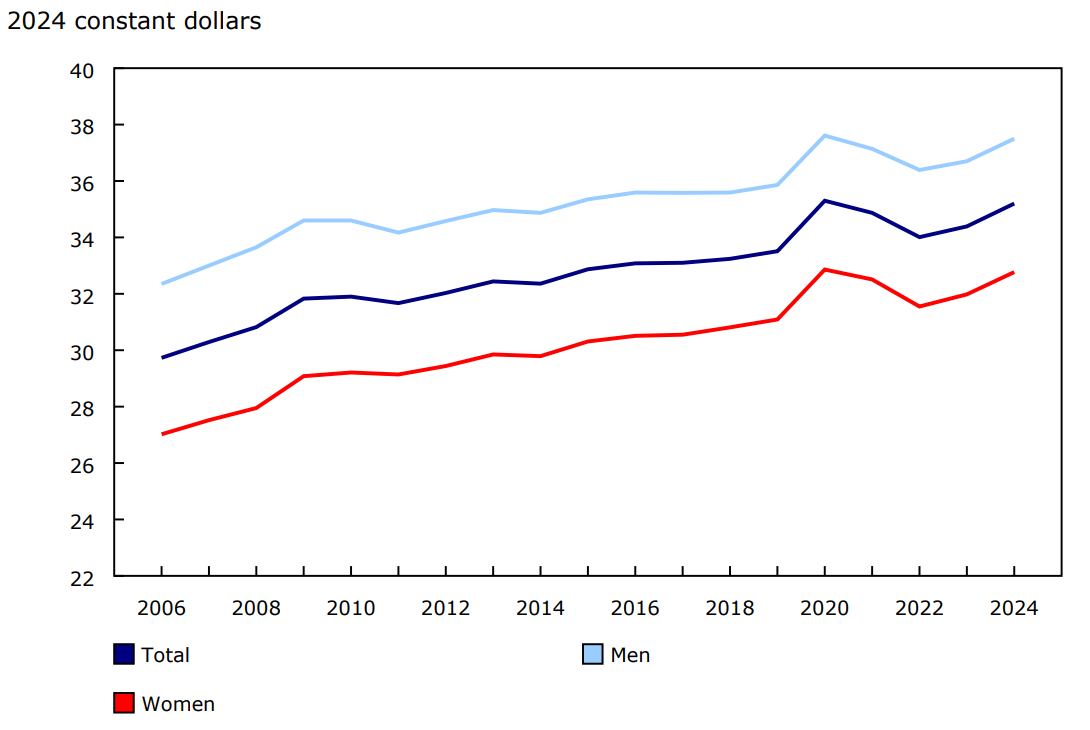
After adjusting for inflation, the average hourly wage of employees in 2024 was up $1.69 (+5.0%) compared with its 2019 pre-COVID-19 pandemic level, and it was up $5.47 (+18.4%) compared with its 2006 level, the earliest year of available comparable data. From 2006 to 2024, average hourly wages grew faster among women (+21.3%) than men (+15.9%).
Chart 1: Average usual hourly wage, employees aged 15 years and older, Canada, 2006 to 2024
Description - Chart 1
Data table: Average usual hourly wage, employees aged 15 years and older, Canada, 2006 to 2024
Note: Hourly wages are adjusted for inflation and expressed in 2024 constant dollars. Due to rounding, estimates and percentages may differ slightly between different Statistics Canada products, such as analytical documents and data tables.
Source: Labour Force Survey (3701), custom tabulation.
In 2024, among core-aged employees (aged 25 to 54 years), First Nations people living off reserve ($33.37), Métis living in the provinces ($35.67) and Inuit living in the provinces ($33.42) all had average hourly wages below that of their non-Indigenous counterparts ($37.77). However, higher education can narrow the wage gap. For example, among people with a bachelor's degree or higher, the wage gap with non-Indigenous employees disappeared for Métis living in the provinces and it was narrower for First Nations people living off reserve.
Rates of perceived job insecurity higher among West Asian and Arab employees than among non-racialized, non-Indigenous employees
Higher proportions of West Asian (13.8%) and Arab (12.8%) employees in April 2025 agreed or strongly agreed that they might lose their job in the next six months compared with their non-racialized, non-Indigenous counterparts (6.9%). Both West Asian and Arab employees were also more likely to have a temporary job. These differences are consistent with those observed in November 2023, the last time this information was collected.
Public sector employees more likely to have access to medical or dental coverage and paid leave
In 2024, 80.9% of public sector employees reported having workplace medical or dental care coverage, compared with 62.1% of private sector employees. Further, 81.7% of public sector employees indicated that they had access to paid vacation leave, compared with 70.0% of private sector employees. The unionization rate was substantially higher among public sector employees, which may have contributed to the higher rate of access to these benefits in the public sector.
Note to readers
Data and analyses published as part of the Quality of Employment in Canada (Catalogue number14280001) publication cover different periods depending on the sources available. New and updated data and analyses are regularly released as part of this publication.
First launched in 2022, Quality of Employment in Canada provides data and insights based on the United Nations Economic Commission for Europe's (UNECE) statistical framework on quality of employment. The UNECE framework, which informs data collection and analysis on quality of employment at Statistics Canada, offers a comprehensive set of indicators that helps monitor changes across different dimensions of quality of employment in the context of rapidly evolving labour market conditions.
The main data source for this publication is the Labour Force Survey (LFS). While the main objective of the LFS is to provide information on the labour force characteristics of the population, it also includes information on a wide variety of dimensions of quality of employment.
As part of its Labour Market Indicators program, Statistics Canada collects additional data on quality of employment through monthly and quarterly supplements to the LFS. Results from these supplements are used to fill data gaps and track changes in a wider range of quality of employment indicators.
The average earnings indicator measures the usual average hourly wages of employees at their main job in 2024 constant dollars.
The perceived job security indicator refers to the proportion of employees who agree or strongly agree that they might lose their job in the next six months.
The medical or dental benefits coverage indicator is the proportion of employees with access to supplemental medical or dental care benefits in their main job.
The paid leave entitlement indicator refers to the percentage of employees entitled to paid vacation leave through their employer.
For more information, please see the Quality of Employment in Canada page.
Contact information
For more information, or to enquire about the concepts, methods or data quality of this release, contact us (toll-free 1-800-263-1136; 514-283-8300; infostats@statcan.gc.ca) or Media Relations (statcan.mediahotline-ligneinfomedias.statcan@statcan.gc.ca).