
Highlights
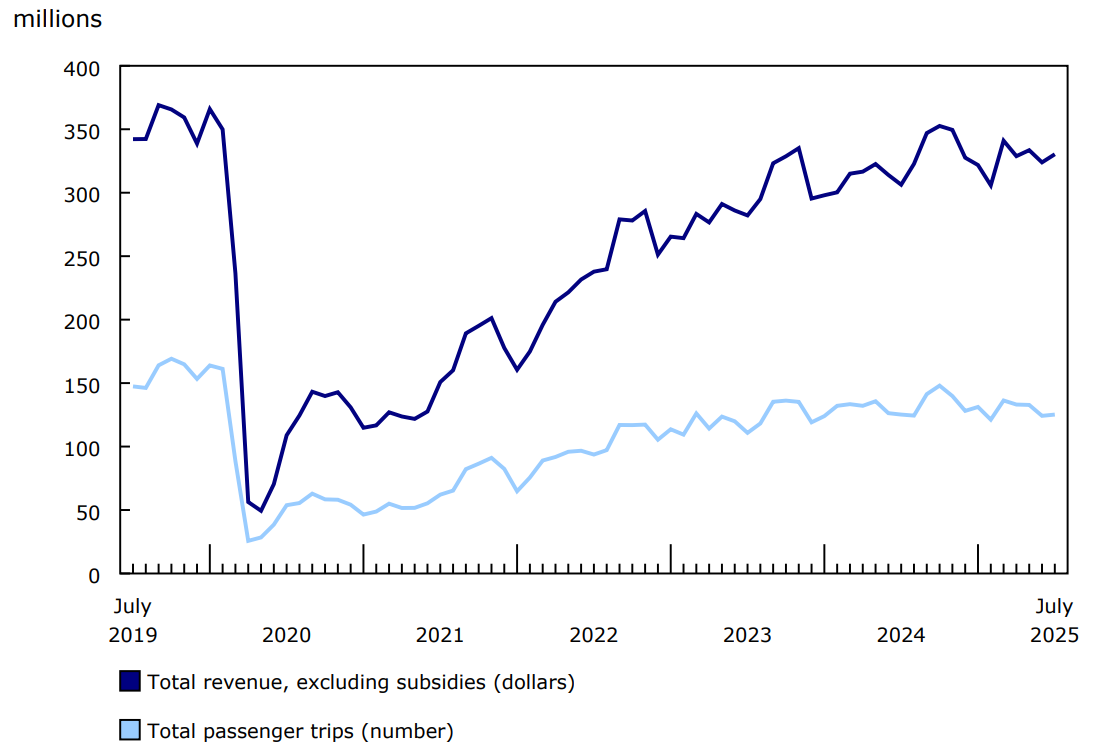
In July, the number of urban transit passenger trips in Canada totalled 125.2 million, essentially unchanged from July 2024.
Data on total passenger trips and operating revenue for selected urban transit agencies are available in table 23-10-0307-01.
Ridership flat
In July 2025, transit riders took an estimated 125.2 million trips on urban public transit systems in Canada, essentially unchanged from July 2024. This followed two consecutive months of year-over-year declines in ridership.
In the two years prior to the COVID-19 pandemic (2018 and 2019), public transit ridership declined by almost 5% from June to July, with summer vacations, fewer students and more active travel. However, ridership in July 2025 edged up 0.8% compared with June. Fewer passenger trips in June, as a result of a labour disruption at a large Quebec transit agency, likely contributed to the monthly gain in July.
Revenue up
In July 2025, transit agency operating revenue (excluding subsidies) increased 7.8% over the same month in 2024, reaching $330.3 million.
Chart 1: Urban public transit operating revenue and passenger trips, monthly, 2019 to 2025
Description - Chart 1
Data table: Urban public transit operating revenue and passenger trips, monthly, 2019 to 2025
Source: Table 23-10-0251-01.
Note to readers
The table 23-10-0307-01—Passenger bus and urban transit statistics, by Urban transit agency—includes operating revenue and ridership at the city level for selected transit agencies. Statistics Canada appreciates the cooperation of these transit agencies in making this information available to Canadians.
Survey data are revised on a monthly basis to reflect new and updated information.
The data in this release are not seasonally adjusted.
This survey collects data on operating revenue (excluding subsidies) and the number of passenger trips from a panel of urban transit companies that represents at least 75% of revenue in each province and territory. Note that the panel is adjusted annually to maintain the 75% coverage and could differ slightly from what it was in the same month the previous year.
One-time payments from secondary and post-secondary institutions for academic-year student passes are typically reported as revenue during the early fall and early winter months.
Data prior to January 2017 can be found in table 23-10-0078-01.
Random tabular adjustment
The random tabular adjustment (RTA) technique, which aims to increase the amount of data made available to users while protecting the confidentiality of respondents, was applied to the totals of the Monthly Passenger Bus and Urban Transit Survey.
Using RTA, Statistics Canada identifies sensitive data and randomly adjusts values rather than suppressing them. The size of the adjustment is calculated to protect respondent confidentiality.
The Transportation Data and Information Hub, featuring data from Statistics Canada, Transport Canada and partners, provides Canadians with online access to comprehensive statistics and indicators for the country's transportation sector.
Contact information
For more information, or to enquire about the concepts, methods or data quality of this release, contact us (toll-free 1-800-263-1136; 514-283-8300; infostats@statcan.gc.ca) or Media Relations (statcan.mediahotline-ligneinfomedias.statcan@statcan.gc.ca).