
The production of critical minerals in Canada has become increasingly important, with 34 minerals labelled as critical by Natural Resources Canada due to their crucial importance in today's technologies and industries. Critical minerals support the green and digital economy and help ensure national security. They are used in a variety of products such as solar panels, smartphones, medical devices, electric vehicle batteries and defense applications. The importance of critical minerals in Canada is also reflected in the federal government's investments, where two of the first five projects considered by the newly created Major Projects Offices includes mines extracting critical minerals.
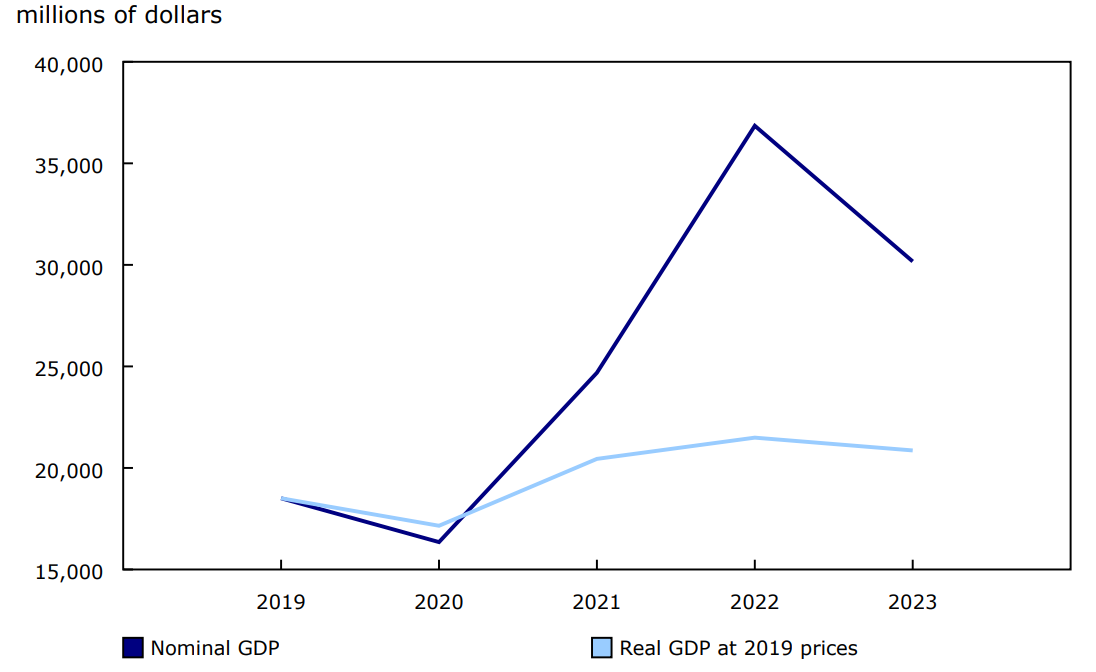
The contribution of critical mineral production to the Canadian economy, as measured by real gross domestic product (GDP), stood at $20.9 billion in 2023, significantly higher than the $18.5 billion recorded in 2019, but down from a high of $21.5 billion in 2022. Among the selected aggregations, aluminum (+38.1%), potash (+35.3%) and services related to critical mineral extraction (+31.1%) experienced growth from 2019 to 2023, while declines were recorded among platinum group metals (-26.3%), the prioritized critical minerals group (-13.6%; including cobalt, copper, and nickel), and the other critical minerals group (-5.5%; including uranium, silicon metal, and zinc).
Rapid increases in prices since 2019
In 2023, the nominal GDP attributable to the production of critical minerals in Canada was $30.2 billion, which represents roughly 1.1% of the total Canadian economy and 37.4% of the mineral and mining sector as defined by the Natural Resources Satellite Account.
The largest nominal GDP values in 2023 belonged to potash ($9.9 billion), prioritized critical minerals ($6.9 billion) and aluminum ($6.2 billion). These top three contributors to total critical mineral GDP have remained consistent since 2019, with potash becoming more predominant among them.
From 2019 to 2023, nominal GDP attributable to the production of critical minerals has increased by 63.0% while real GDP has risen by 12.7%. This divergence in growth reflects the rapidly increasing prices for many mineral and mining commodities. In other words, the value of production in nominal terms reflects the price at which a good or service can sell as well as the amount of goods or services that can be produced in a given period. The volume of production in real terms controls for these price changes. A notable example is the price of potash, which doubled from 2021 to 2022.
Chart 1: Comparison of real and nominal gross domestic product (GDP), critical minerals, Canada
Description - Chart 1
Data table: Comparison of real and nominal gross domestic product (GDP), critical minerals, Canada
Source: Table 36-10-0708-01.
Nearly 55,000 jobs attributable to critical mineral production in Canada
Since 2019, jobs associated with the extraction and production of critical minerals in Canada grew by 6.2% to reach nearly 55,000 jobs in 2023. By comparison, the total number of jobs in the mineral and mining sector grew by 5.2% during the same period and the number of jobs in the total economy grew by 5.6%.
Most of the jobs associated with the production of critical minerals are attributable to services supporting the production and extraction of critical minerals (17,300 jobs), the production of aluminum (13,800), and the production and extraction of prioritized critical minerals (12,800).
Note to readers
The economic contribution of critical minerals in Canada is an extension of the Natural Resources Satellite Account.
The list of critical minerals is determined by Natural Resources Canada in collaboration with various partners. The estimates presented in this release are in accordance with the updated list published in June 2024 but currently exclude "High Purity Iron Ore."
Prioritized critical minerals consists of cobalt, copper, nickel, rare earth elements, graphite, and lithium.
Platinum group metals consist of iridium, palladium, platinum, rhodium and ruthenium.
Other critical minerals consist of all other critical minerals such as bismuth, helium, magnesium, silicon metal, titanium, uranium and zinc.
The estimates for the reference years 2022 and 2023 are considered preliminary and, as such, are subject to changes, sometimes significatively, in future releases.
Gross domestic product (GDP) measures the total unduplicated value of goods and services at current prices produced over a certain period.
Real gross domestic product presents the GDP adjusted for price changes and thus represents a volume measure of the total unduplicated value of goods and services produced over a certain period.
GDP in this release is expressed at basic prices.
Useful links
To learn more about critical minerals in Canada: Critical minerals in Canada.
For the complete list of critical minerals in Canada: Critical minerals: an opportunity for Canada.
To learn more about the first series of projects being referred to the Major Projects Office for consideration: Prime Minister Carney announces first projects to be reviewed by the new Major Projects Office | Prime Minister of Canada.
Contact information
For more information, or to enquire about the concepts, methods or data quality of this release, contact us (toll-free 1-800-263-1136; 514-283-8300; infostats@statcan.gc.ca) or Media Relations (statcan.mediahotline-ligneinfomedias.statcan@statcan.gc.ca).