

Provincial and territorial coroners and medical examiners (C/MEs) are responsible for investigating and classifying deaths that are unexpected, unexplained, suspected of being violence-related or believed to be caused by injury or substances. These investigations help establish the identity of the deceased person, as well as the cause and manner of death. New preliminary information on deaths investigated by C/MEs in Canada is now available in the Canadian Coroner and Medical Examiner Database.
Since 2006, approximately 14% of all deaths in Canada were reported to a C/ME under provincial and territorial legislation, resulting in the completion of an average of 36,500 investigations annually. Many of these deaths were classified as natural following investigations. Over the period from January 2006 to June 2025, 51% of investigated deaths were determined to be natural, 34% were accidental, 11% were suicide, 3% were undetermined (i.e., the intent of an injury incident could not be determined) and 1% were homicide. The distribution of investigated deaths by manner of death varied by province and territory. The greatest share of investigated deaths was classified as being natural in all jurisdictions except British Columbia, where it was those classified as accidents (47%), and Nunavut, where it was those classified as suicide (38%).
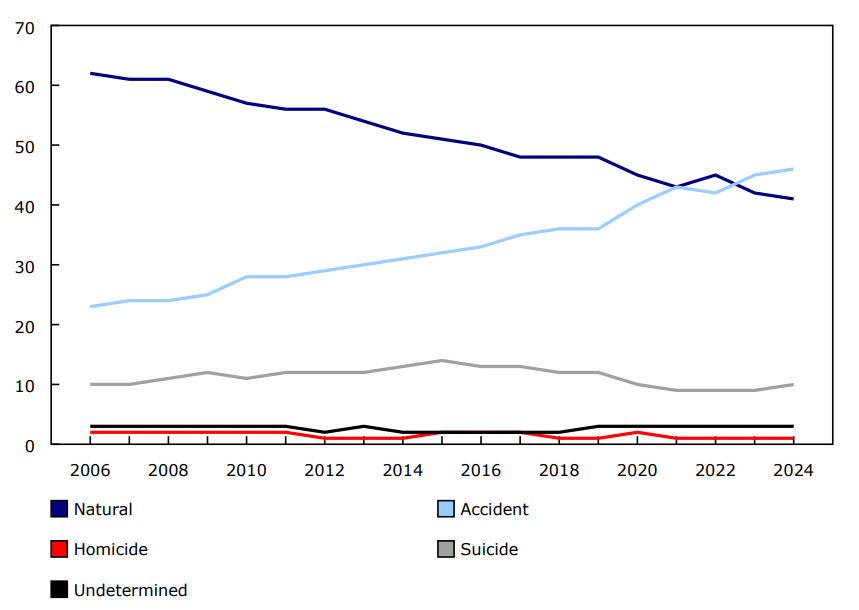
Deaths classified as accidents account for the largest share of deaths investigated by coroners and medical examiners since 2023
Investigations determining the manner of death as an accident began to represent a greater share of the C/ME caseload in 2023. Previously, natural deaths accounted for the largest share of the caseload. In 2006, natural deaths represented 62% of the C/ME caseload, but this share steadily declined to 41% in 2024. This decrease was offset by a similar increase in deaths classified as accidents, which accounted for 23% of the C/ME caseload in 2006 and 46% of that in 2024. The trend of natural deaths may be explained by changes in regulatory or legislative requirements for investigating apparent natural deaths in certain jurisdictions, which contributes to a decline in deaths classified as natural. The growth in deaths classified as accidents can be attributed to the increase in accidental drug poisoning deaths during the opioid crisis and the COVID-19 pandemic and the rise in fatal falls since 2000. The proportions of other manners of death were relatively stable from 2006 to 2024. Proportions in recent years may change as investigations are completed.
Chart 1: Annual distribution of deaths investigated by coroners and medical examiners, by manner of death, 2006 to 2024
Description - Chart 1
Notes: Data were not available for all jurisdictions for all years (see Note to readers). Canadian Coroner and Medical Examiner Database counts referenced in this chart were rounded to a neighbouring multiple of five. Percentages may change for recent years as investigations are finalized.
Source: Canadian Coroner and Medical Examiner Database (5125).
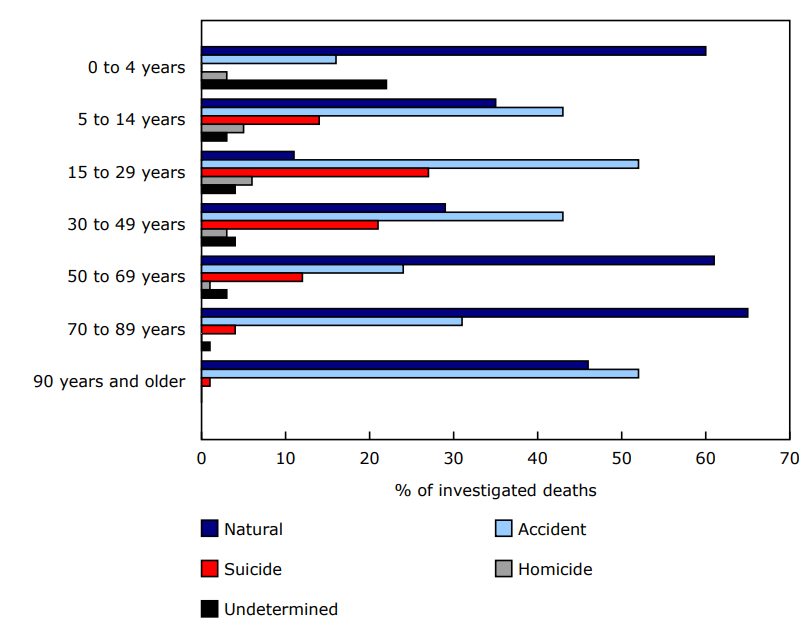
Deaths classified as accidents account for the largest proportion of investigated deaths among people aged 5 to 49 years and 90 years and older
Over the period from January 2006 to June 2025, deaths classified as accidents represented the manner of death accounting for the largest share of C/ME investigations among individuals aged 5 to 14 years (43%), 15 to 29 years (52%), 30 to 49 years (43%) and 90 years and older (52%). Among the younger age groups, transport accidents and accidental drug poisoning were reported as being the most common causes of death, whereas fall-related deaths were more prevalent among the oldest age group. Natural deaths represented the second-highest proportion of investigated deaths among these age groups except in the group aged 15 to 29 years, in which a higher percentage of investigated deaths were classified as suicide (27%). This trend was observed among both males and females.
Chart 2: Distribution of deaths investigated by coroners and medical examiners, by manner of death and age group, January 2006 to June 2025
Description - Chart 2
Notes: Data were not available for all jurisdictions for all years (see Note to readers). Canadian Coroner and Medical Examiner Database counts referenced in this chart were rounded to a neighbouring multiple of five. Percentages may change for recent years as investigations are finalized.
Source: Canadian Coroner and Medical Examiner Database, January 2006 to June 2025 (5125).
Note to readers
The Canadian Coroner and Medical Examiner Database was developed in 2008 by Statistics Canada in collaboration with the 13 provincial and territorial chief coroners and chief medical examiners and the Public Health Agency of Canada. Currently, it combines death investigation data from all provincial and territorial databases, except Manitoba. The database contains detailed information on the demographics of the deceased person (e.g., age, sex, date of death, province or territory), cause and manner of death, related health conditions and circumstances of death.
The average number of deaths investigated by coroners and medical examiners (C/MEs) per year is based on data available from 2006 to 2023. All data are considered preliminary and include closed cases. Data on open cases from selected provinces—Ontario, Newfoundland and Labrador and Prince Edward Island—are also included. Closed cases are completed death investigations (i.e., the cause and manner of death are final). Open cases refer to ongoing investigations (i.e., the cause and manner of death are pending or preliminary). While the proportion of open cases is high for the 2024/2025 cycle (26% in 2024 and 53% in 2025), the proportion of each manner of death is consistent with that reported in 2023. The percentage of open cases decreases as investigations are finalized. The percentage of deaths investigated in recent years (2020 to 2025) will likely be greater as investigations are completed. For this reason, data for recent years should be interpreted with caution.
Data for some provinces and territories for selected years were excluded from this release as counts are incomplete and do not reflect what is included in their respective jurisdictional databases. Data for provinces and territories were available for all years in the reference period with the following exceptions: data for Nova Scotia are available from 2009 to 2025, data for Nunavut are available from 2010 to 2013 and 2019 to 2022, and data for Yukon are available for 2006 to 2016 and 2018 to 2025.
Because the completeness of the available information varies between jurisdictions, users are advised to exercise caution when comparing data between years and across provinces and territories.
Selected jurisdictions investigate stillbirths as per their provincial or territorial legislation. Stillbirths are included in the calculation of the overall proportion of deaths investigated by C/MEs and in the calculation of the provincial or territorial totals but are excluded from the calculation of statistics related to age or sex and manner of death.
Counts referenced in this release were rounded to a neighbouring multiple of five.
Below are the definitions for the five categories of manners of death, that is, the means by which death occurs.
Natural: All deaths in which a disease initiates the chain of events ending in death.
Accident: All deaths in which an injury initiates the chain of events ending in death and there is no element of intent in the circumstances leading to the injury.
Suicide: All deaths in which a self-inflicted injury initiates the chain of events ending in death and the deceased intends to cause their own death.
Homicide: All deaths in which an injury initiates the chain of events ending in death and there is evidence to indicate some intent on the part of another individual to cause harm.
Undetermined: All deaths in which investigation is unable to attribute to one of the previous manners are categorized as undetermined. Note that in such instances, the cause of death may be known.
Contact information
For more information, or to enquire about the concepts, methods or data quality of this release, contact us (toll-free 1-800-263-1136; 514-283-8300; infostats@statcan.gc.ca) or Media Relations (statcan.mediahotline-ligneinfomedias.statcan@statcan.gc.ca).