

The share of young Canadians enrolled in formal education continues to shift in response to evolving economic conditions, labour market demands and demographic changes. In 2024/2025, 49% of individuals aged 18 to 24 years were participating in education, a slight increase from 47% a decade earlier. While the overall increase is modest, it coincides with notable shifts in the makeup of students attending colleges and universities across the country.
Understanding education participation rates
The rate of participation in education represents the proportion of the population enrolled in a formal education institution at a given time. The rate includes enrolments in elementary and secondary schools, colleges and universities, and it is measured as a percentage of a defined age group. Education participation rates are important indicators of engagement in learning and human capital development, which have implications for workforce readiness, lifelong learning and economic competitiveness.
Higher participation rates in education are associated with improved employment prospects, higher income levels and stronger social outcomes. Monitoring these rates over time allows policymakers and educators to assess the accessibility, attractiveness and responsiveness of education systems.
Education participation rate remains highest among young adults
Among people aged 18 to 24 years—the group most likely to pursue postsecondary studies—the education participation rate reached 49% in 2024/2025, up two percentage points over the past decade. In contrast, the participation rate among people aged 25 to 29 years remained steady at 12%, and the rate for 30- to 34-year-olds held at 6%, suggesting limited growth in education engagement among older young adults.
This pattern reflects the continued concentration of formal education earlier in adulthood, although some individuals return to learning later for upskilling or career shifts.
Participation in education rate on the rise in Manitoba, Alberta and British Columbia
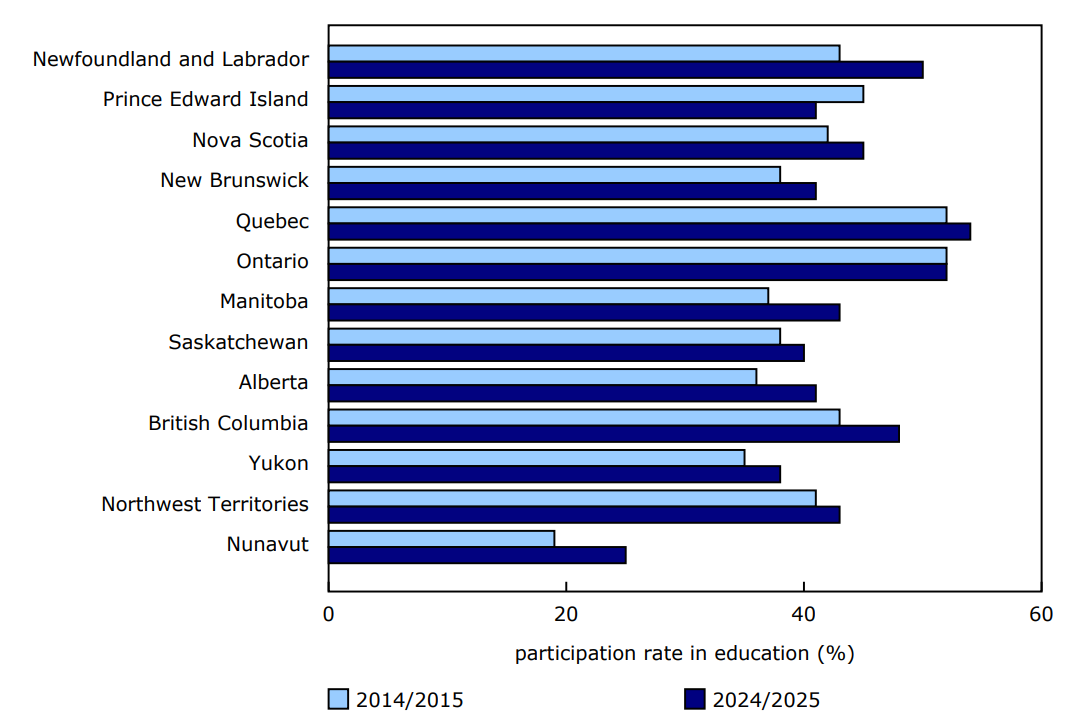
Manitoba recorded the largest increase in the education participation rate among 18- to 24-year-olds over the past decade, rising six percentage points to reach 43% in 2024/2025. Alberta and British Columbia also saw notable gains, each increasing by five percentage points over the same period; the rate reached 41% in Alberta and 48% in British Columbia. This suggests rising engagement with formal education among young adults in these provinces.
Despite these gains, Quebec continued to record the highest overall participation rate in 2024/2025 at 54%, a result largely due to its unique Collège d'enseignement général et professionnel system. Ontario (52%), Newfoundland and Labrador (50%) and British Columbia (48%) also posted strong participation rates, reflecting the continued importance of provincial education systems in shaping access and engagement.
Chart 1: Manitoba sees largest increase in participation in education rate from 2014/2015 to 2024/2025
Description - Chart 1
Data table: Manitoba sees largest increase in participation in education rate from 2014/2015 to 2024/2025
Source: Pan-Canadian Education Indicators Program (5420), table 37-10-0103-01.
Who's in the classroom? Growth in international students offsets decline in Canadian students
Growth in university enrolments was the primary contributor to the 2024/2025 increase in education participation among young adults aged 18 to 24 years. The education participation rate at the university level rose to 31%, up five percentage points from a decade earlier. In contrast, the rate at the college level held steady at 14% over the same period.
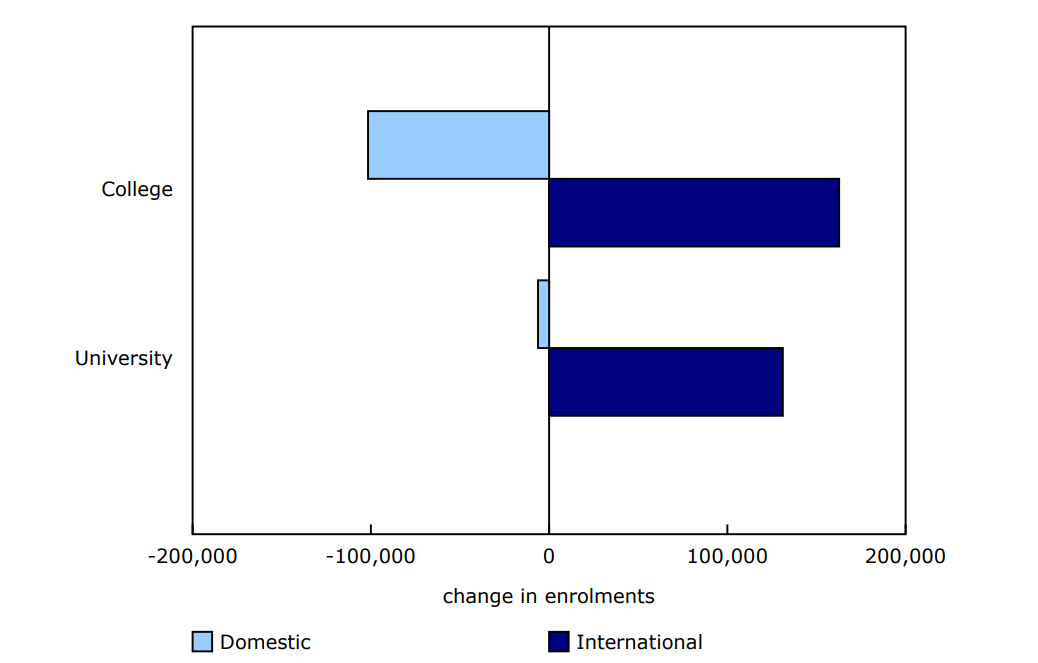
While university and college programs continue to be the main paths of formal education among young adults, recent data from the Postsecondary Student Information System point to a shift in student population composition. In 2022/2023—the most recent year for which enrolment data are available—the number of Canadian students enrolled in postsecondary institutions declined by over 6,000 (-0.5%) at universities and by more than 101,000 (-14.6%) at colleges compared with a decade earlier.
In contrast, international student enrolment climbed from 2012/2013 to 2022/2023, increasing by more than 131,000 (+99.5%) at universities and 162,000 (+382.5%) at colleges. This rapid growth in enrolment of international students more than offset the decline in enrolment of Canadian students, sustaining the overall postsecondary participation rate while shifting the underlying composition of the student population.
In 2024 and 2025, Immigration, Refugees and Citizenship Canada introduced a series of measures—such as a cap on study permits—intended to moderate growth of the international student population and ensure system sustainability. These measures will contribute to the ongoing evolution of the student body. Understanding these shifts is essential for policy planning, particularly as it relates to capacity, funding and long-term alignment of the school system with the labour market.
Chart 2: International enrolments more than offset decline in domestic enrolments from 2012/2013 to 2022/2023
Description - Chart 2
Data table: International enrolments more than offset decline in domestic enrolments from 2012/2013 to 2022/2023
Source: Postsecondary Student Information System (5017).
Note to readers
The participation rate in education represents the total enrolment in elementary and secondary schools, colleges and universities as a percentage of the total population for each age group. The number of students used to calculate the participation rate is based on a monthly average from September to April from the Labour Force Survey and includes both full-time and part-time students.
This analysis focuses on differences between estimates that are statistically significant at the 90% confidence level. A change is considered statistically significant if the 90% confidence intervals of the compared estimates do not overlap. Estimates presented in this analysis were produced using the bootstrap method, which applies 1,000 bootstrap weights to account for sampling variability.
For more information on the concepts and methodology used in this release, please refer to Education Indicators in Canada: Handbook for the Report of the Pan-Canadian Education Indicators Program.
The Pan-Canadian Education Indicators Program is an ongoing initiative of the Canadian Education Statistics Council, which is a partnership between Statistics Canada and the Council of Ministers of Education, Canada. The program provides a set of statistical measures on education systems in Canada.
Contact information
For more information, or to enquire about the concepts, methods or data quality of this release, contact us (toll-free 1-800-263-1136; 514-283-8300; infostats@statcan.gc.ca) or Media Relations (statcan.mediahotline-ligneinfomedias.statcan@statcan.gc.ca).