
A new in-depth analytical portrait released today, "Portrait of the Arab Populations in Canada: Diversity and Socioeconomic Outcomes," shows the diverse characteristics of Arab populations in Canada, including data on places of birth, places of residence, age, language, immigration characteristics, religion, education, employment, occupations, income and social inclusion. It breaks down many of these characteristics by place of birth to provide a deeper understanding of the diversity of experiences and outcomes within Arab populations.
This is the second of a series of portraits on racialized groups in Canada, developed by Statistics Canada to support Canada's Anti-Racism Strategy.
The Arab populations in Canada are growing
Arab populations in Canada more than tripled from 2001 to 2021 because of immigration and the growth of the Canadian-born Arab population. In 2021, Arab populations reached 795,665 people and made up 2.2% of the total population of Canada. According to the latest demographic projections, Arab populations in Canada could number 1.4 million to 1.9 million people by 2041, constituting 3.1% to 3.6% of the population of Canada.
Arabs in Canada have many different places of birth, with Canada being the most common
Based on 2021 data, about 3 in 10 Arabs were born in Canada (30.3%). The next most common places of birth included Lebanon (10.3%), Syria (10.0%), Iraq (7.0%) and the Arabian Peninsula (6.8%) in Southwest Asia and Morocco (9.4%), Egypt (7.4%) and Algeria (6.4%) in Northern Africa. The proportion of Arabs in Canada who were born in Lebanon declined from 1 in 5 in 2001 to 1 in 10 in 2021, as immigration from other places of birth increased. The peak of Arab immigration from Lebanon was in the late 1980s and early 1990s.
Just over half of Arabs who immigrated to Canada from 1980 to 2021 are economic immigrants
In 2021, just over half (51.3%) of Arabs in Canada who had immigrated from 1980 to 2021 were economic immigrants (selected for their ability to contribute to Canada's economy), while close to 2 in 10 (18.4%) were sponsored by family members and 3 in 10 (29.5%) were refugees. More than 70% of Arab immigrants born in Egypt, Algeria or Morocco were economic immigrants. Most Arab immigrants born in Lebanon were either economic immigrants (52.1%) or sponsored by family members (32.2%). Refugees made up the majority of Arab immigrants born in Syria (78.3%) or Iraq (67.6%).
Quebec is the most common province of residence for Arabs born in Morocco, Algeria or Tunisia
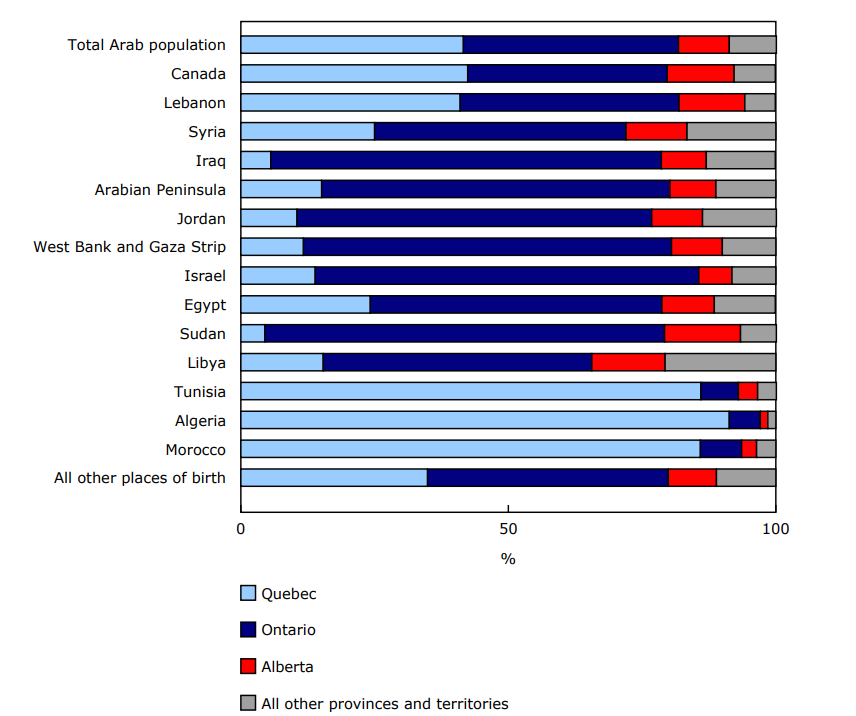
In 2021, a little over 4 in 10 Arabs in Canada lived in Quebec, and roughly the same proportion lived in Ontario. Close to one-tenth lived in Alberta, and about the same proportion lived in the remaining provinces and territories (Chart 1).
Quebec was home to over 80% of Arabs born in Morocco, Algeria or Tunisia, countries with historical connections to France. In comparison, Ontario was home to over 70% of Arabs born in Iraq, over 60% of those born in the Arabian Peninsula and over half of those born in Egypt.
Chart 1: Province of residence of Arab populations by place of birth, Canada, 2021
Description - Chart 1
Data table: Province of residence of Arab populations by place of birth, Canada, 2021
Notes: The names used for places of birth are based on the Standard Classification of Countries and Areas of Interest 2019 – Countries and Areas of Interest for Social Statistics, which was used to classify place of birth in the 2021 Census of Population. The Arabian Peninsula is an aggregation of several places of birth, as described in the Note to readers.
Source: Census of Population, 2021 (3901).
Arabs are one of the youngest populations in Canada
The median age of Arabs in Canada in 2021 was 30.2 years, more than 10 years younger than the overall median age in Canada of 41.2 years. Over one-quarter (27.0%) of Arabs in Canada were under the age of 15 years, a share similar to that of Black populations (26.1%) but larger than that of other racialized groups. Most (63.6%) Arabs lived in households made up of a two-parent family with children, a considerably larger proportion than among the overall population of Canada (40.5%).
Many Arabs in Canada are bilingual or multilingual
In 2021, nearly all Arabs in Canada (95.5%) knew at least one official language (English or French) well enough to have a conversation in it, and a little over three-quarters (77.6%) knew both Arabic and an official language. In addition, more than 3 in 10 Arabs (31.8%) knew both English and French, which is well above the Canadian average of 18.0%.
This multilingualism was reflected in everyday life. For instance, 7 in 10 Arabs born outside Canada (70.0%) had Arabic as their only mother tongue, yet most spoke English or French on a regular basis at home. Among Arabs born outside Canada, three-quarters (75.3%) of those living in Quebec spoke French at home on a regular basis, and nearly three-quarters (73.8%) of those living in Canada outside Quebec spoke English at home on a regular basis. Official languages were often spoken in combination with Arabic: 75.6% of Arabs born outside Canada spoke Arabic at home on a regular basis.
Bilingualism and multilingualism were also common among Arabs born in Canada. Over half (53.4%) of Canadian-born Arabs living in Quebec had French as their only mother tongue and over half (58.2%) of those living in Canada outside Quebec had English as their only mother tongue. The majority (57.5%) of Canadian-born Arabs also knew Arabic well enough to have a conversation in it.
The most common religious affiliations of Arabs in Canada are Muslim and Christian
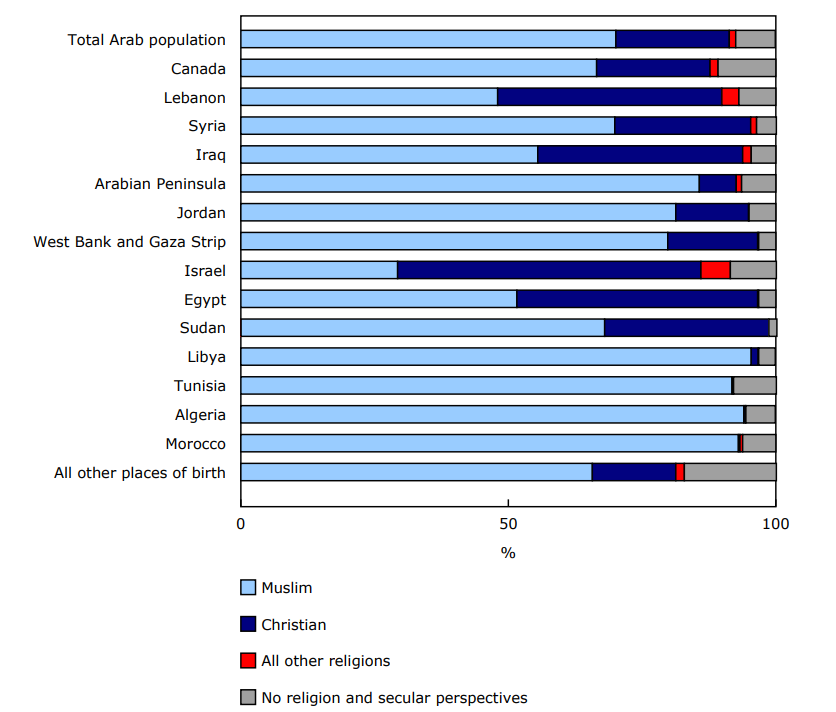
Chart 2: Religion of Arab populations by place of birth, Canada, 2021
Description - Chart 2
Data table: Religion of Arab populations by place of birth, Canada, 2021
Notes: The names used for places of birth are based on the Standard Classification of Countries and Areas of Interest 2019 – Countries and Areas of Interest for Social Statistics, which was used to classify place of birth in the 2021 Census of Population. The Arabian Peninsula is an aggregation of several places of birth, as described in the Note to readers.
Source: Census of Population, 2021 (3901).
Religious affiliations reported by Arabs in Canada in 2021 differed by place of birth (Chart 2). Arabs born in Lebanon, Egypt or Iraq included a mix of Muslims and Christians. A little over half of Arabs born in Iraq (55.5%) or Egypt (51.6%) and a little under half of Arabs born in Lebanon (48.0%) were Muslim. More than 4 in 10 Arabs born in Egypt (45.0%) or Lebanon (41.9%) were Christians, as were nearly 4 in 10 Arabs born in Iraq (38.3%). Arab Christians were mainly a mix of Catholic (41.1%) and Orthodox (27.5%), while over one-quarter (28.2%) did not report being a specific denomination.
Among Arabs born in Syria, 69.9% were Muslim and 25.4% were Christian. In comparison, over 90% of Arabs born in Morocco, Algeria or Tunisia were Muslim.
Canadian-born Arabs who had one or both parents born in Canada were less likely than other Arabs to have a religious affiliation. One-quarter (25.0%) of Arabs with one Canadian-born parent and 30.7% of those with both parents born in Canada reported having no religion or having secular perspectives, compared with 7.4% of Arabs overall.
Half of Arabs aged 25 to 54 years have a bachelor's degree or higher
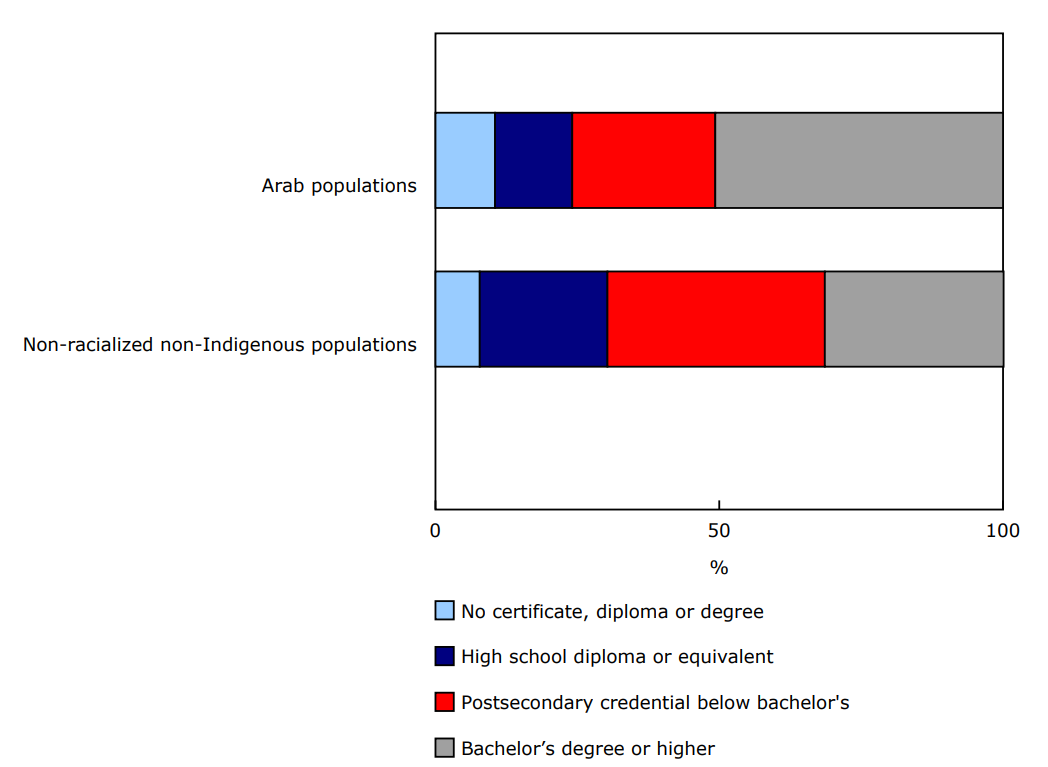
Chart 3: Educational attainment of Arab and non-racialized non-Indigenous populations aged 25 to 54, Canada, 2021
Description - Chart 3
Data table: Educational attainment of Arab and non-racialized non-Indigenous populations aged 25 to 54, Canada, 2021
Source: Census of Population, 2021 (3901).
As of 2021, half (50.7%) of Arabs aged 25 to 54 years had a bachelor's degree or higher, compared with less than one-third (31.5%) of the non-racialized non-Indigenous population (Chart 3). The share of Arabs aged 25 to 54 years who had a bachelor's degree or higher ranged from 31.4% of Arabs born in Syria to 84.2% of Arabs born in Egypt.
Arabs were also highly represented in certain health fields of study. Compared with the overall population aged 25 to 54 years, Arabs were 4.4 times more likely to have a pharmacy degree, 4.0 times more likely to have a degree in dentistry and 3.3 times more likely to have a medical degree.
Arabs with foreign degrees face higher rates of job mismatch
As of 2021, Arabs with degrees from outside Canada were less likely to have an occupation relating to their field of study than those with Canadian degrees. For example, 82.1% of Arabs aged 25 to 54 years who had a Canadian medical degree worked as physicians, compared with 45.6% of Arabs in the same age group who had a medical degree from outside Canada. Among the non-racialized non-Indigenous population aged 25 to 54 years who had a Canadian medical degree, 89.5% worked as physicians.
Similarly, Arabs were more than twice as likely as the overall population of Canada to have a degree in engineering, but they were less likely to have an occupation matching that field of study. While 42.4% of non-racialized non-Indigenous people who had a Canadian engineering degree worked as engineers, this was the case for 32.4% of Arabs with a Canadian engineering degree and for 13.8% of Arabs with an engineering degree from outside Canada.
Experiences of discrimination are associated with lower confidence in institutions
In 2020, nearly 4 in 10 Arabs (38.9%) reported having experienced discrimination at some point in the past six years. They most frequently reported having experienced discrimination based on their ethnicity or culture (29.0%), religion (22.2%), race or colour (16.6%) or language (14.7%). More than 3 in 10 Arab Muslims (31.6%) experienced discrimination based on religion.
As of 2020, Arabs were more likely than the non-racialized non-Indigenous population to have high confidence in Parliament, the school system, the justice system and courts, and major corporations. However, Arabs who had experienced discrimination in the previous six years were less likely than those who had not experienced discrimination during that period to have high confidence in Parliament, the school system and major corporations, as well as in the police, banks and the Canadian media.
Note to readers
The series of portraits on racialized groups in Canada was developed in partnership with the Department of Canadian Heritage to support Canada's Anti-Racism Strategy, which seeks to address racism and discrimination faced by racialized groups and Indigenous Peoples. This analytical portrait aligns with the Disaggregated data action plan: Why it matters to you, a whole-of-government approach led by Statistics Canada to enhance data collection, analysis and dissemination pertaining to diverse populations in Canada.
Data sources
This analysis was conducted principally using data from the 2021 Census of Population. Data were also used from earlier censuses, the 2011 National Household Survey and the 2020 General Social Survey – Social Identity. Information on the coverage of each data source is available in the portrait.
Methods
This portrait provides descriptive analysis of the characteristics of Arab populations in Canada.
Definitions
Arab populations: Are, in this portrait, people who responded to the population group question with "Arab"; a write-in response that was considered consistent with "Arab" only, such as "Egyptian" or "Jordanian"; both of the above; or "Arab" and "White" without any write-in response. The inclusion of those who responded "Arab" and "White" differs from the standard definition of the Arab population from the "visible minority" variable. This inclusion is used in this portrait to be consistent with methods for other racialized groups in this portrait series (e.g., South Asian, Chinese, Black, Filipino) and to more fully reflect the characteristics of the Arab populations in Canada.
The definition of the Arab populations excludes 2,815 Arabs (2021 data) who reported being both Arab and White and also provided a write-in response that was considered consistent with "Arab." This population cannot be identified in a comparable way across census cycles.
The definition of the Arab populations also excludes 45,065 people who reported being both Arab and in one or more other racialized groups (including those who reported being Arab along with a write-in response that was not associated with "Arab" only, such as responses of "Middle Eastern" or "Kurdish"). This population cannot be identified in a comparable way across census cycles. Details on these populations were provided in a highlight box within the portrait.
Arabian Peninsula: Is, in this portrait, made up of Kuwait, Bahrain, Qatar, the United Arab Emirates, Saudi Arabia, Oman and Yemen.
Economic immigrant: Refers to an immigrant who has been selected for their ability to contribute to Canada's economy through their ability to meet labour market needs, to own and manage or to build a business, to make a substantial investment, to create their own employment or to meet specific provincial or territorial labour market needs.
Educational attainment: Refers to the highest level of education that a person has successfully completed, using the classification of highest certificate, diploma or degree. The general hierarchy used in deriving this variable (high school, trades, college, university) is loosely tied to the "in-class" duration of the various types of education.
Immigrant: Refers to a person who is, or has been, a landed immigrant or permanent resident. Such a person has been granted the right to live in Canada permanently by immigration authorities. Immigrants who have obtained Canadian citizenship by naturalization are included in this group. In the 2021 Census of Population, it includes immigrants who were admitted to Canada on or prior to May 11, 2021.
Immigrant sponsored by family: Refers to an immigrant who was sponsored by a Canadian citizen or permanent resident and was granted permanent resident status based on their relationship either as the spouse, partner, parent, grandparent, child or other relative of this sponsor. The terms "family class" or "family reunification" are sometimes used to refer to this category.
Mother tongue: Refers to the first language a person learned at home in childhood and still understands. A person can have more than one mother tongue if they learned multiple languages at the same time in early childhood and still understand them.
Non-racialized non-Indigenous population: Is, in this portrait, people who were not categorized as a "visible minority" using the visible minority variable; were not categorized as "White and Arab," "White and Latin American" or "White and West Asian" using the population group variable; and did not report First Nations, Métis or Inuit identity in the question on Indigenous identity. In contrast to the standard definition, it excludes people who reported being both Arab and White, both Latin American and White or both West Asian and White. For more information on the visible minority and population group variables, consult the Visible Minority and Population Group Reference Guide, Census of Population, 2021.
Northern Africa: Is made up of Egypt, Sudan, Libya, Tunisia, Algeria, Morocco and Western Sahara. This follows the Standard Classification of Countries and Areas of Interest 2019 – Countries and Areas of Interest for Social Statistics, which was used to classify place of birth and place of birth of parents in the 2021 Census of Population.
Refugee: Refers to an immigrant who was granted permanent resident status based on a well-founded fear of returning to their home country.
Religion: Refers to a person's self-identified connection to or affiliation with any religious denomination, group, body or other religiously defined community or system of belief. Religion is not limited to formal membership in a religious organization or group. For infants or children, religion refers to the specific religious group or denomination, if any, in which they are being raised.
Southwest Asia: Is, in this portrait, made up of Lebanon, Syria, Iraq, the Arabian Peninsula (Kuwait, Bahrain, Qatar, the United Arab Emirates, Saudi Arabia, Oman and Yemen), Jordan, Israel, and the West Bank and Gaza Strip.
West Bank and Gaza Strip: Designates the territories referred to in the Declaration of Principles, signed by Israel and the Palestine Liberation Organization in 1993. It includes responses of Palestine. This terminology follows the Standard Classification of Countries and Areas of Interest 2019 – Countries and Areas of Interest for Social Statistics, which was used to classify place of birth and place of birth of parents in the 2021 Census of Population.
Contact information
For more information, or to enquire about the concepts, methods or data quality of this release, contact us (toll-free 1-800-263-1136; 514-283-8300; infostats@statcan.gc.ca) or Media Relations (statcan.mediahotline-ligneinfomedias.statcan@statcan.gc.ca).