

Productivity rebounds in the third quarter
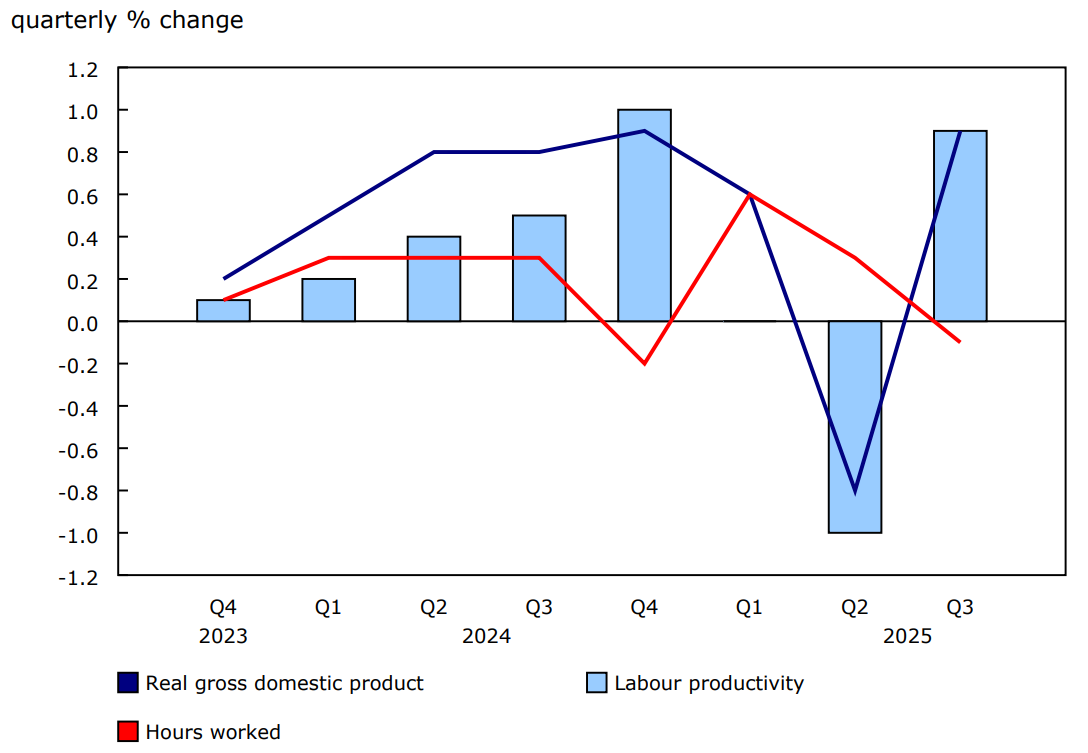
Labour productivity of Canadian businesses rebounded in the third quarter, increasing 0.9% after a 1.0% decline in the second quarter and no change in the first quarter. This was the sixth quarterly increase in eight quarters.
Chart 1: Business output recovers significantly, while hours worked edge down
Description - Chart 1
Data table: Business output recovers significantly, while hours worked edge down
Source: Table 36-10-0206-01.
This upturn in productivity in the third quarter reflects the sharp recovery in business output, following a quarter of decline, while hours worked declined slightly.
Despite a context of persistent uncertainty related to international trade during the third quarter, real gross domestic product of businesses rebounded, rising 0.9%, after a 0.8% contraction in the second quarter.
Goods-producing businesses contribute the most to the overall growth in productivity
In the third quarter, productivity rose in both goods-producing businesses (up 1.6% after a 1.3% decline in the previous quarter) and service-producing businesses (up 0.2% after a 0.3% decline in the previous quarter). Overall, productivity increased in 9 of the 16 main industry sectors in the third quarter.
Manufacturing and, to a lesser extent, the mining and oil and gas extraction sector, the agriculture, forestry, fishing and hunting sector, and the real estate and rental and leasing sector were the main industries that contributed to the productivity increase in the business sector during the third quarter. Construction as well as accommodation and food services also contributed to this increase. Meanwhile, utilities posted a significant decline for a second consecutive quarter.
Hours worked record a slight decline
Hours worked in the business sector recorded a slight decline of 0.1% in the third quarter, after increasing in each of the first two quarters of 2025. Hours worked in goods-producing businesses fell 0.6% in the third quarter, more than offsetting the 0.2% increase in hours worked in service-producing businesses.
Overall, 10 of the 16 main industry sectors posted increases in hours worked in the third quarter. The agriculture, forestry, fishing and hunting sector recorded the largest decline (-5.7%), while the arts, entertainment and recreation sector posted the largest increase (+1.2%).
Wildfires, which affected certain economic regions of Canada in July and August, contributed to a 0.01 percentage point decline in hours worked in the business sector in the third quarter.
Wildfires in certain economic regions of the country: impact on hours worked, July and August 2025
Data on lost work hours and overtime due to the wildfires, which affected certain economic regions of the country in July and August 2025, were taken from questions added to the Labour Force Survey (LFS) questionnaire for all provinces, except Quebec and Prince Edward Island.
These additional questions were included in the August LFS (for the reference period of July) and the September LFS (for the reference period of August). Data from these questions allowed Statistics Canada to adjust the estimates of hours worked that are used to calculate labour productivity.
In July and August, the business sector recorded a loss of 1.6 million hours of work, half of which was offset by overtime hours worked. As a result, for the third quarter as a whole, the net effect was a loss of 789,000 hours of work.
Growth in unit labour costs slows in the third quarter
As productivity increased 0.9% in the third quarter, the 1.2% rise in hourly compensation observed during the quarter resulted in a 0.3% growth in the unit labour costs of businesses. This was a slower pace of growth than in the second quarter (+0.8%).
Unit labour costs represent the labour costs required to produce one unit of output.
Learn more about labour productivity
To learn more about productivity, the factors that influence it and why it matters for Canadians, listen to the Eh Sayers podcast episode, "Why economists are sounding the alarm on productivity."
Table 1: Business sector: Labour productivity and related variables for Canada – Seasonally adjusted
Note to readers
Revisions
With this release, the data were revised back to the first quarter of 2022 at the aggregate level, that is, for the total economy as well as for the business and non-commercial sectors. These revisions are consistent with those incorporated in the release on quarterly gross domestic product (GDP) by income and expenditure, released on November 28, 2025.
At the industry level, data were updated to the first quarter of 1997 to reflect the integration of the North American Industry Classification System 2022 in the monthly GDP by industry estimates, also released on November 28, 2025.
As of this release, data on GDP and related measures (including labour productivity, labour compensation and unit labour costs) for the total economy and the non-commercial sector are no longer published in table 36-10-0207-01. This is due to the difficulty of adequately measuring production in certain sectors such as government or non-profit institutions serving households. However, data on hours worked and related measures (including jobs and average hours worked) for the total economy and non-business sector remain available.
Productivity measures
The term productivity in this release refers to labour productivity. For the purposes of this analysis, labour productivity and related variables cover the business sector only.
Labour productivity is a measure of real GDP per hour worked.
Unit labour cost is defined as the cost of workers' wages and benefits per unit of real GDP.
The approach to measuring real output in the business sector differs from the one that is used in the estimates by industry. For the business sector, output is measured using the expenditure-based GDP approach at market prices, while the measure of output by industry is based on the value-added approach at basic prices.
All the growth rates reported in this release are rounded to one decimal place. They are calculated with index numbers rounded to three decimal places, which are now available in data tables.
All necessary basic variables for productivity analyses (such as hours worked, employment, output and compensation) are seasonally adjusted. For information on seasonal adjustment, see Seasonally adjusted data – Frequently asked questions.
Next release
Next release of quarterly data
Labour productivity, hourly compensation and unit labour cost data for the fourth quarter of 2025 will be released on March 4, 2026.
Next release of annual data
The release of revised data on hours worked and labour productivity in the provinces and territories, which was initially scheduled for February 9, 2026, has been postponed to May 20, 2026. Revised data will incorporate new benchmark data from the Supply and Use Tables for the reference year 2022 and reflect the North American Industry Classification System 2022.
Contact information
For more information, or to enquire about the concepts, methods or data quality of this release, contact us (toll-free 1-800-263-1136; 514-283-8300; infostats@statcan.gc.ca) or Media Relations (statcan.mediahotline-ligneinfomedias.statcan@statcan.gc.ca).