

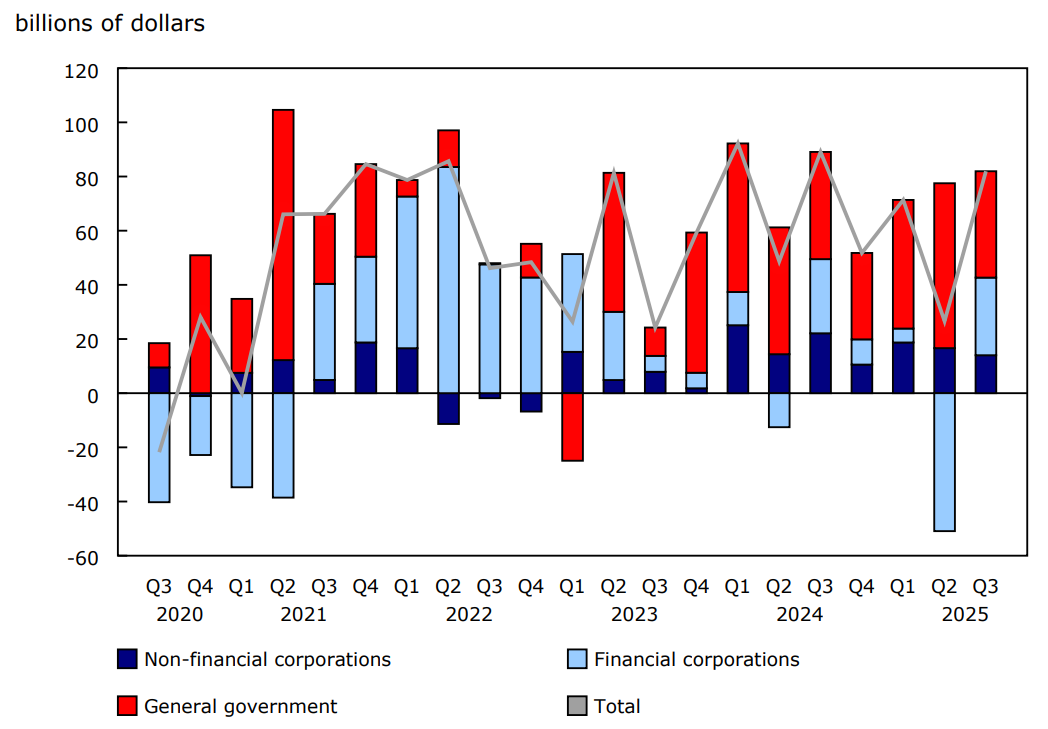
Canadian governments and corporations borrowed a net $81.9 billion in the form of debt securities in the third quarter, the highest level of activity since the third quarter of 2024. The financing activity in the third quarter of 2025 was led by the government sector, followed by financial corporations.
The stock of Canadian debt securities, in book value terms, reached $6,321.0 billion at the end of the third quarter, up $127.3 billion from the previous quarter. The increase over this period reflected net issuances and, to a lesser extent, the impact of the depreciating Canadian dollar relative to the US dollar, which increased the value of instruments denominated in this currency when converted to Canadian dollars. About one-fifth of the stock of Canadian debt securities is denominated in US dollars.
By sector of issuer, the stock of Canadian debt securities issued by governments was the highest, at $2,822.2 billion at the end of September, followed by financial corporations ($2,579.5 billion) and non-financial corporations ($919.4 billion). The government sector became the main borrowing sector starting in the first quarter of 2021, a period marked by strong borrowing needs related to the COVID-19 pandemic. Before 2021, financial corporations were the most important borrowers in the form of debt securities.
Chart 1: Debt securities issues by sector, stocks at book value

Description - Chart 1
Data table: Debt securities issues by sector, stocks at book value
Source: Table 36-10-0605-01.
Net issuances of debt securities led by the government sector
In the third quarter, net issuances of debt securities by the government sector amounted to $39.3 billion, marking the 10th consecutive quarter in which issuances exceeded retirements. The federal government led the issuance activity, as it raised a net $22.6 billion of funds, mainly in the form of bonds. Meanwhile, provincial and territorial governments issued a net $16.6 billion of debt securities. Since the second quarter of 2023, governments' debt issuance activity has been significant, raising a net $434.4 billion in the form of debt instruments over this period, most of which were issuances by the federal government.
Canadian financial corporations were also net borrowers of funds in the third quarter of 2025, raising $28.7 billion on the credit market. Issuances by insurance corporations and pension funds totalled $12.5 billion, the largest amount since the first quarter of 2024. Non-financial corporations issued $14.0 billion worth of debt securities in the third quarter of 2025, led by firms in the utilities industry.
Chart 2: Canadian debt securities issues by sector, net issuances
Description - Chart 2
Data table: Canadian debt securities issues by sector, net issuances
Note: Net issuances denote new issuances less retirements.
Source: Table 36-10-0602-01.
By market of issuance, over 40% of all net issuances of debt securities by Canadian governments and corporations in the third quarter were placed on international markets, led by borrowings from financial corporations. This activity was an important source of funds in the balance of international payments to finance Canada's current account deficit in the third quarter.
Retirements of Canadian shares exceed new issuances, while strong market gains continue to increase valuations
Chart 3: Canadian equity securities issues by sector, net issuances

Description - Chart 3
Data table: Canadian equity securities issues by sector, net issuances
Note: Net issuances denote new issuances less retirements.
Source: Table 36-10-0621-01.
Net retirements of Canadian equity securities reached $20.3 billion in the third quarter of 2025, mainly retirements related to share buyback activity. Financial corporations retired $12.5 billion worth of equity securities over the quarter, while non-financial corporations retired $7.9 billion worth.
The total outstanding market value of Canadian equity securities grew by $607.7 billion to reach $5,933.5 billion at the end of third quarter. This followed a $391.9 billion gain in the second quarter. The growth in the third quarter mostly came from non-financial corporations, notably shares of the mining, quarrying, and oil and gas extraction industry. Canadian share prices, as measured by the Standard & Poor's (S&P)/Toronto Stock Exchange composite index, rose by 11.8% in the third quarter and by 7.8% in the second quarter.
Canadian holdings of foreign securities increase in the third quarter
Canadian holdings of foreign securities, in market value terms, reached $4,618.5 billion at the end of the third quarter, up $391.1 billion from the previous quarter. The increase was due to the strong growth in foreign equity prices, notably US stock prices, as well as the upward revaluation from the depreciation of the Canadian dollar against the US dollar. Strong net purchases of foreign securities by Canadian investors in the third quarter also contributed to the increase in holdings. US share prices, as measured by the S&P 500 composite index, were up 7.8% in the third quarter.
Holdings of foreign shares stood at $3,503.3 billion at the end of September, while holdings of foreign debt securities reached $1,115.2 billion. At the end of the third quarter, 71.2% of all foreign securities held by Canadian investors were in the form of US instruments, most of which are US shares. US shares accounted for more than three-quarters of all US securities held by Canadian investors. In comparison, European securities represented 13.8% of all foreign securities held by Canadian investors, mostly instruments from the United Kingdom, Germany and France.
Table 1: Debt and equity securities issues, net issuances
Table 2: Debt securities issues, stocks at book value
Table 3: Debt and equity securities issues, stocks at market value
Note to readers
This quarterly release, available about 70 days after the reference period, includes information on debt securities issues by sector, currency, maturity, type of interest rate and market of issuance, as well as by the economic sectors issuing debt securities in relation with the sectors investing in these instruments. It also includes information on Canadian equity securities by sector and industry. Statistics on Canadian portfolio investment abroad, previously released with Canada's international investment position, are now available with this release. Canadian holdings of foreign securities by type of securities, currency of denomination, country of issuer of these securities and sector of non-resident issuer are available.
Definitions and concepts used are consistent with the recommendations of the Handbook on Securities Statistics, an internationally agreed-upon framework for classifying securities instruments. Data are accessible through an easy-to-use and flexible visualization tool. The tool includes dynamic cross-tables that allow users to look at the dataset from a variety of dimensions, as well as other visualization layers that illustrate different characteristics of the data in the form of interactive tables and charts.
Definitions
Securities statistics cover issuances and holdings of negotiable financial instruments. Securities include debt instruments designed to be traded in financial markets, such as treasury bills, commercial paper and bonds, as well as equity instruments, such as listed shares.
The book value of a debt instrument reflects the value of the debt at creation, and any subsequent economic flows, such as transactions (e.g., repayment of principal), valuation changes (independent of changes in its market price) and other changes. The book value is composed of the outstanding principal amount plus any accrued interest. The market value reflects the value at which securities are acquired or disposed of in transactions between willing parties, excluding commissions, fees and taxes.
Currency valuation
The value of securities denominated in foreign currency is converted to Canadian dollars at the end of each period. When the Canadian dollar appreciates in value, the restatement of the value of these instruments in Canadian dollars lowers the recorded value. The opposite is true when the Canadian dollar depreciates.
Contact information
For more information, or to enquire about the concepts, methods or data quality of this release, contact us (toll-free 1-800-263-1136; 514-283-8300; infostats@statcan.gc.ca) or Media Relations (statcan.mediahotline-ligneinfomedias.statcan@statcan.gc.ca).