
High green-intensity industries show higher productivity and resilience
A new study—"Powering Progress: Toward a Better Understanding of Canada's Green Economy"—provides evidence that industries with higher green-intensity have higher labour productivity levels and growth, greater economic dynamism, and strong resilience during periods of economic disruption.
A novel index to measure green activity
To assess green activity, the study introduces a composite index of green intensity at the four-digit level of the North American Industry Classification System. The index integrates eight indicators capturing green outputs and processes—such as the production of green goods and services, the prevalence of green tasks in occupations, the investment in clean technologies, and the export of environmental goods. Based on this index, 285 industries were classified into three categories of green-intensity: low, medium and high. Of these industries, 6.7% fell into the high green-intensity category, while 33.0% were classified as medium, and 60.4% as low.
Higher labour productivity and growth among high green-intensity industries
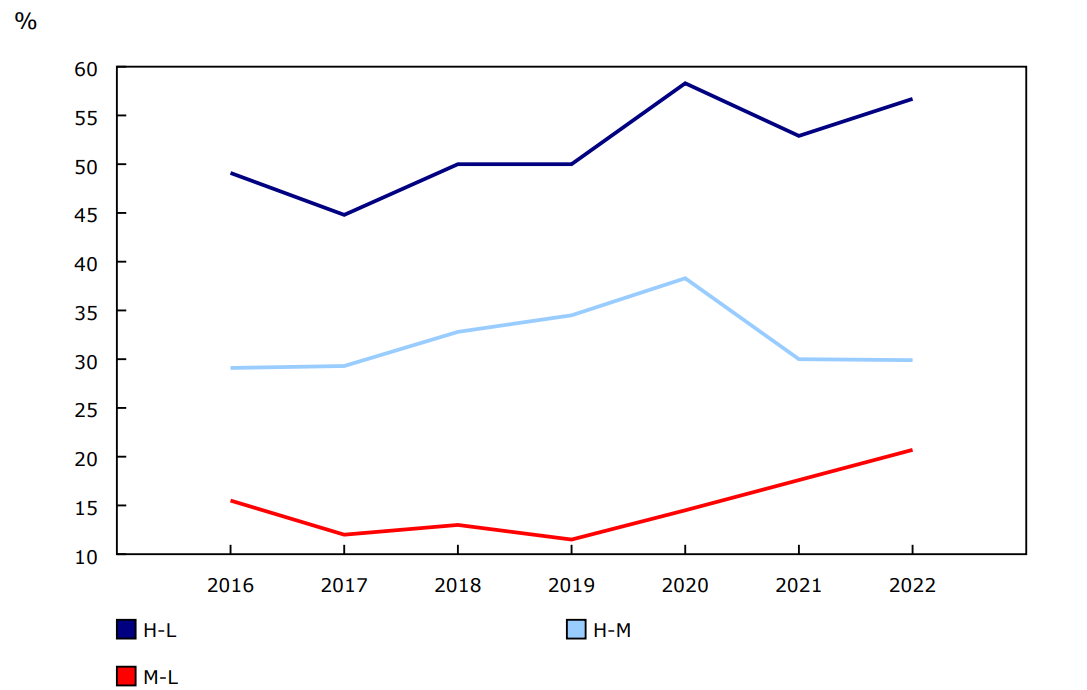
From 2016 to 2022, high green-intensity industries—including those in sectors such as professional, scientific and technical services; construction; and agriculture, forestry, fishing and hunting—showed the highest productivity measured by value added per worker. These industries were on average 51.7% more productive relative to low-intensity ones, while medium-intensity industries maintained a 29.1% advantage relative to low-intensity industries. Notably, the productivity gap between high and medium green-intensity industries grew from 15.5% in 2016 to 20.7% in 2022.
Chart 1: Labour productivity gap by year
Description - Chart 1
Data table: Labour productivity gap by year
Note: H-L denotes the productivity gap (in percentage) between high and low green-intensity industries. M-L denotes the gap between medium and low green-intensity industries. H-M denotes the gap between high and medium green-intensity industries.
Source: Authors' calculation from the National Accounts Longitudinal Microdata File.
The study applies a framework to break down aggregate productivity growth into within-firm productivity improvements, between-firm reallocation of employment, and the effects of firm entry and exit. From 2016 to 2022, aggregate labour productivity across all industries rose by 12.8%, driven primarily by within-firm improvement (9.6 percentage points), alongside reallocation among firms (2.0 percentage points) and net entry (1.3 percentage points).
From 2016 to 2022, high green-intensity industries (+15.8%) led productivity growth, supported by balanced contributions from within-firm efficiency gains (contribution of 5.7 percentage points), reallocation of employment to more productive firms (5.5 percentage points) and positive net entry (4.6 percentage points). In contrast, productivity in low green-intensity industries rose by 13.0%, mostly from within-firm efficiency gains (9.2 percentage points), while medium-intensity industries grew by 11.7%, also driven by internal gains (11.3 percentage points).
Greater resilience through economic disruptions
During the first two full years of the COVID-19 pandemic (2021 and 2022), all groups saw declines in productivity. However, high green-intensity industries (-3.1%) experienced the smallest decline, compared with medium-intensity industries (-8.0%) and low-intensity ones (-11.9%). Uniquely, only the high green-intensity group registered positive, though slight, contributions from employment reallocation (+0.7 percentage points) and net entry (+0.2 percentage points), highlighting their relative resilience in the face of economic disruption.
Key findings and implications
Overall, the study demonstrates that Canada's high green-intensity industries not only outperform in terms of productivity but also exhibit more balanced and dynamic growth mechanisms. Their productivity gains come from both firm-level improvements and efficient reallocation of resources toward more productive firms.
The results of this study add to the growing evidence that environmental sustainability and economic performance can reinforce each other, offering insights for policy makers supporting Canada's transition toward a more sustainable and competitive economy.
Contact information
For more information, or to enquire about the concepts, methods or data quality of this release, contact us (toll-free 1-800-263-1136; 514-283-8300; infostats@statcan.gc.ca) or Media Relations (statcan.mediahotline-ligneinfomedias.statcan@statcan.gc.ca).