

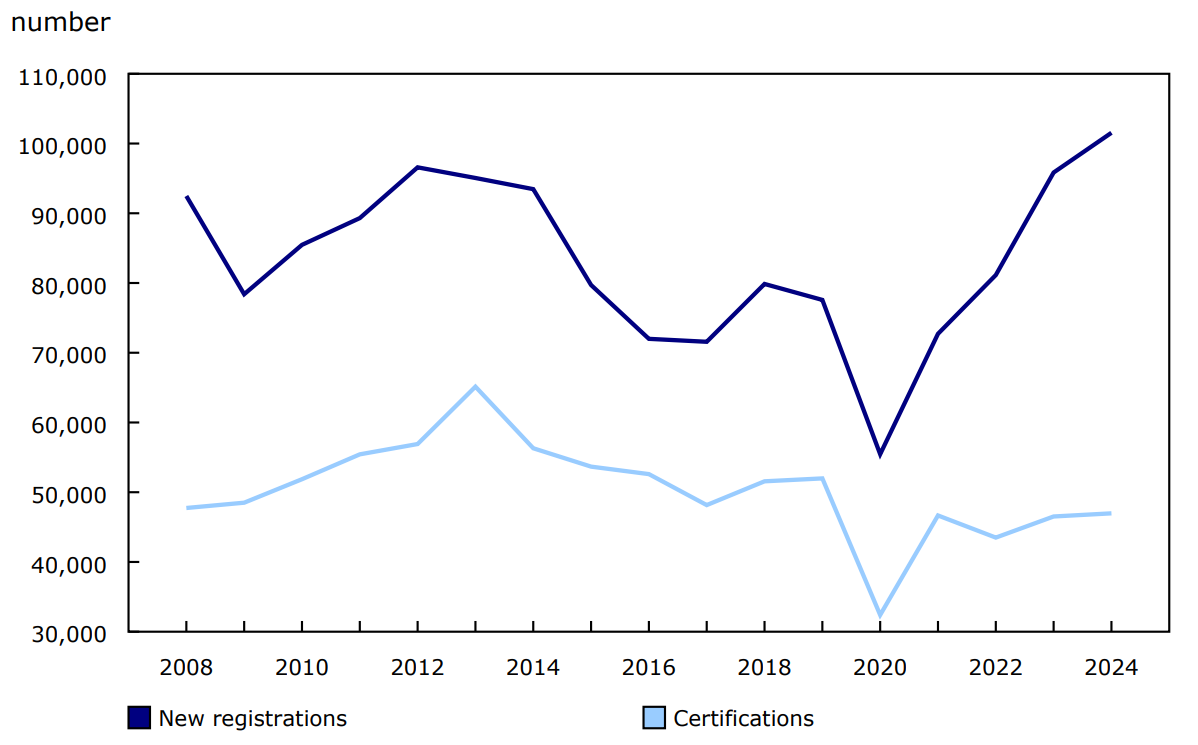
New registrations in apprenticeship programs reached 101,541 in 2024, marking a 5.9% increase from 2023 and setting a record high since the beginning of the series in 2008. This milestone also marks the fourth consecutive year of growth since the near-record lows of 2020, during the COVID-19 pandemic. The strong recovery in apprenticeship registrations highlights the sustained demand for skilled trades across the country.
There were 46,971 apprentices who certified in 2024 (+1.0%), a figure largely unchanged from 2023. However, the lingering effects of the pandemic were still evident; in 2024, certifications remained below pre-pandemic levels—the gap was 9.6%.
Chart 1: New registrations and certifications by year, Canada, 2008 to 2024
Description - Chart 1
Data table: New registrations and certifications by year, Canada, 2008 to 2024
Note: Because of changes in administrative practices in Alberta, data as of 2023 are not comparable with data from previous years. For further details, see Note to readers.
Source: Registered Apprenticeship Information System (3154).
Gains in Alberta, Ontario and British Columbia drive national growth in new registrations
Despite overall national growth in new registrations, six provinces and two territories experienced year-over-year declines in 2024. The largest decreases were recorded in Nova Scotia (-7.4%) and Quebec (-4.3%). However, gains in new registrations for electricians, plumbers, pipefitters and steamfitters, and interior finishers in Alberta and British Columbia, along with growth in automotive service workers and electricians in Ontario, more than offset the declines in other jurisdictions.
Despite these year-over-year declines in most jurisdictions, all provinces except Quebec (-8.4%) exceeded their new registration levels from before the pandemic (2019).
New registrations increase in most trade groups in 2024, while they remain well below pre-pandemic levels in several other groups
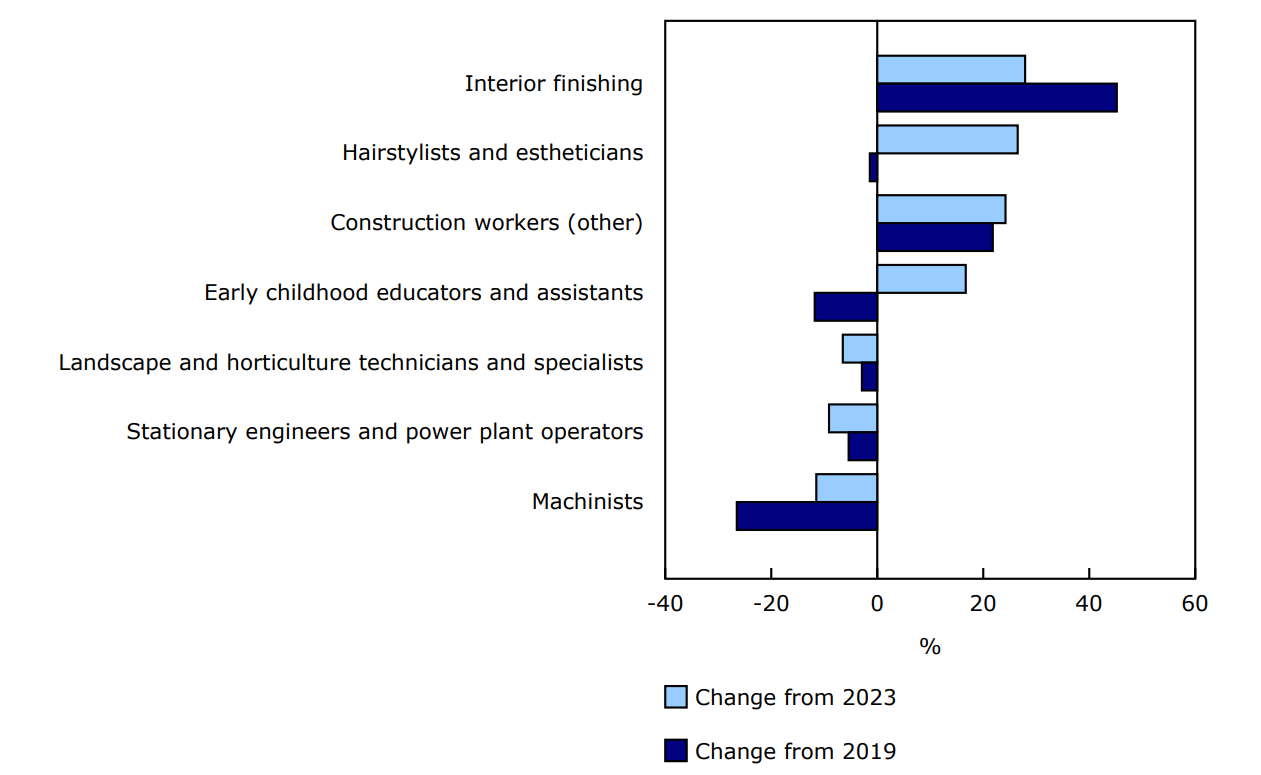
In 2024, new registrations increased year over year in 16 of the 24 major trade groups or remained relatively unchanged. Interior finishers (+27.9%), hairstylists and estheticians (+26.5%), construction workers (+24.2%), and early childhood educators and assistants (+16.7%) saw the highest growth.
Conversely, machinists (-11.5%), stationary engineers and power plant operators (-9.1%), and landscape and horticulture technicians and specialists (-6.5%) saw the largest year-over-year declines. Levels in these groups also remained below those observed before the pandemic.
Chart 2: Percentage change of new registrations in selected trade groups in 2024, compared with the previous year (2023) and the year before the pandemic (2019), Canada
Description - Chart 2
Source: Registered Apprenticeship Information System (3154).
Certifications stabilize nationally but vary across trades and provinces and territories
The number of apprentices who became certified in 2024 (+1.0%) showed little change from 2023, and national certification counts remained below pre-pandemic levels.
British Columbia (+12.9%) accounted for most of the national increase, driven by strong growth in certifications among plumbers, pipefitters and steamfitters, food service workers, and automotive service technicians. Prince Edward Island (+19.6%), Newfoundland and Labrador (+19.4%), and Nova Scotia (+7.8%) also recorded notable proportional gains. Meanwhile, certifications declined in Saskatchewan (-5.3%), Alberta (-3.8%), Ontario (-0.9%) and Quebec (-0.6%).
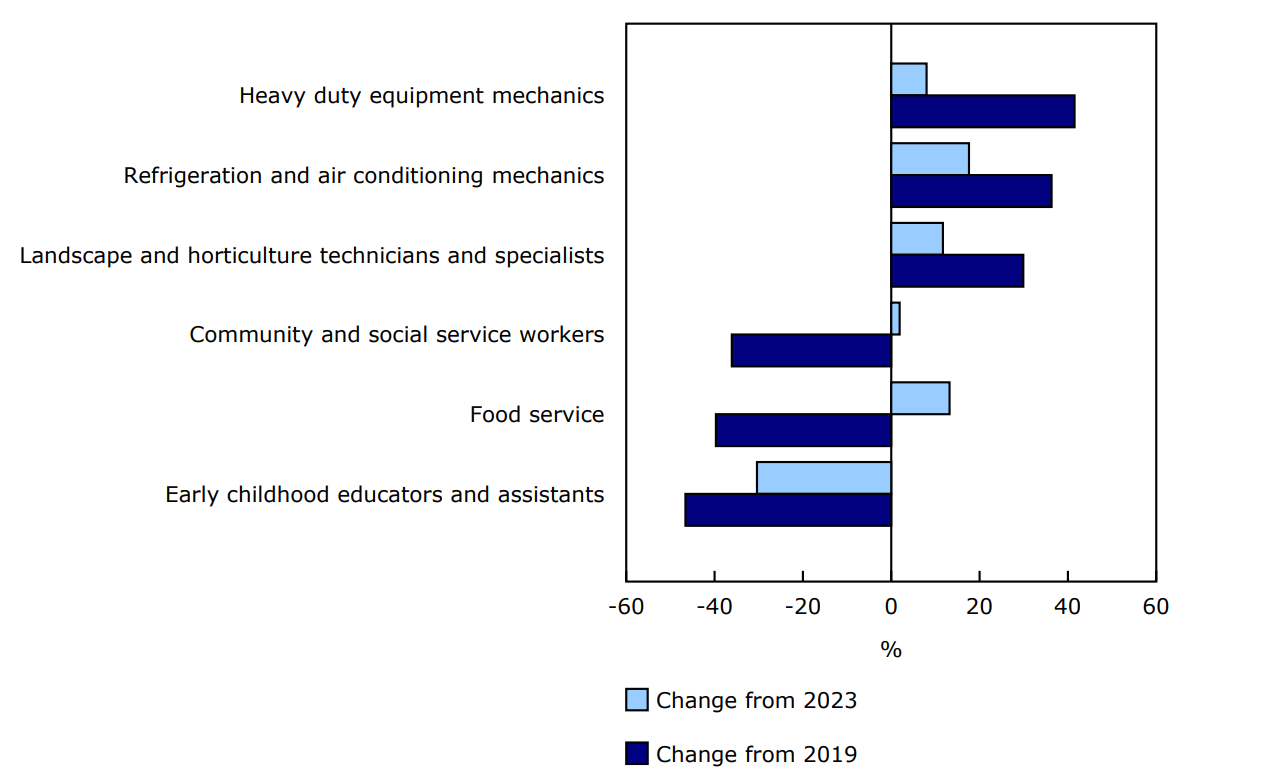
Among trade groups, heavy duty equipment mechanics (+41.5%), refrigeration and air conditioning mechanics (+36.3%), and landscape and horticulture technicians and specialists (+29.9%) experienced the largest growth since the pandemic, surpassing 2019 certification levels.
Chart 3: Percentage change of certifications in selected trade groups in 2024, compared with the previous year (2023) and the year before the pandemic (2019), Canada
Description - Chart 3
Source: Registered Apprenticeship Information System (3154).
Conversely, service-oriented trade groups, such as early childhood educators and assistants (-46.6%), food service workers (-39.7%), and community and social service workers (-36.1%), remained furthest below 2019 levels.
Apprenticeship pathways show some improvement
The certification rate—the percentage of apprentices completing their programs within the expected duration—increased by 1.1 percentage points to 19.9% in 2024, marking the third consecutive year of growth. Despite these gains, the rate remained slightly below the pre-pandemic level recorded in 2019 (20.9%).
In 2024, the continuation rate—defined as the percentage of apprentices who were still registered in their programs at the end of its expected duration but have yet to certify—declined slightly (-0.8 percentage points) compared with 2023. However, it remained elevated, at 49.2%, in 2024. Continuation rates have historically been high, ranging typically from 40% to 45%; however, this was especially true in the years following the pandemic. Since most apprenticeship programs have a duration of four years, many apprentices evaluated at the end of their program's duration in 2024 had registered in 2020, at the height of the pandemic. Disruptions during that period may have contributed to some apprentices taking longer to complete their training.
The discontinuation rate—the share of apprentices who left their programs within the expected duration—declined slightly (-0.3 percentage points) to 30.9% in 2024.
Note to readers
Context
The provinces and territories, which provide the data for this release, can make operational and administrative changes related to training and certification in the trades within their jurisdictions. These changes may affect historical comparisons. In 2023, Alberta designated a number of occupations as trades and began issuing certificates. Additionally, individuals in certain trades could now be reported multiple times for their registrations and certifications across related sub-trades, a practice that was not implemented prior to 2023. The data should be interpreted within the context of these administrative and operational changes. For further information on federal, provincial and territorial government changes, see the Registered Apprenticeship Information System (RAIS) Guide.
In the 2024 release, Ontario's data were updated to resolve instances where apprentices may have been counted as holding both a non–Red Seal certificate and a Red Seal certificate within the same trade. These updates were applied retroactively and affected only the non–Red Seal certificate count.
This release includes data from the 2024 RAIS, part of the Education and Labour Market Longitudinal Platform. Apprenticeship pathway data include information on certification, continuation and discontinuation rates at the program duration, one and a half times the program duration, and twice the program duration, corresponding to four, six and eight years after registration for most programs. For more information on the concepts and the methodology used in this release, consult "Pathways indicators for registered apprentices in Canada, 2021." This guide is part of the Technical Reference Guides for the Education and Labour Market Longitudinal Platform (37200001).
Data, definitions and concepts
Apprenticeship pathway indicators were derived for all trades at the aggregate level and for selected trades at disaggregate levels, including the 25 Red Seal trades and 5 non–Red Seal trades that account for most apprentices from 2008 to 2024. Four non–Red Seal trades—child and youth worker, developmental services worker, early childhood educator, and educational assistant—are considered designated trades with apprenticeship programs only in Ontario.
Certification
The requirements for granting a certificate vary by jurisdiction in Canada. In most instances, an apprentice is issued a certificate if they complete requirements such as supervised on-the-job training and technical training and pass one or more examinations. Meanwhile, most trade qualifiers become certified once they pass an examination.
Cohort
A cohort is the group of apprentices who finished their program duration by the end of a given calendar year. The most common program duration is four years; however, it varies from one to five years across provinces and territories and trades. As a result, a cohort is a group of apprentices who start their training in different years, depending on the program duration. For example, the 2021 cohort is composed of apprentices who started a one-year program in 2020, a two-year program in 2019, a three-year program in 2018, a four-year program in 2017 and a five-year program in 2016.
Compulsory trades
These are trades where workers are required to undertake or complete an apprenticeship program to be employed in the trade. Provinces and territories determine the compulsory or non-compulsory status of designated trades. As such, the compulsory or non-compulsory status of a designated trade varies across provinces and territories.
Continuation
This is the proportion of apprentices who are continuing a given apprenticeship program at the end of the reporting year.
Designated trades
These are trades for which apprenticeship training and trade qualifications are available in Canada. These trades are governed by provincial and territorial jurisdictions, which determine the trades for which apprenticeship training is made available and certificates are granted. Provinces and territories also determine which designated trades require certification to work unsupervised in the trade. Data from the RAIS include only trades designated in at least one province or territory.
Discontinuation
This is the proportion of apprentices who discontinued a given apprenticeship program after their registration date.
Red Seal and non–Red Seal programs
The Red Seal program sets common standards to assess the skills of tradespeople across Canada. Journeypersons who meet the Red Seal standards through examination receive a Red Seal endorsement on their provincial or territorial trade certificates. There are 54 trades at the national level for which common Red Seal standards are currently available. Non–Red Seal trades, by contrast, do not have interprovincial standards. Many non–Red Seal trades do not have an examination requirement to work in the trade.
Registered apprentices
These are individuals in a supervised work training program in a designated trade within their provincial or territorial jurisdiction. To complete the training, the apprentice must be registered with the appropriate governing body, usually a ministry of education, ministry of labour or trade-specific industry governing body.
Registrations
The reference period is from January 1 to December 31, 2024.
Trade qualifiers or trade challengers
These are individuals who have worked in a specific trade for an extended period of time, without having ever been an apprentice, and who have received certification from a jurisdiction. This is usually done via a skills assessment in the trade.
Contact information
For more information, or to enquire about the concepts, methods or data quality of this release, contact us (toll-free 1-800-263-1136; 514-283-8300; infostats@statcan.gc.ca) or Media Relations (statcan.mediahotline-ligneinfomedias.statcan@statcan.gc.ca).