

Gross domestic income earned by Indigenous people increases in 2023
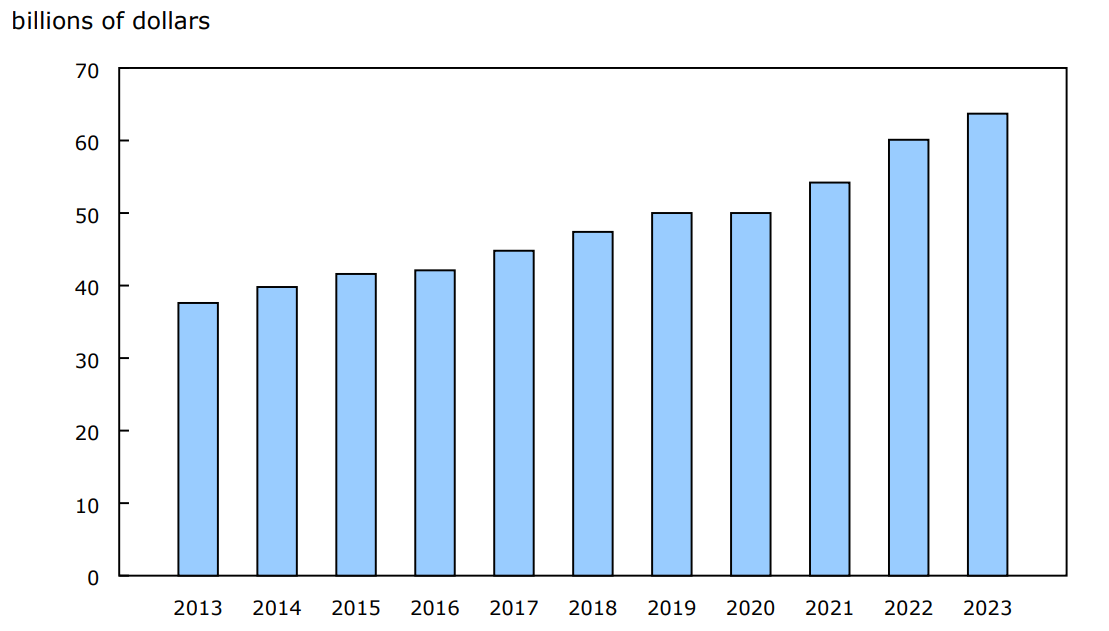
Gross domestic income (GDI), also known as income-based gross domestic product, earned by Indigenous people (Indigenous GDI) reached $63.7 billion in 2023, up 6.1% from 2022. Indigenous GDI as a share of total Canadian GDI increased from 2.0% in 2012 to 2.3% in 2023.
Chart 1: Indigenous gross domestic income, Canada
Description - Chart 1
Data table: Indigenous gross domestic income, Canada
Source: Table 36-10-0695-01.
Indigenous GDI posted growth across many sectors in 2023. The public administration (+$1.1 billion) and health care and social assistance (+$0.6 billion) sectors contributed the most to the overall growth, together accounting for close to one-third (30.9%) of Indigenous GDI in 2023.
The arts, entertainment and recreation sector (+12.6%) grew at the fastest pace in 2023, followed by accommodation and food services (+9.8%). Combined, the two sectors accounted for 3.5% of Indigenous GDI. In both sectors, 2023 marks the first time that Indigenous GDI exceeded levels last reached in 2019, before the COVID-19 pandemic.
Jobs increase in nearly all sectors
In 2023, jobs held by Indigenous people grew by 2.9% to reach nearly 918,000, representing 4.4% of all jobs in Canada. In the 2021 Census, Indigenous people aged 15 years and older accounted for 4.4% of the total population in Canada; this proportion ranged from 2.0% in Prince Edward Island to 82.1% in Nunavut.
The construction (+5,580 jobs) and health care and social assistance (+4,505 jobs) sectors contributed the most to the growth in jobs held by Indigenous people in 2023. Combined, these two sectors accounted for nearly one in four jobs held by Indigenous people (23.6%). Among sectors, utilities (+9.4%) and arts, entertainment and recreation (+8.6%) had the highest rates of growth. Despite this, these sectors contributed less to the overall increase because they represented 2.6% of jobs held by Indigenous people.
Gross domestic income rises in every province and territory
Continuing a trend that began in 2021, Indigenous GDI grew in every province and territory in 2023.
Yukon (+10.2%) and Nova Scotia (+9.9%) saw the largest growth in Indigenous GDI in 2023. In both regions, growth in the public administration sector was a significant contributor to the increase.
Provincial and territorial shares of total Indigenous GDI in Canada remained relatively stable in 2023. Ontario ($15.2 billion; 23.9%) continued to account for the largest share of total Indigenous GDI in Canada, while Prince Edward Island ($0.1 billion; 0.2%) accounted for the smallest.
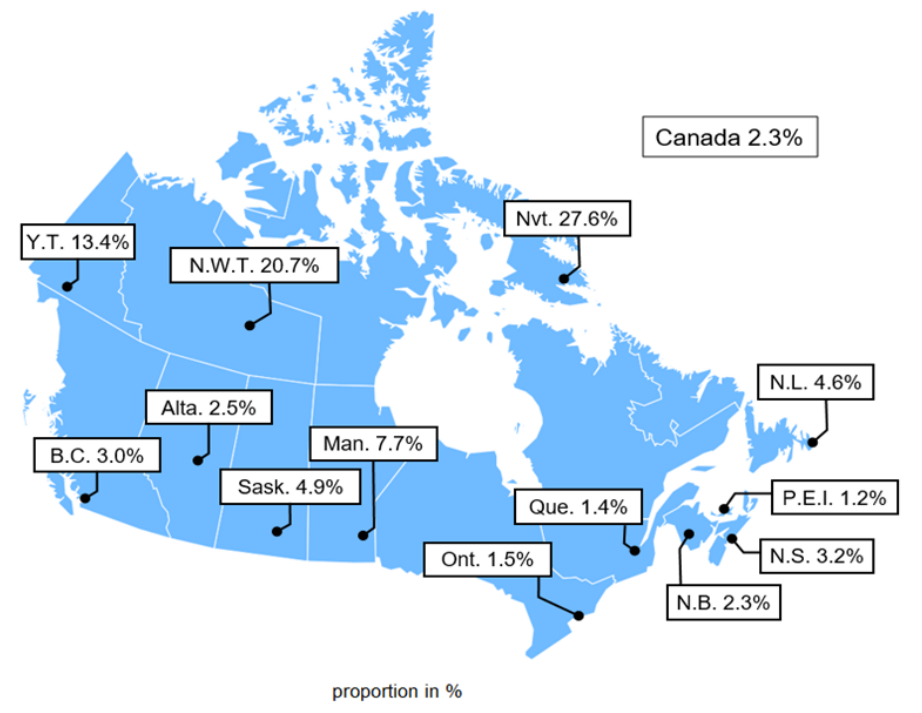
In 2023, the share of total provincial GDI earned by Indigenous people ranged from 1.2% in Prince Edward Island to 7.7% in Manitoba. In the territories, where Indigenous people make up a larger share of the population, Nunavut (27.6%) had the largest share of GDI attributable to Indigenous people, while Yukon (13.4%) had the smallest.
Map 1: Indigenous gross domestic income as a proportion of overall provincial, territorial and national gross domestic income in 2023
Description - Map 1
The title of the map is "Indigenous gross domestic income as a proportion of overall provincial, territorial and national gross domestic income in 2023"
This is a map of Canada by province and territory showing the Indigenous gross domestic income as a proportion of overall provincial, territorial and national gross domestic income in 2023.
Indigenous gross domestic income as a proportion of gross domestic income was 2.3% for Canada, 4.6% for Newfoundland and Labrador, 1.2% for Prince Edward Island, 3.2% for Nova Scotia, 2.3% for New Brunswick, 1.4% for Quebec, 1.5% for Ontario, 7.7% for Manitoba, 4.9% for Saskatchewan, 2.5% for Alberta, 3.0% for British Columbia, 13.4% for Yukon, 20.7% for the Northwest Territories and 27.6% for Nunavut.
Source: Special tabulation.
Characteristics of Indigenous paid worker jobs
In 2023, the number of paid worker jobs held by Indigenous people in Canada rose by 27,330 year over year to nearly 861,000.
This change was driven by growth in the number of full-time jobs (+4.2%), which made up more than three in four jobs (78.6%) in 2023. Part-time jobs (+0.2%) grew at a slower pace, accounting for just over one in five jobs (21.4%).
While the growth in jobs held by Indigenous men (+3.5%) slightly outpaced the growth in jobs held by Indigenous women (+3.1%) in 2023, men and women occupied nearly the same number of jobs overall.
In 2023, people with a high school diploma or less (51.3%) accounted for the largest share of jobs held by Indigenous people, followed by those with a college diploma (22.5%), university degree or higher (15.7%) and trades certificate (10.5%). All four cohorts experienced similar growth in 2023.
People aged 45 years and older (38.7%) had the largest share of jobs held by Indigenous people in 2023, followed by those aged 25 to 34 years (23.5%) and 35 to 44 years (20.3%). Those aged 15 to 24 years had the smallest proportion of jobs (17.5%) and the slowest rate of growth (+2.5%).
Note to readers
The Indigenous Peoples Economic Account data for 2023 have been released along with updated data from 2012 to 2022. These updates reflect the incorporation of new benchmark values from the provincial and territorial supply and use tables, updated source data from the Canadian Macroeconomic Accounts, as well as updated tax data.
Indigenous people include persons who identify as First Nations (North American Indian), Métis and/or Inuk (Inuit) and/or those who report being Registered or Treaty Indians (that is, registered under the Indian Act of Canada), and/or those who report having membership in a First Nation or Indian band. "Indigenous Peoples" is a collective name that refers to the original peoples of North America and their descendants, while the term "Indigenous people," used in this release, refers to individuals.
The Indigenous economy is defined as gross domestic income (GDI) earned by Indigenous workers and Indigenous-led businesses (where more than 50% of the owners identify as Indigenous). The main source for Indigenous workers is the Human Resource Module, which is linked to both the Census of Population and the System of National Accounts estimates of jobs and wages. The main source for Indigenous-led businesses is the Canadian Employer-Employee Dynamics Database, which has been linked to the Census of Population. To learn more, please see the article, "Identifying Indigenous Business Owners and Indigenous-Owned Businesses."
GDI is defined as the income generated by economic activity in the form of employee compensation and business incomes. It is often referred to as income-based gross domestic product; however, taxes less subsidies on products and imports are not included as part of Indigenous GDI. As such, all comparisons with the total economy are done at basic prices rather than market prices as presented in the Provincial and Territorial Gross Domestic Product (GDP) by Income and by Expenditure Accounts.
Statistics Canada acknowledges that other approaches may result in different estimates. For example, when estimating the business income component of GDI, the current approach only considers businesses that are majority-owned (that is, 50% +1) by people identifying as Indigenous. Defining Indigenous-owned businesses differently, such as any businesses where at least one owner identified as Indigenous, would produce different results. However, given the current availability of data, this approach was considered the most appropriate. As new data become available, the choice of methodology may be altered, or the existing methodology could be refined.
Additional information on the methodologies used to construct the Economic Indicators and Human Resource Module estimates can be found in the article "Indigenous Peoples Economic Account: Methodology and Preliminary Results," which is part of the publication Income and Expenditure Accounts Technical Series (13-604-M).
Contact information
For more information, or to enquire about the concepts, methods or data quality of this release, contact us (toll-free 1-800-263-1136; 514-283-8300; infostats@statcan.gc.ca) or Media Relations (statcan.mediahotline-ligneinfomedias.statcan@statcan.gc.ca).