

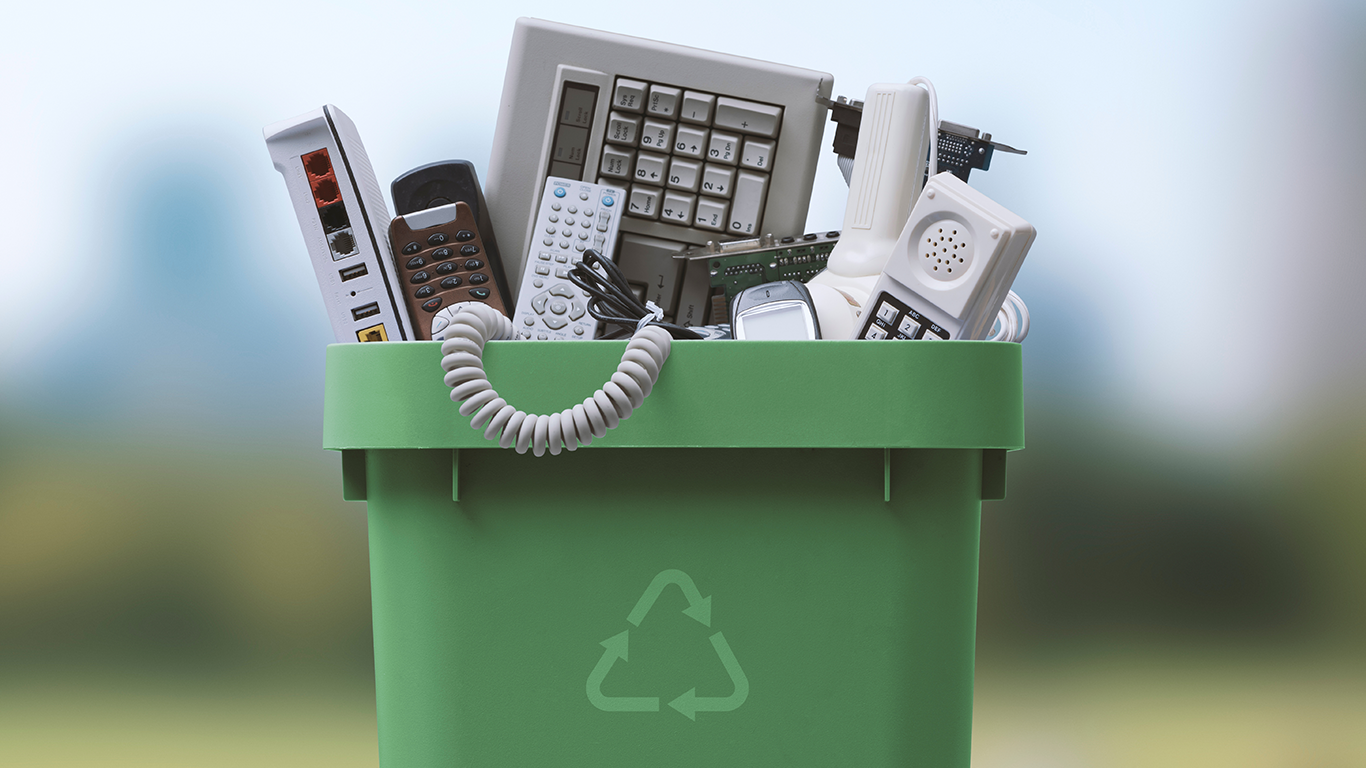
It seems we all can’t get enough of the latest electronics, whether it be cellphones, appliances or everything in between. The question is, where do they all go when they’re obsolete?
Every two years, the Households and the Environment Survey asks Canadian households living in the provinces how they go about disposing—or hanging onto—their electronic waste. Let’s have a look at what Canadians told us about what they did with their electronics.
Small appliances the most likely item awaiting disposal; televisions and cellphones not far behind
In 2023, one in six Canadian households (16%) had unwanted small appliances to dispose of. This type of item was the most commonly reported.
This was followed by computers (14% of households), televisions (14%), cellular phones (14%), printers (10%), audio-visual equipment (9%), microwave ovens (6%), landline telephones (5%), set-top boxes (5%), wearable electronics (4%) and electronic gaming equipment (3%).
In most cases, there was little difference geographically, though there were outliers. For example, more than 1 in 4 households in British Columbia (26%) had unwanted small appliances to dispose of, while 1 in 10 New Brunswick households (10%) had unwanted cellular phones.
Most households with unwanted computers, printers or televisions donate or give them away
Of the 14% of Canadian households that reported having unwanted computers in 2023, almost two-thirds (64%) took or sent them to a depot or drop-off centre, while one in six (16%) donated or gave them away.
Similar proportions of households brought their unwanted televisions (67%), audio-visual equipment (66%) and printers (67%) to a depot or drop-off centre, while these items were less likely to be donated or given away (16%, 18% and 12%, respectively).
Canadians are hanging onto their video games and equipment
Perhaps nostalgia is strongest among the households with gamers, very few of whom had unwanted equipment (and they probably have the nostalgic t-shirt to match!) Of the small fraction of households (3%) reporting having unwanted electronic gaming equipment to dispose of, just over half (52%) of them took them to a depot or drop-off centre, while one in five (21%) donated them or gave them away.
Notably, one in six households (16%) repaired or sold their unwanted gaming equipment. (Sometimes, blowing on a game cartridge isn’t enough.)
You used to call me on my (old) cellphone, and landline
The same proportion of households in 2021 (14%) and 2023 (14%) had unwanted cellular phones to dispose of.
However, in 2023, a greater share of these households (16%, up from 12% in 2021) returned the phones to a supplier or retailer, while a smaller share (33%, down from 40% in 2021) took them to a depot or drop-off centre.
Although shorter mobile contracts have become the norm, many Canadians hang onto their older phones and opt to use them for a cheaper month-to-month plan.
Among the 5% of households with unwanted landline telephones in 2023, one in seven (14%) donated or gave them away, but more than half (54%) put them in the trash.
Still too many materials ending up in the garbage
Speaking of trash—it seems more of us may need to step up our safe-disposal or diversion practices.
Mercury is one of several toxins that is found in electronic equipment and hazardous to both human health and the environment, along with lead, cadmium, beryllium and arsenic.
In 2023, one in six Canadian households (16%) had unwanted mercury-containing lights—either compact fluorescent lights (CFLs), fluorescent tubes or both—down slightly from 2023 (19%). However, more than one-third (36%) of those households in 2023 put them in the garbage, a rate largely unchanged from 2021 (35%).
Households were more likely to bring their fluorescent tubes to a depot or drop-off centre than haul them to the curb, while the reverse was true for CFLs.
Rates of other unwanted items ending up in the trash saw little or no change from 2021 to 2023, suggesting room for improvement.
Our colleagues at the Office of Consumer Affairs have some tips on properly disposing of electronic waste, including an inventory of recycling programs across the country.

📲 Looking for more? Staying informed has never been easier!
Follow the “Environment” subject in the StatsCAN app to receive personalized updates and stay connected with the most recent articles, reports and analyses.
Contact information
For more information, contact the Statistical Information Service (toll-free 1-800-263-1136; 514-283-8300; infostats@statcan.gc.ca) or Media Relations (statcan.mediahotline-ligneinfomedias.statcan@statcan.gc.ca).