

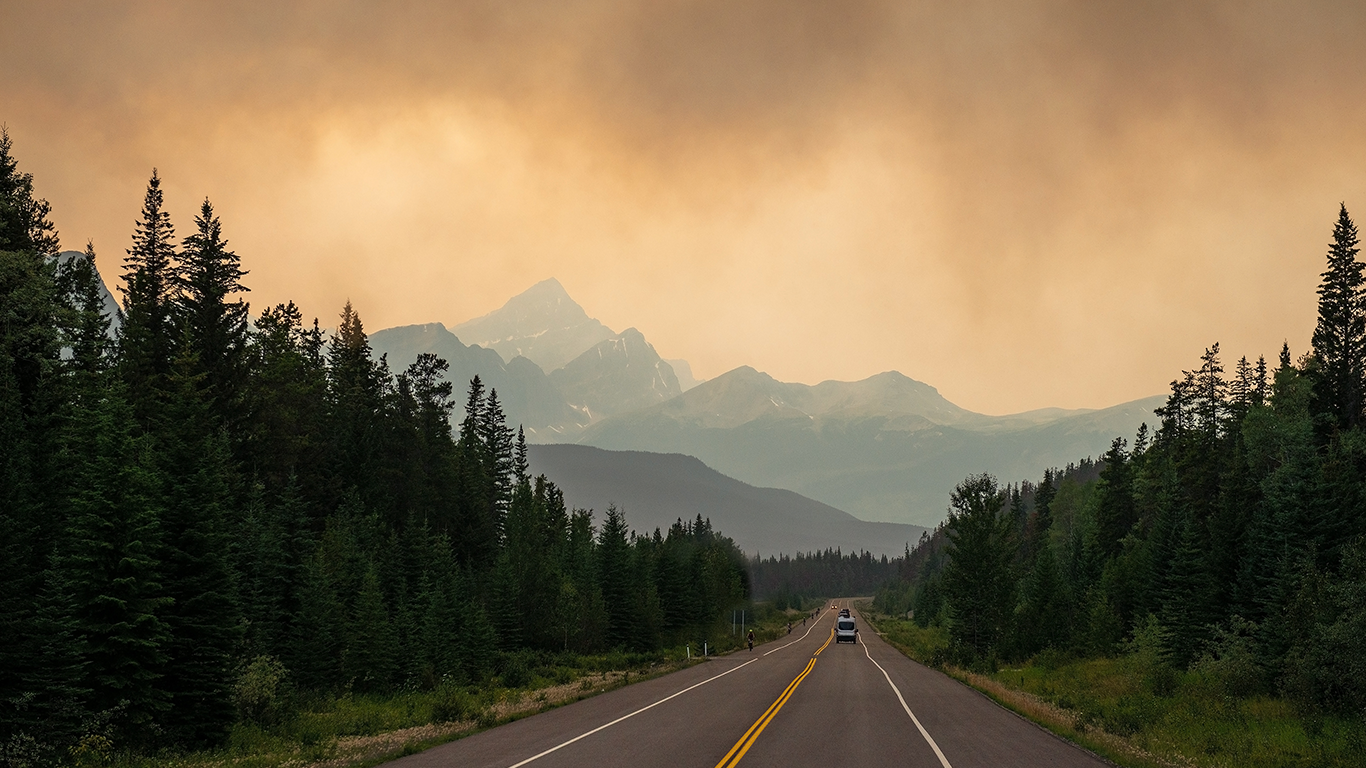
While wildfires are a national concern, their effects are not experienced equally. For many Canadians, recent wildfire seasons have been felt through hazy skies, the smell of smoke, or an orange-tinged horizon, while for others their only exposure to wildfires may be through media reports. For those Canadians in the direct path of a wildfire, however, the consequences may be much more pronounced, including forced evacuations, loss of a home, missed work hours, and broader economic disruptions across the region. A recent paper, titled “Estimates of gross domestic product in wildfire-affected areas during the 2023 and 2024 wildfire seasons,” explores the economic implications of wildfires at the provincial, territorial and regional levels.
Most destructive wildfire season on record in 2023
In 2023, approximately 232,000 Canadians, comparable with the population of Kitchener, Ontario, evacuated their communities in the wake of 282 wildfires.
Indeed, the 2023 wildfire season was the most destructive season on record, with nearly 5,500 fires burning 17.3 million hectares of land. For perspective, the burned area was larger than the land area of the three Maritime provinces.
Quebec, the Northwest Territories, Alberta, British Columbia and Saskatchewan had the most hectares burned. The number of evacuees in these regions ranged from about 5,000 people in Saskatchewan to 59,000 in British Columbia.
Wildfires caused an estimated $945 million in insured damages in the regions of Okanagan and Shuswap in British Columbia, Behchokǫ̀-Yellowknife and Hay River in the Northwest Territories, and Tantallon and Hammonds Plains in Nova Scotia.
Impact of wildfires most pronounced at the territorial and regional levels
When measured nationally or at the provincial level, total business activity in wildfire-affected areas accounted for less than 1% of Canada’s gross domestic product (GDP) in 2023. At the territorial level, however, the impact of wildfires was much more pronounced.
For example, in the Northwest Territories, just under three-quarters (74%) of the territory’s total economic activity was in wildfire-affected areas. This is largely because Yellowknife—where nearly half of the territory’s population lives—faced an evacuation order from August 16 to September 6, 2023.
Regional economies within provinces were also impacted during the 2023 wildfire season, albeit to a far less extent than those in Yellowknife or the Northwest Territories.
Notably, businesses located in wildfire-affected areas covering Edson, Alberta, and surrounding areas accounted for approximately 10% of the GDP in the Banff–Jasper–Rocky Mountain House economic region. This region includes numerous other towns, some of which served as evacuee reception centres.
In Nova Scotia, the Upper Tantallon and Hammonds Plains wildfire led to an evacuation order for residents in late May 2023 and could have affected about 1.1% of economic activity in the Halifax region.
In British Columbia, the West Kelowna and Kelowna wildfires contained locations of businesses representing 1.8% of the GDP of the Thompson–Okanagan region.
Economic impact of Jasper wildfire in 2024
In 2024, a wildfire led to the evacuation of more than 20,000 people from the town of Jasper in late July and most of August. As a result, 7.9% of the economic activity of the Banff–Jasper–Rocky Mountain House region was at risk of wildfires.
The longest evacuation orders were in Yellowknife and Kelowna in 2023 and Jasper in 2024, where over half of the working days in a month were lost, with 6% or more of working days lost on an annual basis.
In Yellowknife and Jasper, most or all local economic activity was effectively shut down during the evacuation periods.
The 2025 wildfire season may be one of the worst yet
As of July 30, 2025, there have been 3,582 wildfires since the beginning of the year, covering an area of 6.26 million hectares, which is more than quadruple the 10-year average of 1.38 million hectares.
Given the changing climate, wildfire risk will likely continue to increase into the future. Statistics Canada researchers have therefore developed new experimental estimates of GDP by square kilometre in Canada to measure economic activity at risk of being affected, but not necessarily being impacted, by wildfires in communities facing mass evacuations.
These new methods found that wildfires had either spread to or caused evacuations in regions representing approximately 0.125% of Canada’s economy (as of June 10, 2025).
By mid-June, Manitoba (2.4%) had the largest percentage of GDP at risk among the provinces, with 21,000 residents under evacuation orders.
Saskatchewan (0.4%) is estimated to have the second-largest percentage of GDP at risk, followed by Alberta (0.2%). Sites of economic activity in British Columbia, New Brunswick, Ontario, Newfoundland and Labrador and Quebec were also located in areas identified as having been affected by wildfires. However, less than 0.1% of the total provincial GDP was at risk in these provinces.
In north Manitoba (26.3%) and northern Saskatchewan (24.4%), where some of the largest fires are concentrated, approximately one-quarter of the regional economy was at risk due to wildfires.
📲 Looking for more? Staying informed has never been easier!
Follow the “Economic accounts” subject in the StatsCAN app to receive personalized updates and stay connected with the most recent articles, reports and analyses.
Contact information
For more information, contact the Statistical Information Service (toll-free 1-800-263-1136; 514-283-8300; infostats@statcan.gc.ca) or Media Relations (statcan.mediahotline-ligneinfomedias.statcan@statcan.gc.ca).