

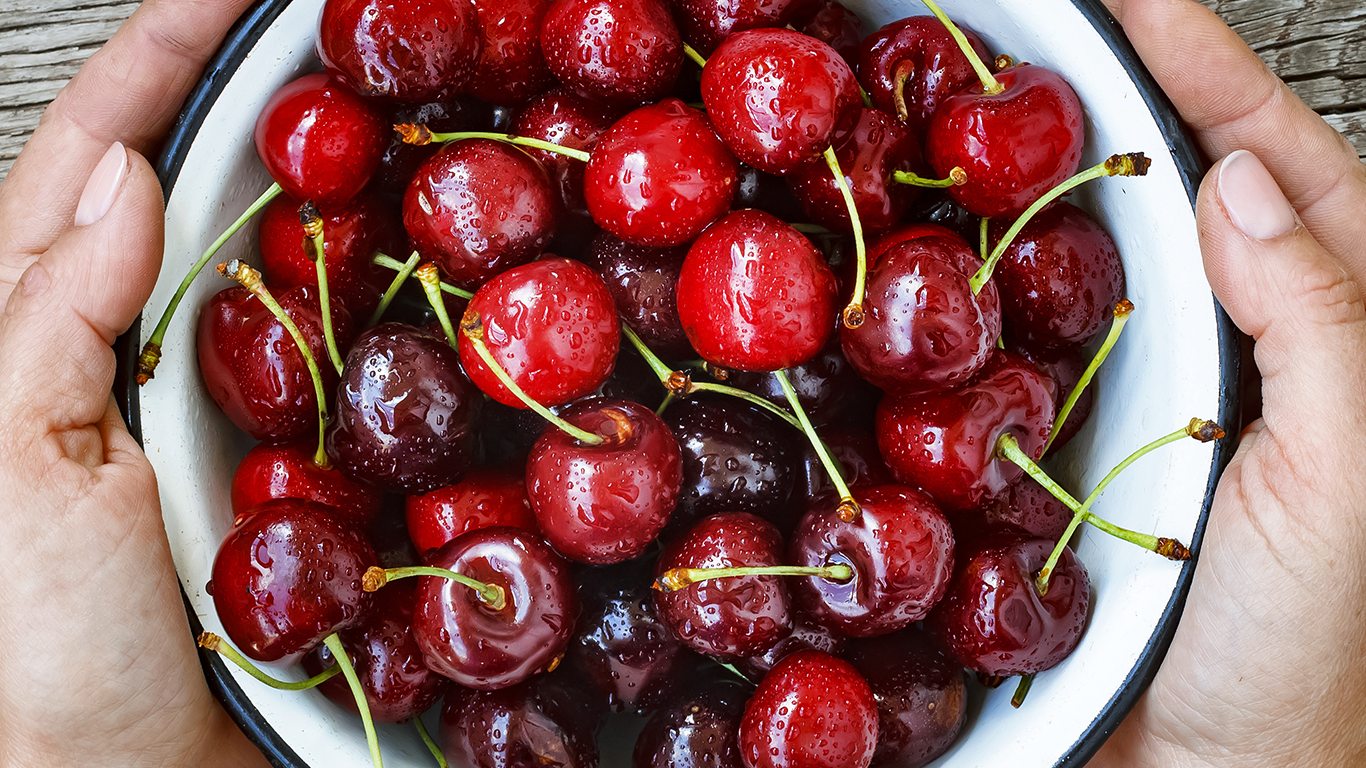
Canadian farmers grow two types of cherries—sour and sweet. Sour cherry trees blossom in late spring and can therefore be grown in most provinces. Sweet cherry trees, however, are prone to frost and are grown commercially in four provinces, with most orchards found in the interior of British Columbia. In 2024, sweet cherry production fell to its lowest level on record, while sour cherry production was down from one year earlier.
Cold snap in British Columbia severely damages sweet cherry trees
Canadian farmers sold a record low of 7,695 tons of sweet cherries in 2024, down by two-thirds (-67.7%) from one year earlier and approximately four times less than the record-high sales of 27,857 tons in 2018.
Most of the decline was attributable to British Columbia, where sweet cherry sales fell from 22,830 tons in 2023 to 6,823 tons in 2024. Extreme winter temperature fluctuations can increase the vulnerability of certain fruit crops, making them more susceptible to damage. In British Columbia’s Okanagan Valley, record-low temperatures in mid-January, following an unusually warm start to winter, severely damaged sweet cherry trees.
Sweet cherry sales also declined in Ontario, falling 12.6% to 837 tons in 2024. Smaller volumes of sweet cherries were also grown in Nova Scotia (28 tons) and Quebec (7 tons).
Most of Canada’s sour cherries are grown in Ontario
While sour cherries are touted for their medicinal qualities, they are also used in baking and jams, added to salads, or eaten dried. Canadian farmers grow a lot less sour cherries than sweet; marketable production of sour cherries ranged from 1,646 tons in 2012 to 8,153 tons in 2007.
In 2024, sour cherry sales fell by over one-third (-35.7%) year over year to 3,916 tons. Over 90% of the sour cherries sold in Canada in 2024 originated from orchards in Ontario, where marketable production was down by over one-third (-36.9%) to 3,654 tons.
Smaller volumes of sour cherries were also grown in British Columbia (146 tons), Saskatchewan (51 tons), Alberta (32 tons) and Quebec (20 tons) in 2024.
Cherry picking Census of Agriculture data
Every five years, Statistics Canada asks farmers what types of fruit they grow as part of the Census of Agriculture.
In 2021, 1,111 farms reported growing sweet cherries on 7,442 acres of land. The vast majority of these farms were located in British Columbia (828 farms) and Ontario (197 farms).
In the same year, we also counted 659 farms growing sour cherries on 1,916 acres of land. British Columbia (172 farms) was home to the most sour cherry farms in 2021, though these were relatively small, with a total acreage of 160 acres for the entire province.
Ontario ranked second (150 farms) in terms of sour cherry farms but led the nation with acreage (1,383 acres).
Additionally, there were 104 farms reporting growing sour cherries in Quebec, with a total acreage of 78 acres for the province.
More cherry data coming your way
Less than one year from now, Statistics Canada will be harvesting fresh farming data through the Census of Agriculture.
For those wanting a sneak peek, the 2026 Census of Agriculture questionnaire is now available.
📲 Looking for more? Staying informed has never been easier!
Follow the “Agriculture” subject in the StatsCAN app to receive personalized updates and stay connected with the most recent articles, reports and analyses.
Contact information
For more information, contact the Statistical Information Service (toll-free 1-800-263-1136; 514-283-8300; infostats@statcan.gc.ca) or Media Relations (statcan.mediahotline-ligneinfomedias.statcan@statcan.gc.ca).