

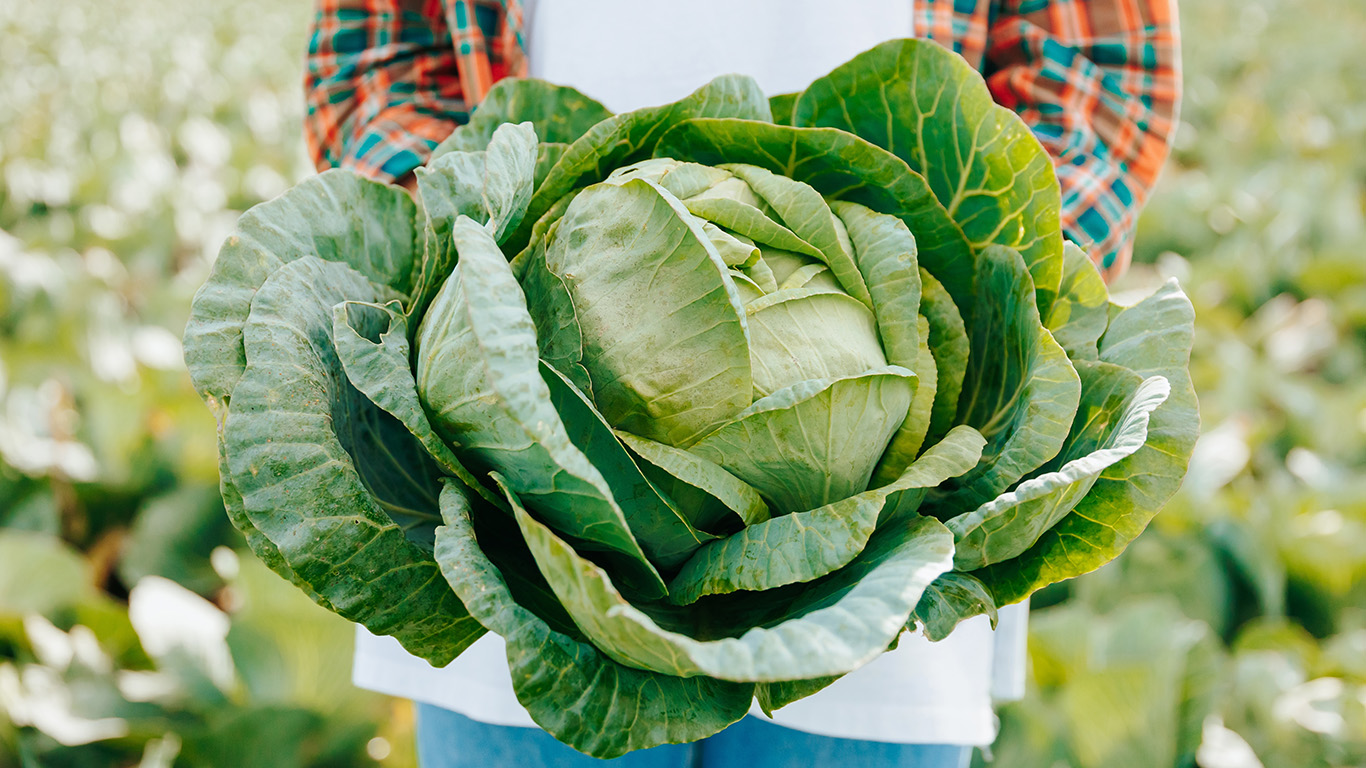
Cabbage grows best in cooler weather, so farmers plant in the spring before things heat up or in the late summer, when cabbage can grow and thrive during the cooler fall days. Kale, a member of the cabbage family does even better in the fall, with the flavour enhanced by a touch of frost. We track the production and sale of three types of cabbage: regular, Chinese and kale. Let’s dig into the data.
Cabbage patches found in every province
Ontario (567 farms) and Quebec (563) were neck and neck for most regular cabbage growing farms, followed by British Columbia (465). Yukon was the lone territory growing regular cabbage.
Chinese cabbage was grown on 850 farms in 2021, with Quebec (281) reporting the most Chinese cabbage patches.
Kale was reported grown on 1,733 farms in 2021, with over half those farms located in Ontario (535) and British Columbia (518). Kale was also grown in Yukon (7) and the Northwest Territories (3).
Good year for regular and Chinese cabbage in 2024, while kale had its worst year on record
Farmers grew 141 312 tonnes of regular cabbage in 2024, up 9.9% from a year earlier but 9.2% below the record high grown in 2016. Farmers received a record high $94.8 million for regular cabbage in 2024, up by over one-fifth (22.5%) from a year earlier.
Chinese cabbage production rose by almost one-fifth (+18.7%) year over year to 27 901 tonnes in 2024, the highest production since 2015. In terms of dollar value, Chinese cabbage farmers enjoyed their best year since 2014, selling $32.1 million of produce in 2024, up 21.3% from a year earlier.
It was a tough year for kale farmers, with production down 12.4% to a record low 2 553 tonnes in 2024. Kale production has been trending downward since we first started collecting data on the vegetable back in 2018, when a record high 3 368 tonnes were grown. Kale sales totalled $8 million in 2024, down 12.6% from a year earlier.
Fresh cabbage availability trending downward
Our food availability release, which tracks the amount of food physically present in a country for consumption, shows that the amount of cabbage available per person is declining for all three varieties we cover.
Availability of fresh regular cabbage fell at the fastest pace over a five-year period, declining from 4.50 kilograms (kg) per person in 2019 to 3.59 kg in 2023. In 2000, there were 5.48 kg of fresh cabbage per person.
Availability of fresh Chinese cabbage declined from 1.68 kg per person in 2022 to 1.53 kg in 2023. Despite the year-over-year decline, Chinese cabbage availability per person in 2023 was over double that of 2000 (0.65 kg).
Fresh kale availability fell from 0.71 kg per person in 2022 to 0.60 kg in 2023. In 2018, when we started tracking the availability of kale, there were 0.79 kg of kale available per person.
📲 Looking for more? Staying informed has never been easier!
Follow the “Agriculture” subject in the StatsCAN app to receive personalized updates and stay connected with the most recent articles, reports and analyses.
Contact information
For more information, contact the Statistical Information Service (toll-free 1-800-263-1136; 514-283-8300; infostats@statcan.gc.ca) or Media Relations (statcan.mediahotline-ligneinfomedias.statcan@statcan.gc.ca).