

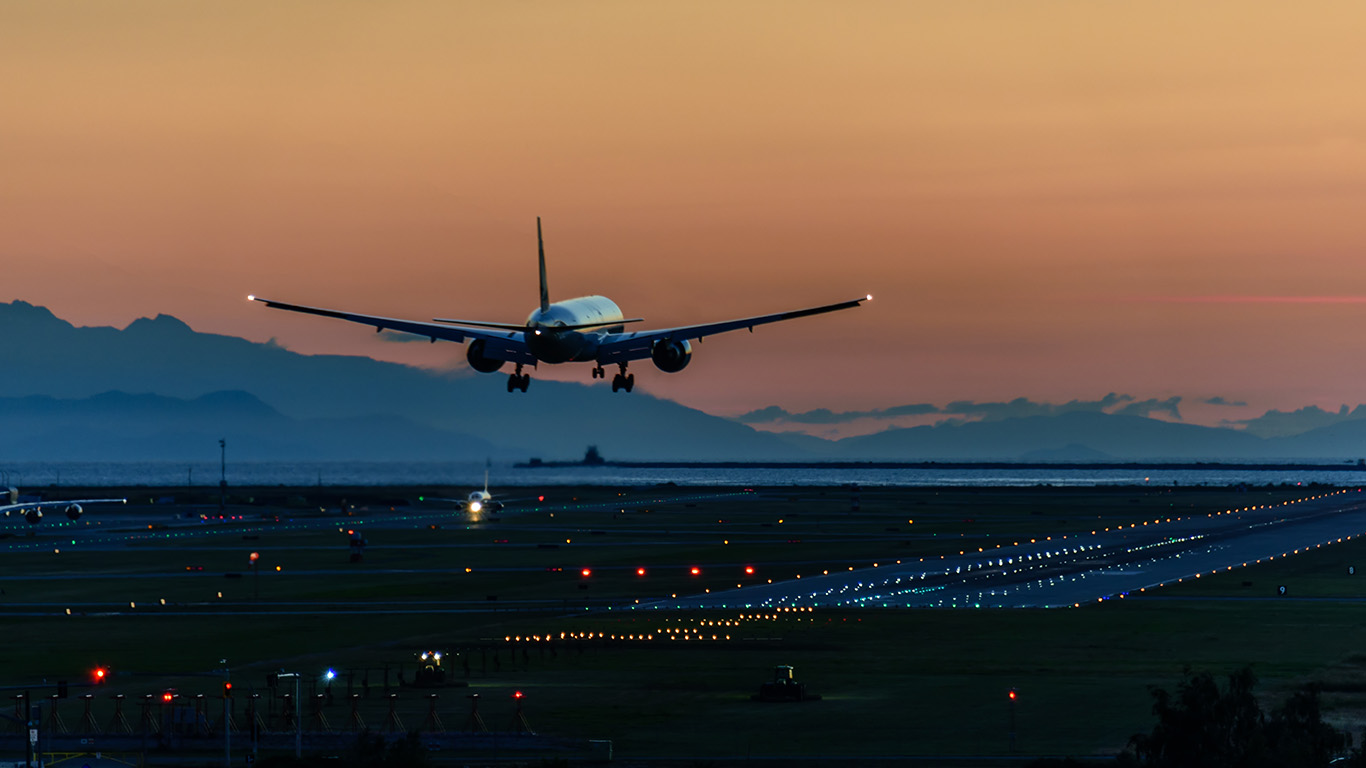
If you’ve landed, taken off or taxied to and from the runway safely, you probably have an air traffic service (ATS) professional to thank for it.
And, as our aviation data show, ATS professionals, including air traffic controllers (ATCs) and flight service specialists (FSSs), have a lot of traffic to direct. Let’s go over some key numbers as we prepare for liftoff.
More than 3 million aircraft movements in 2025
The number of aircraft movements has increased in the years following the COVID-19 pandemic, during which air travel was severely impacted. So far in 2025 (January to July), there have been more than 3.4 million total aircraft movements at Canada’s major and select small airports, up by 4.5% from 3.3 million in 2024. These consist of both itinerant movements (initial takeoff or final landing) and local movements, which include activities often carried out during flight training such as stop-and-go, touch-and-go and simulated approaches without landing. Most of these aircraft movements throughout the country required the services of a dedicated ATS professional.
In August 2025, 5.8 million passengers passed through pre-board security screening at Canada’s eight largest airports, edging down slightly (-0.3%) from August 2024 albeit 5.8% above the pre-pandemic level from August 2019. Almost 1.6 million tonnes of cargo passed through Canadian airports in 2024, up from 1.5 million in 2023 and almost 1.4 million in 2019.
Types of movements and yearly change vary by airport
Although Lester B. Pearson International airport in Toronto is most often Canada’s busiest airport—35,524 total movements in July 2025 alone, and this was up 2.6% from July 2024—the change in activity has been more pronounced at others.
In fact, the 13,046 movements at Victoria International in British Columbia in July 2025 were up 46.3% from July 2024, the largest increase among Canada’s 20 busiest airports.
Just over on the mainland at Vancouver International, the third-busiest airport, movements increased by 8.0% to 30,536 in July 2025. Nearby Boundary Bay airport—which handles helicopter and corporate aircraft and is home base to a number of flight training schools—saw its movements tick down 1.6% to 32,799, though it remained the second-busiest airport.
Montréal’s Pierre Elliott Trudeau International saw a slight decline (-0.7%) to 19,657 movements, while the 11,120 movements at John G. Diefenbaker International in Saskatoon, Saskatchewan, were up considerably (+23.3%).
ATS professionals also serve airports in the north. In July 2025, at Whitehorse/Erik Nielsen International airport in Yukon, there were 1,152 itinerant movements by larger commercial air carriers and 679 by private aircraft.
At the same time, in Yellowknife, Northwest Territories, there were 211 itinerant movements conducted by government civil aircraft. The majority of these movements were in support of wildfire suppression activities.
Celebrating ATS professionals
October 20 is the International Day of the Air Traffic Controller, which pays tribute to ATCs’ hard work that keeps our skies safe.
Much of the data in this story are based on Statistics Canada’s Aircraft Movement Statistics program. Source data for this program are provided by NAV CANADA, whose ATS professionals direct traffic at many of Canada’s airports, including most major ones.
For more information, including more details on the duties of an ATC and FSS, visit the NAV CANADA website. Check out Statistics Canada’s Aviation Data Visualization Hub to explore aircraft movement statistics in an interactive format.

📲 Looking for more? Staying informed has never been easier!
Follow the “Transportation” subject in the StatsCAN app to receive personalized updates and stay connected with the most recent articles, reports and analyses.
Contact information
For more information, contact the Statistical Information Service (toll-free 1-800-263-1136; 514-283-8300; infostats@statcan.gc.ca) or Media Relations (statcan.mediahotline-ligneinfomedias.statcan@statcan.gc.ca).