

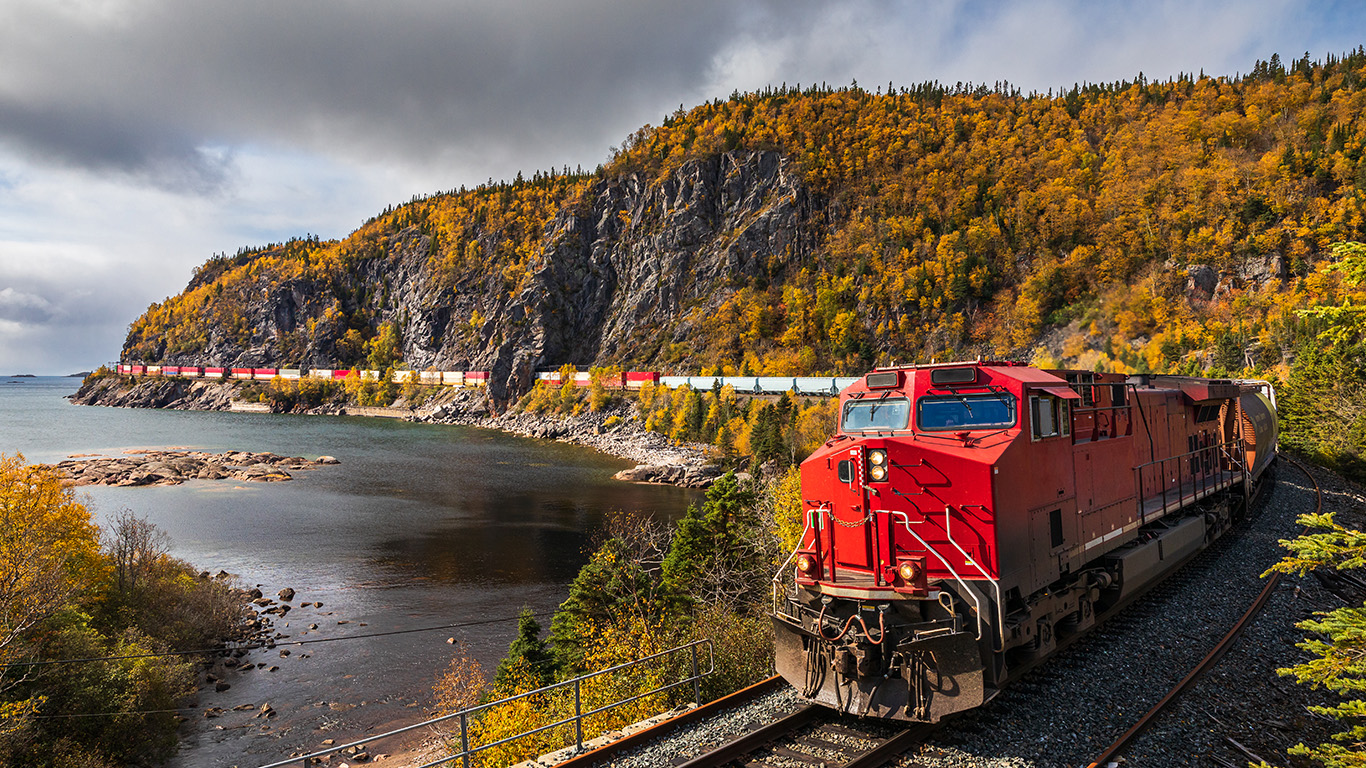
If you’ve ever waited at a level railway crossing as a train rumbled by, you’ve probably noticed the variety of freight cars rolling past, pulled or pushed by locomotives. Let’s take a closer look at Canada’s mainline railway rolling stock, from the mighty locomotives to the diverse freight cars, the cargo they carry and, of course, the dedicated people who keep the trains moving.
Freight and passenger locomotives pulling in different directions
The total number of mainline freight train locomotives declined for the fifth straight year in 2023, dropping by 44 units to 1,997 locomotives. This was the lowest number of freight locomotives since 2011.
Conversely, there were 8 more passenger locomotives than the previous year, bringing the total number up to 88 in 2023, the highest number of passenger locomotives in almost two decades.
However, these were used more intensively, with total train kilometres by mainline rail companies rising 3.4% year over year to 108 million kilometres in 2023, equivalent to going to the moon and back 140 times.
Across all rail companies in Canada, freight train speeds averaged 37.6 kilometres an hour in 2023 and the average freight train length was 112.1 railcars.
Fewest freight cars on record in 2023
There were 45,960 total freight cars running on mainline railways in 2023, down 16.3% from a year earlier and 47.8% lower than at the beginning of this millennium.
However, most newer railcars tend to have increased capacity, particularly in the case of grain hopper cars.
Hopper cars carry wheat and iron ore
A hopper car carries dry bulk freight and usually unloads through gravity by vents on the underside of the car. There were 18,266 hopper cars in service on mainline carriers in 2023, down by over one-fifth (21.2%) from a year earlier and 48.2% lower than in 2000. Approximately two in five freight cars are hoppers.
There are two types of hopper cars: those with a roof and those without. Roofed hopper cars carry goods, such as wheat and phosphates, that cannot be exposed to the elements. Open hopper cars carry things like coal and iron ore.
In July 2025 alone, railways transported 20,774 railcars of wheat. To put this into perspective, if these wheat-carrying railcars were joined together into one massive train, it would stretch from Brandon, Manitoba, to Regina, Saskatchewan.
Canada’s busiest hoppers are undoubtedly the specialized “iron ore jennies,” with 55,768 railway cars of iron ores and concentrates moved in July alone, a train that would stretch from approximately Sault Ste. Marie, Ontario to Trois-Rivières, Quebec.
Flat cars carry lumber and steel
A flat railroad car is without raised sides or ends and is great for carrying heavy or bulky loads such as lumber or steel.
There were 12,732 flat cars in service with mainline railways in 2023, down 13.0% from a year earlier, marking the fewest number of flat cars in service since 2016.
In July 2025, railways in Canada transported 8,259 railcars of lumber. A train that long would stretch from approximately Prince George to Fraser Lake, British Columbia.
Gondola cars carry sand, gravel and crushed stone
A gondola railway car has sides and ends but no top and is used for hauling commodities such as gravel and sand.
There were 8,109 gondola railcars in service in mainline railways in 2023, down by one-fifth compared with the previous year (-20.3%) and over one-third lower than the 21st century peak of 12,953 gondola cars in 2008.
Railways carried 4,513 railway cars of sand, gravel and crushed stone in July 2025, comparable to the distance between Toronto and Cobourg, Ontario.
Box cars carry beverages, food products and newsprint
A box car is a closed railroad car with a roof and a door, used for general service. Box cars are used to carry goods, such as beverages, newsprint and food products that damage easily if exposed to the elements.
The number of box cars in service on mainline railway companies declined for the fourth straight year, falling by 107 cars year over year to a record low 6,553 box cars in 2023. Back in the early years of the 21st century, there were over 20,000 box cars in service.
Box cars are being replaced by intermodal containers in many cases. These containers can be easily transferred between ships, trucks and trains without unloading the cargo.
In July 2025, railways transported 477 railcars of sugar, 348 railcars of newsprint and 120 railcars of alcoholic and non-alcoholic beverages.
Tanker cars carry oil and gas
We don’t track the number of tanker railway cars because they are owned by a third party and thus outside the scope of our annual railway survey. However, we do know how many tankers of oil and gas are shipped every month through our monthly carloadings survey.
In July 2025, railways carried 12,428 railway cars of gaseous hydrocarbons, including liquid petroleum gas, 8,685 railway cars of fuel oils and crude petroleum, and 4,266 railway cars of gasoline and aviation turbine fuel. If these railway cars were combined, the train would stretch from approximately Toronto to Ottawa.
Passenger cars for eating, drinking, sleeping or watching the world go by
There were 420 passenger cars in service with mainline railway companies in 2023, up from 384 one year earlier but well below the 21st century high of 544 in 2009.
Coach cars were the most prevalent, at 228 cars, followed by sleeping (81 cars) and meal/lounge cars (69 cars).
Among all railway companies combined, just under 4.2 million people rode a passenger train in 2023, up by almost one-quarter (24.0%) from a year earlier but 17.9% below pre-pandemic levels in 2019.
More train transportation and maintenance crew in 2023
Railways reported 15,455 people working in transportation in 2023, up 11.5% from a year earlier and the highest level of transportation employees since 2008. Transportation jobs in the railway industry include conductors, locomotive engineers and rail traffic controllers.
The number of employees working in equipment maintenance rose for the third consecutive year, up 4.6% year over year to 5,204.
Railway workers had average hourly earnings well above the national average of $29.70 in 2023, with rail transportation workers making over $40 per hour.
Further reading
This is the second in a three-part series on railways in Canada to mark the 140th anniversary of the completion of the transcontinental railway in 1885.
Part one, “Who are the navvies who work upon the railway today?”, was released earlier this year and part three, “Marking 140 years of transcontinental rail across Canada”, will come out on November 5, 2025.
📲 Looking for more? Staying informed has never been easier!
Follow the “Transportation” subject in the StatsCAN app to receive personalized updates and stay connected with the most recent articles, reports and analyses.
Contact information
For more information, contact the Statistical Information Service (toll-free 1-800-263-1136; 514-283-8300; infostats@statcan.gc.ca) or Media Relations (statcan.mediahotline-ligneinfomedias.statcan@statcan.gc.ca).