


The transition from school to work can be challenging at the best of times, and since 2024, young Canadians have encountered more difficult labour market conditions, with higher unemployment persisting in the summer of 2025 and into September.
Unemployment rate elevated among youth and young people aged 25 to 29
The unemployment rate among youth aged 15 to 24 years reached 14.7% in September 2025, adding to the notable increase recorded since spring 2023. This was the highest youth unemployment rate for the month of September since 2010 (excluding 2020, the first year of the COVID-19 pandemic).
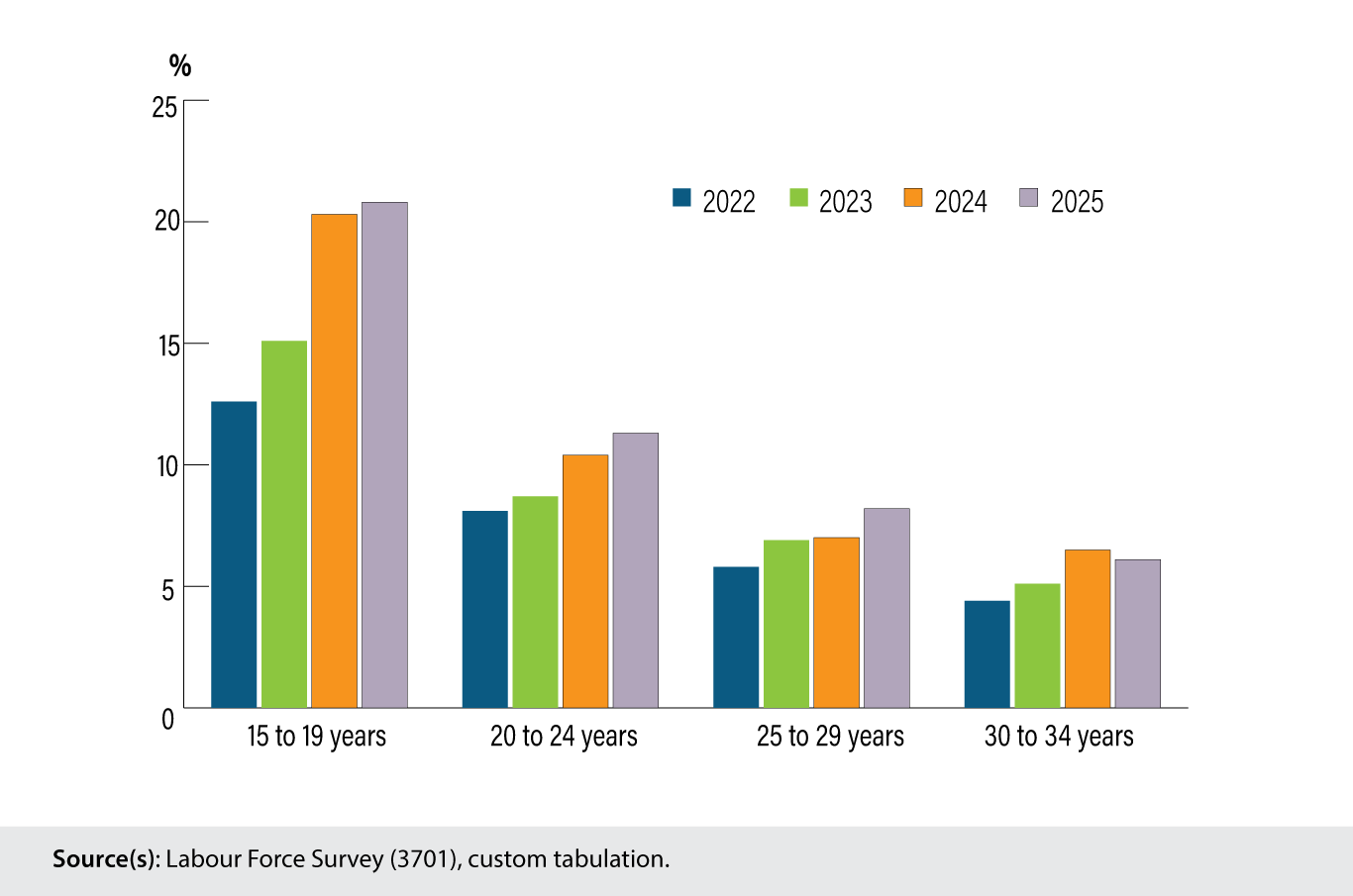
In the third quarter of 2025 (July to September average), the unemployment rate among youth aged 15 to 19 years reached 20.8%, up sharply from 12.6% in the same period in 2022. The unemployment rate also increased at a slower pace among youth aged 20 to 24 years (+3.2 percentage points to 11.3%) and 25 to 29 years (+2.4 percentage points to 8.2%).
Chart 1: Unemployment rate highest among youth aged 15 to 19 in September 2025
Description - Chart 1: Unemployment rate highest among youth aged 15 to 19 in September 2025
The title of this chart is “Unemployment rate highest among youth aged 15 to 19 in September 2025.”
This is a vertical bar chart.
The vertical axis shows the unemployment rate for youth, ranging from 0% to 25% in increments of 5%.
The horizontal axis shows four age groups, from left to right, by order of age: 15 to 19 years, 20 to 24 years, 25 to 29 years and 30 to 34 years.
There are four bars for each age group, representing the month of September in the years 2022, 2023, 2024 and 2025, in chronological order from left to right.
In the 15 to 19 age group, the unemployment rate in September was 12.6% for 2022, 15.1% for 2023, 20.3% for 2024 and 20.8% for 2025.
In the 20 to 24 age group, the unemployment rate in September was 8.1% in 2022, 8.7% in 2023, 10.4% in 2024 and 11.3% in 2025.
In the 25 to 29 age group, the unemployment rate in September was 5.8% in 2022, 6.9% in 2023, 7.0% in 2024 and 8.2% in 2025.
In the 30 to 34 age group, the unemployment rate in September was 4.4% in 2022, 5.1% in 2023, 6.5% in 2024 and 6.1% in 2025.
Source(s): Labour Force Survey (3701), custom tabulation.
Recent university graduates face higher unemployment than before the pandemic
Recent postsecondary graduates are a distinct group who may be looking for positions that can help them kick-start their careers.
Among young adults aged 20 to 29 years who had a bachelor’s degree or higher and were not students, the unemployment rate was 8.1% in September 2025, up from 2022 (6.4%) and the pre-pandemic level observed in 2019 (5.9%).
In this age group, young people with college degrees, trades certificates or diplomas, or university certificates below a bachelor’s typically have a lower unemployment rate than those with a bachelor’s degree or higher. In September, their unemployment rate was 6.4%, up from 4.9% in 2019.
A difficult summer job market for students
In the summer of 2025, returning students did not escape the difficult job market for youth. The unemployment rate for returning students aged 15 to 24 was 17.9% (May to August average), the highest since the summer of 2009 (18.0%), excluding the pandemic year of 2020.
The labour force participation rate of students—the share who were either employed or unemployed—was also at a record low in both the summer of 2024 (57.5%) and the summer of 2025 (57.3%).
Students continued to experience difficulties finding work in September, with the unemployment rate among youth attending school reaching 17.1%, up 3.1 percentage points from the same month in 2024.
The share of postsecondary students who found a summer job related to their studies holds steady
Despite the increase in unemployment, returning postsecondary students who were able to get a summer job were about as likely to have gained relevant work experience as in 2023.
According to data from the July 2025 supplement to the Labour Force Survey (LFS), just over 2 in 5 (42.5%) employed postsecondary students aged 18 to 24 were working at a job that was somewhat or closely related to their field of study. This was little changed compared with July 2023, the last time this question was asked in the LFS.
While the share of female students working in a job that was related to their studies increased (+5.6 percentage points to 44.1%), it was offset by a decline among male students (-4.8 percentage points to 40.5%).
In June, one in five youth in the labour force reported being somewhat or very likely to move to a different region to improve their employment prospects
In the face of challenging labour market conditions, some youth were planning to take action to improve their employment prospects over the next 12 months. In June 2025, one in five (20.0%) youths in the labour force indicated they were either somewhat or very likely to move to a different region, while over one-thirds (36.5%) of employed youth were either somewhat or very likely to look for a job in a different industry.
Among unemployed youth who were not students, more than one in four (27.3%) indicated that they were very likely to return to the regular education system over the following 12 months, and 29.1% indicated that they were somewhat likely to do so.

📲 Looking for more? Staying informed has never been easier!
Follow the “Labour” subject in the StatsCAN app to receive personalized updates and stay connected with the most recent articles, reports and analyses.
Contact information
For more information, contact the Statistical Information Service (toll-free 1-800-263-1136; 514-283-8300; infostats@statcan.gc.ca) or Media Relations (statcan.mediahotline-ligneinfomedias.statcan@statcan.gc.ca).