

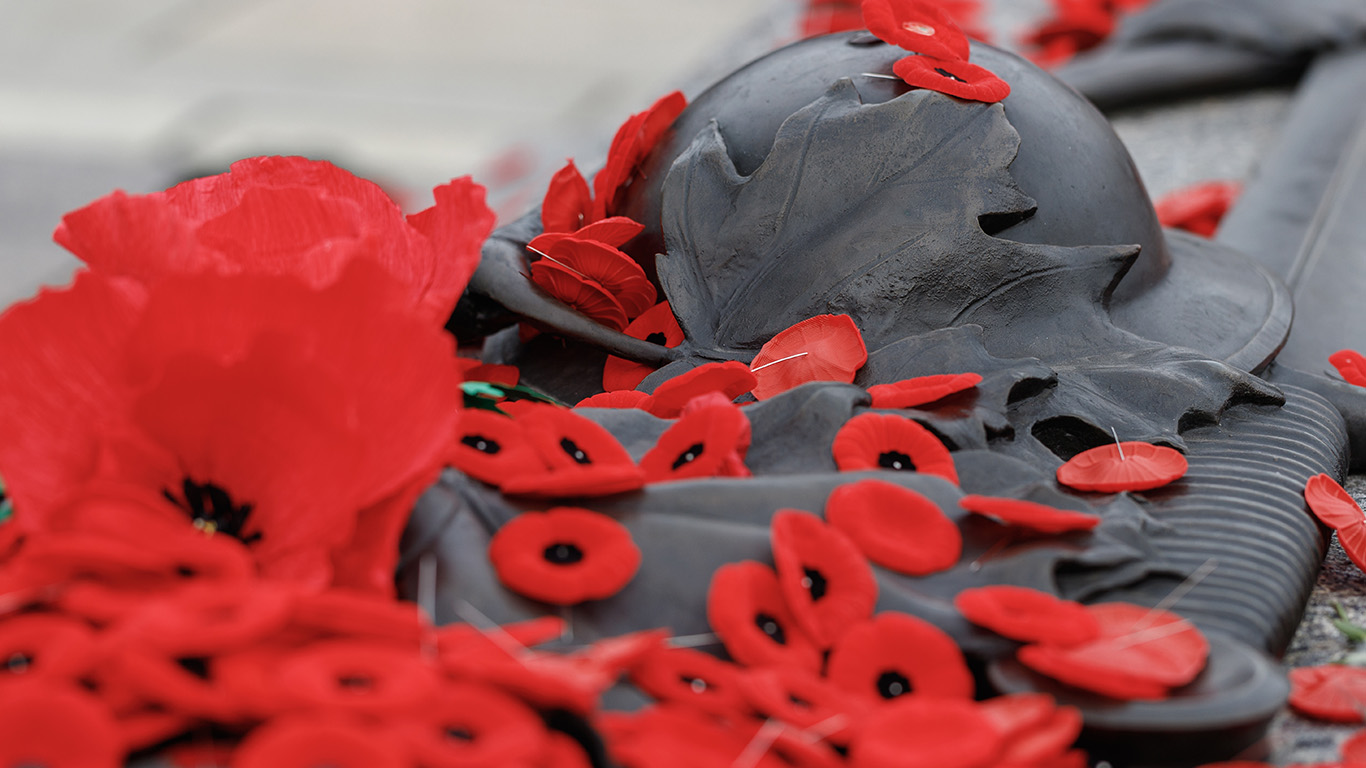
Over 2.3 million Canadians have served in our country’s military over our 158-year history, with more than 118,000 making the ultimate sacrifice.
To put these numbers into a modern context, the number of Canadians who have served in the military would make it the fourth-largest city in Canada at the time of the 2021 Census, just behind Vancouver and ahead of Ottawa–Gatineau, Calgary and Edmonton.
The number of Canadians who have died in military service would amount to the 35th largest city in 2021, just behind Lethbridge and Thunder Bay but ahead of Nanaimo and Kamloops.
While most of Canada’s war dead fell during conflicts in the 20th century, Canada’s Armed Forces have also suffered losses during times of peace. Since 2020, 10 Canadians have died in accidents while serving in the military.
Military families: Supporting our troops
For the first time in 50 years, the 2021 Census of Population collected detailed data on past and active (currently serving) members of the Canadian Armed Forces. In the spring of 2021, there were 97,625 Canadians serving as active members of the Regular Force or Primary Reserve Force, and 461,240 Veterans.
While Canadians can show support for the military by wearing a poppy in early November, military members, both active and Veteran, can draw support from their family year-round.
Indeed, military families have been recognized for the important role they play in supporting both the military’s operations and its members. Family of military members may, for example, contribute to military members’ decisions about entering and staying in military service. They also face unique challenges, such as extended periods of separation when a military member is deployed within or outside the country.
In 2021, there were 345,180 military families in Canada, accounting for 3.4% of all Canadian families. Over 8 in 10 military families (84.5%) were Veteran families, while 15.5% were active military families.
Most active military families consist of couples with one serving member and a civilian partner or spouse
In 2021, close to three in four active military families were couple families, with one currently serving spouse or partner and the other with no military experience (74.1%). This was followed by couple families where both spouses or partners were currently serving (11.8%) and couple families where one of the spouses or partners was currently serving and one was a Veteran (7.5%).
Overall, in 2021, active military couples (64.1%) were less often married, as opposed to being in a common-law union, than non-military couples (77.3%) and Veteran couples (79.0%).
Active military population over a decade younger than Canadians not in the military and almost twice as likely to have children aged five years and younger
Among the population aged 17 years and older, the average age of currently serving members was 35.7 years in 2021, compared with 48.4 years for the non-military population and 60.0 years for the Veteran population.
Just under one-third of active military couple families (30.0%) had children aged five years and younger, close to double the share of non-military couple families (15.9%) and four times the share of Veteran couple families (7.5%). These differences are related to the different age structure of the military and non-military populations.
Almost half of active military couple families moved to a different city within the previous five years
Active military families were much more likely to move to a different city than the non-military population. In 2021, nearly half (48.0%) of persons in active military couples lived in a different city, town, township, village, municipality or First Nations reserve within Canada compared with five years earlier. This proportion is more than twice that of non-military couples (17.1%) and Veteran couples (18.1%).
These relocations occur at the discretion of the Canadian Armed Forces in response to its organizational and operational needs.
Contact information
For more information, contact the Statistical Information Service (toll-free 1-800-263-1136; 514-283-8300; infostats@statcan.gc.ca) or Media Relations (statcan.mediahotline-ligneinfomedias.statcan@statcan.gc.ca).