

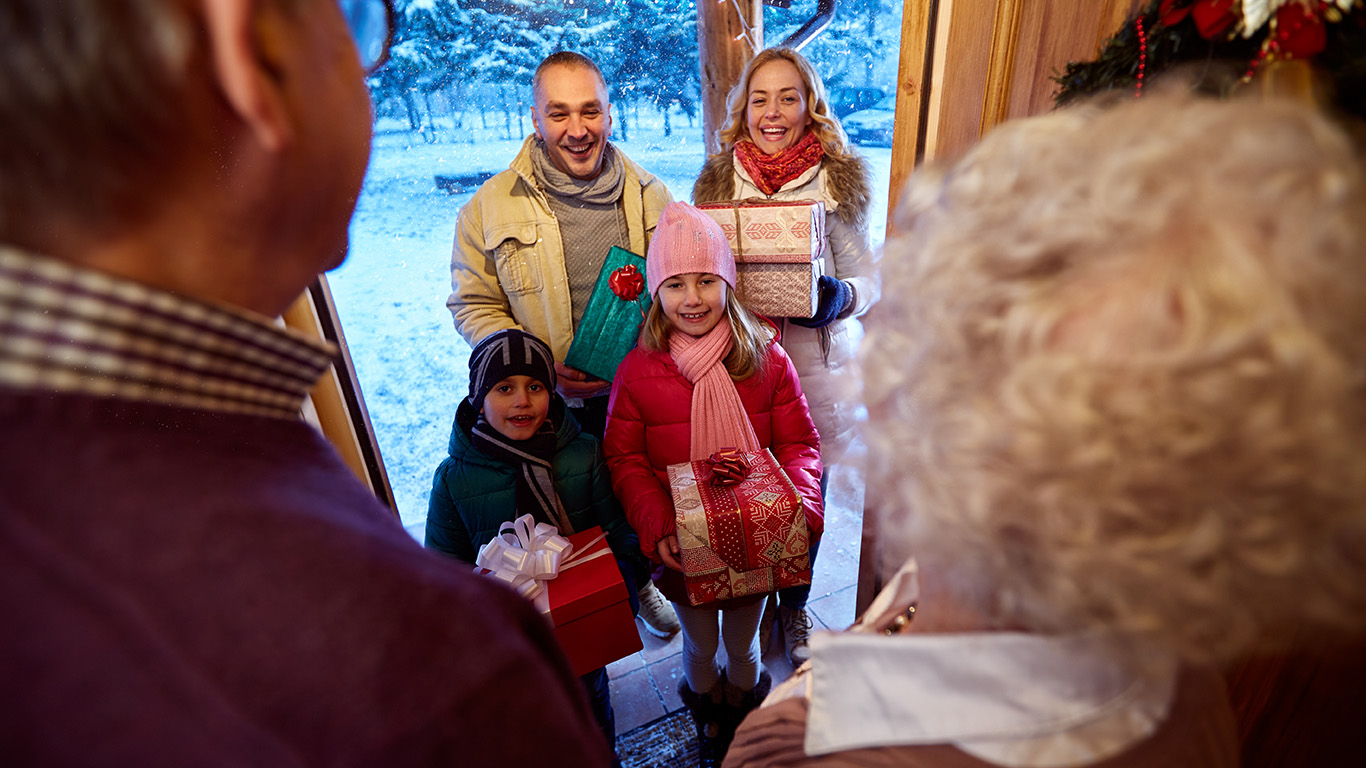
“Home for the holidays” is a familiar refrain at this time of year. How far older adults must travel to get to their parents’ home depends on several factors, including income, according to a recent study.
Just over half of adult children in their 50s nationally lived within 20 kilometres of their parents in the years leading up to the pandemic
For approximately half of adult children in their 50s in the years leading up the pandemic (2016 to 2019), a trip home for the holidays to visit parents most likely meant a short 20-kilometre or less trip away—a 30-minute journey by car, or longer (but still doable) by public transit where available or even by foot.
For other adults however, getting home for the holidays would involve a bit of a trek. Approximately one in seven adult children lived within 100 to 499 kilometres of their parents in the years leading up the pandemic, while one in nine faced a journey of 500 kilometres or more to be home for the holidays.
Over half of adult children in Atlantic Canada live close to home, but those who live far, live very far indeed
Over half of adult children who lived in Atlantic Canada in their teens were predicted to live 20 kilometres or less from their parents in the years leading up the pandemic. Those who lived more than 20 km away from their parents, however, tended on average to live especially far away.
In Newfoundland and Labrador, for example, adult children in their 50s who lived more than 20 kilometres from their parents’ home in the years leading to the pandemic would have to travel an average of 1,530 kilometres to be home for the holidays. Meanwhile, adult children aged 50 and older in Nova Scotia and Prince Edward Island living more than 20 kilometres from their parents faced journeys averaging about 1,000 kilometres.
Adults in Quebec more likely to live closer to their parents than adults in Ontario
In the years leading up to the pandemic, adults in Quebec had a higher likelihood of living within 20 kilometres of their parents than adults in neighbouring Ontario.
Among adults in Quebec who lived farther than 20 kilometres away, the distance from their parents was the shortest nationally, averaging around 270 kilometres.
Adult children in Saskatchewan least likely to live within 20 kilometres of their parents
Adult children from Saskatchewan were the least likely of any province to live within 20 kilometres of their fathers (43%) and mothers (45%) in the years leading up to the pandemic.
Among those who lived further than 20 kilometres away, they faced an average journey of 570 to 580 kilometres.
When it comes to proximity, adult children live closer to their mothers than fathers
The study found that adult children, especially daughters, are more likely to live closer to their mother than their father. This aligns with prior research about daughters living closer to their aging parents than sons, and how it could be associated with the greater involvement in eldercare by daughters or maternal grandparents playing a larger role in caring for their grandchildren.
Adult children born in wealthy homes generally live farther from parents
Adult children from the top of the parental income distribution were significantly less likely to live within 20 kilometres of their parents in the years leading up the pandemic (2016 to 2019).
Those living in higher-income homes when they were teens in the 1980s had a lower likelihood of living close to their parents—particularly their fathers—when they were in their 50s. For sons, those from the top 75% of the parental income distribution were 1.5 to 7.4 percentage points less likely to live within 20 kilometres of their fathers compared with those from the lowest 5% of parental income.
For just over one-third of young adult children, home for the holidays is home every day
Another recent StatCan study found that more young adults are living with their parents, with the share of 20- to 34-year-olds living with at least one parent increasing from 31% in 2001 to 35% by 2021.
For these young adults, home for the holidays is home every day.
How we crunched the numbers
This story uses Canadian tax data to identify cohorts of individuals who lived with their parents in the 1980s as teenagers, tracking their residential distance from their parents as adults in their 50s from 2016 to 2019 based on their postal codes.
Further reading
The full report, “Geographic proximity between adult children and their parents in Canada” is available as part of our Economic and Social Reports series.
Contact information
For more information, contact the Statistical Information Service (toll-free 1-800-263-1136; 514-283-8300; infostats@statcan.gc.ca) or Media Relations (statcan.mediahotline-ligneinfomedias.statcan@statcan.gc.ca).