

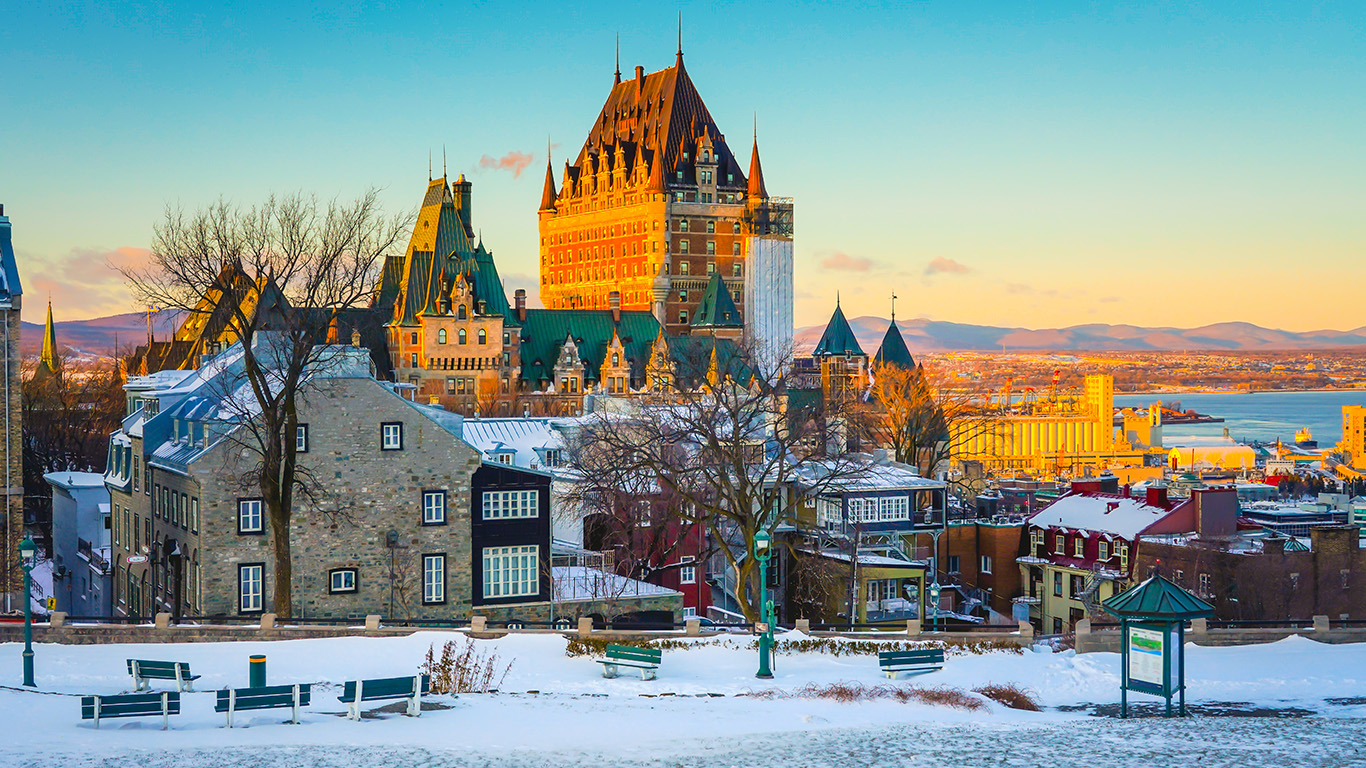
The vast landscape of Quebec attracts many travellers, both from within and from other provinces.
Every quarter, the National Travel Survey (NTS) collects detailed data on trip purpose, number of visitors, and province of origin and destination, among others. The most recent annual data are from 2024. As we continue our series of travel stories, let’s take a drive back through the data to see where Canadian visitors went in Quebec’s tourism regions and what they did.
Some visits involve long distances; most likely trip purpose is to see friends and family, or go on holiday
There were nearly 61.5 million visits to Quebec’s tourism regions (covering the whole province) in 2024, generating nearly $13.7 billion in visit-related expenditures. At nearly 1.3 million square kilometres, Quebec is Canada’s largest province, so it’s probably no surprise that many visits involved lengthy travel.
Most visits involved travelling shorter distances of either 40 km to 79 km (27.8%) or 80 km to 159 km (27.4%). However, more than one in four visits were lengthy: 160 km to 319 km (15.8%), 320 km to 799 km (9.4%), 800 km to 1,599 km (1.1%) and 1,600 km or more (1.2%).
Visiting friends or relatives (41.8%) or holidays, leisure or recreation (40.8%) were the top two reasons for travel, followed by other personal reasons (9.8%), such as shopping, and business (7.6%). Children were along for the ride on almost one in seven visits.
Most visits to Quebec came from within the province (88.7%), while most of the remaining visits came from Ontario (9.2%). Others came from New Brunswick (0.6%), British Columbia (0.5%) and Alberta (0.4%), followed by smaller proportions from the rest of the provinces.
Montréal: Day-trippers, fashion and entertainment
Ontario was the starting point for almost 3 in 10 visits (28.8%) of the more than 9.2 million total domestic visits to Montréal in 2024.
Quebec’s largest city is reachable within a short drive from Ottawa and other major population centres on the Quebec side. This is likely the main reason as to why more than half (53.8%) of visits were day trips and more than three in four visits (78.8%) were by car or truck.
Although most of the $3.4 billion in total visitor expenditures spent went to accommodation, commercial transportation and food and beverages, visitors also spent considerable amounts on entertainment ($226.5 million, or 6.6% of total expenditures) and clothing ($140.5 million; 4.1%), which is a sign of Montréal’s perennial status as a culture and fashion hub.
Québec: Taking in the attractions
Visitors to Québec know that you can find the latest styles there. In 2024, they spent $107.5 million on clothing (5.2% of total expenditures) and almost $2.1 billion in total in the province’s capital.
Similar to Montréal, more than half (55.4%) of visits were same day. Almost one-fifth (19.6%) of overnight visits involved a hotel stay while a lesser proportion (14.9%) involved a stay with a friend or relative.
Visits to Québec were more likely to be for holidays, leisure or recreation (42.5%) than to see friends or relatives (33.0%) or for other personal reasons (15.7%). Though the city attracts a lot of people for Saint-Jean-Baptiste in June and Carnaval de Québec in February, July is the busiest month for visits, possibly due in part to the popular Festival d’été de Québec.
Highlights from other tourism regions
In 2024, more than half (54.4%) of visits to the scenic Gaspésie region involved a travel distance of 320 km to 799 km. For close to half (46.1%) of visits to the Bas-Saint-Laurent region along the St. Lawrence River, visitors travelled anywhere from 160 km to 799 km.
Similarly, considerable proportions of visits to Charlevoix, the Laurentians, Manicouagan and Saguenay-Lac-Saint-Jean involved lengthy travel to head to a cottage, swim in the many lakes or take part in winter activities.
Conversely, visits to the Cantons de l’Est (Eastern Townships) were generally shorter, and most were day trips. Visitors there spent more on food and beverages in restaurants, bars, and stores ($322.0 million) than on accommodation ($237.1 million). Nights spent at the home of a friend or relative (1.1 million) were more than triple those spent at a hotel (320,000).
Next door in the Montérégie region, nights spent with a friend or relative (1.3 million) were more than eight times the nights spent at a hotel (152,000).
Ontario was the starting point for almost one-third (32.7%) of visits to the Outaouais. Right across the Ottawa River from Ottawa and its surrounding areas, the Outaouais (33.3%) was second only to Montréal (35.1%) as having the highest proportion of out-of-province visits among all tourism regions. Almost four in five visits (79.0%) to the Outaouais involved travel of 319 km or less.
And we’ll end with a fun fact: there were about 35,000 visits to the tiny, remote Îles de la Madeleine (Magdalen Islands). Almost half (45.7%) of these visits were by car or truck, with the last leg of the journey by ferry from Souris, Prince Edward Island… unless there are a few private boats we missed, braving the waters of the mighty Gulf of St. Lawrence?
Looking ahead
The NTS will release data for the third quarter of 2025 on February 24, 2026, in The Daily. Data for the second quarter of 2025 for both the NTS and the Visitor Travel Survey are now available.
Note to readers
The data in this story are based on a custom tabulation of detailed provincial-level National Travel Survey (NTS) data from 2024.
Detailed data for 2025 will be released in mid-2026.
For more information, visit the NTS survey information page.

Contact information
For more information, contact the Statistical Information Service (toll-free 1-800-263-1136; 514-283-8300; infostats@statcan.gc.ca) or Media Relations (statcan.mediahotline-ligneinfomedias.statcan@statcan.gc.ca).