

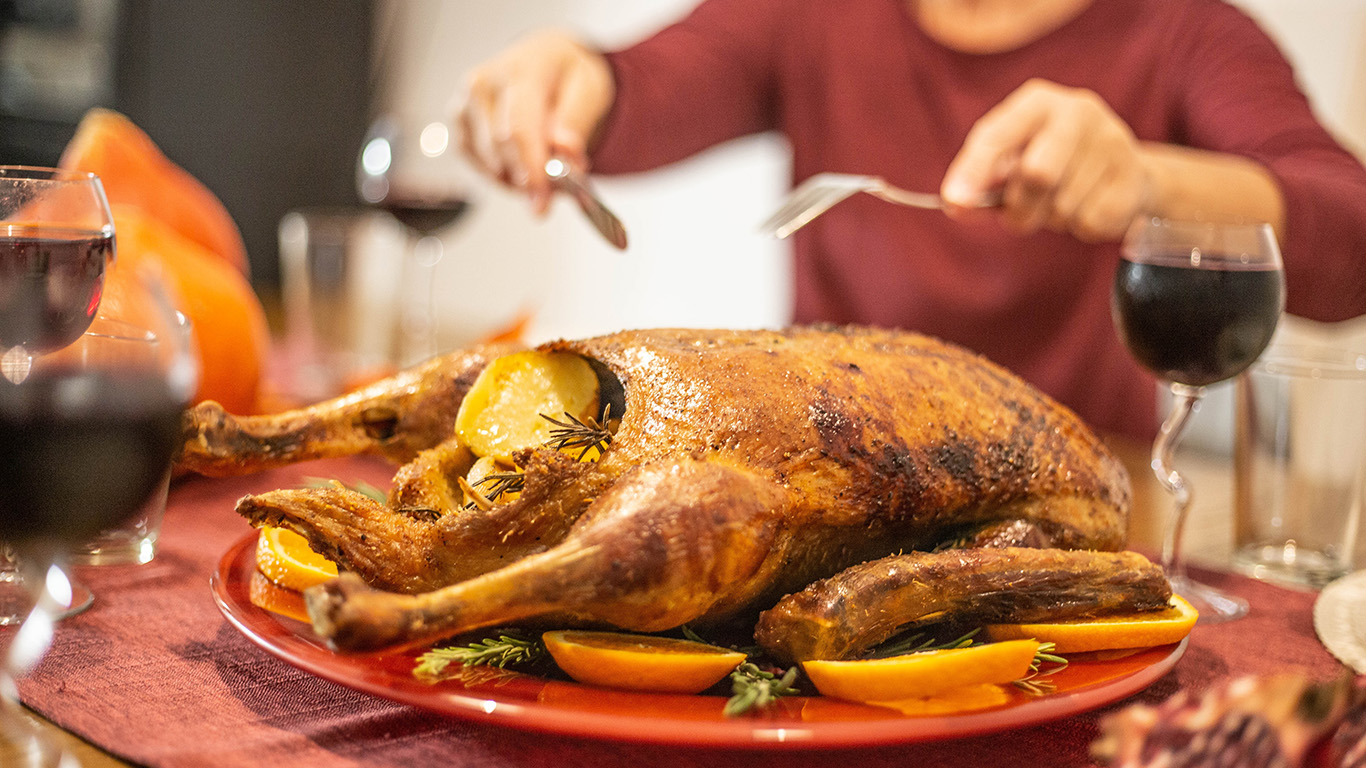
While Canadians can enjoy turkey year-round, it is perhaps most famously served at large family gatherings at Thanksgiving and during the festive season. Let’s talk turkey.
Fewest turkey farms on record in 2021
We have been tracking turkeys on farms for over a century now. A half-century ago, we counted 13,810 farms raising turkeys, with an average of 639 turkeys per farm. By 2021, the number of farms reporting raising turkeys had fallen to 2,225, while the average number of turkeys per farm had risen to 2,734.
There were just over 6 million turkeys clucking on farms at the time of the 2021 Census of Agriculture, the lowest number on record. Prior to 2021, turkey numbers had ranged from 7.7 to 8.8 million birds.
Although turkey farms and turkey numbers have been trending downward for a decade, one reason for the large drop in 2021 may be related to COVID-19. At the time of the census, the pandemic was still in full swing and large family gatherings were limited or even taboo, hence fewer opportunities for big turkey dinners. Whether this was a temporary blip or the continuation of a longer trend will be revealed with the release of 2026 Census of Agriculture data in 2027.
Turkey weight divisions
Turkeys take anywhere from four to six months or more to reach market weight, considerably longer than the six to eight weeks it takes to raise a chicken. The payoff for farmers, of course, is a larger bird that fetches more money than a smaller chicken.
There are two types of turkey raised commercially in Canada: the “broiler” and the “heavy weight.”
Broilers are smaller birds that are ready for slaughter in about four months, while heavy-weight turkeys take six months or more to reach maturity but can weigh over twice as much as broilers.
Canadian farmers raise far more heavy-weight than broiler-weight turkeys overall. In 2024, total turkey production decreased 0.4% year over year to 158.7 million kilograms.
Keeping turkey on ice until the time is right
On any given month in Canada, there are tens of thousands of tonnes of frozen turkey waiting for the right time to be sold. Stocks of frozen turkey tend to wax and wane in line with turkey celebration dinners such as Easter, Thanksgiving and during the Holiday season in December.
In 2024, stocks of frozen turkey were at their lowest ebb in January at 17,628 tonnes, and peaked in September—just before the Thanksgiving weekend—at 37,543 tonnes. By December 2024, stocks of frozen turkey had fallen to 22,888 tonnes.
Turkey availability trending downward
Our food availability release, which tracks the amount of food physically present in a country for consumption, shows that the amount of boneless turkey available per person is trending downward, despite an uptick in 2023.
In 2023, there were 2.71 kilograms of turkey (boneless weight) available per person, up from 2.64 kilograms a year earlier but well below the record high of 3.62 kilograms available in 2008, suggesting turkey is losing ground on Canadian dinner tables.
Contact information
For more information, contact the Statistical Information Service (toll-free 1-800-263-1136; 514-283-8300; infostats@statcan.gc.ca) or Media Relations (statcan.mediahotline-ligneinfomedias.statcan@statcan.gc.ca).