

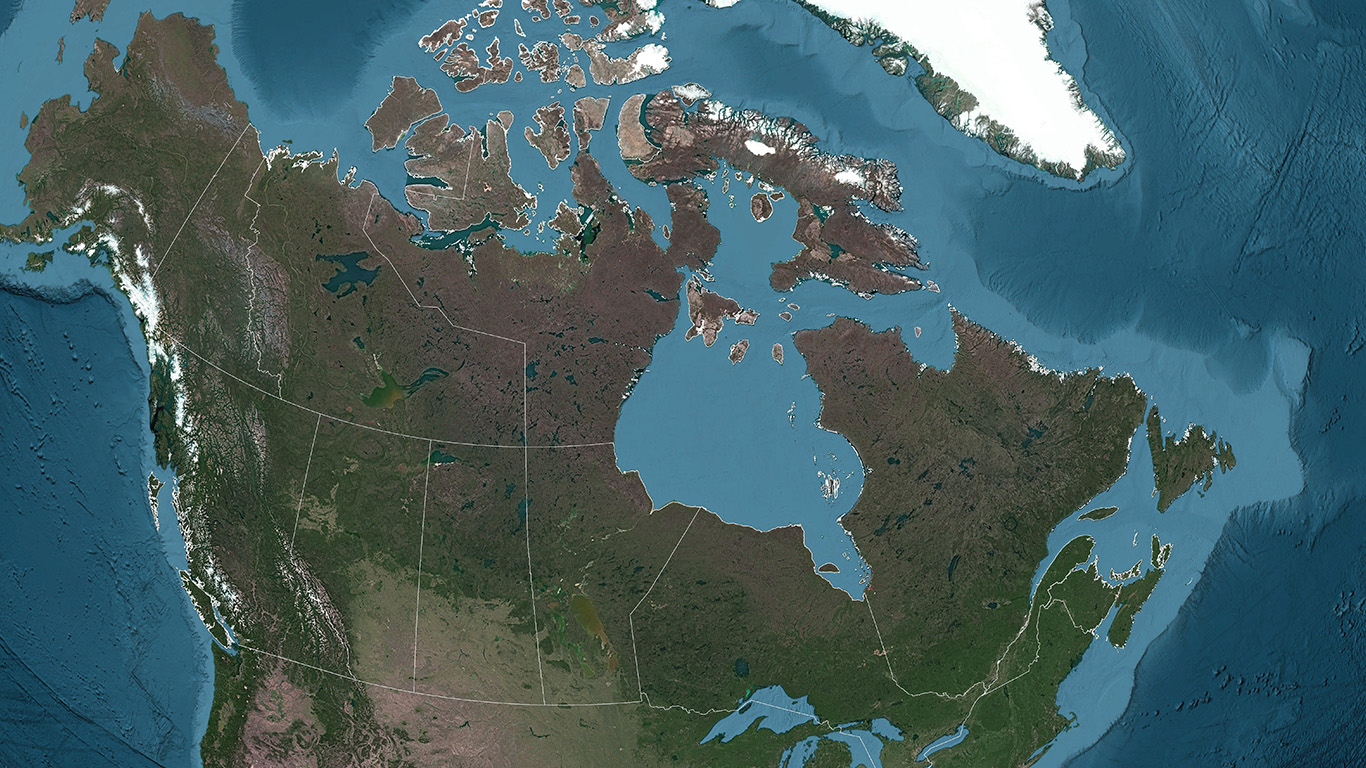
Canada has an abundance of natural assets, including vast areas of land and the longest coastline in the world. The Census of Environment mines multiple data sources to measure the direct and indirect benefits Canadians receive from nature.
The term 'census' in the context of the Census of Environment refers to the systematic and comprehensive creation, collection, compilation, and analysis of data related to ecosystem assets and services.
Not our first census rodeo
We at Statistics Canada are experts at conducting censuses. Indeed, every five years, for over a century, we have mailed out questionnaires to millions of Canadian households as well as farm operators to learn more about Canada’s population and agricultural sector.
For over 40 years now, Statistics Canada has been refining the methods used to measure the links between the environment and the economy. The focus has been on measuring the pressures of population growth on the environment and the related impacts from air emissions, water use and change in land use. It is also key to measure the nation’s diminishing supplies of non-renewable resources and their contribution to national wealth.
Our Census of the Environment, launched in 2021, extends the focus to ecosystems—the forest, prairies, tundra, mountains, lakes, rivers, oceans and urban areas—that are a vital part of Canadian national identity. These elements of natural capital provide a foundation for economic activity and provide important benefits to society. Recent experimental estimates show that Canada’s ocean and coastal areas provided ecosystems services valued at over $7.1 billion in 2023.
This sum is an underestimate of the total value of oceans; it covered only the value of commercial fisheries, carbon sequestration and nature-based tourism. The full value of the benefits that nature provides is undoubtedly much larger. Healthy ecosystems support healthy and safe communities across the country.
These values are estimated by combining government data on market values along with publicly available Earth observation data as well as tourism survey data. The result is a science-based estimate of the economic, social and environmental benefits Canadians receive from nature.
Here is a sample of what we have learned so far.
Canadian cities are a little less green than five years earlier
Among Canada’s top five largest cities, Vancouver (40.2%) was the greenest, followed by Montréal (39.2%) and Toronto (38.3%).
Toronto boasted by far the most land covered by vegetation of any city assessed, at 90 283 hectares.
Winnipeg, Canada’s seventh-largest city, was a green oasis among the dry prairie cities; 40.0% of its land area was covered by lawns and green spaces with shrubs and trees in 2024. This was the second-highest total in Western Canada that year, just behind Vancouver.
Almost one-fifth of Canada’s forests are recovering from forest fire or logging
Almost one-third (3.68 million km2) of inland Canada in 2020 was covered by trees and forests.
Approximately one-fifth (725 223 km2) of this treed area was in various stages of regeneration following forest fires or logging activities from 1990 to 2020.
Almost one-eighth of Canada’s inland area covered by wetlands
Wetlands provide a wealth of ecosystem services, such as purifying and regulating water, storing carbon and supporting recreational activities.
In 2020, 12.7% of Canada’s inland area was covered by non-treed wetlands, representing about 1.27 million km2, comparable with the land area of Quebec.
Harvesting nature’s bounty
In 2022, Canadian farmers and businesses harvested 270 million tonnes of plant and animal life from the environment, equivalent to the weight of 2,300 CN Towers.
Just over half (51.2%) of this biomass harvested in 2022 came from agroecosystems, with agricultural products such as grains, oilseeds, legumes, forage crops and vegetables contributing the most (138 million tonnes).
The forestry industry logged and processed 131 million tonnes of trees from Canada’s forests, while about 750 000 tonnes of fish, shellfish and other products were harvested from our oceans, lakes and rivers.
Sea surface temperatures warming across Canada but remain cold for swimming
All three of Canada’s oceans (the Pacific, Atlantic and Arctic) have shown a warming trend since 1982, with temperatures growing at the fastest pace on the Scotian Shelf (+0.53 °C per decade), Strait of Georgia (+0.36 °C per decade) and Newfoundland-Labrador Shelves and Gulf of St. Lawrence (both up 0.33 °C per decade).
While swimmers may yearn for warmer ocean plunges, rising ocean temperatures can affect fish and marine life in many ways. Notably, warmer oceans pose a higher risk of algae blooms growing or invasive species migrating from warmer climates, upsetting the natural habitat.
Warming waters can also reduce the survival of young fish and eggs. Although due to overfishing rather than warming ocean temperatures, the collapse of the East Coast Cod Fishery in 1992 exemplifies the damage that can be done to livelihoods, the food chain and the economy when the environment is strained.
Contact information
For more information, contact the Statistical Information Service (toll-free 1-800-263-1136; 514-283-8300; infostats@statcan.gc.ca) or Media Relations (statcan.mediahotline-ligneinfomedias.statcan@statcan.gc.ca).