

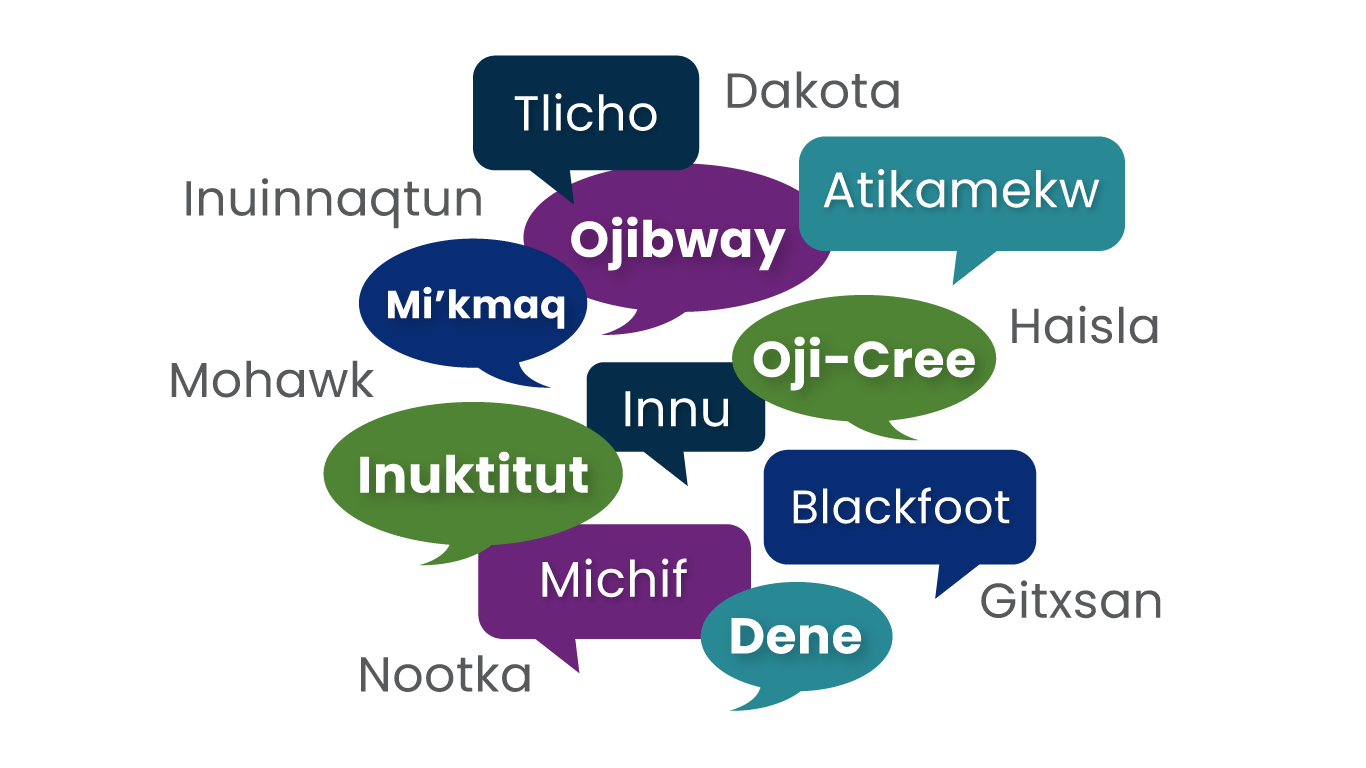
The ideal way to learn a language is during your youth when your mind is nimble, engaging with family, friends and the community around you. Over two-thirds of Indigenous language speakers today were raised in a home where Indigenous languages were spoken regularly, whether it be Algonquin, Dene, Inuktut or one of the other 70 Indigenous languages spoken across the land.
One advantage of learning an Indigenous language as a child is that you are more likely to speak it as an adult. Among Indigenous language speakers who learned the language as their mother tongue, over four in five (82%) spoke it at home (61% most often and 21% on a regular basis).
However, younger generations are less likely to have an Indigenous mother tongue than older generations. In 2021, 184,170 Indigenous people had an Indigenous mother tongue, 14,120 fewer (-7%) than in 2016, mostly because of population aging.
Second language learners playing an important role in Indigenous language revival
Learning a second language can be a challenge. Nevertheless, over one in four Indigenous language speakers today have taken the time, effort and dedication to learn the language of their ancestors well enough to conduct a conversation. A further 5,000 non-Indigenous people have also learned an Indigenous language.
Among those who learned an Indigenous language as a second language, 56% spoke it at home (13% most often and 43% on a regular basis).
During the 2021 Census of Population, we found that 66,880 Indigenous people had learned an Indigenous language as a second language, up 6% from 2016. These second language learners are playing an important role in reviving endangered Indigenous languages throughout the land.
On the West Coast, children outnumber seniors among speakers of Squamish and Halkomelem.
On the Prairies, the number of First Nations people who can converse in Blackfoot has risen by almost one-fifth since 2016.
In 2021, the number of people who can converse in Michif, a uniquely Métis language, grew by 45% from five years earlier to 1,485.
On the East Coast, a larger share of First Nation children aged 14 and younger know Mi’kmaq, Innu and Wolastoqewi than those aged 65 and older.
The silent speakers
“Silent speakers” are those who have an Indigenous mother tongue that they still understand but can no longer speak well enough to conduct a conversation.
In some circumstances, this may reflect those who have not continued to use their mother tongue over time or those who do not have a community of speakers with whom to converse.
In 2021, among the 185,510 people in Canada with an Indigenous mother tongue, 8% were silent speakers of an Indigenous language.
Findings from the Truth and Reconciliation Commission
The history of colonial practices in Canada has had a profoundly negative impact on the use of Indigenous languages. Perhaps most notably, the Truth and Reconciliation Commission report detailed many of the harms done to the languages of First Nations, Métis and Inuit children through the residential school system, in an effort to assimilate Indigenous people and break their ties to their culture.
In response to the Calls to Action by the Truth and Reconciliation Commission, the Indigenous Languages Act was passed in 2019. With its passage, the Office of the Commissioner of Indigenous Languages was created to “help promote Indigenous languages and support the efforts of Indigenous peoples to reclaim, revitalize, maintain and strengthen their languages.”
Indigenous languages and the role of community
Across Canada, Indigenous languages are most widely spoken in places where people live closely together, share daily routines and pass knowledge between generations.
For many First Nations people, Métis and Inuit, these community settings provide the strongest support for learning and maintaining their languages.
Most First Nations people who speak an Indigenous language live on reserve
On First Nations reserves, Indigenous languages continue to be part of everyday life.
In 2021, over two‑thirds (68%) of First Nations people who could speak an Indigenous language lived on reserve. About two in five (40%) First Nations people living on reserve could speak an Indigenous language, compared with 8% of those living off reserve.
When a language is heard at the grocery store, at ceremonies, and around kitchen tables, it becomes much easier for people, and especially children, to learn it and keep it alive.
Many Métis living in Alberta Metis Settlements speak an Indigenous language
The largest Métis land base in Canada consists of the eight Métis Settlements of northern Alberta. Unsurprisingly, Indigenous languages are more often spoken by Métis here than among the Métis population in Canada overall.
In 2021, approximately one in five residents of Peavine (20.5%) and Buffalo Lake (17.3%) could hold a conversation in Michif, compared with 1.3% of Métis people overall. In these settlements, language is tied closely to land, kinship and a shared sense of Métis identity.
Almost every Inuk in Nunavik speaks Inuktut
Inuit Nunangat, stretching across the Inuvialuit Settlement Region, Nunavut, Nunavik, and Nunatsiavut, is one of the strongest Indigenous‑language regions in Canada.
This was especially true in Nunavik, where almost every Inuit person (99%) could converse in Inuktut in 2021, including 98% of children aged 14 and younger. The strong presence of Inuktut among children is key to the continued transmission of the language.
Winnipeg, a centre of Indigenous language ability among big cities in Canada
Indigenous languages are not limited to reserves, settlements, or northern regions, they are spoken across the country, including in Canada’s biggest cities.
In 2021, Winnipeg had the largest number of Indigenous‑language speakers (4,710) among Canada’s largest cities, particularly First Nations speakers. Edmonton had the highest number of Métis language speakers (620) and Ottawa–Gatineau was home to the largest population of Inuit language speakers (600).
Overall, these trends show that Indigenous languages continue to be used across diverse settings in communities throughout the country.
A click away for more Indigenous data
Learn more about Indigenous languages in your area through our Indigenous languages visualization tool.
Contact information
For more information, contact the Statistical Information Service (toll-free 1-800-263-1136; 514-283-8300; infostats@statcan.gc.ca) or Media Relations (statcan.mediahotline-ligneinfomedias.statcan@statcan.gc.ca).