

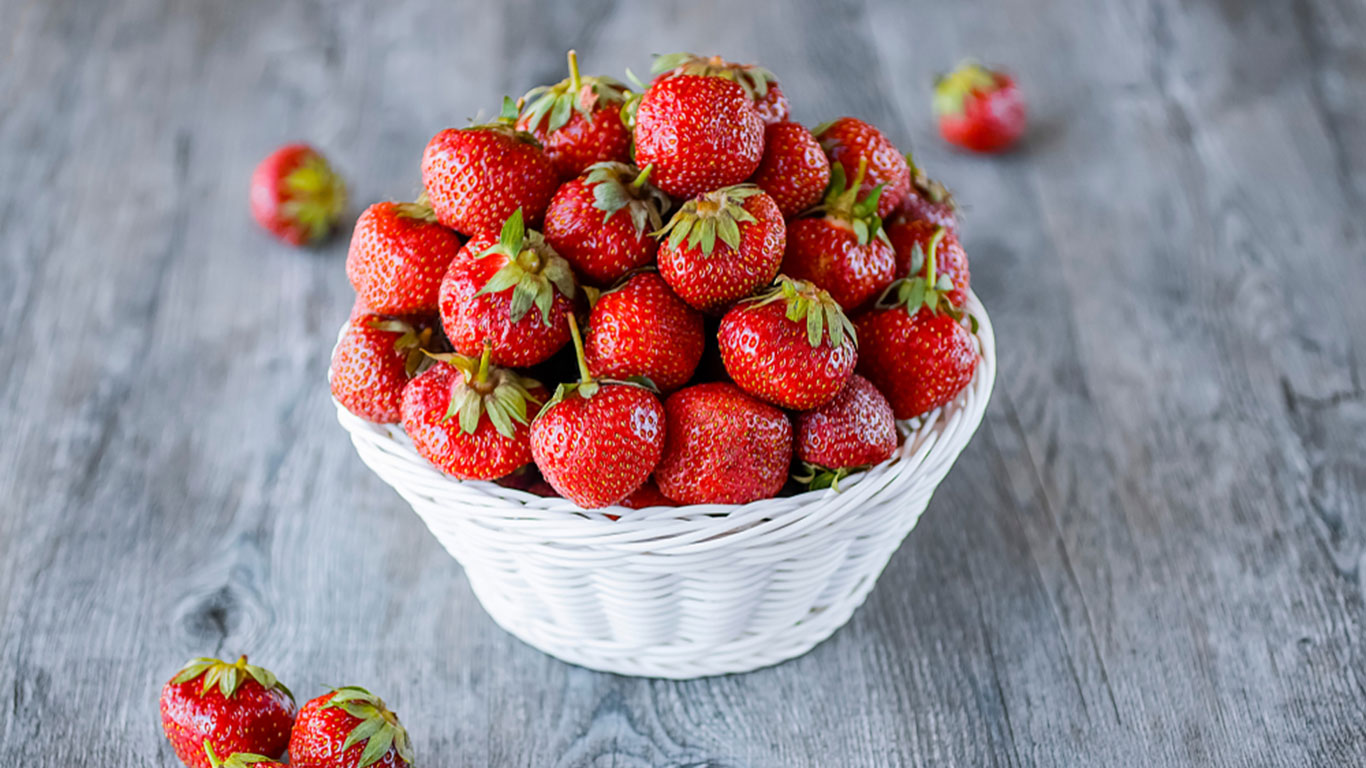
A lot has changed in the last 100 years, but at least one thing at StatCan hasn’t—tracking strawberry data. One of Canada’s favourite fruits is fully in season, so what better time to go back in time?
Millions of quarts
OK, maybe a few things have changed in the way we have tracked strawberry data—including the units of measurement. We started tracking national-level, marketed production of fresh strawberries in 1926, when farmers across Canada produced 10.4 million quarts (there are roughly four cups in a quart). Production more than doubled a decade later (to 21.7 million quarts).
It would take until 1968 (35.3 million quarts) to come close to the bumper crop of 1948 (36.2 million). A record high was set in 1980 (48.1 million), the second-last year for quart data.
British Columbia led the provinces in production in most years during this period and peaked in 1948 (18.0 million).
Tonnes of berries
From 1982 to 1995, data were measured solely in tons (we’ll convert to metric tonnes for this story!) and only available for some provinces. Quebec, Ontario and British Columbia accounted for most of the production.
During that period, Ontario’s production peaked in 1995 (15 441 tonnes), while Quebec’s peaked in 1985 (10 000). Production in British Columbia topped out in 1988 (10 030 tonnes), followed by a steady decline until 1995 (2 850).
Out east, Prince Edward Island’s production peaked at 907.2 tonnes three times (1983, 1984 and 1986); Nova Scotia twice hit 2 835 tonnes (1984 and1985); and New Brunswick’s peak of 2 268 tonnes in 1987 was up by almost three-quarters (+74.0%) from 1982.
Quebec contributes to a new record in 2025
The publishing of national-level data resumed in 1996, when production reached 28 571 tonnes, a peak that would stand until 2025 when production rose to 32 202 tonnes. In the intervening years, 2017 came closest, with 28 372 tonnes produced.
A record haul from Quebec (19 685 tonnes) helped set the new nationwide record in 2025. Quebec has led all provinces in production in every year since 1996 (except 1999).
Greenhouse production up by more than one-half in 2025
A small amount of fresh strawberries is grown in Canadian greenhouses, though that share is growing. In 2025, there were 11.6 million kilograms (kg) grown, up by more than one-half (+54.7%) from 2024 and more than triple the haul (+355.5%) from 2020, the year we started tracking these data.
More strawberries for everyone
Our annual food availability series estimates the amount of food available in Canada on a per-capita basis. The 3.41 kg of strawberries available per Canadian in 2025 coincides with that year’s record production, and was the highest quantity available per Canadian since 2018 (3.45 kg).
We started tracking strawberry availability in 1960, when 0.78 kg were available per Canadian. The all-time high was reached in both 2011 and 2012 (3.88 kg).
More money for farmers
The strawberries grown in fields nationwide in 2025 had a farm gate value of $213.9 million, or $44.8 million more than in 2024. It was the largest year-over-year increase in value since 2017 (+$15.4 million).
Greenhouse-produced strawberries were valued at $114.6 million in 2025, up from $75.2 million in 2024.
If you’re a farmer, we need to hear from you
The 2021 Census of Agriculture counted 1,955 farms that reported growing strawberries, down from 2016 (2,144 farms) and 2011 (2,204).
Strawberry farms are just one part of Canada’s diverse agricultural landscape. As data collection continues for the 2026 Census of Agriculture, we need to hear from all farm operators who have not yet completed their questionnaire—whether they grow strawberries, mushrooms, grains, vegetables, raise livestock or operate any other type of farm.
In addition to supporting data-driven policymaking, the 2026 Census of Agriculture is also the sole source of community-level agriculture data in Canada. It can help identify trends and provide information on emerging issues and opportunities. Farm organizations are also heavy users of census data.
The questionnaire covers a wide range of topics such as land use, crops, livestock, labour, equipment, land management practices and finances.
Visit the census website for more information and to complete your questionnaire.

Contact information
For more information, contact the Statistical Information Service (toll-free 1-800-263-1136; 514-283-8300; infostats@statcan.gc.ca) or Media Relations (statcan.mediahotline-ligneinfomedias.statcan@statcan.gc.ca).