National balance sheet accounts

Archived Content
Information identified as archived is provided for reference, research or recordkeeping purposes. It is not subject to the Government of Canada Web Standards and has not been altered or updated since it was archived. Please "contact us" to request a format other than those available.
Related subjects
-
[an error occurred while processing this directive]
National net worth edged up 0.7% to $6.3 trillion in the third quarter. Growth in non-financial assets was partially offset by an increase in net foreign debt. On a per capita basis, national net worth reached $183,500 in the third quarter, up from $182,800 in the previous quarter.
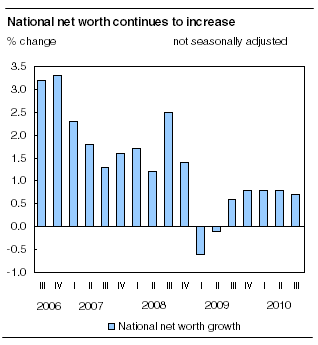
The increase in national wealth was moderated by the continued rise in Canada's net foreign debt (at market value). This reflected increased foreign investment in Canadian debt securities coupled with a slight gain in international assets over the quarter. The relatively larger gains on foreign stock markets helped moderate the increase in net foreign debt.
Household net worth rebounds
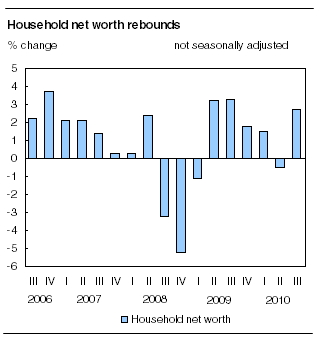
Household net worth grew 2.7% (or $162 billion) to $6.1 trillion, following a 0.5% decline in the second quarter. The 9.5% increase in the Standard and Poor's / Toronto Stock Exchange composite index in the third quarter was reflected in substantial gains in household assets, both in equity and life insurance and pension assets. This marked the strongest quarterly growth in household net worth in a year, reversing the decline in the previous quarter. Household per capita net worth rose from $174,500 in the second quarter to $178,600 in the third quarter.
Note to readers
The National Balance Sheet Accounts (NBSA) comprise the balance sheets of all sectors of the economy: the persons and unincorporated business (households), corporate, government, and non-resident sectors. They cover all national non-financial assets and financial claims and their associated liabilities outstanding in all sectors.
National net worth is national wealth less net foreign liabilities (that is, what is owed to non-residents less what non-residents owe to Canadians). Alternatively, it is the sum of the net worth of the persons and unincorporated business, corporate, and government sectors.
Household credit market debt comprises consumer credit, mortgage, and loan debt of households, non-profit institutions serving households, and unincorporated businesses.
Corporate equity is treated as a liability on the balance sheet of the corporate sector since it represents a claim by shareholders on the corporate sector. As a result, as equity prices increase, corporate net worth will tend to decline, reflecting the increase in the corporate sector's equity liabilities.
As of the release of the NBSA for the third quarter of 2009, a number of sectors and categories that were previously published have been combined in order to provide more relevant sector and category information.
Quarterly series, at both book and market value, are available from the first quarter of 1990. Annual market value data are published from 1970, while book value estimates remain available from 1961. Marketable securities are at market value, unless otherwise stated. For more information on the market value estimates, consult the National Balance Sheet estimates at market value page of our website.
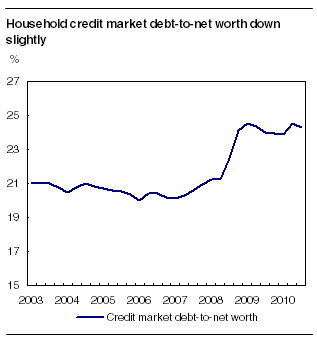
Growth in household mortgage and consumer credit borrowing decelerated in the third quarter, reflecting lower home resale activity. The ratio of household credit market debt to personal disposable income increased to 148.1%. This was mainly due to a 1.5% decline in personal disposable income. While the Bank of Canada overnight rate increased in the third quarter, the five-year fixed mortgage rate declined. The debt-service ratio remained unchanged in the third quarter, as both lower credit market debt growth and borrowing costs offset the decline in personal disposable income.
Household owners' equity as a percentage of real estate assets edged down to its lowest level since 2001, continuing its downward trend from the first quarter of 2010. Household credit market debt-to-net worth edged down to 24.3%.
Government net debt edges up
The increase in overall government net debt (expressed at book value) was the smallest since the third quarter of 2008, when the ratio of net debt to gross domestic product stood at 35.4%. Overall government net debt as a percentage of gross domestic product edged down to 44.3% in the third quarter.
The federal government changed its composition of borrowing to include more treasury bills relative to bonds in the third quarter, following a year of short-term paper retirement. Provincial governments retired short-term paper and continued to borrow through bonds.
Corporate debt to equity edges down
Equity financing (net new issues plus undistributed corporate profits) was the main source of funds for the private non-financial sector. Bond issuance in the corporate sector increased significantly in the third quarter, with a considerable portion of this bond debt purchased by non-residents. The increase in net new borrowing was partially offset by the downward revaluation effect from the appreciation of the Canadian dollar on foreign currency denominated corporate bonds.
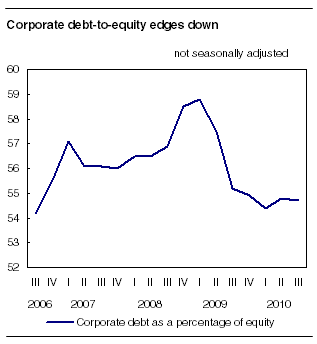
Equity issues and undistributed corporate earnings marginally exceeded the rise in overall borrowing, causing the credit market debt-to-equity ratio (expressed at book value) to edge down (to 54.7%) in the third quarter.
Equity investment of financial corporations increased
The assets of the trusteed pension plans and the mutual fund sectors increased in the third quarter compared with the second quarter. Consistent with the market gains over the third quarter, the value of their marketable equities also rose. These sectors also increased their holdings of provincial bonds.
Available on CANSIM: tables 378-0012 to 378-0014 and 378-0049 to 378-0116.
Definitions, data sources and methods: survey number 1806.
The National economic accounts module, accessible from the Key resource module of our website, features an up-to-date portrait of national and provincial economies and their structure.
The third quarter 2010 National Balance Sheet Accounts: Data Tables, Vol. 3, no. 3 (13-022-X, free), is now available from the Key resource module of our website under Publications.
Additional tables and links to other releases from the national accounts can be found in the third quarter 2010 issue of Canadian Economic Accounts Quarterly Review, Vol. 9, no. 3 (13-010-X, free). This publication is now available from the Key resource module of our website under Publications. This publication will be updated on December 14, at the time of the labour productivity, hourly compensation and unit labour cost release. Revised estimates of the National balance sheet accounts for the first and second quarters of 2010 have been released, along with those for the third quarter of 2010.
Data for the fourth quarter of 2010 will be released on March 14, 2011.
For more information, or to enquire about the concepts, methods or data quality of this release, contact the information officer (613-951-3640; iead-info-dcrd@statcan.gc.ca), Income and Expenditure Accounts Division.
- Date modified: