
Statement outlining results, risks and significant changes in operations, personnel and program
A) Introduction
Statistics Canada's mandate
Statistics Canada ("the agency") is a member of the Innovation, Science and Industry portfolio.
Statistics Canada's role is to ensure that Canadians have access to a trusted source of statistics on Canada that meets their highest priority needs.
The agency's mandate derives primarily from the Statistics Act. The Act requires that the agency collects, compiles, analyzes and publishes statistical information on the economic, social, and general conditions of the country and its people. It also requires that Statistics Canada conduct the Census of Population and the Census of Agriculture every fifth year and protects the confidentiality of the information with which it is entrusted.
Statistics Canada also has a mandate to co-ordinate and lead the national statistical system. The agency is considered a leader, among statistical agencies around the world, in co–ordinating statistical activities to reduce duplication and reporting burden.
More information on Statistics Canada's mandate, roles, responsibilities and programs can be found in the 2025-2026 Main Estimates and in the Statistics Canada 2025-2026 Departmental Plan.
The Quarterly Financial Report:
- should be read in conjunction with the 2025-2026 Main Estimates;
- has been prepared by management, as required by Section 65.1 of the Financial Administration Act, and in the form and manner prescribed by Treasury Board of Canada Secretariat;
- has not been subject to an external audit or review.
Statistics Canada has the authority to collect and spend revenue from other federal government departments and agencies, as well as from external clients, for statistical services and products.
Basis of presentation
This quarterly report has been prepared by management using an expenditure basis of accounting. The accompanying Statement of Authorities includes the agency's spending authorities granted by Parliament and those used by the agency consistent with the Main Estimates for the 2025-2026 fiscal year. This quarterly report has been prepared using a special purpose financial reporting framework designed to meet financial information needs with respect to the use of spending authorities.
The authority of Parliament is required before moneys can be spent by the Government. Approvals are given in the form of annually approved limits through appropriation acts or through legislation in the form of statutory spending authority for specific purposes.
The agency uses the full accrual method of accounting to prepare and present its annual departmental financial statements that are part of the departmental results reporting process. However, the spending authorities voted by Parliament remain on an expenditure basis.
B) Highlights of fiscal quarter and fiscal year-to-date results
This section highlights the significant items that contributed to the net increase in resources available for the year, as well as actual expenditures for the quarter ended December 31.
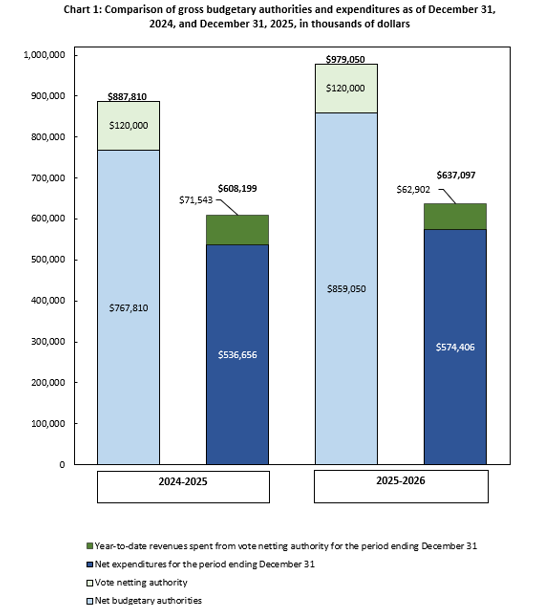
Description - Chart 1: Comparison of gross budgetary authorities and expenditures as of December 31, 2024, and December 31, 2025, in thousands of dollars
This bar graph shows Statistics Canada's budgetary authorities and expenditures, in thousands of dollars, as of December 31, 2024 and 2025:
- As of December 31, 2024
- Net budgetary authorities: $767,810
- Vote netting authority: $120,000
- Total authority: $887,810
- Net expenditures for the period ending December 31: $536,656
- Year-to-date revenues spent from vote netting authority for the period ending December 31: $71,543
- Total expenditures: $608,199
- As at December 31, 2025
- Net budgetary authorities: $859,050
- Vote netting authority: $120,000
- Total authority: $979,050
- Net expenditures for the period ending December 31: $574,406
- Year-to-date revenues spent from vote netting authority for the period ending December 31: $62,902
- Total expenditures: $637,097
Chart 1 outlines the gross budgetary authorities, which represent the resources available for use for the year as of December 31.
Significant changes to authorities
Total authorities available for 2025-26 have increased by $91.2 million, or 10.3%, from the previous year, from $887.8 million to $979 million (Chart 1). The net increase is mostly the result of the following:
- An increase of $86 million in funding received to cover the advanced planning and intensifying production activities related to the ramping up of the 2026 Census of Population program;
- An increase of $12.2 million for the Employee Benefit Plan adjustments and for the carry forward from the previous year. The agency leverages the operating budget carry-forward mechanism to manage the cyclical nature of program operations and investments in the agency's strategic plan;
- An increase of $11.4 million in funding related to compensation following the ratification of collective agreements;
- A decrease of $34.4 million for various initiatives including the Canadian Dental Care Plan and the transfer of certain cloud operations functions to Shared Services Canada;
- An increase of $12.5 million for various initiatives including Canada’s Action Plan on Combatting Hate, the Clean Technology Data Strategy as well as funding to modernize and enhance the collection and dissemination of housing data, supporting Canada’s Housing Plan.
In addition to the appropriations allocated to the agency through the Main Estimates, Statistics Canada also has vote net authority within Vote 1, which entitles the agency to spend revenues collected from other federal government departments, agencies, and external clients to provide statistical services. The vote netting authority is stable at $120 million when comparing the third quarter of fiscal years 2024-2025 and 2025-2026.
Significant changes to expenditures
Year-to-date net expenditures recorded to the end of the third quarter increased by $37.7 million, or 7% from the previous year, from $536.7 million to $574.4 million (see Table A: Variation in Departmental Expenditures by Standard Object).
Statistics Canada spent approximately 66.9% of its authorities by the end of the third quarter, compared with 69.9% in the same quarter of 2024-2025.
Table A: Variation in Departmental Expenditures by Standard Object (unaudited)
| Departmental Expenditures Variation by Standard Object: | Q3 year-to-date variation between fiscal year 2024-2025 and 2025-2026 |
|
|---|---|---|
| $'000 | % | |
| (01) Personnel | 20,232 | 3.7 |
| (02) Transportation and communications | 1,434 | 12.3 |
| (03) Information | 5,188 | 100.6 |
| (04) Professional and special services | -3,350 | -18.5 |
| (05) Rentals | 4,784 | 18.4 |
| (06) Repair and maintenance | 49 | 12.1 |
| (07) Utilities, materials and supplies | 1,604 | 225.3 |
| (08) Acquisition of land, buildings and works | -23 | -63.9 |
| (09) Acquisition of machinery and equipment | -940 | -40.8 |
| (10) Transfer payments | - | - |
| (12) Other subsidies and payments | 132 | 36.6 |
| Total gross budgetary expenditures | 29,109 | 4.8 |
| Less revenues netted against expenditures: | ||
| Revenues | -8,641 | -12.1 |
| Total net budgetary expenditures | 37,750 | 7.0 |
| Note: Explanations are provided for variances of more than $1 million. | ||
Personnel: The increase is primarily due to salary price increases and costs related to the employee benefit plan. To accommodate the cyclical nature of some of Statistics Canada’s programs, including the Census of Population program, resources have been reallocated within the agency.
Transportation and communications: The increase is mainly due to timing differences in invoicing compared to last fiscal year in relation to the connectivity and telecommunications support provided by Shared Services Canada for the 2026 Census of Population.
Information: The increase is mainly due to advertisement and printing costs for 2026 Census of Population materials such as questionnaires, envelopes, and letters.
Professional and special services: The decrease is attributable to the salaries of workers hired under the Statistics Act to operate the Census Help Line and to undertake data collection work during the Census Test, which began and ended in 2024. These operations will commence shortly for the 2026 Census. Also contributing is a reduction in IT consultant costs. Additionally, there has been timing differences in invoicing compared to last year.
Rentals: The increase is mainly due to additional costs for logistical requirements for the 2026 Census of Population, as well as timing differences in invoicing compared to last year.
Utilities, materials and supplies: The increase is mainly due to additional costs for office supplies needed for the 2026 Census of Population.
Revenues: The increase is mainly due to timing differences in invoicing compared to last year.
C) Significant changes to operations, personnel and programs
In 2025-26, the following changes in operations, personnel and program activities are underway:
- The 2026 Census of Population program is ramping up in preparation for next year when the Census will be conducted. As a result, expenditures for this program are increasing.
- Cloud funding is secured for 2025-26; however, funding to continue cloud operations beyond 2026–27 is not included in the agency’s appropriations, as an enterprise-wide funding model is pending. In December 2023, the Treasury Board of Canada Secretariat announced the GC Application Hosting Strategy which included the centralization of cloud operations within Shared Services Canada (SSC). As per the direction, a temporary transfer agreement, effective September 2024, was signed by Statistics Canada (StatCan) and SSC, to transfer certain cloud operations functions from StatCan to SSC which includes the corresponding human resource capacity to ensure continuity of StatCan’s cloud infrastructure operations.
D) Risks and uncertainties
Statistics Canada continues to address financial and operational uncertainties through its corporate risk management framework. Budget variations, particularly from cyclical programs such as the Census and anticipated adjustments stemming from the Comprehensive Expenditure Review are being managed through agile planning and strategic resource management. To ensure long-term financial sustainability, the agency is strengthening partnerships with government entities and modernizing its digital infrastructure.
To support its modernization efforts, Statistics Canada is strengthening its statistical operations and continuing to invest in workforce development and organizational efficiency. The agency remains dedicated to fostering an inclusive and diverse workplace while streamlining operations and optimizing resources. Through continued collaboration with federal partners, the agency is reinforcing its financial stewardship and ensuring a resilient, adaptable organization that meets the evolving needs of Canadians.
Approval by senior officials
Approved by:
André Loranger, Chief Statistician
Ottawa, Ontario
Signed on: February 9, 2026
Kathleen Mitchell, Chief Financial Officer
Ottawa, Ontario
Signed on: February 3, 2026
Appendix
Statement of Authorities (unaudited)
| Fiscal year 2025-2026 | Fiscal year 2024–2025 | |||||
|---|---|---|---|---|---|---|
| Total available for use for the year ending March 31, 2026Table note * | Used during the quarter ended December 31, 2025 | Year-to-date used at quarter-end | Total available for use for the year ending March 31, 2025Table note * | Used during the quarter ended December 31, 2024 | Year-to-date used at quarter-end | |
| in thousands of dollars | ||||||
| Vote 1 — Net operating expenditures | 755,124 | 154,186 | 496,552 | 679,138 | 126,562 | 470,342 |
| Statutory authority — Contribution to employee benefit plans | 103,926 | 25,951 | 77,854 | 88,672 | 22,105 | 66,314 |
| Total budgetary authorities | 859,050 | 180,137 | 574,406 | 767,810 | 148,667 | 536,656 |
|
||||||
Departmental budgetary expenditures by Standard Object (unaudited)
| Fiscal year 2025-2026 | Fiscal year 2024–2025 | |||||
|---|---|---|---|---|---|---|
| Planned expenditures for the year ending March 31, 2026 | Expended during the quarter ended December 31, 2025 | Year-to-date used at quarter-end | Planned expenditures for the year ending March 31, 2025 | Expended during the quarter ended December 31, 2024 | Year-to-date used at quarter-end | |
| in thousands of dollars | ||||||
| Expenditures: | ||||||
| (01) Personnel | 812,216 | 188,748 | 563,655 | 744,253 | 183,572 | 543,423 |
| (02) Transportation and communications | 32,317 | 5,241 | 13,086 | 20,048 | 4,130 | 11,652 |
| (03) Information | 15,029 | 6,482 | 10,345 | 23,141 | 1,743 | 5,157 |
| (04) Professional and special services | 49,469 | 6,408 | 14,803 | 41,537 | 7,866 | 18,154 |
| (05) Rentals | 52,701 | 13,081 | 30,783 | 38,973 | 4,447 | 25,999 |
| (06) Repair and maintenance | 1,327 | 228 | 451 | 1,245 | 188 | 402 |
| (07) Utilities, materials and supplies | 2,722 | 1,546 | 2,316 | 1,439 | 273 | 712 |
| (08) Acquisition of land, buildings and works | 507 | 12 | 13 | 632 | 36 | 36 |
| (09) Acquisition of machinery and equipment | 9,071 | -135 | 1,362 | 12,615 | 896 | 2,302 |
| (10) Transfer payments | - | - | - | - | - | - |
| (12) Other subsidies and payments | 3,691 | 217 | 494 | 3,927 | 154 | 362 |
| Total gross budgetary expenditures | 979,050 | 221,828 | 637,308 | 887,810 | 203,305 | 608,199 |
| Less revenues netted against expenditures: | ||||||
| Revenues | 120,000 | 41,691 | 62,902 | 120,000 | 54,638 | 71,543 |
| Total revenues netted against expenditures | 120,000 | 41,691 | 62,902 | 120,000 | 54,638 | 71,543 |
| Total net budgetary expenditures | 859,050 | 180,137 | 574,406 | 767,810 | 148,667 | 536,656 |