Quarterly Survey of Financial Statements: Weighted Asset Response Rate - second quarter 2026

Weighted Asset Response Rate
Table summary
This table displays the results of Weighted Asset Response Rate. The information is grouped by Release date (appearing as row headers), 2025 Q2, Q3 and Q4 and 2026 Q1 and Q2 calculated using percentage units of measure (appearing as column headers).
Release date20252026
Q2Q3Q4Q1Q2
percentage
August 24, 202684.583.178.678.062.1
May 25, 202684.583.178.659.7 
February 25, 202681.878.258.1  
November 24, 202574.861.0   
August 25, 202561.4    
.. not available for a specific reference period
Source: Quarterly Survey of Financial Statements (2501)

Quarterly Financial Report for the quarter ended June 30, 2026

Statement outlining results, risks and significant changes in operations, personnel and program

A) Introduction

Statistics Canada's mandate

Statistics Canada ("the agency") is a member of the Innovation, Science and Economic Development portfolio.

Statistics Canada's role is to ensure that Canadians have access to a trusted source of statistics on Canada that meets their highest priority needs.

The agency's mandate derives primarily from the Statistics Act. The Act requires that the agency collects, compiles, analyzes and publishes statistical information on the economic, social, and general conditions of the country and its people. It also requires that Statistics Canada conduct the 2026 Census of Population and the 2026 Census of Agriculture every fifth year and protects the confidentiality of the information with which it is entrusted.

Statistics Canada also has a mandate to co-ordinate and lead the national statistical system. The agency is considered a leader, among statistical agencies around the world, in co–ordinating statistical activities to reduce duplication and reporting burden.

More information on Statistics Canada's mandate, roles, responsibilities and programs can be found in the 2026-2027 Main Estimates and in the Statistics Canada 2026-2027 Departmental Plan.

The Quarterly Financial Report:

  • should be read in conjunction with the 2026-2027 Main Estimates;
  • has been prepared by management, as required by Section 65.1 of the Financial Administration Act, and in the form and manner prescribed by Treasury Board of Canada Secretariat;
  • has not been subject to an external audit or review.

Statistics Canada has the authority to collect and spend revenue from other federal government departments and agencies, as well as from external clients, for statistical services and products.

Basis of presentation

This quarterly report has been prepared by management using an expenditure basis of accounting. The accompanying Statement of Authorities includes the agency's spending authorities granted by Parliament and those used by the agency consistent with the Main Estimates for the 2026-2027 fiscal year. This quarterly report has been prepared using a special purpose financial reporting framework designed to meet financial information needs with respect to the use of spending authorities.

The authority of Parliament is required before moneys can be spent by the Government. Approvals are given in the form of annually approved limits through appropriation acts or through legislation in the form of statutory spending authority for specific purposes.

The agency uses the full accrual method of accounting to prepare and present its annual departmental financial statements that are part of the departmental results reporting process. However, the spending authorities voted by Parliament remain on an expenditure basis.

B) Highlights of fiscal quarter and fiscal year-to-date results

This section highlights the significant items that contributed to the net increase in resources available for the year, as well as actual expenditures for the quarter ended June 30.

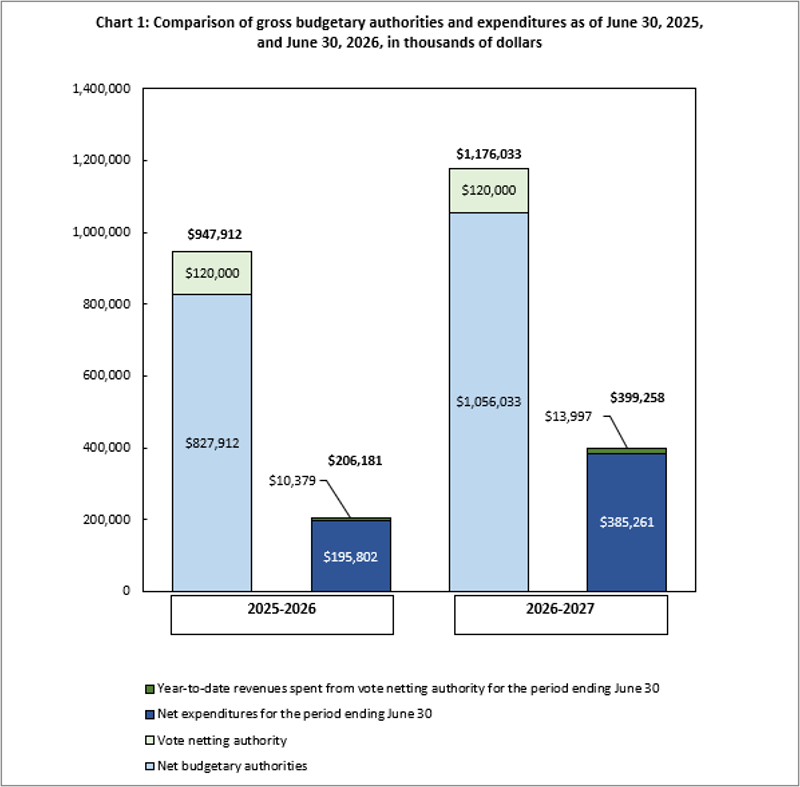
Chart 1 outlines the gross budgetary authorities, which represent the resources available for use for the year as of June 30.

Chart 1: Comparison of gross budgetary authorities and expenditures as of June 30, 2025, and June 30, 2026, in thousands of dollars

Significant changes to authorities

Total authorities available for 2026-27 have increased by $228.1 million, or 24.1%, from the previous year, from $947.9 million to $1.176 billion (Chart 1). The net increase is mostly the result of the following:

  • An increase of $300.7 million for the 2026 Census programs for new cyclical funding received to cover operational activities including Census collection;
  • An increase of $14.9 million for the Employee Benefit Plan adjustments and compensation funding related to collective agreements;
  • A decrease in $52.9 million for the Comprehensive Expenditure Review (CER) announced in Budget 2025;
  • A decrease of $25.9 million for cloud operations. Through the Spring Economic Update 2026, the Government announced an extension of this funding through 2028–29;
  • A decrease of $8 million for various initiatives including Canada's Action Plan on Combatting Hate and the Flood Risk Awareness Portal.

In addition to the appropriations allocated to the agency through the Main Estimates, Statistics Canada also has vote net authority within Vote 1, which entitles the agency to spend revenues collected from other federal government departments, agencies, and external clients to provide statistical services. The vote netting authority is stable at $120 million when comparing the first quarter of fiscal years 2025-2026 and 2026-2027.

Significant changes to expenditures

Year-to-date net expenditures recorded to the end of the first quarter increased by $189.5 million, or 96.8% from the previous year, from $195.8 million to $385.3 million (see Table A: Variation in Departmental Expenditures by Standard Object).

Statistics Canada spent approximately 36.5% of its authorities by the end of the first quarter, compared with 23.7% in the same quarter of 2025-2026.

Table A: Variation in Departmental Expenditures by Standard Object (unaudited)
Departmental Expenditures Variation by Standard Object:Q1 year-to-date variation between fiscal year 2025-2026 and 2026-2027
$'000%
(01) Personnel11,4846.1
(02) Transportation and communications53,6571,496.0
(03) Information4,923373.5
(04) Professional and special services121,1943,054.6
(05) Rentals2,04022.5
(06) Repair and maintenance32.5
(07) Utilities, materials and supplies-7-8.3
(08) Acquisition of land, buildings and works--
(09) Acquisition of machinery and equipment-390-87.1
(10) Transfer payments--
(12) Other subsidies and payments174118.5
Total gross budgetary expenditures193,07896.1
Less revenues netted against expenditures:
Revenues3,61834.9
Total net budgetary expenditures189,46096.8

Note: Explanations are provided for variances of more than $1 million.

Personnel: There is an overall increase in the agency's activities as the 2026 Censuses are in their main collection period this quarter. This increase in spending is partly offset by savings targets announced in Budget 2025 under the Comprehensive Expenditure Review (CER).

Transportation and communications: The increase is mainly due to postage costs for the mailing of Census materials as well as travel expenditures for enumerators for the 2026 Censuses collection activities occurring this fiscal year.

Information: The increase is mainly due to advertisement and printing costs for the 2026 Census materials such as questionnaires, envelopes, and letters.

Professional and special services: The increase is mainly due to the cost incurred for Statistics Act employees hired to conduct the 2026 Censuses.

Rentals: The increase is mainly due to additional costs for logistical requirements for the 2026 Censuses, as well as timing differences in invoicing compared to last year.

Revenues: The increase is mainly due to timing differences in invoicing compared to last year.

C) Significant changes to operations, personnel and programs

In 2026-27, the following changes in operations, personnel and program activities are underway:

  • The 2026 Census programs are currently underway. As a result, expenditures for this program are at their peak.
  • Funding for cloud infrastructure is not reflected in the authorities for 2026-27 since funding was originally set to end in 2025–26. However, through the Spring Economic Update 2026, the Government announced an extension of this funding through 2028–29. The associated funding is expected to be received by Statistics Canada during the 2026–27 fiscal year. As a result, the impact of this announced funding is not yet captured in the figures presented.
  • To support the implementation of the savings targets announced in Budget 2025 for the Comprehensive Expenditure Review, Statistics Canada will achieve these reductions through program realignment, targeted reductions and rescoping, and cost-saving efficiencies.

D) Risks and uncertainties

Statistics Canada continues to address financial and operational uncertainties through its integrated risk management framework.  Budget fluctuations related to cyclical programs, such as the Censuses, and anticipated impacts from the Comprehensive Expenditure Review are being managed through strong governance, disciplined financial management, and strategic resource allocation. At the same time, the agency continues to improve efficiency through automation, greater use of existing data sources and enhanced digital services. Strong partnerships across government and continued refinement of collaborative approaches are strengthening organizational resilience and supporting the efficient delivery of high-quality statistical information to Canadians.

Approval by senior officials

Approved by:

André Loranger
Chief Statistician
Ottawa, Ontario
Signed on: August 11, 2026

Martin Chapman
Acting Chief Financial Officer
Ottawa, Ontario
Signed on: July 30, 2026

Appendix

Statement of Authorities (unaudited)
 Fiscal year 2026-2027Fiscal year 2025–2026
Total available for use for the year ending March 31, 2027Footnote 1Used during the quarter ended June 30, 2026Year-to-date used at quarter-endTotal available for use for the year ending March 31, 2026Footnote 1Used during the quarter ended June 30, 2025Year-to-date used at quarter-end
in thousands of dollars
Vote 1 — Net operating expenditures945,509357,630357,630724,106169,851169,851
Statutory authority — Contribution to employee benefit plans110,52427,63127,631103,80625,95125,951
Total budgetary authorities1,056,033385,261385,261827,912195,802195,802
Departmental budgetary expenditures by Standard Object (unaudited)
 Fiscal year 2026-2027Fiscal year 2025–2026
Planned expenditures for the year ending March 31, 2027Expended during the quarter ended June 30, 2026Year-to-date used at quarter-endPlanned expenditures for the year ending March 31, 2026Expended during the quarter ended June 30, 2025Year-to-date used at quarter-end
in thousands of dollars
Expenditures:
(01) Personnel784,447198,919198,919782,276187,435187,435
(02) Transportation and communications107,58357,24457,24431,9943,5873,587
(03) Information24,5706,2416,24114,8651,3181,318
(04) Professional and special services218,207125,162125,16249,4473,9683,968
(05) Rentals27,06311,10411,10452,1899,0649,064
(06) Repair and maintenance1,3851281281,314125125
(07) Utilities, materials and supplies1,59682822,6868989
(08) Acquisition of land, buildings and works277--502--
(09) Acquisition of machinery and equipment9,60658588,983448448
(10) Transfer payments------
(12) Other subsidies and payments1,2993203203,656147147
Total gross budgetary expenditures1,176,033399,258399,258947,912206,181206,181
Less revenues netted against expenditures:
Revenues120,00013,99713,997120,00010,37910,379
Total revenues netted against expenditures120,00013,99713,997120,00010,37910,379
Total net budgetary expenditures1,056,033385,261385,261827,912195,802195,802

Annual Exploration, Development and Capital Expenditures Survey: Petroleum and Natural Gas Industry - Preliminary Estimate for 2026 and Intentions for 2027

Why are we conducting this survey?

This survey collects data on capital expenditures in Canada. The information is used by federal and provincial government departments and agencies, trade associations, universities and international organizations for policy development and as a measure of regional economic activity.

Your information may also be used by Statistics Canada for other statistical and research purposes.

Your participation in this survey is required under the authority of the Statistics Act.

Other important information

Authorization to collect this information

Data are collected under the authority of the Statistics Act, Revised Statutes of Canada, 1985, Chapter S-19.

Confidentiality

By law, Statistics Canada is prohibited from releasing any information it collects that could identify any person, business, or organization, unless consent has been given by the respondent, or as permitted by the Statistics Act. Statistics Canada will use the information from this survey for statistical purposes only.

Record linkages

To enhance the data from this survey and to reduce the reporting burden, Statistics Canada may combine the acquired data with information from other surveys or from administrative sources.

Data-sharing agreements

To reduce respondent burden, Statistics Canada has entered into data-sharing agreements with provincial and territorial statistical agencies and other government organizations, which have agreed to keep the data confidential and use them only for statistical purposes. Statistics Canada will only share data from this survey with those organizations that have demonstrated a requirement to use the data.

Section 11 of the Statistics Act provides for the sharing of information with provincial and territorial statistical agencies that meet certain conditions. These agencies must have the legislative authority to collect the same information, on a mandatory basis, and the legislation must provide substantially the same provisions for confidentiality and penalties for disclosure of confidential information as the Statistics Act. Because these agencies have the legal authority to compel businesses to provide the same information, consent is not requested and businesses may not object to the sharing of the data.

For this survey, there are Section 11 agreements with the provincial and territorial statistical agencies of Newfoundland and Labrador, Nova Scotia, New Brunswick, Quebec, Ontario, Manitoba, Saskatchewan, Alberta, British Columbia, and the Yukon. The shared data will be limited to information pertaining to business establishments located within the jurisdiction of the respective province or territory.

Section 12 of the Statistics Act provides for the sharing of information with federal, provincial or territorial government organizations. Under Section 12, you may refuse to share your information with any of these organizations by writing a letter of objection to the Chief Statistician, specifying the organizations with which you do not want Statistics Canada to share your data and mailing it to the following address:

Chief Statistician of Canada
Statistics Canada
Attention of Director, Enterprise Statistics Division
150 Tunney’s Pasture Driveway
Ottawa, Ontario
K1A 0T6

You may also contact us by email at statcan.esd-helpdesk-dse-bureaudedepannage.statcan@canada.ca- this link will open in a new window or by fax at 613-951-6583.

For this survey, there are Section 12 agreements with the statistical agencies of Prince Edward Island, the Northwest Territories and Nunavut as well as Environment and Climate Change Canada, Infrastructure Canada, the Canada Energy Regulator, Natural Resources Canada and Sustainability Development Technology Canada.

For agreements with provincial and territorial government organizations, the shared data will be limited to information pertaining to business establishments located within the jurisdiction of the respective province or territory.

Business or organization and contact information

1. Verify or provide the business or organization's legal and operating name and correct where needed.

Note: Legal name modifications should only be done to correct a spelling error or typo.

Legal Name

The legal name is one recognized by law, thus it is the name liable for pursuit or for debts incurred by the business or organization. In the case of a corporation, it is the legal name as fixed by its charter or the statute by which the corporation was created.

Modifications to the legal name should only be done to correct a spelling error or typo.

To indicate a legal name of another legal entity you should instead indicate it in question 3 by selecting 'Not currently operational' and then choosing the applicable reason and providing the legal name of this other entity along with any other requested information.

Operating Name

The operating name is a name the business or organization is commonly known as if different from its legal name. The operating name is synonymous with trade name.

Legal name

Operating name (if applicable)

2. Verify or provide the contact information of the designated business or organization contact person for this questionnaire and correct where needed.

Note: The designated contact person is the person who should receive this questionnaire. The designated contact person may not always be the one who actually completes the questionnaire.

First name

Last name

Title

Preferred language of communication

  • English
  • French

Mailing address (number and street)

City

Province, territory or state

Postal code or ZIP (Zone Improvement Plan) code
Example: A9A 9A9 or 12345-1234

Country
  • Afghanistan
  • Åland Islands
  • Albania
  • Algeria
  • American Samoa
  • Andorra
  • Angola
  • Anguilla
  • Antarctica
  • Antigua and Barbuda
  • Argentina
  • Armenia
  • Aruba
  • Australia
  • Austria
  • Azerbaijan
  • Bahamas
  • Bahrain
  • Bangladesh
  • Barbados
  • Belarus
  • Belgium
  • Belize
  • Benin
  • Bermuda
  • Bhutan
  • Bolivia
  • Bonaire, Sint Eustatius and Saba
  • Bosnia and Herzegovina
  • Botswana
  • Bouvet Island
  • Brazil
  • British Indian Ocean Territory
  • Brunei Darussalam
  • Bulgaria
  • Burkina Faso
  • Burma (Myanmar)
  • Burundi
  • Cambodia
  • Cameroon
  • Canada
  • Cape Verde
  • Cayman Islands
  • Central African Republic
  • Chad
  • Chile
  • China
  • Christmas Island
  • Cocos (Keeling) Islands
  • Colombia
  • Comoros
  • Congo, Republic of the
  • Congo, The Democratic Republic of the
  • Cook Islands
  • Costa Rica
  • Côte d'Ivoire
  • Croatia
  • Cuba
  • Curaçao
  • Cyprus
  • Czech Republic
  • Denmark
  • Djibouti
  • Dominica
  • Dominican Republic
  • Ecuador
  • Egypt
  • El Salvador
  • Equatorial Guinea
  • Eritrea
  • Estonia
  • Ethiopia
  • Falkland Islands (Malvinas)
  • Faroe Islands
  • Fiji
  • Finland
  • France
  • French Guiana
  • French Polynesia
  • French Southern Territories
  • Gabon
  • Gambia
  • Georgia
  • Germany
  • Ghana
  • Gibraltar
  • Greece
  • Greenland
  • Grenada
  • Guadeloupe
  • Guam
  • Guatemala
  • Guernsey
  • Guinea
  • Guinea-Bissau
  • Guyana
  • Haiti
  • Heard Island and McDonald Islands
  • Holy See (Vatican City State)
  • Honduras
  • Hong Kong Special Administrative Region
  • Hungary
  • Iceland
  • India
  • Indonesia
  • Iran
  • Iraq
  • Ireland, Republic of
  • Isle of Man
  • Israel
  • Italy
  • Jamaica
  • Japan
  • Jersey
  • Jordan
  • Kazakhstan
  • Kenya
  • Kiribati
  • Korea, North
  • Korea, South
  • Kosovo
  • Kuwait
  • Kyrgyzstan
  • Laos
  • Latvia
  • Lebanon
  • Lesotho
  • Liberia
  • Libya
  • Liechtenstein
  • Lithuania
  • Luxembourg
  • Macao Special Administrative Region
  • Macedonia, Republic of
  • Madagascar
  • Malawi
  • Malaysia
  • Maldives
  • Mali
  • Malta
  • Marshall Islands
  • Martinique
  • Mauritania
  • Mauritius
  • Mayotte
  • Mexico
  • Micronesia, Federated States of
  • Moldova
  • Monaco
  • Mongolia
  • Montenegro
  • Montserrat
  • Morocco
  • Mozambique
  • Namibia
  • Nauru
  • Nepal
  • Netherlands
  • New Caledonia
  • New Zealand
  • Nicaragua
  • Niger
  • Nigeria
  • Niue
  • Norfolk Island
  • Northern Mariana Islands
  • Norway
  • Oman
  • Pakistan
  • Palau
  • Panama
  • Papua New Guinea
  • Paraguay
  • Peru
  • Philippines
  • Pitcairn
  • Poland
  • Portugal
  • Puerto Rico
  • Qatar
  • Réunion
  • Romania
  • Russian Federation
  • Rwanda
  • Saint Barthélemy
  • Saint Helena
  • Saint Kitts and Nevis
  • Saint Lucia
  • Saint Martin (French part)
  • Saint Pierre and Miquelon
  • Saint Vincent and the Grenadines
  • Samoa
  • San Marino
  • Sao Tome and Principe
  • Sark
  • Saudi Arabia
  • Senegal
  • Serbia
  • Seychelles
  • Sierra Leone
  • Singapore
  • Sint Maarten (Dutch part)
  • Slovakia
  • Slovenia
  • Solomon Islands
  • Somalia
  • South Africa, Republic of
  • South Georgia and the South Sandwich Islands
  • South Sudan
  • Spain
  • Sri Lanka
  • Sudan
  • Suriname
  • Svalbard and Jan Mayen
  • Swaziland
  • Sweden
  • Switzerland
  • Syria
  • Taiwan
  • Tajikistan
  • Tanzania
  • Thailand
  • Timor-Leste
  • Togo
  • Tokelau
  • Tonga
  • Trinidad and Tobago
  • Tunisia
  • Turkey
  • Turkmenistan
  • Turks and Caicos Islands
  • Tuvalu
  • Uganda
  • Ukraine
  • United Arab Emirates
  • United Kingdom
  • United States
  • United States Minor Outlying Islands
  • Uruguay
  • Uzbekistan
  • Vanuatu
  • Venezuela
  • Viet Nam
  • Virgin Islands, British
  • Virgin Islands, United States
  • Wallis and Futuna
  • West Bank and Gaza Strip (Palestine)
  • Western Sahara
  • Yemen
  • Zambia
  • Zimbabwe

Email address
Example: user@example.gov.ca

Telephone number (including area code)
Example: 123-123-1234

Extension number (if applicable)

Fax number (including area code)
Example: 123-123-1234

3. Verify or provide the current operational status of the business or organization identified by the legal and operating name above.

  • Operational
  • Not currently operational
  • e.g., (for example) temporarily or permanently closed, change of ownership

Why is this business or organization not currently operational?

  • Seasonal operations
  • Ceased operations
  • Sold operations
  • Amalgamated with other businesses or organizations
  • Temporarily inactive but will re-open
  • No longer operating due to other reasons

When did this business or organization close for the season?

  • Date
    Example: YYYY-MM-DD

When does this business or organization expect to resume operations?

  • Date
    Example: YYYY-MM-DD

When did this business or organization cease operations?

  • Date
    Example: YYYY-MM-DD

Why did this business or organization cease operations?

  • Bankruptcy
  • Liquidation
  • Dissolution
  • Other

Specify the other reasons why the operations ceased.

When was this business or organization sold?

  • Date
    Example: YYYY-MM-DD

What is the legal name of the buyer?

When did this business or organization amalgamate?

  • Date
    Example: YYYY-MM-DD

What is the legal name of the resulting or continuing business or organization?

What are the legal names of the other amalgamated businesses or organizations?

When did this business or organization become temporarily inactive?

  • Date
    Example: YYYY-MM-DD

When does this business or organization expect to resume operations?

  • Date
    Example: YYYY-MM-DD

Why is this business or organization temporarily inactive?

When did this business or organization cease operations?

  • Date
    Example: YYYY-MM-DD

Why did this business or organization cease operations?

4. Verify or provide the current main activity of the business or organization identified by the legal and operating name above.

Note: The described activity was assigned using the North American Industry Classification System (NAICS).

This question verifies the business or organization's current main activity as classified by the North American Industry Classification System (NAICS). The North American Industry Classification System (NAICS) is an industry classification system developed by the statistical agencies of Canada, Mexico and the United States. Created against the background of the North American Free Trade Agreement, it is designed to provide common definitions of the industrial structure of the three countries and a common statistical framework to facilitate the analysis of the three economies. NAICS is based on supply-side or production-oriented principles, to ensure that industrial data, classified to NAICS , are suitable for the analysis of production-related issues such as industrial performance.

The target entity for which NAICS is designed are businesses and other organizations engaged in the production of goods and services. They include farms, incorporated and unincorporated businesses and government business enterprises. They also include government institutions and agencies engaged in the production of marketed and non-marketed services, as well as organizations such as professional associations and unions and charitable or non-profit organizations and the employees of households.

The associated NAICS should reflect those activities conducted by the business or organizational units targeted by this questionnaire only, as identified in the 'Answering this questionnaire' section and which can be identified by the specified legal and operating name. The main activity is the activity which most defines the targeted business or organization's main purpose or reason for existence. For a business or organization that is for-profit, it is normally the activity that generates the majority of the revenue for the entity.

The NAICS classification contains a limited number of activity classifications; the associated classification might be applicable for this business or organization even if it is not exactly how you would describe this business or organization's main activity.

Please note that any modifications to the main activity through your response to this question might not necessarily be reflected prior to the transmitting of subsequent questionnaires and as a result they may not contain this updated information.

The following is the detailed description including any applicable examples or exclusions for the classification currently associated with this business or organization.

Description and examples

  • This is the current main activity
  • This is not the current main activity

Provide a brief but precise description of this business or organization's main activity.

e.g. , breakfast cereal manufacturing, shoe store, software development

Main activity

5. You indicated that is not the current main activity.

Was this business or organization's main activity ever classified as:?

  • Yes
    • When did the main activity change?
      • Date
  • No

6. Search and select the industry classification code that best corresponds to this business or organization's main activity.

How to search:

  • if desired, you can filter the search results by first selecting this business or organization's activity sector
  • enter keywords or a brief description that best describes this business or organization main activity
  • press the Search button to search the database for an activity that best matches the keywords or description you provided
  • then select an activity from the list.

Select this business or organization's activity sector (optional)

  • Farming or logging operation
  • Construction company or general contractor
  • Manufacturer
  • Wholesaler
  • Retailer
  • Provider of passenger or freight transportation
  • Provider of investment, savings or insurance products
  • Real estate agency, real estate brokerage or leasing company
  • Provider of professional, scientific or technical services
  • Provider of health care or social services
  • Restaurant, bar, hotel, motel or other lodging establishment
  • Other sector

Reporting period information

1. What are the start and end dates of this organization's 2026 fiscal year?

Note: For this survey, the end date should fall between April 1, 2026 and March 31, 2026.

Here are twelve common fiscal periods that fall within the targeted dates:

  • May 1, 2025 to April 30, 2026
  • June 1, 2025 to May 31, 2026
  • July 1, 2025 to June 30, 2026
  • August 1, 2025 to July 31, 2026
  • September 1, 2025 to August 31, 2026
  • October 1, 2025 to September 30, 2026
  • November 1, 2025 to October 31, 2026
  • December 1, 2025 to November 30, 2026
  • January 1, 2026 to December 31, 2026
  • February 1, 2026 to January 31, 2027
  • March 1, 2026 to February 28, 2027
  • April 1, 2026 to March 31, 2027.

Here are other examples of fiscal periods that fall within the required dates:

  • September 18, 2025 to September 15, 2026 (e.g., floating year-end)
  • June 1, 2026 to December 31, 2026 (e.g., a newly opened business).

Fiscal Year Start
Example: YYYY-MM-DD

  • Date

Fiscal Year-End
Example: YYYY-MM-DD

  • Date

2. What is the reason the reporting period does not cover a full year?

Select all that apply.

Seasonal operations

New business

Change of ownership

Temporarily inactive

Change of fiscal year

Ceased operations

Other reason - specify:

Additional reporting instructions

3. Throughout this questionnaire, please report financial information in thousands of Canadian dollars.

For example, an amount of $763,880.25 should be reported as:

CAN$ '000

I will report in the format above.

Capital Expenditures - Preliminary Estimate 2026

4. For the fiscal year 2026, what are this organization's preliminary estimates for capital expenditures?

Include: all capitalized overhead and capitalized interest.

  • When there are partnerships and joint venture activities or projects, report the expenditures reflecting this corporation's net interest in such projects or ventures.
  • Report all dollar amounts in thousands of Canadian dollars ('000).
  • Exclude sales tax.
  • When precise figures are not available, please provide your best estimates.

If there are no capital expenditures, please enter '0'.

A. Oil and gas rights acquisition and retention costs (exclude inter-company sales or transfers):

Include acquisition costs and fees for oil and gas rights (include bonuses, legal fees and filing fees), and oil and gas retention costs.

B. Exploration and evaluation, capitalized or expensed ( e.g. , leases and licences, seismic, exploration drilling):

These expenditures include mineral rights fees and retention costs, geological, geophysical and seismic expenses, exploration drilling, and other costs incurred during the reporting period in order to determine whether oil or gas reserves exist and can be exploited commercially. Report gross expenditures, before deducting any incentive grants, incurred for oil and gas activities on a contracted basis and/or by your own employees. Exclude the cost of land acquired from other oil and gas companies.

C. Building construction ( e.g. , process building, office building, camp, storage building, and maintenance garage):

Include capital expenditures on buildings such as office buildings, camps, warehouses, maintenance garages, workshops, and laboratories. Fixtures, facilities and equipment that are integral parts of the building are included.

D. Other construction assets ( e.g. , development drilling and completions, processing facilities, natural gas plants, upgraders):

Include all infrastructure, other than buildings, such as the cost of well pads, extraction and processing infrastructure and plants, upgrading units, transportation infrastructure, water and sewage infrastructure, tailings, pipelines and wellhead production facilities (pumpjacks, separators, etc. ). Include all preconstruction planning and design costs such as development drilling, regulatory approvals, environmental assessments, engineering and consulting fees and any materials supplied to construction contractors for installation, as well as site clearance and preparation. Equipment which is installed as an integral or built-in feature of a fixed structure ( e.g. , casings, tanks, steam generators, pumps, electrical apparatus, separators, flow lines, etc. ) should be reported with the construction asset; however, when the equipment is replaced within an existing structure, the replacement cost should be reported in machinery and equipment (sustaining capital).

E. Machinery and equipment purchases ( e.g. , trucks, shovels, computers, etc. ):

Include transportation equipment for people and materials, computers, software, communication equipment, and processing equipment not included in the above categories.

Preliminary Estimate

 2026 Preliminary Estimate ( CAN$ '000 )
Oil and gas rights acquisitions and retention costs 
Exploration and evaluation 
Non-residential building construction 
Development and other construction 
Machinery and equipment 
Total 

Total

Research and Development

5. For the fiscal year 2026, did this organization perform scientific research and development in Canada of at least $10,000 or outsource (contract-out) to another organization scientific research and development activities of at least $10,000?

Research and experimental development (R&D) comprise creative and systematic work undertaken in order to increase the stock of knowledge - including knowledge of humankind, culture and society - and to devise new applications of available knowledge. For an activity to be an R&D activity, it must satisfy five core criteria:

  1. To be aimed at new findings (novel);
  2. To be based on original, not obvious, concepts and hypothesis (creative);
  3. To be uncertain about the final outcome (uncertainty);
  4. To be planned and budgeted (systematic);
  5. To lead to results to could be possibly reproduced (transferable/ or reproducible).

The term R&D covers three types of activity: basic research, applied research and experimental development. Basic research is experimental or theoretical work undertaken primarily to acquire new knowledge of the underlying foundations of phenomena and observable facts, without any particular application or use in view. Applied research is original investigation undertaken in order to acquire new knowledge. It is, however, directed primarily towards a specific, practical aim or objective. Experimental development is systematic work, drawing on knowledge gained from research and practical experience and producing additional knowledge, which is directed to producing new products or processes or to improving existing products or processes.

  • Yes
  • No

Capital Expenditures - Intentions 2027

6. For the fiscal year 2027, what are this organization's intentions for capital expenditures?

Include: all capitalized overhead and capitalized interest.

  • When there are partnerships and joint venture activities or projects, report the expenditures reflecting this corporation's net interest in such projects or ventures.
  • Report all dollar amounts in thousands of Canadian dollars ('000).
  • Do not include sales tax.
  • Percentages should be rounded to whole numbers.
  • When precise figures are not available, please provide your best estimates.

If there are no capital expenditures, please enter '0'.

A. Oil and gas rights acquisition and retention costs (exclude inter-company sales or transfers):

Include acquisition costs and fees for oil and gas rights (include bonuses, legal fees and filing fees), and oil and gas retention costs

B. Exploration and evaluation, capitalized or expensed ( e.g. , leases and licences, seismic, exploration drilling):

These expenditures include mineral rights fees and retention costs, geological, geophysical and seismic expenses, exploration drilling, and other costs incurred during the reporting period in order to determine whether oil or gas reserves exist and can be exploited commercially. Report gross expenditures, before deducting any incentive grants, incurred for oil and gas activities on a contracted basis and/or by your own employees. Exclude the cost of land acquired from other oil and gas companies.

C. Building construction ( e.g. , process building, office building, camp, storage building, and maintenance garage):

Include capital expenditures on buildings such as office buildings, camps, warehouses, maintenance garages, workshops, and laboratories. Fixtures, facilities and equipment that are integral parts of the building are included.

D. Other construction assets ( e.g. , development drilling and completions, processing facilities, natural gas plants, upgraders):

Include all infrastructure, other than buildings, such as the cost of well pads, extraction and processing infrastructure and plants, upgrading units, transportation infrastructure, water and sewage infrastructure, tailings, pipelines and wellhead production facilities (pumpjacks, separators, etc. ). Include all preconstruction planning and design costs such as development drilling, regulatory approvals, environmental assessments, engineering and consulting fees and any materials supplied to construction contractors for installation, as well as site clearance and preparation. Equipment which is installed as an integral or built-in feature of a fixed structure ( e.g. , casings, tanks, steam generators, pumps, electrical apparatus, separators, flow lines, etc. ) should be reported with the construction asset; however, when the equipment is replaced within an existing structure, the replacement cost should be reported in machinery and equipment (sustaining capital).

E. Machinery and equipment purchases ( e.g. , trucks, shovels, computers, etc. ):

Include transportation equipment for people and materials, computers, software, communication equipment, and processing equipment not included in the above categories.

Intentions 2027

 Intentions 2027 ( CAN$ '000 )
Oil and gas rights acquisitions and retention costs 
Exploration and evaluation 
Non-residential building construction 
Development and other construction 
Machinery and equipment 
Total 

Total

7.  You have not reported any capital expenditure intentions for 2027.

Please indicate the reason.

  • Zero capital expenditure intentions for 2027
  • Figures not available but plans are for no change in capital expenditures for 2027
  • Figures not available but plans are for an increase in capital expenditures for 2027
  • Figures not available but plans are for a decrease in capital expenditures for 2027

Research and Development

8. For the 2027 fiscal year, does this organization plan on performing scientific research and development in Canada of at least $10,000 or outsourcing (contracting-out) to another organization scientific research and development activities of at least $10,000?

Research and experimental development (R&D) comprise creative and systematic work undertaken in order to increase the stock of knowledge - including knowledge of humankind, culture and society - and to devise new applications of available knowledge. For an activity to be an R&D activity, it must satisfy five core criteria:

  1. To be aimed at new findings (novel);
  2. To be based on original, not obvious, concepts and hypothesis (creative);
  3. To be uncertain about the final outcome (uncertainty);
  4. To be planned and budgeted (systematic);
  5. To lead to results to could be possibly reproduced (transferable/ or reproducible).

The term R&D covers three types of activity: basic research, applied research and experimental development. Basic research is experimental or theoretical work undertaken primarily to acquire new knowledge of the underlying foundations of phenomena and observable facts, without any particular application or use in view. Applied research is original investigation undertaken in order to acquire new knowledge. It is, however, directed primarily towards a specific, practical aim or objective. Experimental development is systematic work, drawing on knowledge gained from research and practical experience and producing additional knowledge, which is directed to producing new products or processes or to improving existing products or processes.

  • Yes
  • No

Notification of intent to extract web data

9. Does this business have a website?

Statistics Canada engages in web-data extraction, also known as web scraping, which is a process by which information is gathered and copied from the Web using automated scripts or robots, for retrieval and analysis. As a result, we may visit the website for this organization to search for and compile additional information. The use of web scraping is part of a broader effort to reduce the response burden on organizations, as well as produce additional statistical indicators to ensure that our data remain accurate and relevant.

We will strive to ensure that the data collection does not interfere with the functionality of the website. Any data collected will be used by Statistics Canada for statistical and research purposes only, in accordance with the agency’s privacy and confidentiality mandate.

More information regarding Statistics Canada’s web scraping initiative- this link will open in a new window.

Learn more about Statistics Canada’s transparency and accountability- this link will open in a new window.

If you have any questions or concerns, please contact Statistics Canada Client Services, toll-free at 1-877-949-9492 [Teletypewriter or Telecommunication device for the deaf/teletype machine (TTY): 1-800-363-7629] or by email at infostats@statcan.gc.ca - this link will open in a new window. Additional information about this survey can be found by selecting the following link: Annual Capital Expenditures Survey: Preliminary Estimate for 2026 and Intentions for 2027.

Changes or events

10. Indicate any changes or events that affected the reported values for this business or organization, compared with the last reporting period.

Select all that apply.

  • Labour shortages or employee absences
  • Disruptions in supply chains
  • Deferred plans to future or projects on hold
  • Strike or lock-out
  • Exchange rate impact
  • Price changes in goods or services sold
  • Contracting out
  • Organizational change
  • Price changes in labour or raw materials
  • Natural disaster
  • Recession
  • Change in product line
  • Sold business or business units
  • Expansion
  • New or lost contract
  • Plant closures
  • Acquisition of business or business units
  • Other
    Specify the other changes or events:
  • No changes or events

Contact person

11. Statistics Canada may need to contact the person who completed this questionnaire for further information.

Is [Provided Given Names], [Provided Family Name] the best person to contact?

  • Yes
  • No

Who is the best person to contact about this questionnaire?

First name:

Last name:

Title:

Email address:
Example: user@example.gov.ca

Telephone number (including area code):
Example: 123-123-1234

Extension number (if applicable):
The maximum number of characters is 5.

Fax number (including area code):
Example: 123-123-1234

Feedback

12. How long did it take to complete this questionnaire?

Include the time spent gathering the necessary information.

  • Hours:
  • Minutes:

13. Do you have any comments about this questionnaire?

Survey on Technology Use by Businesses 2026

Information for respondents

Purpose

The 2026 Survey on Technology Use by Businesses (STUB) is designed to measure the impacts of technology use, with particular focus on artificial intelligence (AI) technologies, on the operations of Canadian enterprises.

The STUB also includes indicators on online presence, involvement in e-commerce, and use of data and cloud computing services by enterprises. Skills and employment in technology-related jobs are also examined.

Additional information

Your information may also be used by Statistics Canada for other statistical and research purposes.

Your participation in this survey is required under the authority of the Statistics Act.

Authority

Data are collected under the authority of the Statistics Act, Revised Statutes of Canada, 1985, Chapter S-19.

Confidentiality

By law, Statistics Canada is prohibited from releasing any information it collects that could identify any person, business, or organization, unless consent has been given by the respondent, or as permitted by the Statistics Act. Statistics Canada will use the information from this survey for statistical purposes only.

Data-sharing agreements

To reduce respondent burden, Statistics Canada has entered into data-sharing agreements with provincial and territorial statistical agencies and other government organizations, which have agreed to keep the data confidential and use them only for statistical purposes. Statistics Canada will only share data from this survey with those organizations that have demonstrated a requirement to use the data.

Section 11 of the Statistics Act provides for the sharing of information with provincial and territorial statistical agencies that meet certain conditions. These agencies must have the legislative authority to collect the same information, on a mandatory basis, and the legislation must provide substantially the same provisions for confidentiality and penalties for disclosure of confidential information as the Statistics Act. Because these agencies have the legal authority to compel businesses to provide the same information, consent is not requested and businesses may not object to the sharing of the data.

For this survey, there are Section 11 agreements with the provincial and territorial statistical agencies of Newfoundland and Labrador, Nova Scotia, New Brunswick, Quebec, Ontario, Manitoba, Saskatchewan, Alberta, British Columbia and the Yukon.
The shared data will be limited to information pertaining to business establishments located within the jurisdiction of the respective province or territory.

Section 12 of the Statistics Act provides for the sharing of information with federal, provincial or territorial government organizations. Under

Section 12, you may refuse to share your information with any of these organizations by writing a letter of objection to the Chief Statistician, specifying the organizations with which you do not want Statistics Canada to share your data and mailing it to the following address

Chief Statistician of Canada
Statistics Canada
Attention of Director, Centre for Innovation, Technology and Enterprise Statistics
150 Tunney's Pasture Driveway
Ottawa, ON
K1A 0T6

You may also contact us by email at statcan.digitaleconomysociety-economiesocietenumerique.statcan@statcan.gc.ca.

For this survey, there are Section 12 agreements with the statistical agencies of Prince Edward Island, Northwest Territories and Nunavut.

For agreements with provincial and territorial government organizations, the shared data will be limited to information pertaining to business establishments located within the jurisdiction of the respective province or territory.

Record linkage

To enhance the data from this survey and to reduce respondent burden, Statistics Canada may combine it with information from other surveys or from administrative sources.

Reporting instructions

Please complete this questionnaire for the operations of your entire enterprise in Canada only.

For this questionnaire:

  • Report dollar amounts in Canadian dollars.
  • Report dollar amounts rounded to the nearest dollar.
  • Exclude sales tax.
  • When precise figures are not available, provide your best estimates.
  • Enter "0" if there is no value to report.

Web presence

Web presence – Question identifier: 1

Which of the following types of web presence does this business have?

Web presence refers to Internet-based locations where information about a business can be found by external parties.

Exclude websites and apps that are used primarily for instant messaging; e.g., iMessage, WhatsApp, WeChat, Facebook Messenger.

Select all that apply.

  • Company websites
    Do any of this business's websites have the following features?
    Select all that apply.
    • Optimized for use on mobile devices
    • Designed to meet web accessibility standards 
      OR
    • None of these features
      OR
    • Don't know
  • Company apps
  • Social media accounts
  • Other third-party websites, apps or online marketplaces
  • Paid online advertising
  • Free online advertising
  • Email marketing
  • Other
    OR
  • None

Web presence – Question identifier: 2

For which of the following reasons does this business not have a web presence?

Web presence refers to Internet-based locations where information about a business can be found by external parties.

Select all that apply.

  • Not required given the nature of this business
  • Set-up costs too high
  • Ongoing maintenance and updating costs too high
  • Lack of technical expertise to develop, maintain or use
  • Other

Web presence – Question identifier: 3

Which of the following types of paid online advertising did this business use in 2026?

Exclude free online advertising.

Select all that apply.

  • Pay per click
  • Social media ads
  • Influencer marketing
  • Banner ads
  • Interest-based advertising
  • Search engine optimization (SEO)
  • Programmatic advertising
  • Other

Web presence – Question identifier: 4

In the last 12 months, how much did this business spend on online advertising?

If precise figures are not available or the year is not yet complete, please provide your best estimate in Canadian dollars. If online advertising spending cannot be separated from total advertising spending, please select "Don't know."

  • Online advertising spending
    OR
  • Don't know

E-commerce

E-commerce - Question identifier: 5

In 2026, did this business receive orders or sell goods or services over the Internet?

Include:

  1. all sales of this business' goods or services where the order was received, and the commitment to purchase was made, over the Internet, including through web pages, extranet or Electronic Data Interchange (EDI). Payment can be made by other means.
  2. sales made on company and third-party websites and apps.

Exclude:

  1. the delivery of digital products and services for which orders were not made online.
  2. orders received or commitments to purchase made by telephone, facsimile or email.
  • Yes
    Which of the following sources does this business use in conducting e-commerce sales or securing orders online?
    Select all that apply.
    • Third-party e-commerce platforms used within company websites or apps
    • Third-party websites, apps or online marketplaces
    • Sources built into company websites or apps
    • Other
  • No
  • Don't know

E-commerce - Question identifier: 6

What were this business' total gross sales conducted over the Internet in the last 12 months?

If precise figures are not available, please provide your best estimate in Canadian dollars. Rounded to the nearest CAN$

  • Gross sales over the internet
    OR
  • Don't know

E-commerce - Question identifier: 7

In 2026, what types of goods or services did this business sell over the Internet?

Select all that apply.

  • Digitally delivered goods or services
    In 2026, approximately what percentage of this businesses' e-commerce sales came from digitally delivered good or services?
    • Percentage
  • Physical goods
  • Other services
    OR
  • Don't know

E-commerce - Question identifier: 8

For this business' gross sales conducted over the Internet in 2026, in which of the following regions were the customers located?

Select all that apply.

  • Canada
    For this business' gross sales conducted over the Internet in 2026, in which of the following provinces or territories were the customers located?
    Select all that apply.
    • Province or territory in which this business is headquartered
    • Any other province or territory
  • United States
  • Mexico
  • Other Latin America and the Caribbean
  • China
  • Other Asia
  • European Union
  • United Kingdom
  • Other regions
    OR
  • Don't know

E-commerce - Question identifier: 9

In 2026, did this business sell any digitally delivered goods or services to customers located outside of Canada?

  • Yes
  • No
  • Don't know

E-commerce - Question identifier: 10

Which of the following challenges limited or prevented sales over the Internet in 2026?

Select all that apply.

  • Goods or services not suitable for online sales
  • Issues adapting goods or services for online sales
  • High set-up cost
  • High maintenance cost
  • High shipping cost
  • Logistical issues associated with the implementation or maintenance of e-commerce system
  • Security concerns
  • Employees lack the skills, training or experience
  • Language barriers between the business and customers
  • Legal issues, barriers or concerns
  • Interprovincial trade barriers
  • Accessibility concerns
  • Other
    • Specify the other challenges
  • OR
  • This business did not face challenges that limited or prevented sales over the Internet
    OR
  • This business does not sell goods or services
    OR
  • Don't know

E-commerce - Question identifier: 11

Which of the following challenges was the greatest in limiting or preventing sales over the Internet in 2026?

  • Goods or services not suitable for online sales
  • Issues adapting goods or services for online sales
  • High set-up cost
  • High maintenance cost
  • High shipping cost
  • Logistical issues associated with the implementation or maintenance of e-commerce system
  • Security concerns
  • Employees lack the skills, training or experience
  • Language barriers between the business and customers
  • Legal issues, barriers or concerns
  • Interprovincial trade barriers
  • Accessibility concerns
  • Other

Artificial intelligence (AI)

Artificial intelligence (AI) – Question identifier: 12

In 2026, did this business allow employees to use generative AI technologies for work?

Generative Artificial Intelligence (AI) tools answer questions, provide information or advice and create new content, including text, images, programming code, videos, or other data, based on user prompting such as asking questions or providing instructions.

Examples include ChatGPT, Copilot, Claude and Gemini.

  • Yes
    Did this business pay for licences or subscriptions for generative AI technologies?
    • Yes
      What percentage of employees have access to paid versions of generative AI technologies?
      • 75% to 100%
      • 50% to less than 75%
      • 25% to less than 50%
      • More than 0% but less than 25%
    • No
    • Don't know
  • No
  • Don't know

Artificial intelligence (AI) – Question identifier: 13

In 2026, which of the following AI technologies did this business use?

Include AI technologies which are imbedded in other software and any level of utilization of AI technologies, even if only minimal.
Select all that apply.

  • AI technologies generating pictures, videos, sound or audio
    Which of these types of output did this business generate? 
    Select all that apply.
    • Pictures
    • Video
    • Sound or audio
  • AI technologies generating written, spoken language or computer code
    Which of these types of output did this business generate? 
    Select all that apply.
    • Written language
    • Spoken language
    • Computer code
  • Data analysis and processing with AI
  • AI Chatbots
  • AI for analysis of written language
  • AI for analysis of spoken language
  • Face recognition systems or other image-analysis software
  • Hardware with integrated AI
  • Technologies that automate workflows or assist in decision making
    Did this business use agentic AI technologies?
    Agentic AI technologies are AI systems given the authority to plan, make decisions and take actions on a user's or a business's behalf, rather than simply generating responses to user inputs. Examples include AI systems that schedule meetings, make purchases, or write and deploy computer code.
    • Yes
    • No
    • Don't know
  • Other
    • Specify the other AI technologies
  • OR
  • This business did not use AI technologies
    OR
  • Don't know

Artificial intelligence (AI) – Question identifier: 14

Which of the following describes the types of AI technologies this business used in 2026?

Select all that apply

  • Proprietary AI technologies developed by this business
  • AI technologies customized or adapted for this business
  • AI technologies used without modification
    OR
  • Don't know

Artificial intelligence (AI) – Question identifier: 15

In 2026, at what stage of implementation were AI technologies being used for the following business activities?

Researching or is under development/ Implemented in this activity/ No use or not applicable/ Don't know

  1. For marketing or sales
  2. For production processes or procedures
  3. For business administration processes
  4. For research and development
  5. For management of enterprises
  6. For logistics
  7. For Information and Communication Technologies (ICT) security
  8. For human resources management or recruiting

Artificial intelligence (AI) – Question identifier: 16

When were AI technologies first implemented by this business?

  • Within the last year
  • From 1 to 3 years ago
  • From 3 to 5 years ago
  • More than 5 years ago
  • Don't know

Artificial intelligence (AI) – Question identifier: 17

How much did this business spend on AI technologies and related skills training in the last 12 months?

If precise figures are not available, please provide your best estimate in Canadian dollars. If figures for specific categories are not available, the total for all expenses may be provided instead.

Enter "0" if there is no value to report.

  1. AI-based software licenses or subscription fees
  2. AI-related skills training
  3. AI-related research and development expenses
  4. AI-related hardware expenses
  5. Other AI-related expenditures

Artificial intelligence (AI) – Question identifier: 18

When acquiring AI-related technologies or services, how important are each of the following factors to this business?

Very important/ Somewhat important/ Not important/ Don't know

  1. Seller or service provider is Canadian owned
  2. Seller or service provider has Canadian operations

Artificial intelligence (AI) – Question identifier: 19

Does this business have or have plans to put in place any written policies related to the use of AI technologies?

Include guidelines, memos or other documents related to the use of AI technologies.

  • Yes, this business has written policies in place
    What do these policies cover? 
    Select all that apply.
    • Restrictions on which AI technologies can be used
    • Restrictions on how AI technologies can be used
    • Quality control measures on inputs for AI technologies
    • Quality control measures for outputs of AI technologies
    • Requirements for users of AI technologies to take training
    • Other
  • The business does not currently have written policies in place but plans to implement policies in the future
  • This business has no plans to put written policies in place
  • Don't know

Artificial intelligence (AI) – Question identifier: 20

What percentage of employees in this business use AI technologies in their regular work?

Include the use of free and paid AI technologies.

If precise figures are not available, please provide your best estimate.

  • 75% to 100%
  • 50% to less than 75%
  • 25% to less than 50%
  • More than 0% but less than 25%
  • None
  • Don't know

Artificial intelligence (AI) – Question identifier: 21

For AI technologies adopted within the past three years, which of the following impacts have AI technologies had on this business's workforce?

Select all that apply.

  • AI-related training was offered or provided to employees
  • New employees were hired with AI-related skills
  • Employees were re-assigned within the business
  • Fewer employees were hired due to AI technologies
  • Layoffs or attrition due to AI technologies
  • Other workforce impacts
    • Specify other workforce impacts
  • OR
  • No workforce impacts
    OR
  • Don't know

Artificial intelligence (AI) – Question identifier: 22

For AI technologies adopted within the past three years, how have AI technologies affected this business's total employment?

  • Increased
  • Decreased
  • No change
  • Don't know

Artificial intelligence (AI) – Question identifier: 23

Have this business's sales increased due to the implementation of AI technologies?

  • Yes
  • No
  • Too early to assess
  • Don't know

Artificial intelligence (AI) – Question identifier: 24

Since the implementation of AI technologies, how has AI impacted the output per employee in this business?

  • Significant increase
  • Moderate increase
  • Minor increase
  • No change or decrease
  • Too early to assess
  • Don't know

Artificial intelligence (AI) – Question identifier: 25

For AI technologies adopted within the past three years, which of the following other impacts have AI technologies had on this business?

Select all that apply

  • Computing power or specialized equipment were purchased
  • Cloud services or cloud storage were purchased
  • Data collection or data management practices were changed
  • New workflows were developed
  • Vendors or consulting services were used to install or integrate AI
  • Other change
    • Specify other changes
  • OR
  • Don't know
    OR
  • None of the above

Artificial intelligence (AI) – Question identifier: 26

Which of the following challenges limited this business' implementation or further integration of AI technologies in 2026?

Select all that apply.

  • Lack of knowledge of available technologies
  • Lack of technical expertise or skilled personnel
  • Incompatibility with existing equipment or software
  • Concerns about the quality of outputs
  • Cost of technologies or implementation is too high
  • Employee resistance to introduction of new technologies
  • Not enough time or resources to implement new technologies
  • Security concerns
  • Privacy concerns
  • Incompatibility with existing business processes
  • Internet reliability
  • Legal issues, barriers or concerns
  • Procurement issues in the acquisition of AI technologies
  • Challenges in implementation of technologies
  • Accessibility concerns
  • Other
    • Specify the other challenges
  • OR
  • This business did not face challenges in the implementation or further integration of AI technologies
    OR
  • Don't know

Artificial intelligence (AI) – Question identifier: 27

Which of the following challenges was the greatest in limiting this business' implementation or further integration of AI technologies in 2026?

  • Lack of knowledge of available technologies
  • Lack of technical expertise or skilled personnel
  • Incompatibility with existing equipment or software
  • Concerns about the quality of outputs
  • Cost of technologies or implementation is too high
  • Employee resistance to introduction of new technologies
  • Not enough time or resources to implement new technologies
  • Security concerns
  • Privacy concerns
  • Incompatibility with existing business processes
  • Internet reliability
  • Legal issues, barriers or concerns
  • Procurement issues in the acquisition of AI technologies
  • Challenges in implementation of technologies
  • Accessibility concerns
  • Other

Artificial intelligence (AI) – Question identifier: 28

In the next 12 months, how likely is this business to adopt or further integrate AI technologies into business operations?

  • Very likely or somewhat likely 
    Does this business plan to seek financing to support these activities?
    • Yes
    • No
    • Don't know
  • Not likely or not at all
  • Don't know

Artificial intelligence (AI) – Question identifier: 29

For which of the following reasons did this business not use AI technologies in 2026?

Select all that apply

  • No business need identified
  • Lack of knowledge of available technologies
  • Lack of technical expertise or skilled personnel
  • Incompatibility with existing equipment or software
  • Concerns about the quality of outputs
  • Cost of technologies or implementation is too high
  • Employee resistance to introduction of new technologies
  • Not enough time or resources to implement new technologies
  • Security concerns
  • Privacy concerns
  • Lack of trust in AI technologies
  • Incompatibility with existing business processes
  • Internet reliability
  • Legal issues, barriers or concerns
  • Procurement issues
  • Challenges in implementation of technologies
  • Accessibility concerns
  • Other
    • Specify the other reasons
  • OR
  • Don't know

Artificial intelligence (AI) – Question identifier: 30

Which of the following was the greatest challenge for why this business did not use AI technologies in 2026?

  • No business need identified
  • Lack of knowledge of available technologies
  • Lack of technical expertise or skilled personnel
  • Incompatibility with existing equipment or software
  • Concerns about the quality of outputs
  • Cost of technologies or implementation is too high
  • Employee resistance to introduction of new technologies
  • Not enough time or resources to implement new technologies
  • Security concerns
  • Privacy concerns
  • Lack of trust in AI technologies
  • Incompatibility with existing business processes
  • Internet reliability
  • Legal issues, barriers or concerns
  • Procurement issues
  • Challenges in implementation of technologies
  • Accessibility concerns
  • Other

Cloud computing

Cloud computing – Question identifier: 31

In 2026, which of the following cloud computing services did this business use?

Cloud computing services are services used over the Internet to access software, processing power or storage capacity.

Select all that apply.

  • Cloud-based email
  • Cloud-based software
  • Processing power to run own software
  • File storage
  • Data storage
  • Cloud-based environment for application development, testing or deployment
  • Other
    • Specify other cloud computing services
  • OR
  • Business did not use any cloud computing services
    OR
  • Don't know

Cloud computing – Question identifier: 32

In the last 12 months, how much did this business spend on cloud computing services?

If precise figures are not available, please provide your best estimate in Canadian dollars.

Enter "0" if this business did not have any spending on cloud computing services.

  • Cloud computing expense
    OR
  • Don't know

Cloud computing – Question identifier: 33

When acquiring cloud-computing services, how important are each of the following factors to this business?

Very important/Somewhat important/Not important/Don't know

  • Service provider is Canadian owned
  • Data or information remains or resides in Canada

Data

Data – Question identifier: 34

In the last 12 months, did this business purchase any data or information?

Examples include customer or client data or information and data for research purposes.

  • Yes
  • No
  • Don't know

Data – Question identifier: 35

How much did this business spend on data or information from the following sources in the last 12 months?

If precise figures are not available, please provide your best estimate in Canadian dollars. If figures for specific categories are not available, the total for all expenses may be provided instead.

Enter "0" if there is no value to report.

  1. Data from Canadian-owned sources
  2. Data from foreign-owned sources

Data – Question identifier: 36

In 2026, which of the following types of data or information did this business store electronically?

Select all that apply.

  • Customer or client data or information
  • Employee data or information
  • Data or information from other internal sources
  • Other data or information
    • Specify other data or information
  • OR
  • No data or information were stored electronically
    OR
  • Don't know

Data – Question identifier: 37

In 2026, where were the servers storing data or information located?

Select all that apply.

  • In Canada
  • Outside of Canada 
    OR
  • Don't know

Data – Question identifier: 38

What methods did this business use to protect data or information stored electronically in 2026?

Select all that apply.

  • Store data offline
  • Limit access
  • Encryption of data
  • Protection by third party
  • Other
    OR
  • None
    OR
  • Don't know

Data – Question identifier: 39

In 2026, did this business use any of the following types of data or information to train or fine-tune AI models?

Include activities conducted by third parties using data acquired by this business.

Select all that apply.

  • Customer or client data or information
  • Employee data or information
  • Data or information collected from other internal sources
  • Other
    OR
  • This business did not train or fine-tune AI models with data or information
    OR
  • Don't know

Data – Question identifier: 40

In 2026, for what purposes were data analyzed by this business?

Include AI-based analytical techniques.

Select all that apply.

  • Market analysis
  • Financial analysis
  • Targeted marketing
  • Adjusting inventories
  • Performance measurement
  • Improvement of products, services or methods
  • To sell datasets, analyses or other data products
  • Operational decision making
  • Other
    • Specify the other purposes for which this business analyzes data
  • OR
  • This business does not analyze data

Internet-connected smart devices

Internet-connected smart devices – Question identifier: 41

Which of the following Internet-connected smart devices did this business use in 2026?

Internet-connected smart devices are everyday objects with Internet connectivity enabling them to send and receive data.

Exclude smartphones, tablets, laptops and desktop computers.

Select all that apply.

  • Devices for energy consumption management
  • Devices for security
  • Other consumer-market devices
  • Industrial equipment
  • Devices for logistics management
  • Infrastructure for Internet-connected smart devices
  • Other
    OR
  • Business does not use internet connected smart devices
    OR
  • Don't know

Quantum technologies

Quantum technologies – Question identifier: 42

In 2026, did this business use or perform research on quantum technologies?

Include quantum technologies this business is currently developing.

Select all that apply.

  • Yes, this business used quantum technologies
  • Yes, this business performed research on quantum technologies
    OR
  • No
    OR
  • Don't know

Quantum technologies – Question identifier: 43

Does this business currently have any plans to adopt quantum technologies?

  • Yes, within the next two years
  • Yes, within the next two to five years
  • Yes, when the desired technology becomes available
  • No, this business has already assessed quantum technologies and has no plans to adopt them
  • No, this business has not assessed quantum technologies and has no plans to adopt them

Use of other technologies

Use of other technologies – Question identifier: 44

Which of the following technologies or techniques did this business use in 2026?

Select all that apply.

  • Customer relationship management (CRM) software
  • Electronic data interchange (EDI)
  • Enterprise resource planning (ERP) software
  • Radio-frequency identification (RFID) tags
  • Robotics
  • 3D printing
  • Open-source software (OSS)
  • Blockchain technologies
  • Data analytics software
  • Geomatics or geospatial technologies
  • Nanotechnologies
  • Biotechnologies
  • Clean technologies
    OR
  • None

Skills and employment

Skills and employment – Question identifier: 45

In 2026, did this business provide training to develop or upgrade the technical skills of its employees?

Include training provided to any type of employee, and AI-related and non-AI-related technical skills.

  • Yes
    Was any of the training for AI-related skills?
    • Yes
    • No
    • Don't know
  • No
  • Don't know
  • Not applicable

Skills and employment – Question identifier: 46

In 2026, did this business attempt to recruit employees with any of the following technical skills?

Include both part-time and full-time employees.

Select all that apply.

  • Knowledge of, or experience with, building technical infrastructure
  • Knowledge of, or experience with, AI technologies
  • Knowledge of, or experience with, e-commerce sales or digital trade
  • Knowledge of, or experience with, other particular technologies
  • Programming, software development, or app development
  • Website development
  • Social media management
  • Data science, management or analysis
  • Knowledge of cyber security principles or techniques
  • Media editing
  • Other
    • Specify the other technical skills
  • OR
  • This business did not attempt to recruit employees with technical skills

Skills and employment – Question identifier: 47

In 2026, for which of the following technical skills did this business attempt to recruit employees from outside of Canada?

Include both part-time and full-time employees.

Select all that apply.

  • Knowledge of, or experience with, building technical infrastructure
  • Knowledge of, or experience with, AI technologies
  • Knowledge of, or experience with, e-commerce sales or digital trade
  • Knowledge of, or experience with, other particular technologies
  • Programming, software development, or app development
  • Website development
  • Social media management
  • Data science, management or analysis
  • Knowledge of cyber security principles or techniques
  • Media editing
  • Other
    OR
  • This business did not attempt to recruit employees from outside of Canada with technical skills

Skills and employment – Question identifier: 48

Excluding AI-related skills, did this business experience any of the following challenges in filling job vacancies for employees with technical skills in 2026?

Include recruitment or hiring of employees with technical skills for this business done by a third party.

Select all that apply.

  • Lack of skilled candidates
  • Salary requests too high
  • Not enough time for effective recruitment
  • Lack of candidate interest in the position
  • Difficulty finding Canadian candidates
  • Immigration challenges
  • Other
    • Specify the other challenges
  • OR
  • None 
    OR
  • Don't know

Skills and employment – Question identifier: 49

Excluding AI-related skills, which of the following was the greatest challenge in filling job vacancies for employees with technical skills in 2026?

  • Lack of skilled candidates
  • Salary requests too high
  • Not enough time for effective recruitment
  • Lack of candidate interest in the position
  • Difficulty finding Canadian candidates
  • Immigration challenges
  • Other

Skills and employment – Question identifier: 50

Did this business experience any of the following challenges in filling job vacancies for AI-related skills in 2026?

Include recruitment or hiring of employees with AI-related skills for this business done by a third party.

Select all that apply.

  • Lack of skilled candidates
  • Salary requests too high
  • Not enough time for effective recruitment
  • Lack of candidate interest in the position
  • Difficulty finding Canadian candidates
  • Immigration challenges
  • Other
    • Specify the other challenges
  • OR
  • None 
    OR
  • Don't know

Skills and employment – Question identifier: 51

Which of the following was the greatest challenge in filling job vacancies for AI-related skills in 2026?

  • Lack of skilled candidates
  • Salary requests too high
  • Not enough time for effective recruitment
  • Lack of candidate interest in the position
  • Difficulty finding Canadian candidates
  • Immigration challenges
  • Other

Skills and employment – Question identifier: 52

Did this business offer employees the option to telework in 2026?

Telework is a flexible working practice that allows employees to work outside the business's premises on a network enabled by digital technology. This practice is also often referred to as working from home.

Include both part-time and full-time employees.

  • Yes
    On an average week in 2026, what percentage of this business' employees teleworked?
    If precise figures are not available or the year is not yet complete, please provide your best estimate.
    • Percentage
  • No
  • Don't know

Notification of intent to extract web data

Notification of intent to extract web data – Question identifier: 53

What are this business's website addresses?

  • Website addresses

National Travel Survey: C.V.s for Person-Trips by Duration of Trip, Main Trip Purpose and Country or Region of Trip Destination - Q1 2026

National Travel Survey: C.V.s for Person-Trips by Duration of Trip, Main Trip Purpose and Country or Region of Trip Destination - Q4 2025
Table summary
This table displays the results of C.V.s for Person-Trips by Duration of Trip, Main Trip Purpose and Country or Region of Trip Destination. The information is grouped by Duration of trip (appearing as row headers), Main Trip Purpose, Country or Region of Trip Destination (Total, Canada, United States, Overseas) calculated using Person-Trips in Thousands (× 1,000) and C.V. as a units of measure (appearing as column headers).
Duration of TripMain Trip PurposeCountry or Region of Trip Destination
TotalCanadaUnited StatesOverseas
Person-Trips (x 1,000)C.V.Person-Trips (x 1,000)C.V.Person-Trips (x 1,000)C.V.Person-Trips (x 1,000)C.V.
Total DurationTotal Main Trip Purpose69,012A59,948A4,886B4,178A
Holiday, leisure or recreation23,601A18,409B2,080B3,113A
Visit friends or relatives27,663A25,637B1,180B846B
Personal conference, convention or trade show1,860D1,801D58E2E
Shopping, non-routine4,330C3,751C575E5E
Other personal reasons5,452B4,950B429C74E
Business conference, convention or trade show2,080C1,838C207C35E
Other business4,024B3,562B358C104D
Same-DayTotal Main Trip Purpose44,127A42,277A1,850C.. 
Holiday, leisure or recreation12,735B12,129B606D.. 
Visit friends or relatives17,813B17,533B280D.. 
Personal conference, convention or trade show1,602E1,586EF .. 
Shopping, non-routine4,146C3,573C573E.. 
Other personal reasons4,355B4,032B323D.. 
Business conference, convention or trade show844D837DF .. 
Other business2,631C2,587C44E.. 
OvernightTotal Main Trip Purpose24,885A17,671A3,036A4,178A
Holiday, leisure or recreation10,866A6,280B1,473B3,113A
Visit friends or relatives9,850A8,104B900B846B
Personal conference, convention or trade show258C215C41E2E
Shopping, non-routine184C178CF 5E
Other personal reasons1,097B918B105D74E
Business conference, convention or trade show1,236B1,000C200C35E
Other business1,393B975C314C104D

..

data not available

Estimates contained in this table have been assigned a letter to indicate their coefficient of variation (c.v.) (expressed as a percentage). The letter grades represent the following coefficients of variation:

A

c.v. between or equal to 0.00% and 5.00% and means Excellent.

B

c.v. between or equal to 5.01% and 15.00% and means Very good.

C

c.v. between or equal to 15.01% and 25.00% and means Good.

D

c.v. between or equal to 25.01% and 35.00% and means Acceptable.

E

c.v. greater than 35.00% and means Use with caution.

F

too unreliable to be published

Leading the future of official statistics

Today, Canadians, governments across Canada, businesses, researchers and communities rely on Statistics Canada to provide objective, high-quality information that helps them understand the country and make decisions.

The world is changing rapidly, and the role of official statistics is changing with it.

Why Statistics Canada is transforming

As the pace of change accelerates, expectations for our data are also evolving. Canadians increasingly need information that is more timely, detailed and accessible to navigate a complex world, and we must transform how we create and deliver value to meet these changing expectations.

We must respond to declining survey response rates, rapid advances in technology, the growing influence of misinformation and disinformation, and ongoing fiscal pressures, all while continuing to deliver the high-quality statistics Canadians rely on.

Our mandate remains unchanged: to provide Canadians with objective, high-quality official statistics they can trust. However, to continue fulfilling that mandate in a rapidly changing world, we must continuously modernize how we produce and deliver those statistics.

Transformation is about more than adopting new technologies. It is about fundamentally rethinking how we work, from the way we produce statistics to how we deliver insights, so that Statistics Canada remains a trusted and resilient national statistical office for generations to come.

Our vision for the future: StatCan 2030

StatCan 2030 sets the long-term direction for our transformation:
Deliver enhanced, more connected, and trusted insights for Canadians when it matters most.

This vision sets our long-term direction and reflects our commitment to ensuring Canadians continue to have access to reliable information in an increasingly complex world. Our mandate remains unchanged. What is changing is how we deliver it.

Our transformation is centred on three long-term outcomes that define the agency we are building.

Deliver enhanced insights

We are transforming how official statistics are produced by modernizing our methods, making greater use of technology and automation, and simplifying the way we work. As the information landscape evolves, we will continue to strengthen our statistical approaches while maintaining the rigour and quality that Canadians expect from their national statistical office.  These changes will enable us to produce more timely, relevant and responsive insights, provide a deeper understanding of emerging issues, and allow our employees to focus on work that delivers greater value for Canadians.

Deliver more connected insights

Canada's challenges are increasingly interconnected and cannot be fully understood when viewed separately. We are strengthening our ability to bring together data, expertise and perspectives from across the agency and across the National Statistical System to provide a more complete understanding of Canada's economy, society and environment. By improving how information is connected and shared, we will make our data easier to access and use while delivering richer insights that better support decision making.

Deliver trusted insights

Trust is the foundation of everything we do. Throughout our transformation, we remain committed to protecting the confidentiality of the information entrusted to us, maintaining the highest standards of quality and objectivity, and ensuring data are used responsibly. As new technologies, including artificial intelligence, become part of our operations, they will be implemented in ways that strengthen—not compromise—the integrity, transparency and reliability of Canada's official statistics.

Turning vision into action

Statistics Canada's 2026–2029 strategic plan translates StatCan 2030 into three concrete priorities for action over the next three years. These priorities will guide decisions, investments and transformation efforts across the agency:

  • First, we are building a future-ready statistical workforce by investing in the skills, leadership and culture needed to thrive in an evolving data environment.
  • Second, we are safeguarding quality while transforming our statistical programs to ensure they continue to meet the needs of Canadians and align with international standards.
  • Finally, we are simplifying and transforming how statistics are produced by reducing complexity, adopting modern approaches and technologies, and building a more integrated and scalable statistical system.

Together, these priorities provide the foundation for a more agile, resilient and modern Statistics Canada, enabling the agency to better respond to changing needs while maintaining the trust and quality that define official statistics. The impact of this transformation will be measured not only by how we work differently, but by the value of the information we provide for Canadians and our partners.

What this means for Canadians and our partners

For Canadians and our partners, this transformation will make it easier to access and use our data and insights. Users can expect more timely information, better connected analysis across topics; and statistical products that are easier to find, understand and integrate into their own work. Survey respondents will benefit from continued efforts to reduce response burden through greater use of existing data and more efficient collection methods.

While how we work is evolving, what Canadians can expect from Statistics Canada remains unchanged: objective, independent and high-quality official statistics, produced with rigorous methods and protected by some of the strongest privacy and confidentiality safeguards in the world.

Statistics Canada's transformation is an investment in the future of official statistics—ensuring Canadians continue to have access to trusted, relevant and timely information in a rapidly changing world.

Canadian Housing Statistics Program (CHSP) – Record linkage results per province and territory, 2024

Canadian Housing Statistics Program (CHSP) – Record linkage results per province and territory, 2024Tablenote 1

Record linkage results per province and territory - 2024
Province/TerritoryLinkageLinkage RateTablenote 2False Discovery RateTablenote 3Tablenote 5False Negative error RateTablenote 4Tablenote 5
%
Prince Edward IslandCensus (persons)86.3%<2.0%<2.0%
Tax & Social Insurance Registry (persons)95.3%<1.5%<2.5%
Business Register (businesses and governments)94.6%<0.5%<0.5%
Newfoundland and LabradorCensus (persons)86.7%<2.5%<2.0%
Tax & Social Insurance Registry (persons)95.3%<3.0%<2.5%
Business Register (businesses and governments)96.9%<1.0%<2.0%
Nova ScotiaCensus (persons)88.2%<2.0%<1.0%
Tax & Social Insurance Registry (persons)96.1%<1.5%<1.0%
Business Register (businesses and governments)96.7%<0.5%< 2.0%
New BrunswickCensus (persons)88.0%<2.5%<1.5%
Tax & Social Insurance Registry (persons)96.6%<3.5%<1.5%
Business Register (businesses and governments)97.6%<1.0%<1.5%
OntarioCensus (persons)93.1%< 0.5%< 0.5%
Tax & Social Insurance Registry (persons)98.9%< 0.5%< 0.5%
Business Register (businesses and governments)98.8%< 1.0%<1.0%
ManitobaCensus (persons)92.4%<1.0%<2.0%
Tax & Social Insurance Registry (persons)98.1%<1.0%<2.0%
Business Register (businesses and governments)97.3%<1.0%<0.5%
AlbertaCensus (persons)89.2%<1.0%<3.0%
Tax & Social Insurance Registry (persons)95.9%<1.5%<4.0%
Business Register (businesses and governments)99.0%<0.5%<2.5%
British ColumbiaCensus (persons)90.6%< 1.5%<1.0%
Tax & Social Insurance Registry (persons)97.1%< 1.5%<1.5%
Business Register (businesses and governments)98.9%<0.5%<1.0%
YukonCensus (persons)82.6%<2.5%<2.0%
Tax & Social Insurance Registry (persons)92.2%<2.5%<1.0%
Business Register (businesses and governments)98.9%<0.5%<1.0%
Northwest Territories
 
Census (persons)92.3%<0.5%<0.5%
Tax & Social Insurance Registry (persons)98.3%<0.5%<1.0%
Business Register (businesses and governments)97.4%<0.5%<0.5%
NunavutCensus (persons)66.5%<3.0%<1.5%
Tax & Social Insurance Registry (persons)92.4%<1.5%<1.5%
Business Register (businesses and governments)99.7%<0.5%<0.5%

Tablenote 1

Canadian Housing Statistics Program (CHSP) – Record linkage results per province and territory, 2023.

Return to tablenote 1 referrer

Tablenote 2

Linkage Rate: The linkage rate is calculated as the percentage of owner records with accepted links to the database shown. While it is not a data quality indicator alone, in addition to the FDR and the false negative error rate (FNR) it provides a complete picture of the overall linkage quality. Linkage rates increased in most provinces and territories in 2024 compared to the previous year due to the improvements in the methodology.

Return to tablenote 2 referrer

Tablenote 3

False Discovery Rate (FDR): The FDR is calculated as the percentage of records with false links among records with accepted links (i.e., a record with a false link is a record that was linked incorrectly).

Return to tablenote 3 referrer

Tablenote 4

False Negative error Rate (FNR): The FNR is calculated as the percentage of records with true links among those that were not found in the linkage process (i.e., records that were not linked when they should have been).

Return to tablenote 4 referrer

Tablenote 5

The FDR and FNR rates were derived based on quality assessments of previous reference years.

Return to tablenote 5 referrer

National Travel Survey: C.V.s for Visit-Expenditures by Duration of Visit, Main Trip Purpose and Country or Region of Expenditures - Q1 2026

National Travel Survey: C.V.s for Visit-Expenditures by Duration of Visit, Main Trip Purpose and Country or Region of Expenditures, including expenditures at origin and those for air commercial transportation in Canada, in Thousands of Dollars (x 1,000)
Table summary
This table displays the results of C.V.s for Visit-Expenditures by Duration of Visit, Main Trip Purpose and Country or Region of Expenditures. The information is grouped by Duration of trip (appearing as row headers), Main Trip Purpose, Country or Region of Expenditures (Total, Canada, United States, Overseas) calculated using Visit-Expenditures in Thousands of Dollars (x 1,000) and c.v. as units of measure (appearing as column headers).
Duration of VisitMain Trip PurposeCountry or Region of Expenditures
TotalCanadaUnited StatesOverseas
$ '000C.V.$ '000C.V.$ '000C.V.$ '000C.V.
Total DurationTotal Main Trip Purpose30,864,345A14,524,605A5,988,095B10,351,645A
Holiday, leisure or recreation17,569,940A5,567,619B3,676,271B8,326,051A
Visit friends or relatives6,278,606B4,163,764B916,589C1,198,252B
Personal conference, convention or trade show344,226E306,169E34,734E3,323E
Shopping, non-routine1,016,746D902,121D105,329E9,296E
Other personal reasons1,703,036C1,035,354B380,089E287,593E
Business conference, convention or trade show1,618,916B1,197,310C322,375C99,231E
Other business2,332,875C1,352,268C552,708D427,899E
Same-DayTotal Main Trip Purpose5,433,251B4,935,441B421,596D76,214D
Holiday, leisure or recreation1,862,563B1,677,909B110,184D74,470E
Visit friends or relatives1,524,237B1,475,761B46,957EF 
Personal conference, convention or trade show188,495E186,938EF .. 
Shopping, non-routine888,804D784,556D104,248E.. 
Other personal reasons581,021
 
C425,686B155,204EF 
Business conference, convention or trade show127,809D126,245DF F 
Other business260,323C258,346C1,911EF 
OvernightTotal Main Trip Purpose25,431,094A9,589,165B5,566,498B10,275,431A
Holiday, leisure or recreation15,707,377A3,889,710B3,566,087B8,251,581A
Visit friends or relatives4,754,370B2,688,003B869,632C1,196,734B
Personal conference, convention or trade show155,731C119,231C33,177E3,323E
Shopping, non-routine127,941D117,565DF 9,296E
Other personal reasons1,122,015C609,669C224,885E287,462E
Business conference, convention or trade show1,491,107B1,071,065C320,840 C99,201E
Other business2,072,552C1,093,922D550,796D427,834E

..

data not available

Estimates contained in this table have been assigned a letter to indicate their coefficient of variation (c.v.) (expressed as a percentage). The letter grades represent the following coefficients of variation:

A

c.v. between or equal to 0.00% and 5.00% and means Excellent.

B

c.v. between or equal to 5.01% and 15.00% and means Very good.

C

c.v. between or equal to 15.01% and 25.00% and means Good.

D

c.v. between or equal to 25.01% and 35.00% and means Acceptable.

E

c.v. greater than 35.00% and means Use with caution.

F

too unreliable to be published

National Travel Survey Q1 2026: Response Rates

National Travel Survey Q1 2026: Response Rates
Table summary
This table displays the results of Response Rate. The information is grouped by Province of residence (appearing as row headers), Unweighted and Weighted (appearing as column headers), calculated using percentage unit of measure (appearing as column headers).
Province of residenceUnweightedWeighted
Percentage
Newfoundland and Labrador22.318.1
Prince Edward Island20.316.8
Nova Scotia24.520.5
New Brunswick24.220.5
Quebec26.423.0
Ontario26.824.3
Manitoba27.622.1
Saskatchewan27.724.6
Alberta25.422.0
British Columbia29.026.9
Canada26.323.7