
On this page
- At a glance
- From the Minister
- From the Chief Statistician
- Plans to deliver on core responsibilities and internal services
- Department-wide considerations
- Planned spending and human resources
- Federal tax expenditures
- Corporate information
- Definitions
Copyright information
© His Majesty the King in Right of Canada, as represented by the Minister of Industry and Minister responsible for Canada Economic Development for Quebec Regions, 2026
Catalogue Number: 11-635-X2026001
ISSN: 2371-7718
At a glance
This departmental plan details Statistics Canada's priorities, plans and associated costs for the upcoming three fiscal years.
These plans align with the priorities outlined in the Mandate Letter as well as Statistics Canada's vision, mission, raison d'être and operating context.
Key priorities
Statistics Canada identified the following key priorities for 2026-27:
- Build the next generation of statistical programs and operations.
- Build and adopt a complete enabling infrastructure.
- Shape a healthy, diverse and skilled workforce to meet the current and future needs of Canadians.
Comprehensive Expenditure Review
The government is committed to restraining the growth of day-to-day operational spending to make investments that will grow the economy and benefit Canadians.
As part of meeting this commitment, Statistics Canada is planning the following spending reductions (not cumulative):
- 2026-27: $52,893,480
- 2027-28: $69,715,356
- 2028-29: $95,953,628
It is anticipated that these spending reductions will involve a decrease of approximately 900 full-time equivalents by 2028-29.
Statistics Canada will achieve these reductions by doing the following:
- Program realignment through targeted reductions and rescoping.
- Implementation of program cost-saving efficiencies.
The figures in this departmental plan reflect these reductions.
Highlights for Statistics Canada in 2026-27
Statistics Canada undertakes a wide array of data collection and analysis activities and two will be especially significant in 2026-27. As required by law, the agency will conduct the Census of Population and the Census of Agriculture, both of which will be launched in May 2026.
Through the Census of Population, the agency will collect and produce comprehensive information on the demographics of people and households across Canada. This national exercise requires extensive preparation to ensure that Statistics Canada's infrastructure, systems and workforce ready to deliver Canada's largest statistical undertaking. The 24th Census of Population will include new topics—such as sexual orientation and homelessness—and will leverage emerging technologies to better meet Canadians' evolving data needs.
For the 2026 Census of Agriculture, Statistics Canada will introduce questions on new commodities to capture emerging agricultural trends. The agency will also expand the use of administrative data to reduce response burden while maintaining the high-quality agricultural information that Canadians, businesses and governments rely on.
In 2026-27, total planned spending (including internal services) for Statistics Canada is $1,056,027,729 and total planned full-time equivalent staff (including internal services) is 7,293.
Summary of planned results
The following provides a summary of the results the department plans to achieve in 2026-27 under its main areas of activity, called "core responsibilities."
Core responsibility: Statistical information
Core responsibility: Statistical information
Canada is undergoing a major socioeconomic transformation, driven by shifts in the global trading environment; demographic change; and rapid technological advancement, such as artificial intelligence (AI). Statistics Canada's data will play a vital role in measuring and understanding the impact of this transformation. At the same time, the agency will continue to address challenges common to national statistical organizations, such as declining response rates, growing privacy concerns, the expanding availability of big data (large, complex datasets) and a proliferation of private data providers.
To continue delivering the information Canadians rely on to navigate this era of rapid change, Statistics Canada will strengthen its foundational programs—the censuses and the economic and social statistics programs. These will be supported by modern methods and infrastructure and a skilled, engaged workforce that has the tools and conditions needed to deliver high-quality data.
The Census of Population will provide essential demographic insights, while the Census of Agriculture will help answer questions about food production and security and the state of the agricultural sector. This large-scale effort will represent the first use of cloud technology and chatbots for the census, supporting the collection of millions of questionnaires to address evolving data needs. Enhanced cyber security measures will underpin census activities, protecting the privacy of Canadians and the confidentiality of their information.
Statistics Canada's robust economic statistics program will continue to provide timely, relevant data on Canada's economic performance, including gross domestic product and inflation measures. The program will also generate new insights into government priorities, such as interprovincial and international trade, and will emphasize technology-focused surveys to capture the impact of AI and other emerging technologies on Canadian businesses, households and governments.
The social statistics program will address a range of emerging issues of interest to Canadians and their government, such as financial resilience, by providing insights into poverty and financial security. The agency will conduct a suite of surveys to shed light on housing affordability and the Canadians most affected by rising housing costs. The agency will also leverage new methodologies to expand labour market information, while new sources of immigration data will strengthen demographic projections. Additionally, the agency will contribute to initiatives addressing crime-related issues such as bail and non-criminal hate incidents.
To support these initiatives, Statistics Canada will continue investing in its workforce and infrastructure. The agency will advance accessibility, equity, diversity and inclusion, fostering a healthy, inclusive workplace. Employees will have access to training opportunities to enhance their programming, analytical, management and interpersonal skills. Executives will be offered training focused on change management and leadership development. An updated digital infrastructure and new data platforms will make it easier for employees to locate, analyze and use the data and tools they need to deliver results efficiently.
Through these initiatives, Statistics Canada will continue to adapt and innovate to advance its key priorities. The agency will do this while maintaining the trust of Canadians, aligning with government financial priorities, and ensuring its data and services evolve to meet the needs of tomorrow.
Planned spending: $970,615,786
Planned human resources: 6,692
More information about statistical information can be found in the full plan.
For complete information on Statistics Canada's total planned spending and human resources, read the Planned spending and human resources section of the full plan.
From the Minister

It is our pleasure to present the 2026-27 Departmental Plan for Statistics Canada, which outlines the key priorities the agency is working to advance for the benefit of all Canadians.
As the country continues to face a complex landscape shaped by economic, demographic and technological shifts, Statistics Canada remains committed to its role as Canada's trusted data steward. By delivering timely, relevant and high-quality data, the agency empowers governments, businesses and communities to make evidence-based decisions that respond to evolving societal needs.
In 2026-27, Statistics Canada will increase the efficiency of its statistical programs to meet savings targets, while maintaining its commitment to excellence in data quality and service delivery. The agency will advance initiatives to strengthen data on affordability, housing, health, education and equity—critical areas that reflect the lived realities of Canadians and influence policy development across sectors. These efforts will be supported by the adoption of innovative tools, methodologies and technologies that improve data operations, collection, infrastructure and analysis.
Two significant undertakings for the year ahead are the 2026 Census of Population and the 2026 Census of Agriculture. These large-scale initiatives take place every five years and provide the most comprehensive statistical portraits of Canada's increasingly diverse population and its agriculture sector. Together, they serve as essential tools for planning services, infrastructure and programs that reflect the needs of all Canadians and support the sustainability of our communities and food systems.
Collectively, these initiatives ensure that Statistics Canada remains sustainable and focused on delivering what Canadians need today to build a better future.
We invite you to read this report to learn more about how Statistics Canada, as part of the Innovation, Science and Economic Development Canada Portfolio, is supporting all Canadians in participating in, and benefitting from, a competitive and growing economy.
The Honourable Mélanie Joly
Minister of Industry and Minister responsible for Canada Economic Development for Quebec Regions
From the Chief Statistician

Canada is navigating a period of rapid and complex transformation. Shifts in the global trading environment, technological innovation and evolving social dynamics are reshaping the way Canadians live, work and interact. Statistics Canada plays a vital role in measuring and understanding the impact of changes on Canada's economy and society and providing critical insights to Canadians.
The agency's 2026-27 Departmental Plan reflects our commitment to delivering high-quality statistical information that supports evidence-based policy and decision making. Over the next few years, we will fulfill this commitment while at the same time implementing the austerity announced in Budget 2025. As we modernize our processes, we will continue to prioritize services and programs, while also finding new efficiencies. Through careful planning and prudent resource management, we will continue to invest in initiatives that enhance data quality, innovation and public value.
In 2026-27, the agency's work will continue to be guided by three key strategic priorities:
- Build the next generation of statistical programs and operations.
- Build and adopt a complete enabling infrastructure.
- Shape a healthy, diverse and skilled workforce to meet the current and future needs of Canadians.
In May 2026, Statistics Canada will conduct the Census of Population, a cornerstone of Canada's statistical system. Following extensive consultations, this census will include new questions on homelessness, sexual orientation and mobility. These data will help inform policies on housing, health, education and equity, helping governments and communities to respond more effectively to real-world needs. We will also conduct the Census of Agriculture, which provides crucial agricultural information to farm operators, agricultural organizations and policy makers at all levels of government.
Beyond the censuses, Statistics Canada will continue to strengthen its economic and social statistics programs. Updated economic frameworks and an increased focus on trade statistics will help Canadians understand and navigate changing economic conditions, along with the critical information on affordability and inflation that we will continue to publish. In addition, new data on artificial intelligence (AI) and emerging technologies will help Canadian businesses stay competitive, while promoting digital access, safety and inclusion. The agency will expand social statistics and analysis on employment, housing, financial resilience, immigration and crime, which will help government programs and policies better reflect the different realities of Canadians.
Statistics Canada plays an important leadership role internationally, contributing to the development of international statistical standards, frameworks and classifications. This work shapes international statistics and ensures domestic data are aligned and comparable worldwide. To this end, the agency is a member of the Organisation for Economic Co-operation and Development's Committee on Statistics and Statistical Policy steering group which focuses on improving the quality and comparability of statistical data across countries. As chief statistician, I am also proud to continue to serve as chair of the United Nations Conference of European Statisticians (CES), driving innovation in the field of statistics. The CES is one of the oldest statistical bodies globally, with its roots tracing back to the League of Nations and the first Conference on Statistics in 1928. Over the years it has played a significant role in promoting statistical development and improving the methodologies used in national statistics. In addition to these statistical committees, Statistics Canada is well represented and leads many other international statistical expert and working groups.
Statistics Canada will continue to explore modern technologies and methodologies—such as innovative data collection strategies—and enhance its infrastructure. The agency's responsible integration of AI will improve the website search and power the new chatbot functionality, making it easier for Canadians to access and benefit from high-quality statistics, while boosting operational efficiency.
The agency will continue to invest in the development of our workforce with a focus on change management, analytical skills and leadership competencies. This training will ensure that managers and employees are equipped to adapt to evolving organizational needs.
Together, these initiatives will ensure that governments, businesses and people have the information they need to make sound decisions and build a more inclusive, resilient and prosperous Canada.
André Loranger
Chief Statistician of Canada
Plans to deliver on core responsibilities and internal services
Core responsibilities and internal services
Core responsibility: Statistical information
In this section
Description
Statistics Canada's core responsibility is to produce objective, high-quality statistical information for the whole of Canada. The statistical information produced relates to the commercial, industrial, financial, social, economic, environmental and other activities and conditions of the people of Canada.
The role of Statistics Canada as Canada's national statistical agency
Canada is experiencing a socioeconomic transformation shaped by global trade dynamics; demographic shifts; and rapid technological advances, such as artificial intelligence (AI). While AI offers opportunities to increase productivity and reshape industries, it also introduces complex considerations regarding privacy, ethics and workforce adaptation. In this environment, Statistics Canada's role as Canada's national statistical agency is more important than ever in providing timely and trusted data to inform evidence-based decisions and help Canadians navigate change.
Statistics Canada's extensive suite of statistical programs provides invaluable insight into Canada's economy, society and environment, informing decisions that affect Canadians every day—from determining where schools and health facilities are built to monitoring food prices and preparing for emergencies. Four of the agency's programs are foundational to shaping Canada's economic and social policies:
- The Census of Population and the Census of Agriculture provide vital insights for infrastructure planning, community services and agricultural development.
- The Consumer Price Index (CPI) tracks inflation, informing fiscal policy and the Bank of Canada's monetary decisions.
- The Labour Force Survey (LFS) measures employment and labour market trends to guide workforce and training policies.
- The System of National Accounts (SNA) provides a comprehensive view of economic activity, including gross domestic product (GDP), enabling analysis and decision making across government and industry.
Statistics Canada will carry out its role while
- contributing to standards and statistical practices
- maintaining trust in statistics
- navigating a new reality for national statistical organizations.
It will do this in alignment with its key priorities while continuing to value and support employees. By fostering an inclusive and respectful workplace, Statistics Canada ensures its people are motivated and equipped to deliver results for Canadians.
- Contributing to statistical standards and practices: To support its role and maintain public trust, Statistics Canada adheres to established standards and frameworks—such as the United Nations (UN) Fundamental Principles of Official Statistics (PDF)—ensuring credibility and data coherence and comparability over time. Through engagement with international organizations, the agency shapes global statistical standards, making sure that they reflect Canadian values and priorities and that domestic data are comparable worldwide.
Within Canada, Statistics Canada will continue to lead the 2023–2026 Data Strategy for the Federal Public Service to promote sound data stewardship, secure and ethical data use, and high-quality statistical practices. Internationally, the agency contributes to developing and maintaining global classification systems—such as the North American Industry Classification System (NAICS) and the North American Product Classification System (NAPCS)—and participates in initiatives like the ongoing update of the Generic Statistical Business Process Model, led by the UN Economic Commission of Europe.
- Maintaining trust in statistics: Statistics Canada's role is to provide Canadians with high-quality, reliable information they can trust. However, misinformation can erode confidence in public institutions and undermine this role. To address this challenge, Statistics Canada will continue to uphold the highest standards of scientific integrity and ethics, while strengthening transparency through its communication efforts, website updates and ongoing outreach via its Trust Centre.
The agency will implement a misinformation response strategy that includes protocols to identify and address misinformation, enhance social media monitoring, and increase public engagement on responsible data use. Statistics Canada will also collaborate with other federal and international partners to share expertise and best practices for maintaining data integrity.
- Navigating a new reality for national statistical organizations: National statistical organizations are navigating a rapidly evolving environment marked by declining response rates, growing privacy concerns, the increasing availability of big data and an expanding ecosystem of private data providers. To remain relevant and trustworthy, Statistics Canada will continue to innovate by adopting new methodologies, addressing ethical considerations and collaborating with partners across the data landscape.
As part of this effort, the agency is leading international work to establish practical guidelines that will address non-response bias, reduce survey costs and enhance data quality, contributing to the evolution of national statistical systems worldwide.
Together, these initiatives will position Statistics Canada to build a more modern, responsive and trusted statistical system to serve Canadians in an era of rapid change. This work will be supported by a skilled and adaptable workforce and by partnerships that promote collaboration, learning and continuous improvement.
Quality of life impacts
Statistics Canada plays a key role in providing high-quality, timely data on quality of life in Canada. The agency's core responsibility—to provide high-quality statistical information for the whole of Canada—contributes to the "Good governance" domain of the Quality of Life Framework for Canada and, more specifically, to "Confidence in institutions." The agency's data will support other departments in planning their activities and reporting on quality of life outcomes.
Indicators, results and targets
This section presents details on the department's indicators, the actual results from the three most recently reported fiscal years, the targets and target dates for statistical information. Details are presented by departmental result.
Table 1: High-quality statistical information is available to Canadians
Table 1 provides a summary of the target and actual results for each indicator associated with the results under statistical information.
| Departmental Result Indicators | Actual Results | 2026–27 Target | Date to Achieve Target |
|---|---|---|---|
| Number of post-release corrections due to accuracy for mission critical programs |
|
0Table 1 - Footnote 1 | March 31, 2027 |
| Percentage of international standards with which Statistics Canada conforms |
|
95% | March 31, 2027 |
| Number of statistical products available on the website |
|
56,400 | March 31, 2027 |
| Number of Statistics Canada data tables available on the Open Data Portal |
|
10,600 | March 31, 2027 |
|
|||
Table 2: High-quality statistical information is accessed by Canadians
Table 2 provides a summary of the target and actual results for each indicator associated with the results under statistical information.
| Departmental Result Indicators | Actual Results | 2026–27 Target | Date to Achieve Target |
|---|---|---|---|
| Number of visits to Statistics Canada's website |
|
40,000,000Table 2 - Footnote 1 | March 31, 2027 |
| Number of hits on Statistics Canada's Application Programming Interface (API) |
|
33,300,000Table 2 - Footnote 2 | March 31, 2027 |
| Percentage of website visitors that found what they were looking for |
|
75%Table 2 - Footnote 3 | March 31, 2027 |
| Number of interactions on social media |
|
10,000,000Table 2 - Footnote 4 | March 31, 2027 |
|
|||
Table 3: High-quality statistical information is relevant to Canadians
Table 3 provides a summary of the target and actual results for each indicator associated with the results under statistical information.
| Departmental Result Indicators | Actual Results | 2026–27 Target | Date to Achieve Target |
|---|---|---|---|
| Number of media citations on Statistics Canada data |
|
140,000Table 3 - Footnote 1 | March 31, 2027 |
| Number of journal citations |
|
38,000 | March 31, 2027 |
| Percentage of users satisfied with statistical information |
|
80% | March 31, 2027 |
|
|||
Additional information on the detailed results and performance information for the Statistics Canada's program inventory is available on GC InfoBase.
Plans to achieve results
The following section describes the planned results for statistical information in 2026-27.
Statistical information
In 2026-27, Statistics Canada will continue to modernize its statistical programs and provide its employees with the tools and training they need to deliver on its core responsibility of providing trustworthy, objective, high-quality information for Canadians. These efforts will allow the agency to maintain its relevance and support its key priority to build the next generation of statistical programs and operations.
The agency will focus on areas that are critical to responding to government priorities and building a comprehensive picture of the country:
- the 2026 Censuses
- economic statistics
- social statistics
- modern statistical methods
- an enabled workforce.
The 2026 Censuses
Following several years of preparation, Statistics Canada will conduct the 2026 Census of Population and Census of Agriculture in May 2026. Together, these programs will produce detailed information on Canada's population of over 40 million people and their households, farms and agricultural products. Census data will inform planning for services such as child care, education and health care, as well as the development of policies and programs that support Canada's farm operators and their communities.
The census programs represent Statistics Canada's most complex and visible undertaking. They involve the recruitment of thousands of employees—including enumerators who conduct in-person data collection—and extensive coordination across the agency's collection, communications, analysis and dissemination teams. The Census of Population is expected to process approximately 2 million paper questionnaires and many more online submissions, while responding to over 1 million calls for assistance. In parallel, the Census of Agriculture will send out roughly 200,000 letters inviting farm operators to respond online, generating more than 3 million data points for analysis and dissemination.
- Census of Population: In response to stakeholder feedback received during national consultations, the 2026 Census of Population will introduce new questions on sexual orientation, homelessness and mobility to address the evolving data needs of Canadians. It will also mark the first use of cloud technology in a Canadian census, enhancing data security and resilience against cyber threats. To further support respondents, the agency will introduce a new chatbot that provides real-time assistance throughout the collection process. Data releases will begin in February 2027 with information on population and dwelling counts.
- Census of Agriculture: Statistics Canada will continue to modernize the Census of Agriculture to reduce its burden on respondents and better reflect emerging agricultural trends. Greater use of administrative data will simplify reporting for farm operators while supporting the collection of information on new products and practices in the sector. The first major release of Census of Agriculture results is planned for May 2027.
Economic statistics
Building on the foundation provided by the census, Statistics Canada's economic statistics program offers detailed insights into the forces shaping Canada's economy and its competitiveness in a rapidly changing world.
Statistics Canada plays a central role in providing reliable and timely economic data to support informed decision making by governments, businesses and Canadians. The agency's broad suite of programs—covering agriculture, business performance, construction, energy, the environment, GDP, inflation, manufacturing, trade and wealth—helps track the nation's economic performance. This information also promotes transparency and enables sound investment decisions across Canada's economy.
In 2026-27, Statistics Canada will continue to deliver its core economic statistics while responding to new and emerging data needs related to
- economic performance
- international trade
- internal trade
- affordability
- new technologies.
Economic performance
Canada's economy continues to adjust to the realignment of global trade systems and the ongoing challenge of domestic labour productivity. In this context, Statistics Canada remains committed to producing accurate and timely data that help Canadians understand and respond to evolving economic conditions.
- Economic measurement: Statistics Canada will continue to produce robust, high-quality estimates of economic activity through its suite of economic accounts. These accounts illustrate how money moves through the economy, detailing what people earn and spend, what businesses produce and invest, how much is traded internationally, and how government finances operate. This information forms the foundation for key indicators, such as GDP, to guide fiscal and monetary policy. The agency will also capture the economic impacts of events such as wildfires, infrastructure damage, and fiscal policy changes related to taxes and subsidies.
- Updated frameworks: Statistics Canada will embark on a multi-year update of its measurement frameworks to align with the 2025 System of National Accounts (SNA) and the seventh edition of the Balance of Payments and International Investment Position Manual. These updates will be coordinated with those of other national statistical organizations to ensure international comparability. The changes will strengthen Canada's capacity to measure emerging areas of the economy, such as the valuation of natural resources and data, and will enhance the accuracy of international investment statistics, providing Canadians with a clearer picture of the country's exposure to global financial risks.
International trade
International trade remains a cornerstone of Canada's economy, with exports accounting for nearly one-quarter of GDP. As global trade patterns evolve and new data needs emerge, Statistics Canada is committed to producing relevant, high-quality statistics that track the country's trade in goods and services. To optimize the accessibility and usability of Canada's rich set of trade statistics, the agency will also maintain and seek opportunities to enhance its suite of interactive tools and data products that inform policy makers, businesses and the public. This includes the monthly International Trade Explorer, which allows users to explore details of Canada's trade relationships, and the Canadian International Merchandise Trade Web Application, which provides detailed trade data by commodity.
Internal trade
Internal trade is an essential element of Canada's economy and plays an important role in mitigating the effects of international trade disruptions. In 2026-27, Statistics Canada will enhance its estimates of internal trade flows by commodity to better support the analysis of economic integration and supply-chain resilience.
- Enhanced estimates of trade flows by commodity: To highlight the economic importance of internal trade in Canada, the agency will release expanded datasets on interprovincial and territorial trade flows, aligned with the SNA. These updated datasets—scheduled for release in 2026-27—will include origin and destination details and data for 2025.
- Improved supply-chain data and metrics: In collaboration with Transport Canada, Statistics Canada will expand its production of supply-chain indicators, including data on commodity and trade flows, supply-chain price and volume indexes, and updates to the Canadian Transportation Economic Account. Analysis will assess how regulatory changes and disruptions to transportation corridors affect supply chains. This work will inform decisions related to multimodal transportation, transportation corridors and internal trade, strengthening supply-chain resilience across Canada.
Affordability
Affordability remains a top concern for many Canadians. In 2026-27, Statistics Canada will continue to deliver a broad range of data products and analytical tools that shed light on affordability and inflation, including the Consumer Price Index (CPI) Portal, the Food Price Data Hub and the Personal Inflation Calculator. To strengthen public understanding of inflation and consumer trends, the agency will continue to engage directly with Canadians through webinars, podcasts and technical briefings on topics such as changing consumption patterns, shrinkflation and food price measurement. These efforts will enhance statistical literacy and ensure that the CPI remains a trusted and transparent measure for households, businesses and governments.
New technologies
As new technologies reshape the global economy, Statistics Canada will provide data and analysis to help Canadians understand and adapt to this transformation. Through the relaunch of technology-related surveys and the introduction of new studies, the agency will examine AI adoption and readiness, as well as the broader impacts of emerging technologies on productivity, research and development, and intellectual property. These insights will inform policies and programs that enable Canadian businesses to innovate and remain competitive, while supporting digital access, safety, literacy and inclusion for Canadians.
Social statistics
Complementing its economic data, Statistics Canada's social statistics program provides vital insights into the lives of Canadians, covering areas such as health, education, employment, the population, travel and tourism. These data are essential for understanding how Canadian society is evolving and for supporting policies that enhance the well-being of individuals and communities. In 2026-27, the agency will continue to deliver a broad range of social statistics, including data on
- employment
- housing
- financial resilience
- immigration
- crime and justice.
Employment
Canada's labour market is evolving in response to emerging technologies, demographic shifts and changing global trade dynamics. Statistics Canada will continue to generate timely, high-quality information to help governments, businesses and Canadians understand these trends and adapt effectively.
- Ongoing survey programs: In 2026-27, the agency will continue to produce core labour market insights through the Labour Force Survey (LFS) and the Survey of Employment, Payrolls and Hours. Statistics Canada will enhance the availability of local labour market information by expanding the use of small area estimation (SAE) modelling techniques. SAE improves the accuracy of employment and unemployment estimates by combining survey data with employment insurance records and demographic projections in areas where LFS samples are too small to produce reliable data. Statistics Canada will also incorporate additional data sources, such as information from the census, to produce new indicators describing the job and worker characteristics of Canada's 20-million-strong labour force.
- Linking education and labour datasets: Statistics Canada links labour statistics with administrative education data to deliver deeper insights without increasing response burden. These linked datasets allow policy makers and researchers to follow individuals' journeys through education, training and employment. They support longitudinal analysis to offer a clearer picture of student and apprenticeship pathways, transitions into the workforce, and long-term career outcomes. Statistics Canada will continue to leverage data linkages to help governments, educational institutions and learners better understand how education influences career trajectories—insights that are increasingly important in an economy shaped by technological and structural change.
Housing
There were more than 16.5 million households in Canada in 2024, and many continue to face both high demand and high prices for homes. Through programs such as the Canadian Housing Statistics Program, the Quarterly Rent Statistics program and the Canadian Income Survey, Statistics Canada provides timely, reliable information on housing affordability and the Canadians most affected by high housing costs. In 2026-27, the agency will expand its data production and analysis on housing conditions, market trends and factors influencing housing affordability. It will also deliver information on the outcomes of federal housing programs to support the development of effective, evidence-based housing policies and programs that respond to the needs of Canadians.
Financial resilience
Canadians continue to face financial pressures driven by persistent affordability challenges and a changing labour market. To help address these realities, Statistics Canada conducts surveys and research that shed light on poverty and financial security, supporting the development of policies that improve Canadians' financial well-being. In 2026-27, the agency will continue to provide timely data and analysis through initiatives such as the Dimensions of Poverty Hub, which offers accessible information on poverty and financial resilience.
- Poverty: Statistics Canada will continue to produce the Market Basket Measure, which is used to set regional poverty thresholds based on the cost of essential goods and services for a family of four. Families with disposable income below these thresholds are considered to be living in poverty. In 2023, just over 10% of Canadians were classified as living in poverty. In collaboration with Employment and Social Development Canada, the agency will develop poverty estimates for smaller communities to provide a more detailed picture of poverty across Canada.
- Financial security: In 2026-27, Statistics Canada will publish results from the 2025 Survey of Financial Security, offering an updated snapshot of the financial health of Canadian households. The agency will also assess the feasibility of using alternative data sources to measure savings in registered plans, such as Registered Retirement Savings Plans, First Home Savings Accounts and Tax-Free Savings Accounts, to provide deeper insights into Canadians' financial preparedness and resilience.
Immigration
Immigration data—together with birth and death records—are essential to producing accurate and timely population estimates. Immigrants represented nearly one-quarter of Canada's population in 2021, underscoring the importance of these data for planning and policy. Statistics Canada's immigration statistics inform government decisions on resource allocation, economic development and social integration. In 2026-27, the agency will continue to monitor immigration flows and population movements to provide accurate demographic estimates that support government programming and priorities such as affordable housing and community services.
- Demographic estimates and projections: Statistics Canada will explore new data sources on immigration flows, refine estimation methods and produce more disaggregated data to strengthen and expand its population estimates. These modernization efforts will ensure that the agency continues to deliver the high-quality demographic estimates and projections that Canadians and all levels of government rely upon.
- The Longitudinal Immigration Statistical Environment (LISE): The LISE connects data from the Longitudinal Immigration Database with health, education and Census of Population datasets, among others, to support in-depth analysis of the socioeconomic outcomes of newcomers to Canada. These linked datasets enable policy makers and researchers to better understand newcomers' experiences over time—from arrival and settlement to participation in education, work and community life. In 2026-27, Statistics Canada will expand access to the LISE through its network of research data centres. These data will inform immigration policies and programs and support planning for education, health care and other essential services.
Crime and justice
Statistics Canada produces data and analysis on multiple aspects of Canada's criminal justice system—from the number of adults and youth in custody to the outcomes of police-reported incidents. These statistics inform the development of policies and programs that promote public safety and an equitable justice system. In 2026-27, the agency will support initiatives that enhance the understanding of key justice issues, including bail practices and the reporting of non-criminal hate incidents (NCHIs).
- Bail statistics: As part of a federal action plan to improve the availability of bail statistics, Statistics Canada will participate in a study to identify relevant bail metrics, assess data collection and reporting challenges, and propose solutions. This work will contribute to the development of a more comprehensive national picture of bail practices in Canada.
- NCHIs: Statistics Canada will conduct a pilot study to assess the feasibility of tracking NCHIs in Canada. These incidents do not meet the legal definition of a criminal offence but monitoring them can help detect potential escalations in hostility and violence. Using reports made to police, the agency will explore the feasibility of producing NCHI data at the national level, supporting efforts to monitor community safety and cohesion.
Modern statistical methods
Underpinning Statistics Canada's efforts to maintain relevant economic and social statistics is its commitment to refining and updating its statistical methods to build the next generation of statistical programs and operations. In 2026-27, Statistics Canada will continue to investigate new methods to produce high-quality data in the face of declining response rates. The agency will also continue to leverage data linkages and alternative data to produce new insights without increasing the burden on respondents.
- Adaptive collection design: Statistics Canada will continue evaluating ways to improve response rates for the LFS, one of the agency's core programs. Building on earlier initiatives, such as the "online-first" strategy (which promotes the use of online questionnaires for data collection) and the contact confirmation initiative (which establishes early contact with households in the sample), the agency will next explore adaptive collection design. This method will tailor collection activities to the respondent—based on information obtained during previous cycles of the LFS—to adjust the timing and frequency of follow-ups, among other strategies.
- Gridded data initiative: Statistics Canada's gridded data initiative provides detailed, map-based information to support decision makers at all levels of government across Canada. This activity organizes community-level data into a national grid, integrating administrative sources—such as tax and immigration files—with estimates of GDP, employment and crime modelled for small geographic areas. These data can be further linked with physical features like infrastructure, watersheds, and urban or rural designations. In 2026-27, Statistics Canada will expand the initiative to cover new topics, which will allow governments to better understand how socioeconomic issues and environmental events impact local communities.
- Enhanced Social Data Linkage Environment (SDLE): The SDLE expands the research potential of existing datasets—such as those related to health, justice, education and income—through the creation of linked analytical data files. Linking datasets allows for additional analytical insights without collecting more information from Canadians. In 2026-27, Statistics Canada will incorporate more health data into the SDLE, further supporting the development of effective health policies and programs.
An enabled workforce
In today's rapidly evolving landscape, equipping employees with the right tools, training and guidance is essential for organizational success. A well-supported workforce can adapt to new challenges, maintain productivity and drive innovation. Aligned with Statistics Canada's key priority to shape a healthy, diverse and skilled workforce to meet the current and future needs of Canadians, the agency will provide employees with the resources necessary to respond to government priorities by
- promoting mental health through the delivery of wellness and awareness campaigns to foster a psychologically healthy and safe workplace
- providing robust information technology (IT) infrastructure, advanced IT tools and strengthened cyber security
- enhancing employee development so employees feel confident in leveraging new programming and analytical tools and methods
- equipping managers to effectively guide and support employees as they advance their work and navigate change.
Through Statistics Canada's plans to achieve results, the agency will provide valuable insights for Canadians by responding to emerging issues, leveraging new methods and technologies, and supporting its employees. The agency will also work to embed Indigenous data priorities into the national statistical system, supporting the Government of Canada's commitment to reconciliation.
Gender-based Analysis Plus
Statistics Canada plays a vital role in supporting Gender-based Analysis Plus (GBA Plus) by providing detailed and reliable information on Canada's diverse demographic groups. The agency will continue to prioritize the availability of disaggregated statistics to inform decision makers through a wide range of data sources, including surveys and administrative data sources. A key objective is to ensure that these data and analyses are accessible to Canadians, researchers and policy makers. The Gender, Diversity and Inclusion Statistics (GDIS) Hub serves as a central access point for data, analyses and reference materials relevant to GBA Plus, including those that support the Gender Results Framework.
In 2026-27, the GDIS Hub will continue to be updated with the latest disaggregated statistical products available. In addition, Statistics Canada will continue to disaggregate key indicators within the Quality of Life Framework for Canada and the Canadian Indicator Framework for the Sustainable Development Goals (SDGs), further strengthening Canada's capacity to measure well-being and equity across population groups.
Planned resources to achieve results
Table 4: Planned resources to achieve results for statistical information
Table 4 provides a summary of the planned spending and full-time equivalents required to achieve results.
| Resource | Planned |
|---|---|
| Spending | 970,615,786 |
| Full-time equivalents | 6,692 |
Complete financial and human resources information for the Statistics Canada's program inventory is available on GC InfoBase.
Program inventory
Statistical information is supported by the following programs:
- Economic and Environmental Statistics
- Socio-economic Statistics
- Censuses
- Cost-recovered Statistical Services
- Centres of Expertise.
Additional information related to the program inventory for statistical information is available on the Results section on GC InfoBase.
Internal services
In this section
Description
Internal services are the services that are provided within a department so that it can meet its corporate obligations and deliver its programs. There are 10 categories of internal services:
- acquisition management services
- communications services
- financial management services
- human resources management services
- information management services
- information technology services
- legal services
- material management services
- management and oversight services
- real property management services
Plans to achieve results
This section presents details on how the department plans to achieve results and meet targets for internal services.
Internal services are essential to Statistics Canada's success, providing the support, resources and infrastructure employees need to work effectively and efficiently. By managing professional development, technology and internal systems, the agency can ensure that it operates smoothly, advances its key priorities and delivers on its mandate.
In 2026-27, the agency will continue to
- build a healthy, diverse and inclusive workforce grounded in values and ethics
- invest in capacity building across all areas of the agency
- strengthen its digital readiness through modern tools, systems and processes
- conduct internal audit and evaluation exercises.
Building a healthy, diverse and inclusive workforce grounded in values and ethics
Statistics Canada's greatest strength is its people, and one of the agency's key priorities is to shape a healthy, diverse and skilled workforce to meet the current and future needs of Canadians. In 2026-27, the agency will continue to invest in employee well-being through training, engagement and awareness initiatives. Statistics Canada will also enhance the implementation of its strengthened Code of Conduct, reinforcing accountability, integrity and trust across the agency.
To advance reconciliation, accessibility, equity, diversity and inclusion, Statistics Canada will embed accessibility and inclusive design principles into its digital platforms and implement targeted initiatives that promote a healthy, respectful and diverse workplace.
Investing in capacity building across all areas of the agency
Training is essential to developing employees' skills, building their confidence and helping them to adapt to a changing work environment. In 2026-27, Statistics Canada will continue to take a multi-faceted approach to capacity building, focusing on
- developing skills to support the adoption of modern, open-source technologies and AI
- strengthening analytical expertise, management competencies and interpersonal skills
- enhancing executives' skills in all areas, from AI upskilling and strengthening leadership competencies, to promoting their change leadership capacity, allowing them to better support employees through all aspects of their work.
Through these efforts, Statistics Canada will ensure its workforce remains agile, capable and equipped to meet the evolving data needs of Canadians, contributing to its key priority to shape a healthy, diverse and skilled workforce.
Strengthening digital readiness through modern tools, systems and processes
In 2026-27, Statistics Canada will leverage new digital tools and infrastructure to become a more agile and innovative agency, advancing its key priorities to
- build the next generation of statistical programs and operations
- build and adopt a complete enabling infrastructure.
A centralized data repository will make it easier for employees to find and use data, supporting the production of high-quality, timely statistics for Canadians. New functionality, such as self-serve platforms, will also empower employees to access the IT systems and resources they need, when they need them. The agency will continue to strengthen its cyber security posture to ensure the secure and successful delivery of all of its statistical programs, including the 2026 censuses. These initiatives align with the agency's Target Enterprise Architecture—Statistics Canada's long-term digital roadmap that guides the future development of its systems, processes and infrastructure.
Conducting internal audit and evaluation exercises
In 2026-27, Statistics Canada's Audit and Evaluation Branch will conduct audits, evaluations and advisory engagements to provide assurance and generate insight on the effectiveness of the agency's management practices. These activities will assess the appropriateness of decision making, governance structures and processes that enable employees to operate efficiently within a robust management system. In addition, user-centric evaluations will examine the relevance and performance of programs, offering evidence-based insight into how effectively user needs are considered and met in program design and delivery.
Planned resources to achieve results
Table 5: Planned resources to achieve results for internal services this year
Table 5 provides a summary of the planned spending and full-time equivalents required to achieve results.
| Resource | Planned |
|---|---|
| Spending | 85,411,943 |
| Full-time equivalents | 601 |
Complete financial and human resources information for the Statistics Canada's program inventory is available on GC InfoBase.
Planning for contracts awarded to Indigenous businesses
Statistics Canada is committed to meeting targets of awarding at least 5% of the total value of contracts to Indigenous businesses each year.
Statistics Canada incorporates Indigenous businesses into its procurement strategy. This includes using voluntary and conditional Procurement Strategy for Indigenous Business set-asides when qualified Indigenous suppliers are identified in the market, raising awareness about the initiative with each requisition, and enhancing internal expertise through training sessions hosted by Indigenous Services Canada. The agency's forecasted targets were developed through consultation with key internal stakeholders, as well as an analysis of historical procurement data to identify commodities previously sourced by Indigenous businesses.
Statistics Canada's deputy head has approved an exception for software renewal contracts and specific software needs to support business objectives, including the Census of Population. While there may be an opportunity to open the software solution to competitive bidding when the contract expires, maintenance and support for software are limited by intellectual property and interoperability constraints. As a result, the mitigation strategy to reduce recurrence focuses on maximizing capacity with Indigenous businesses.
Statistics Canada will track progress toward meeting the 5% target and will adjust its procurement strategies as needed.
Table 6: Percentage of contracts planned and awarded to Indigenous businesses
Table 6 presents the current, actual results with forecasted and planned results for the total percentage of contracts the department awarded to Indigenous businesses.
| 5% Reporting Field | 2024-25 Actual Result | 2025-26 Forecasted Result | 2026-27 Planned Result |
|---|---|---|---|
| Total percentage of contracts with Indigenous businesses | 11.21% | 5.71% | 5.52% |
Department-wide considerations
In this section
Related government priorities
United Nations 2030 Agenda for Sustainable Development and the UN Sustainable Development Goals
Statistics Canada contributes to Canada's commitment to the UN 2030 Agenda for Sustainable Development by providing the data needed to track progress toward the SDGs. In 2026-27, Statistics Canada will explore ways to expand the availability of disaggregated data in its national SDG reporting. The agency will conduct analytical studies to better understand SDG progress across different subpopulations, examine the interconnections among goals and assess how the SDG framework aligns with other national statistical frameworks used by the Government of Canada.
As a member of the UN Inter-agency and Expert Group on SDG Indicators, the agency will continue to support other countries in implementing the Global Indicator Framework and addressing data challenges related to SDG measurement. Statistics Canada also serves on the UN Economic Commission for Europe task team for measuring progress, where it is co-leading the development of a new methodology for assessing SDG progress. This methodology will be featured in the second addendum to the Conference of European Statisticians Road Map on Statistics for SDGs.
More information on Statistics Canada's contributions to Canada's Federal Implementation Plan on the 2030 Agenda and the Federal Sustainable Development Strategy can be found in our Departmental Sustainable Development Strategy.
Artificial intelligence
Emerging technologies such as AI are central to addressing many of the challenges faced by national statistical organizations and will enable Statistics Canada to build the next generation of statistical programs and operations. These technologies will be implemented in line with Statistics Canada's long-standing commitments to privacy, transparency and responsible data use. The agency will continue to build on its adoption of AI by developing and supporting scalable, secure and sustainable digital infrastructure.
AI will be applied to enhance the search function on the Statistics Canada website, helping Canadians find the information they need more easily. AI chatbots will also be used to support services such as the census and general inquiries, improving responsiveness and reducing wait times for users. Aligned with the objectives of the Statistics Canada AI strategy, by the end of 2026-27, agency staff will
- integrate AI assistants into their daily work to increase efficiency
- use AI-enabled automated coding for standard classifications such as NAICS and NAPCS
- expand the use of AI for data extraction from unstructured sources such as satellite images and PDF files.
Key risks
To accomplish its objectives, Statistics Canada must develop strategies to address risks that could impact its ability to achieve its mandate. The agency uses an integrated risk management approach to identify, assess and respond to risks, embedding these considerations into its decision-making process. The following risks are the most relevant to achieving the agency's planned results in 2026-27:
- Public trust: The agency may not be perceived as a trusted national statistical office. To mitigate this, Statistics Canada will communicate proactively and transparently with Canadians to reinforce its role as an authoritative source of high-quality statistical information.
- Relevance: Statistics Canada information and services may be seen as less relevant if they do not meet users' evolving needs. To address this risk, the agency will ensure it is viewed as a relevant, authoritative source of information by Canadians, even as emerging tools become more widespread. The agency will align with international standards, adapt to changes in privacy legislation and position itself to offer a unique value proposition. The agency will also strengthen engagement with policy makers to ensure alignment with policy shifts and regulatory updates.
- Organizational resilience: Challenges may arise in delivering the agency's mandate because of workforce attrition or outdated technology, infrastructure and business processes. In response, the agency will promote training and employee wellness initiatives to close knowledge gaps and improve employee retention. The agency will also invest in next-generation statistical infrastructure.
- Financial capacity: Reduced budgets may hinder Statistics Canada's ability to effectively fulfill its role. To address this, the agency will align and prioritize resources to safeguard the delivery of its core statistical programs.
Planned spending and human resources
This section provides an overview of Statistics Canada's planned spending and human resources for the next three fiscal years and of planned spending for 2026-27 with actual spending from previous years.
Spending
This section presents an overview of the department's planned expenditures from 2023-24 to 2028-29.
Budgetary performance summary
Table 7: Three-year spending summary for core responsibilities and internal services (dollars)
Table 7 presents Statistics Canada's spending over the past three years to carry out its core responsibilities and for internal services. Amounts for the 2025–26 fiscal year are forecasted based on spending to date.
| Core responsibilities and Internal services | 2023-2024 Actual Expenditures | 2024-25 Actual Expenditures | 2025-2026 Forecast Spending |
|---|---|---|---|
| Statistical Information | 784,946,138 | 763,566,349 | 810,405,025 |
| Internal services | 88,762,478 | 99,113,781 | 94,445,823 |
| Total gross | 873,708,616 | 862,680,130 | 904,850,848 |
| Respendable revenue | -132,999,612 | -128,407,475 | -110,075,609 |
| Total net | 740,709,004 | 734,272,655 | 794,775,239 |
Analysis of the past three years of spending
Statistics Canada is funded through direct parliamentary appropriations and cost-recovery activities. The agency has the authority to generate respendable revenue from two streams: statistical surveys and related services, and custom requests and workshops.
In recent years, respendable cost-recovery revenue has contributed $110 million to $132 million annually to the agency's total resources. A large portion of this respendable revenue is generated through federal departments funding specific statistical projects.
Actual 2024-25 expenditures under internal services reflect investments in accessibility initiatives, the modernization of Statistics Canada offices across the country and the replacement of information technology (IT) equipment.
The increase in forecast spending under statistical information in 2025-26 reflects continued preparation for the 2026 Census of Population.
More financial information from previous years is available on the Finances section of GC Infobase.
Table 8: Planned three-year spending on core responsibilities and internal services (dollars)
Table 8 presents Statistics Canada's planned spending over the next three years by core responsibilities and for internal services.
| Core responsibilities and Internal services | 2026-27 Planned Spending | 2027-28 Planned Spending | 2028-29 Planned Spending |
|---|---|---|---|
| Statistical Information | 1,090,488,458 | 678,005,501 | 577,720,384 |
| Internal services | 85,539,271 | 81,968,939 | 75,888,781 |
| Total gross | 1,176,027,729 | 759,974,440 | 653,609,165 |
| Respendable revenue | -120,000,000 | -120,000,000 | -120,000,000 |
| Total net | 1,056,027,729 | 639,974,440 | 533,609,165 |
Analysis of the next three years of spending
Spending will peak in 2026-27, when the 2026 Census of Population and 2026 Census of Agriculture are conducted, consistent with the cyclical nature of the Census Program. This increase in spending is partly offset by savings targets announced in Budget 2025 under the Comprehensive Expenditure Review (CER).
To meet CER savings targets over three years, Statistics Canada will increase the efficiency of its statistical programs by adopting new tools and methods to reduce costs while continuing to deliver relevant and high-quality data for Canadians. In addition, adjustments will be made to the frequency of collection and level of detail collected for datasets that are less relevant to Canadians. The agency will also modernize processes, flatten management structures and modernize internal services. These changes will build on the agency's prior strategic investments in technology, particularly in artificial intelligence, machine learning and automation, which have already been shown to improve operational efficiency and responsiveness.
The agency successfully completed the transition of its IT infrastructure from data centres to the cloud. Starting in 2026-27, funding to continue operating in the cloud is not included in the planned spending, in anticipation of an enterprise-wide funding model. Funding for the 2031 Census of Population and 2031 Census of Agriculture is not included in 2028-29, as it will be sought through a forthcoming approval process.
More detailed financial information on planned spending is available on the Finances section of GC Infobase.
Table 9: Budgetary gross and net planned spending summary (dollars)
Table 9 reconciles gross planned spending with net spending for 2026-27.
| Core responsibilities and Internal services | 2026-27 Gross planned spending (dollars) | 2026-27 Planned revenues netted against spending (dollars) | 2026-27 Planned net spending (authorities used) |
|---|---|---|---|
| Statistical Information | 1,090,488,458 | -119,872,672 | 970,615,786 |
| Internal services | 85,539,271 | -127,328 | 85,411,943 |
| Total | 1,176,027,729 | -120,000,000 | 1,056,027,729 |
Analysis of budgetary gross and net planned spending summary
Statistics Canada has the authority to generate $120 million annually in respendable revenue, which is reflected in the 2026-27 planned revenues netted against spending. Additionally, from 2025-26 to 2027-28, Statistics Canada will provide financial management services to the Office of the Intelligence Commissioner under a cost-recovery agreement, reflected under internal services.
Information on the alignment of Statistics Canada's spending with Government of Canada's spending and activities is available on the Finances section of GC Infobase.
Funding
This section provides an overview of the department's voted and statutory funding for its core responsibilities and for internal services. For further information on funding authorities, consult the Government of Canada budgets and expenditures.
Graph 1: Approved funding (statutory and voted) over a six-year period
Graph 1 summarizes the department's approved voted and statutory funding from 2023-24 to 2028-29.
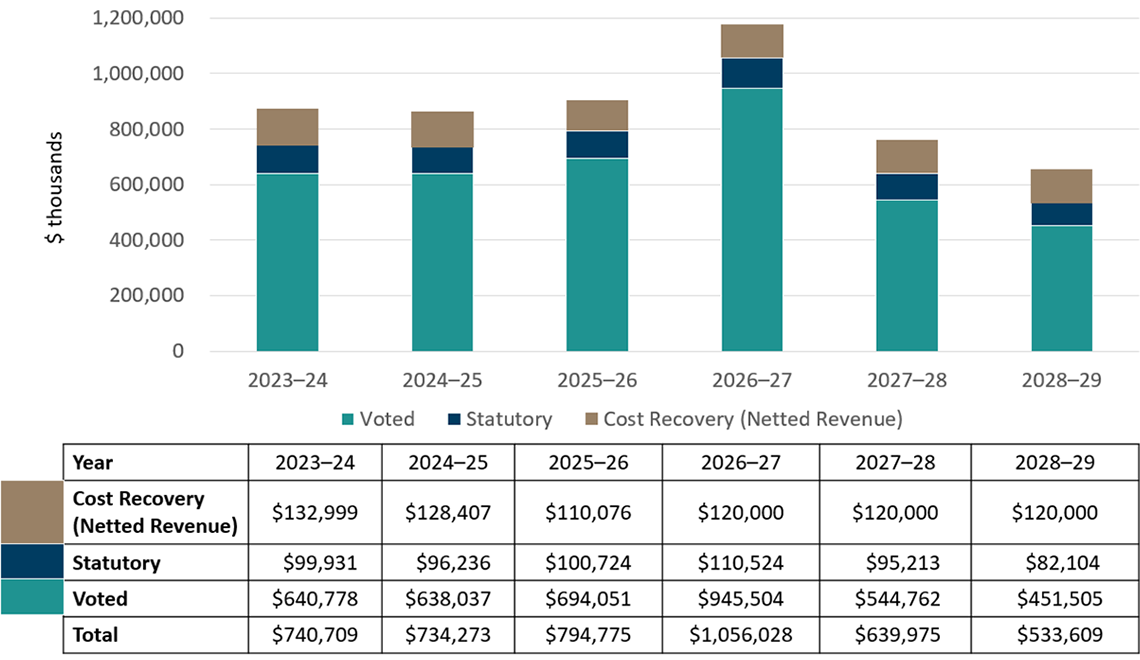
Text description of Graph 1: Approved funding (statutory and voted) over a six-year period
| Fiscal year | Total | Voted | Statutory | Cost recovery (netted revenue) |
|---|---|---|---|---|
| 2023-24 | 740,709 | 640,778 | 99,931 | 132,999 |
| 2024-25 | 734,273 | 638,037 | 96,236 | 128,407 |
| 2025-26 | 794,775 | 694,051 | 100,724 | 110,076 |
| 2026-27 | 1,056,028 | 945,504 | 110,524 | 120,000 |
| 2027-28 | 639,975 | 544,762 | 95,213 | 120,000 |
| 2028-29 | 533,609 | 451,505 | 82,104 | 120,000 |
Analysis of statutory and voted funding over a six-year period
Spending fluctuations shown in the graph and table are primarily driven by the Census Program. Spending continues to ramp up through 2025-26 and will peak in 2026-27, when the 2026 Census of Population and 2026 Census of Agriculture are conducted. Spending will decline significantly in subsequent years as census operations wind down. Funding for the 2031 Census of Population and 2031 Census of Agriculture is not included in 2028-29, as it will be sought through a forthcoming approval process. Implementation of the targeted savings identified through the CER also contributes to the decline in funding.
For further information on Statistics Canada's departmental appropriations, consult the 2026-27 Main Estimates.
Future-oriented condensed statement of operations
The future-oriented condensed statement of operations provides an overview of Statistics Canada's operations for 2025-26 to 2026-27.
Table 10: Future-oriented condensed statement of operations for the year ended March 31, 2027 (dollars)
Table 10 summarizes the expenses and revenues which net to the cost of operations before government funding and transfers for 2025-26 to 2026-27. The forecast and planned amounts in this statement of operations were prepared on an accrual basis. The forecast and planned amounts presented in other sections of the Departmental Plan were prepared on an expenditure basis. Amounts may therefore differ.
| Financial information | 2025-26 Forecast results | 2026-27 Planned results | Difference (Planned results minus forecasted) |
|---|---|---|---|
| Total expenses | 1,018,814,250 | 1,352,602,923 | 333,788,673 |
| Total revenues | 110,075,609 | 120,000,000 | 9,924,391 |
| Net cost of operations before government funding and transfers | 908,738,641 | 1,232,602,923 | 323,864,282 |
Analysis of forecasted and planned results
The difference between 2025-26 forecast results and 2026-27 planned results is primarily attributable to increased spending on the Census Program and the agency's use of the operating budget carry-forward mechanism to manage the cyclical nature of its operations. The increased spending is partly offset by the CER.
The agency successfully completed the transition of its IT infrastructure from data centres to the cloud. Starting in 2026-27, funding to continue operating in the cloud is not included in the planned spending, in anticipation of an enterprise-wide funding model.
A more detailed Future-Oriented Statement of Operations and associated Notes for 2026-27, including a reconciliation of the net cost of operations with the requested authorities, is available on Statistics Canada's website.
Human resources
This section presents an overview of the department's actual and planned human resources from 2023-24 to 2028-29.
Table 11: Actual human resources for core responsibilities and internal services
Table 11 shows a summary of human resources, in full-time equivalents, for Statistics Canada's core responsibilities and for its internal services for the previous three fiscal years. Human resources for the 2025–26 fiscal year are forecasted based on year to date.
| Core responsibilities and internal services | 2023-24 Actual full-time equivalents | 2024-25 Actual full-time equivalents | 2025-26 Forecasted full-time equivalents |
|---|---|---|---|
| Statistical Information | 6,291 | 6,075 | 6,350 |
| Internal services | 619 | 685 | 664 |
| Total gross | 6,910 | 6,760 | 7,014 |
| Respendable revenue | -1,373 | -1,267 | -1,087 |
| Total net | 5,537 | 5,493 | 5,927 |
Analysis of human resources over the last three years
The increase in human resources under statistical information in 2025-26 is related to preparations for the 2026 Census of Population. Fluctuations in human resources under internal services are largely attributable to how the agency strategically manages its investments. The agency leverages the operating budget carry-forward mechanism to manage the cyclical nature of program operations and investments in the agency's strategic priorities.
Table 12: Human resources planning summary for core responsibilities and internal services
Table 12 shows information on human resources, in full-time equivalents, for each of Statistics Canada's core responsibilities and for its internal services planned for the next three years.
| Core responsibilities and internal services | 2026-27 Planned full-time equivalents | 2027-28 Planned full-time equivalents | 2028-29 Planned full-time equivalents |
|---|---|---|---|
| Statistical Information | 6,692 | 5,756 | 4,984 |
| Internal services | 601 | 576 | 532 |
| Total gross | 7,293 | 6,332 | 5,516 |
| Respendable revenue | -1,164 | -1,164 | -1,164 |
| Total net | 6,129 | 5,168 | 4,352 |
Analysis of human resources for the next three years
Statistics Canada's planned full-time equivalents for 2026-27 to 2028-29 reflect the cyclical nature of the Census Program, which is partly offset by the savings targets announced under the CER.
Human resources will peak in 2026-27, when the 2026 Census of Population and 2026 Census of Agriculture are conducted. As in previous census cycles, a significant decrease in FTEs is expected in subsequent years as census operations wind down. This pattern is consistent with past trends and reflects the workforce required to support the agency's largest statistical operation. Resources for the 2031 cycle of Census of Population and Census of Agriculture are not included in 2028-29, as funding for the future cycle will be sought through a forthcoming approval process.
Federal tax expenditures
Statistics Canada's Departmental Plan does not include information on tax expenditures.
The tax system can be used to achieve public policy objectives through the application of special measures such as low tax rates, exemptions, deductions, deferrals and credits. The Department of Finance Canada publishes cost estimates and projections for these measures each year in the Report on Federal Tax Expenditures.
This report also provides detailed background information on tax expenditures, including descriptions, objectives, historical information and references to related federal spending programs as well as evaluations and GBA Plus of tax expenditures.
Corporate information
Departmental profile
Departmental profile
Appropriate minister:
The Honourable Mélanie Joly, P.C., M.P.
Institutional head:
André Loranger
Ministerial portfolio:
Innovation, Science and Economic Development
Enabling instruments:
Year of incorporation / commencement:
The Dominion Bureau of Statistics was established in 1918. In 1971, with the revision of the Statistics Act, the agency became Statistics Canada.
Other:
Under the Statistics Act, Statistics Canada is required to collect, compile, analyze, abstract and publish statistical information relating to the commercial, industrial, financial, social, economic and general activities and condition of the people of Canada.
Statistics Canada has two primary objectives:
- provide statistical information and analysis on the economic and social structure and functioning of Canadian society, as a basis for developing, operating and evaluating public policies and programs; for public and private decision making; and for the general benefit of all Canadians
- promote the quality, coherence and international comparability of Canada's statistics through collaboration with other federal departments and agencies and the provinces and territories, in accordance with sound scientific standards and practices.
Statistics Canada's head office is located in Ottawa. There are regional offices across the country in Halifax, Sherbrooke, Montréal, Toronto, Sturgeon Falls, Winnipeg, Edmonton, Vancouver and Yellowknife. There are also 35 research data centres located throughout the country in academic institutions. In addition, there are five secure rooms available for access by employees of federal departments and selected provincial ministries. These centres provide researchers with access to microdata from population and household survey programs in a secure setting. Canadians can follow the agency on Facebook, Instagram, LinkedIn, Reddit, X (Twitter) and YouTube.
Departmental contact information
Departmental contact information
Mailing address:
Statistics Canada
150 Tunney's Pasture Driveway
Ottawa, Ontario
K1A 0T6
Telephone:
Toll-free: 1-800-263-1136
International: 1-514-283-8300
TTY:
1-800-363-7629
Fax:
1-514-496-4879
Email:
Website:
Definitions
List of terms
- appropriation (crédit)
- Any authority of Parliament to pay money out of the Consolidated Revenue Fund.
- budgetary expenditures (dépenses budgétaires)
- Operating and capital expenditures; transfer payments to other levels of government, departments or individuals; and payments to Crown corporations.
- core responsibility (responsabilité essentielle)
- An enduring function or role performed by a department. The intentions of the department with respect to a core responsibility are reflected in one or more related departmental results that the department seeks to contribute to or influence.
- Departmental Plan (plan ministériel)
- A report on the plans and expected performance of an appropriated department over a 3year period. Departmental Plans are usually tabled in Parliament each spring.
- departmental result (résultat ministériel)
- A consequence or outcome that a department seeks to achieve. A departmental result is often outside departments' immediate control, but it should be influenced by program-level outcomes.
- departmental result indicator (indicateur de résultat ministériel)
- A quantitative measure of progress on a departmental result.
- departmental results framework (cadre ministériel des résultats)
- A framework that connects the department's core responsibilities to its departmental results and departmental result indicators.
- Departmental Results Report (rapport sur les résultats ministériels)
- A report on a department's actual accomplishments against the plans, priorities and expected results set out in the corresponding Departmental Plan.
- full-time equivalent (équivalent temps plein)
- A measure of the extent to which an employee represents a full person-year charge against a departmental budget. For a particular position, the full-time equivalent figure is the ratio of number of hours the person actually works divided by the standard number of hours set out in the person's collective agreement.
- gender-based analysis plus (GBA Plus) (analyse comparative entre les sexes plus [ACS Plus])
- Is an analytical tool used to support the development of responsive and inclusive policies, programs, and other initiatives. GBA Plus is a process for understanding who is impacted by the issue or opportunity being addressed by the initiative; identifying how the initiative could be tailored to meet diverse needs of the people most impacted; and anticipating and mitigating any barriers to accessing or benefitting from the initiative. GBA Plus is an intersectional analysis that goes beyond biological (sex) and socio-cultural (gender) differences to consider other factors, such as age, disability, education, ethnicity, economic status, geography (including rurality), language, race, religion, and sexual orientation.
Using GBA Plus involves taking a gender- and diversity-sensitive approach to our work. Considering all intersecting identity factors as part of GBA Plus, not only sex and gender, is a Government of Canada commitment.
- government priorities (priorités gouvernementales)
- For the purpose of the 2026-27 Departmental Plan, government priorities are the high-level themes outlining the government's agenda in the 2025 Speech from the Throne.
- horizontal initiative (initiative horizontale)
- An initiative where two or more federal departments are given funding to pursue a shared outcome, often linked to a government priority.
- Indigenous business (entreprise autochtones)
- Requirements for verifying Indigenous businesses for the purposes of the departmental result report are available through the Indigenous Services Canada Mandatory minimum 5% Indigenous procurement target website.
- non‑budgetary expenditures (dépenses non budgétaires)
- Non-budgetary authorities that comprise assets and liabilities transactions for loans, investments and advances, or specified purpose accounts, that have been established under specific statutes or under non-statutory authorities in the Estimates and elsewhere. Non-budgetary transactions are those expenditures and receipts related to the government's financial claims on, and obligations to, outside parties. These consist of transactions in loans, investments and advances; in cash and accounts receivable; in public money received or collected for specified purposes; and in all other assets and liabilities. Other assets and liabilities, not specifically defined in G to P authority codes are to be recorded to an R authority code, which is the residual authority code for all other assets and liabilities.
- performance (rendement)
- What a department did with its resources to achieve its results, how well those results compare to what the department intended to achieve, and how well lessons learned have been identified.
- performance indicator (indicateur de rendement)
- A qualitative or quantitative means of measuring an output or outcome, with the intention of gauging the performance of a department, program, policy or initiative respecting expected results.
- plan (plan)
- The articulation of strategic choices, which provides information on how a department intends to achieve its priorities and associated results. Generally, a plan will explain the logic behind the strategies chosen and tend to focus on actions that lead to the expected result.
- planned spending (dépenses prévues)
- For Departmental Plans and Departmental Results Reports, planned spending refers to those amounts presented in Main Estimates.
A department is expected to be aware of the authorities that it has sought and received. The determination of planned spending is a departmental responsibility, and departments must be able to defend the expenditure and accrual numbers presented in their Departmental Plans and Departmental Results Reports.
- program (programme)
- Individual or groups of services, activities or combinations thereof that are managed together within the department and focus on a specific set of outputs, outcomes or service levels.
- program inventory (répertoire des programmes)
- Identifies all the department's programs and describes how resources are organized to contribute to the department's core responsibilities and results.
- result (résultat)
- A consequence attributed, in part, to a department, policy, program or initiative. Results are not within the control of a single department, policy, program or initiative; instead they are within the area of the department's influence.
- statutory expenditures (dépenses législatives)
- Expenditures that Parliament has approved through legislation other than appropriation acts. The legislation sets out the purpose of the expenditures and the terms and conditions under which they may be made.
- target (cible)
- A measurable performance or success level that a department, program or initiative plans to achieve within a specified time period. Targets can be either quantitative or qualitative.
- voted expenditures (dépenses votées)
- Expenditures that Parliament approves annually through an appropriation act. The vote wording becomes the governing conditions under which these expenditures may be made.