
By the numbers
By the numbers highlights some of Statistics Canada's key findings on various occasions that are meaningful to Canadians.
By the numbers highlights some of Statistics Canada's key findings on various occasions that are meaningful to Canadians.
Date: December 2022
Program manager: Director, Canadian Centre for Justice and Community Safety Statistics
Director General, Heath Justice and Special Surveys
Personal information collected through the Profiles of Victims of Gang Violence: Analysis of a BC Cohort project is described in Statistics Canada's "Statistical Infrastructure Services" Class of Personal Information. The Class of Personal Information refers to records related to statistical infrastructure services (e.g., development of concepts, support for data collection and dissemination activities, provision of advice and technical assistance) offered on a cost-recovery basis to meet the needs of external clients such as other federal government departments.
"Statistical Infrastructure Services" Class of Personal Information (Record number: StatCan SOP 610) is published on the Statistics Canada website under the latest Information about programs and Information Holdings chapter.
Under the authority of the Statistics ActFootnote1, Statistics Canada has entered into an agreement with British Columbia's integrated anti-gang police force, Combined Forces Special Enforcement Unit of British Columbia (CFSEU-BC) to study the effects of gang-related violence within the province of British Columbia. This study will require the submission of personal information from CFSEU-BC that will be used in conjunction with existing Statistics Canada databases, to produce a de-identified and aggregated report, as well as other possible de-identified and aggregated publications. No personal identifiable information from Statistics Canada's databases will be shared with CFSEU-BC or included in any products resulting from the study. The personal information received by CFSEU-BC will be used strictly for this activity. All identifiers will be destroyed as soon as the study is complete, and no identifiable personal information received from CFSEU BC will be retained by Statistics Canada as a result of this study.
This project has been requested by the CFSEU-BC who maintain a gang-related victim repository that includes data for individuals across the province who are the victims of a suspected or confirmed gang-related homicide or attempt homicide. The CFSEU-BC seeks to further understand the profiles of the victims and their trajectories through the justice and other social systems, which will require linkage of the CFSEU-BC cohort to other social data sources held by Statistics Canada.
The CFSEU-BC will be providing Statistics Canada with an extract of Police Records Information Management Environment (PRIME) and Canadian Police Information Centre (CPIC) data via Statistics Canada's secure data acquisition process, a process that includes but is not limited to the use of the encrypted Electronic File Transfer (EFT) service to place the data on secure Statistics Canada servers which are monitored by active security groups. The PRIME data will detail information concerning the victims of gang-related homicide and attempted homicide in British Columbia between 2006 and 2020, specifically the events surrounding the incidents of homicide or attempted homicide. This data will contain names; dates of birth; race; and last known address or minimum postal code. The CPIC data will detail the criminal convictions, criminal charges, outstanding warrants and charges, and records of discharge of the victims. The PRIME and CPIC data may contain data on minors.
In order for Statistics Canada to conduct the required analysis, data will be linked to other Statistics Canada datasets through the Social Data Linkage Environment (SDLE)Footnote2, including the following datasets:
This will enable the determination of contact between the victim and the criminal justice system, health care system, and employment and social assistance services. A linkage to the Vital Statistics (Deaths) file in the SDLE will be used to validate the linkage of victims of homicide.
Statistics Canada's microdata linkageFootnote3 and related statistical activities were assessed for privacy in the Social Data Linkage Environment (SDLE) Privacy Impact AssessmentFootnote4 and Statistics Canada's Generic Privacy Impact AssessmentFootnote5.
Statistics Canada will share the subsequent analysis with the CFSEU-BC in the form of aggregated results and any conclusions drawn compiled into a report, which may be further published in a volume of JuristatFootnote6. Any analysis released outside of Statistics Canada will be fully anonymized and non-confidential, without any direct personal identifiers, which prevents the possibility of identifying individuals. Data used for this project will not be made available in the Research Data Centres nor anywhere outside of Statistics Canada and will be destroyed following the conclusion of the project.
The personal information elements, method of collection, legal authority for collection, relevant PIB, storage location/system, and purpose of collection are listed in Appendix 1 - Personal Information Elements Table.
While the Generic Privacy Impact Assessment (PIA) addresses most of the privacy and security risks related to statistical activities conducted by Statistics Canada, this supplement is being carried out due to the sensitive nature of data surrounding victimization. The supplement also emphasizes that none of the data or resulting analysis will be used for administrative, investigative, or operational uses. As is the case with all PIAs, Statistics Canada's privacy framework ensures that elements of privacy protection and privacy controls are documented and applied.
The use of personal information for the activity can be justified against Statistics Canada's Necessity and Proportionality Framework:
Necessity: Research has demonstrated that individuals involved in gangs engage in antisocialFootnote7 and often violent behavioursFootnote8. In addition to individual adverse health risks for those involved in gangs, including substance abuse, gun carrying, arrest, illicit drug sales, familial hardship, high-risk sexual behaviour, nonfatal intentional injury, and homicide, gangs and their criminal behaviours have a detrimental effect on communities and public safetyFootnote9. British Columbia has observed negative impacts that gangs and gang activity have on the community, such as violence related to drugs, firearms, illegal gaming, and other criminal activity. In fact, the CFSEU-BC data details the more than 500 homicides and attempted homicides with a gang nexus across British Columbia between January 2006 and December 2020, demonstrating the frequency and severity of gang-related violence across the province. These occurrences have impacted more than 30 jurisdictions across the province, and have even occurred within institutions, such as correctional facilities.
Through this analysis, Statistics Canada aims to provide information that will allow an in-depth understanding of victims of gang-related violence (homicide and attempted homicide) and explore longitudinal trajectories and life histories that have led to individuals becoming victims of gang-related violence. For this reason, the data originating from the CFSEU-BC and, in particular, personal indicators, are needed for linking to administrative data within Statistics Canada's Social Data Linkage Environment (SDLE). Microdata linkage works best using personal indicators such as names, date of birth, and addresses as these most accurately identify the same individuals from different data sources. Without the personal identifiers, an accurate linkage of this administrative data, and therefore this analysis, would not be possible.
The variables to be included in the linkage and analysis, as well as the rationale for including the various databases/variables, can be found in Appendix 1.
While data on race is particularly sensitive and could potentially lead to stereotyping and result in harm to certain vulnerable groups, it is being included as a variable to ensure that the life courses of individuals of differing racial backgrounds are captured as accurately as possible, which is in line with Statistics Canada's efforts to perform analysis using disaggregated dataFootnote10. Statistics Canada's Canadian Centre for Justice and Community Safety Statistics (CCJCSS) has years of experience with sensitively and carefully producing reports on gang-related individuals, including Indigenous and other racialized groups, and will ensure that the information is presented in a manner which does not stigmatize particular groups.
The ability to link information on the same individual through their income, education, immigration, health, and other data across various human services and across the individual's lifespan, prior to becoming a gang victim, is integral to the ability to identify risk factors for gang involvement and victimization.
This project will help Statistics Canada meet its statistical mandate by providing statistical information and analysis about Canada's social structure to develop and evaluate public policies and programs and to improve public and private decision-making for the benefit of all Canadians. Specifically, this data-driven effort will enhance CFSEU-BC's ability to develop an informed, community-based program that could be funded through Public Safety's Youth Gang Prevention Fund (YGPF) or Crime Prevention Action Fund (CPAF), as well as provincial funding streams. These programs, if successful, could then be applied across the country.
Further, this project promotes sound statistical standards and practices by improving statistical methods and systems through joint research studies and projects.
Effectiveness - Working assumptions: With the personal identifiers from the CFSEU-BC datasets, Statistics Canada will be in a unique position to be able to map the life events of the victims of gang-related homicide and gang-related assisted homicide through the administrative data holdings contained within the SDLE. High quality personal indicators, such as names and dates of birth, are required to ensure that the linkage can be done as accurately as possible.
The linked data will provide an in-depth understanding of the victims of gang-related violence, including their trajectories and life history to the point of becoming a victim of violence. Integrating these additional administrative data with the victim records will allow Statistics Canada researchers to examine how victims have interacted with different government entities such as the criminal justice system, health care system, and employment and social assistance services, etc., along their life course. More specifically, cluster analysisFootnote11 of the linked data will allow for the identification of key risk factors associated with the likelihood of joining gangs, coming into contact with police, courts, and corrections, as well as becoming a victim of gang-related violence. Survival analysisFootnote12 will then be used to estimate the strength of the relationships between risk factors and victimization, which would then allow for an exploration of which interventions would have the most impact. Examples of the linked variables to be analyzed can be found in the appendix.
With this better understanding stemming from the aggregated analysis, the CFSEU-BC hope to inform better allocation of resources for gang prevention initiatives. The analysis performed for this project will provide policy- and program-relevant results by helping to show which background factors are most strongly associated with gang involvement and gang violence, and this could help shape programs designed to address the identified risk factors.
Proportionality: The sample size to be used for this project is relatively small and it is not expected for every member of the sample to be found in each data source, meaning that the pool of linked observations will be even smaller. Any data, despite the sensitivity, which might lead to a linkage is therefore crucial to achieve the goal of this project. All personal information being collected about each affected individual via the CFSEU-BC, despite the sensitivity of any of the elements of personal information, is crucial to this collection to ensure the highest possible quality of linkage and analysis can be performed, resulting in strong and actionable conclusions. The data to be used in this project have already been collected, thus eliminating the need of any additional burden on the victims. The files and variables used represent only those needed to produce high quality aggregated analytical information.
In the preparation of this project, consultations have been held with the Canadian Centre for Justice and Community Safety Statistics (CCJCSS), the Data Ethics Committee (DEC), the Office of Privacy Management and Information Coordination (OPMIC), and SDLE at Statistics Canada, as well as the CFSEU-BC, to ensure that only that data which is necessary is included in this project.
While the data being used for this project are sensitive, their analysis will allow the CFSEU-BC to enhance prevention and intervention efforts for at-risk individuals by informing policy and helping programs aimed at preventing British Columbians from entering into a criminal lifestyle. As mentioned above, these efforts aim to protect the lives and wellbeing of those at risk.
Information that will be provided by the CFSEU-BC for this analysis includes:
These data are sensitive as they concern the victims of gang-related homicide and gang-related assisted homicide, and may include data on minors.
The overall risk of harm to the survey respondents has been deemed manageable with existing Statistics Canada safeguards that are described in Statistics Canada's Generic Privacy Impact Assessment, of which the following is of particular importance for this project: upon receipt of the files, personal identifiers will be separated from the other data and replaced with an anonymized linkage key. The personal identifiers will be stored securely and separately from the analytical file and will be available only to the project team at Statistics Canada on a need-to-know basis.
It should be noted that no investigative file information will be disclosed by the CFSEU-BC to Statistics Canada, and Statistics Canada will not be providing any identifiers to the CFSEU-BC. The data will only be used for research purposes (i.e., analysis and the development of aggregate reports for publication), and will not be used for administrative, investigative, or operational purposes.
This assessment concludes that, with the existing Statistics Canada safeguards, any remaining risks are such that Statistics Canada is prepared to accept and manage the risk.
| Geography | Month |
|---|---|
| 202303 | |
| % | |
| Canada | 0.7 |
| Newfoundland and Labrador | 1.6 |
| Prince Edward Island | 2.5 |
| Nova Scotia | 2.2 |
| New Brunswick | 1.5 |
| Quebec | 1.2 |
| Ontario | 1.4 |
| Manitoba | 1.3 |
| Saskatchewan | 2.8 |
| Alberta | 1.3 |
| British Columbia | 1.5 |
| Yukon Territory | 0.9 |
| Northwest Territories | 2.0 |
| Nunavut | 1.2 |
In line with the Government of Canada's priority to make more detailed data accessible on gender and diversity characteristics to support and inform the development of equitable policies and programs, Budget 2018 committed funds for Statistics Canada to create the Centre for Gender, Diversity and Inclusion Statistics (CGDIS). While the original focus of the CGDIS was mainly on Gender-based Analysis Plus (GBA Plus), the scope and mandate broadened over time and now include other groups such as 2SLGBTQI+ and racialized groups.
Through its work, the CGDIS aims to:
These measures extend to conducting intersectional analyses and contributing to training initiatives that will help build an understanding of the barriers that different groups face and how best to support them with evidence-based policies.
The CGDIS strives to achieve its mandate through the following three objectives:
Moreover, as Statistics Canada's centre of excellence for GDI-related data, the CGDIS has also been assigned a key role in supporting the Disaggregated Data Action Plan, which aims to fill data and knowledge gaps around GDI.
This evaluation was conducted by Statistics Canada in accordance with the Treasury Board Policy on Results and Statistics Canada's Integrated Risk-Based Audit and Evaluation Plan (2021/2022 to 2025/2026). The objective of the evaluation is to assess the relevance of the CGDIS, its effectiveness in achieving intended results and its readiness to move forward. Effectiveness was examined in terms of its progress towards its objectives.
The CGDIS made progress on all three key objectives and has met the key deliverables outlined in its strategic proposal. The Gender, Diversity and Inclusion Statistics (GDIS) Hub was launched in September 2018, and the Centre delivered several products over the period. In addition, GBA Plus training material was developed in collaboration with Women and Gender Equality Canada and the Canada School of Public Service, and hub tours were delivered.
The CGDIS' engagement strategy promoted the awareness and use of the GDIS Hub and related products but mainly among federal government organizations (FGOs). Overall, the CGDIS met the needs of most FGOs, particularly those who were regular clients of the Centre. While the needs of non-FGOs were met to a lesser extent, most of them still supported the work of the CGDIS and underscored the importance of the GDIS Hub. Data needs varied across user groups, but they all expressed a desire to have more disaggregated data to better understand the intersectionality as opposed to binary interactions. Many opportunities for improvements were also noted for the presentation of data, overall functionality of the Hub and outreach efforts to non-FGOs.
The CGDIS has strategically transformed its organization to adapt and evolve. However, gaps in its overall program management, oversight and capacity are risks. Having robust planning and prioritization processes, relevant performance measurement, clearly defined roles and responsibilities, and proper governance are key considerations as the CGDIS moves forward. A more strategic targeted approach is also required to improve outreach and engagement with non-FGOs.
The evaluation proposed the following three recommendations:
The Assistant Chief Statistician, Social, Health and Labour Statistics Field (Field 8), should ensure that the CGDIS:
The Assistant Chief Statistician, Social, Health and Labour Statistics Field (Field 8), should ensure that the CGDIS:
The Assistant Chief Statistician, Social, Health and Labour Statistics Field (Field 8), should ensure that the CGDIS takes steps to broaden and enhance its outreach, consultation and engagement efforts to include external non-FGO stakeholders.
This survey collects information on scientific activities of Canadian businesses. The research and development expenditures and personnel information is used by federal, provincial and territorial governments and agencies, academics, trade associations and international organizations for statistical analyses and policy purposes. These data also contribute to national totals of research and development activities. The payments and receipts information is used by these agencies to monitor knowledge flows across international borders and between Canadian businesses.
Your information may also be used by Statistics Canada for other statistical and research purposes.
Your participation in this survey is required under the authority of the Statistics Act.
Authorization to collect this information
Data are collected under the authority of the Statistics Act, Revised Statutes of Canada, 1985, Chapter S-19.
Confidentiality
By law, Statistics Canada is prohibited from releasing any information it collects that could identify any person, business, or organization, unless consent has been given by the respondent, or as permitted by the Statistics Act. Statistics Canada will use the information from this survey for statistical purposes only.
Record linkages
To enhance the data from this survey and to reduce the reporting burden, Statistics Canada may combine the acquired data with information from other surveys or from administrative sources.
Data-sharing agreements
To reduce respondent burden, Statistics Canada has entered into data-sharing agreements with provincial and territorial statistical agencies and other government organizations, which have agreed to keep the data confidential and use them only for statistical purposes. Statistics Canada will only share data from this survey with those organizations that have demonstrated a requirement to use the data.
Provincial and territorial statistical agencies
Section 11 of the Statistics Act provides for the sharing of information with provincial and territorial statistical agencies that meet certain conditions. These agencies must have the legislative authority to collect the same information, on a mandatory basis, and the legislation must provide substantially the same provisions for confidentiality and penalties for disclosure of confidential information as the Statistics Act. Because these agencies have the legal authority to compel businesses to provide the same information, consent is not requested and businesses may not object to the sharing of the data.
For this survey, there are Section 11 agreements with the provincial and territorial statistical agencies of Newfoundland and Labrador, Nova Scotia, New Brunswick, Quebec, Ontario, Manitoba, Saskatchewan, Alberta, British Columbia and the Yukon. The shared data will be limited to information on in-house research and development expenditures (Question 14) and in-house research and development personnel (Question 72) pertaining to business establishments located within the jurisdiction of the respective province or territory.
Section 12 of the Statistics Act provides for the sharing of information with federal, provincial or territorial government organizations. Under Section 12, you may refuse to share your information with any of these organizations by writing a letter of objection to the Chief Statistician, specifying the organizations with which you do not want Statistics Canada to share your data and mailing it to the following address:
Chief Statistician of Canada
Statistics Canada
Attention of Director, Enterprise Statistics Division
150 Tunney's Pasture Driveway
Ottawa, Ontario
K1A 0T6
You may also contact us by email at statcan.esdhelpdesk-dsebureaudedepannage.statcan@statcan.gc.ca or by fax at 613-951-6583.
Other data-sharing agreement
For this survey, there are Section 12 agreements with the statistical agencies of Prince Edward Island, the Northwest Territories and Nunavut. The shared data will be limited to information on in-house research and development expenditures (Question 14) and in-house research and development personnel (Question 72) pertaining to business establishments located within the jurisdiction of the respective province or territory.
Innovation, Science and Economic Development Canada
For this survey, Statistics Canada will share survey data with Innovation, Science and Economic Development Canada. The shared data will be limited to information on research and development expenditures (Questions 4 to 21) and in-house research and development personnel (Questions 70 to 72).
Natural Resources Canada
For respondents with expenditures on energy-related research and development in technology (fossil fuels, renewable energy resources, nuclear fission and fusion, electric power, hydrogen and fuel cells, energy efficiency, other energy-related technologies), Statistics Canada will also share survey data with the Office of Energy Research and Development (OERD) of Natural Resources Canada. The shared data will be limited to information on Energy Research and Development Expenditures by Area of Technology (Questions 22 to 69).
Sustainable Development Technology Canada
For this survey, Statistics Canada will share survey data with Sustainable Development Technology Canada.
1. Verify or provide the business or organization's legal and operating name and correct where needed.
Note: Legal name modifications should only be done to correct a spelling error or typo.
Legal Name
The legal name is one recognized by law, thus it is the name liable for pursuit or for debts incurred by the business or organization. In the case of a corporation, it is the legal name as fixed by its charter or the statute by which the corporation was created.
Modifications to the legal name should only be done to correct a spelling error or typo.
To indicate a legal name of another legal entity you should instead indicate it in question 3 by selecting 'Not currently operational' and then choosing the applicable reason and providing the legal name of this other entity along with any other requested information.
Operating Name
The operating name is a name the business or organization is commonly known as if different from its legal name. The operating name is synonymous with trade name.
2. Verify or provide the contact information of the designated business or organization contact person for this questionnaire and correct where needed.
Note: The designated contact person is the person who should receive this questionnaire. The designated contact person may not always be the one who actually completes the questionnaire.
3. Verify or provide the current operational status of the business or organization identified by the legal and operating name above.
4. Verify or provide the current main activity of the business or organization identified by the legal and operating name above.
Note: The described activity was assigned using the North American Industry Classification System (NAICS).
This question verifies the business or organization's current main activity as classified by the North American Industry Classification System (NAICS). The North American Industry Classification System (NAICS) is an industry classification system developed by the statistical agencies of Canada, Mexico and the United States. Created against the background of the North American Free Trade Agreement, it is designed to provide common definitions of the industrial structure of the three countries and a common statistical framework to facilitate the analysis of the three economies. NAICS is based on supply-side or production-oriented principles, to ensure that industrial data, classified to NAICS, are suitable for the analysis of production-related issues such as industrial performance.
The target entity for which NAICS is designed are businesses and other organizations engaged in the production of goods and services. They include farms, incorporated and unincorporated businesses and government business enterprises. They also include government institutions and agencies engaged in the production of marketed and non-marketed services, as well as organizations such as professional associations and unions and charitable or non-profit organizations and the employees of households.
The associated NAICS should reflect those activities conducted by the business or organizational units targeted by this questionnaire only, as identified in the 'Answering this questionnaire' section and which can be identified by the specified legal and operating name. The main activity is the activity which most defines the targeted business or organization's main purpose or reason for existence. For a business or organization that is for-profit, it is normally the activity that generates the majority of the revenue for the entity.
The NAICS classification contains a limited number of activity classifications; the associated classification might be applicable for this business or organization even if it is not exactly how you would describe this business or organization's main activity.
Please note that any modifications to the main activity through your response to this question might not necessarily be reflected prior to the transmitting of subsequent questionnaires and as a result they may not contain this updated information.
The following is the detailed description including any applicable examples or exclusions for the classification currently associated with this business or organization.
Description and examples
5. You indicated that is not the current main activity.
Was this business or organization's main activity ever classified as:?
6. Search and select the industry classification code that best corresponds to this business or organization's main activity.
How to search:
Select this business or organization's activity sector (optional)
Enter keywords or a brief description, then press the Search button
1. Throughout this questionnaire, please report financial information in thousands of Canadian dollars.
For example, an amount of $763,880.25 should be reported as: 764, CAN$ '000
I will report in the format above
1. What is the end date of this business's fiscal year?
Note: For this survey, this business's fiscal year end date should fall on or before March 31, 2023.
Here are some examples of fiscal periods that fall within the targeted dates:
Fiscal Year-End date
This fiscal year will be referred to as 2022 throughout the questionnaire
2. What is this business's GST number (9-digit business number)?
GST number (9-digit business number)
In-house research and development (R&D) expenditures
Before you begin, differences between Scientific Research and Experimental Development (SR&ED) tax incentive program and this survey
Include the following expenditures in this survey:
'In-house R&D ' refers to
Expenditures within Canada for R&D performed within this business by:
'Outsourced R&D ' refers to
Payments made within or outside Canada to other businesses, organizations or individuals to fund R&D performance:
3. In 2022, did this business have expenditures for R&D performed in-house within Canada?
Exclude payments for outsourced (contracted out or granted) R&D, which should be reported in question 9.
In-house refers to R&D which is performed on-site or within the business's establishment. Exclude R&D expenses performed by other companies or organizations. A later question will collect these data.
Research and experimental development ( R&D ) comprise creative and systematic work undertaken in order to increase the stock of knowledge - including knowledge of humankind, culture and society - and to devise new applications of available knowledge.
R&D is performed in the natural sciences, engineering, social sciences and humanities. There are three types of R&D activities: basic research, applied research and experimental development.
Research work in the social sciences
Include if projects are employing new or significantly different modelling techniques or developing new formulae, analyzing data not previously available or applying new research techniques, development of community strategies for disease prevention, or health education.
Exclude:
4. In 2022, what were this business's expenditures for R&D performed in-house within Canada?
Exclude payments for outsourced (contracted out or granted) R&D, which should be reported in question 9.
Please report all amounts in thousands of Canadian dollars.
Report '0' for no R&D expenditures.
In-house R&D expenditures are composed of current in-house R&D expenditures and capital in-house R&D expenditures.
Current in-house R&D expenditures
Include:
a. Wages, salaries of permanent, temporary and casual R&D employees
Include benefits and fringe benefits of employees engaged in R&D activities. Benefits and fringe benefits include bonus payments, holiday or vacation pay, pension fund contributions, other social security payments, payroll taxes, etc.
b. Services to support R&D
Include:
c. R&D materials
Include:
d. All other current R&D costs including overhead
Include administrative and overhead costs (e.g., office, lease/rent, post and telecommunications, internet, legal expenditures, insurance), prorated if necessary to allow for non- R&D activities within the business.
Exclude:
Capital in-house expenditures are the annual gross amount paid for the acquisition of fixed assets that are used repeatedly, or continuously in the performance of R&D for more than one year. Report capital in-house expenditures in full for the period when they occurred.
Include costs for software, land, buildings and structures, equipment, machinery and other capital costs.
Exclude capital depreciation.
e. Software
Include applications and systems software (original, customized and off-the-shelf software), supporting documentation and other software-related acquisitions.
f. Land acquired for R&D including testing grounds, sites for laboratories and pilot plants.
g. Buildings and structures that are constructed or purchased for R&D activities or that have undergone major improvements, modifications, renovations and repairs for R&D activities.
h. Equipment, machinery and all other capital
Include major equipment, machinery and instruments, including embedded software, acquired for R&D activities.
| CAN$ '000 | |
|---|---|
| 2022 - Current in-house R&D expenditures within Canada | |
| Wages, salaries of permanent, temporary and casual R&D employees Include fringe benefits. |
|
| Services to support R&D Include services of self-employed individuals or contractors who are working on-site on this business's R&D projects. Exclude contracted out or granted expenditures to other organizations to perform R&D (report in question 9). |
|
| R&D materials | |
| All other current R&D costs Include overhead costs. |
|
| 2022 - Total current in-house R&D expenditures within Canada | |
| 2022 - Capital in-house R&D expenditures within Canada | |
| Software Exclude capital depreciation. |
|
| Land Exclude capital depreciation. |
|
| Buildings and structures Exclude capital depreciation. |
|
| Equipment, machinery and all other capital Exclude capital depreciation. |
|
| 2022 - Total capital in-house R&D expenditures within Canada | |
| 2022 - Total in-house R&D expenditures within Canada |
5. In 2023 and 2024, does this business plan to have expenditures for R&D performed in-house within Canada?
Exclude payments for outsourced (contracted out or granted) R&D, which should be reported in question 11.
Select all that apply
In-house R&D expenditures are composed of current in-house R&D expenditures and capital in-house R&D expenditures.
Research and experimental development ( R&D ) comprise creative and systematic work undertaken in order to increase the stock of knowledge - including knowledge of humankind, culture and society - and to devise new applications of available knowledge
Inclusions
Prototypes
Include design, construction and operation of prototypes, provided that the primary objective is to make further improvements or to undertake technical testing.
Exclude if the prototype is for commercial purposes.
Clinical Trials
Include clinical trial phases 1, 2, and 3. Include clinical trial phase 4 only if it brings about a further scientific or technological advance.
Pilot plants
Include construction and operation of pilot plants, provided that the primary objective is to make further improvements or to undertake technical testing.
Exclude if the pilot plant is intended to be operated for commercial purposes.
New computer software or significant improvements/modifications to existing computer software
Includes technological or scientific advances in theoretical computer sciences; operating systems e.g., improvement in interface management, developing new operating system of converting an existing operating system to a significantly different hardware environment; programming languages; and applications if a significant technological change occurs.
Contracts
Include all contracts which require R&D. For contracts which include other work, report only the R&D costs.
Research work in the social sciences
Include if projects are employing new or significantly different modelling techniques or developing new formulae, analyzing data not previously available or applying new research techniques, development of community strategies for disease prevention, analysis of the effectiveness of health interventions, or health education.
Exclusions
Routine analysis in the social sciences including policy-related studies, management studies and efficiency studies
Exclude analytical projects of a routine nature, with established methodologies, principles and models of the related social sciences to bear on a particular problem (e.g., commentary on the probable economic effects of a change in the tax structure, using existing economic data; use of standard techniques in applied psychology to select and classify industrial and military personnel, students, etc., and to test children with reading or other disabilities).
Consumer surveys, advertising, market research
Exclude projects of a routine nature, with established methodologies intended for commercialization of the results of R&D.
Routine quality control and testing
Exclude projects of a routine nature, with established methodologies not intended to create new knowledge, even if carried out by personnel normally engaged in R&D.
Pre-production activities such as demonstration of commercial viability, tooling up, trial production, trouble shooting
Although R&D may be required as a result of these steps, these activities are excluded.
Prospecting, exploratory drilling, development of mines, oil or gas wells
Include only if for R&D projects concerned with new equipment or techniques in these activities, such as in-situ and tertiary recovery research.
Engineering
Exclude engineering unless it is in direct support of R&D.
Design and drawing
Exclude design and drawing unless it is in direct support of R&D.
Patent and licence work
Exclude all administrative and legal work connected with patents and licences.
Cosmetic modifications or style changes to existing products
Exclude if no significant technical improvement or modification to the existing products has occurred.
General purpose or routine data collection
Exclude projects of a routine nature, with established methodologies intended for on-going monitoring of an activity.
Routine computer programming, systems maintenance or software application
Exclude projects of a routine nature, with established methodologies intended to support on-going operations.
Routine mathematical or statistical analysis or operations analysis
Exclude projects of a routine nature, with established methodologies intended for on-going monitoring of an activity.
Activities associated with standards compliance
Exclude projects of a routine nature, with established methodologies intended to support standards compliance.
Specialized routine medical care such as routine pathology services
Exclude projects of a routine nature, with established methodologies intended for on-going monitoring of an activity where results do not further scientific, technological advance, or understanding of the effectiveness of a technology.
6. In 2023, what are this business's planned expenditures for R&D performed in-house within Canada?
Exclude payments for outsourced (contracted out or granted) R&D, which should be reported in question 11.
Please report all amounts in thousands of Canadian dollars.
Report '0' for no R&D expenditures.
| CAN$ '000 | |
|---|---|
| 2023 - Total current in-house R&D expenditures within Canada | |
| 2023 - Total capital in-house R&D expenditures within Canada |
7. In 2024, what are this business's planned expenditures for R&D performed in-house within Canada?
Exclude payments for outsourced (contracted out or granted) R&D, which should be reported in question 11.
Please report all amounts in thousands of Canadian dollars.
Report '0' for no R&D expenditures.
| CAN$ '000 | |
|---|---|
| 2024 - Total current in-house R&D expenditures within Canada | |
| 2024 - Total capital in-house R&D expenditures within Canada |
8. In 2022, did this business have outsourced (contracted out or granted) R&D expenditures within Canada or outside Canada?
Include:
Exclude services of self-employed individuals or contractors who are working on-site on this business's R&D projects, which should be reported in question 4.
Select all that apply.
Outsourced (contracted out or granted) R&D expenditures are payments made through contracts, grants and fellowships to another company, organization or individual to purchase R&D activities.
9. In 2022, what were this business's outsourced (contracted out or granted) R&D expenditures within Canada or outside Canada?
Include:
Exclude services of self-employed individuals or contractors who are working on-site on this business's R&D projects, which should be reported in question 4.
Please report all amounts in thousands of Canadian dollars.
Report '0' for no R&D expenditures.
Include payments made through contracts, grants, donations and fellowships to another company, organization or individual to purchase or fund R&D activities.
Exclude expenditures for on-site R&D contractors.
Parent and subsidiary companies are companies connected to each other through majority ownership of the subsidiary company by the parent company. Affiliated companies are companies connected to a parent through minority ownership of the affiliated companies by the parent.
Companies include all incorporated for-profit businesses and government business enterprises providing products in the market at market rates.
Private non-profit organizations include voluntary health organizations, private philanthropic foundations, associations, consortia, accelerators, and societies and research institutes. They are not-for-profit organizations that serve the public interest by supporting activities related to public welfare (such as health, education, the environment).
Industrial research institutes or associations include all non-profit organizations that serve the business sector, with industrial associations frequently consisting of their membership.
Universities include hospitals and clinics when they are affiliated with a university and provide education services or when R&D activity is under the direct control of a university.
Federal government includes all federal government departments and agencies. It excludes federal government business enterprises providing products in the market.
Provincial or territorial governments include all provincial or territorial government ministries, departments and agencies. It excludes provincial or territorial government business enterprises providing products in the market.
Provincial or territorial research organizations are organizations created under provincial or territorial law which conduct or facilitate research on behalf of the province or territory.
Other organizations - individuals, non-university educational institutions, for profit accelerators and incubators, foreign governments including ministries, departments and agencies of foreign governments.
| Within Canada CAN$ '000 |
Outside Canada CAN$ '000 |
|
|---|---|---|
| Parent, affiliated and subsidiary companies | ||
| Other companies | ||
| Private non-profit organizations | ||
| Industrial research institutes or associations | ||
| Hospitals | ||
| Universities | ||
| Federal government departments and agencies | ||
| Provincial or territorial government departments, ministries and agencies | ||
| Provincial or territorial research organizations | ||
| Other organizations e.g., individuals, non-university educational institutions, foreign governments | ||
| 2022 - Total outsourced (contracted out or granted) R&D expenditures |
10. In 2023 and 2024, does this business plan to outsource (contract out or grant) R&D expenditures within Canada or outside Canada?
Include:
Exclude services of self-employed individuals or contractors who are working on-site on this business's R&D projects, which should be reported in questions 6 and 7.
Select all that apply.
Outsourced (contracted out or granted) R&D expenditures are payments made through contracts, grants and fellowships to another company, organization or individual to purchase R&D activities.
11. In 2023 and 2024, what are this business's planned outsourced (contracted out or granted) R&D expenditures within Canada or outside Canada?
Include:
Exclude services of self-employed individuals or contractors who are working on-site on this business's R&D projects, which should be reported in questions 6 and 7.
Please report all amounts in thousands of Canadian dollars.
Report '0' for no R&D expenditures.
Include payments made through contracts, licenses, grants, donations, endowments and fellowships to another company, university, hospital, consortia, organization or individual to purchase or fund R&D activities.
Exclude expenditures for on-site R&D contractors.
| Within Canada CAN$ '000 |
Outside Canada CAN$ '000 |
|
|---|---|---|
| a. 2023 | ||
| b. 2024 |
12. Summary of total R&D expenditures from 2022 to 2024
| 2022 CAN$ '000 |
2023 CAN$ '000 |
2024 CAN$ '000 |
|
|---|---|---|---|
| Total current in-house R&D expenditures within Canada | |||
| Total capital in-house R&D expenditures within Canada | |||
| Total in-house R&D expenditures within Canada | |||
| Total outsourced (contracted out or granted) R&D expenditures | |||
| Total R&D expenditures |
13. In 2022, in which provinces or territories did this business have expenditures for R&D performed in-house?
Exclude:
Select all that apply.
14. In 2022, how were this business's total expenditures for R&D performed in-house distributed by province or territory?
Exclude:
Please report all amounts in thousands of Canadian dollars.
For in-house R&D activities on federal lands, please include in the closest province or territory.
| Current in-house R&D expenditures CAN$ '000 |
Capital in-house R&D expenditures CAN$ '000 |
|
|---|---|---|
| Newfoundland and Labrador | ||
| Prince Edward Island | ||
| Nova Scotia | ||
| New Brunswick | ||
| Quebec | ||
| Ontario | ||
| Manitoba | ||
| Saskatchewan | ||
| Alberta | ||
| British Columbia | ||
| Yukon | ||
| Northwest Territories | ||
| Nunavut | ||
| 2022 - Total current and capital in-house R&D expenditures | ||
| 2022 - Total current and capital in-house R&D expenditures previously reported from question 4 |
15. In 2022, what were the sources of funds for this business's total expenditures for R&D performed in-house?
Include Canadian and foreign sources.
Exclude:
Select all that apply.
Funds from this business
Amount contributed by this business to R&D performed within Canada (include amounts eligible for income tax purposes, e.g., Scientific Research and Experimental Development (SR-ED) program, other amounts spent for projects not claimed through SR-ED, and funds for land, buildings, machinery and equipment (capital expenditures) purchased for R&D).
Funds from parent, affiliated and subsidiary companies
Amount received from parent, affiliated and subsidiary companies used to perform R&D within Canada (include amounts eligible for income tax purposes, e.g., Scientific Research and Experimental Development (SR-ED) program, other amounts spent for projects not claimed through SR-ED, and funds for land, buildings, machinery and equipment (capital expenditures) purchased for R&D).
R&D contract work for other companies
Funds received from other companies to perform R&D on their behalf.
Federal government grants or funding
Grants or funds received from the federal government in support of R&D activities not connected to a specific contractual deliverable.
Federal government contracts
Funds received from the federal government in support of R&D activities connected to a specific contractual deliverable.
Provincial or territorial government grants or funding
Grants or funds received from the provincial or territorial government in support of R&D activities not connected to a specific contractual deliverable.
Provincial or territorial government contracts
Funds received from the provincial or territorial government in support of R&D activities connected to a specific contractual deliverable.
R&D contract work for private non-profit organizations
Funds received from non-profit organizations to perform R&D on their behalf.
Other sources
Funds received from all other sources not previously classified.
16. In 2022, what were the sources of funds for this business's total expenditures of $ [Amount] for R&D performed in-house?
Exclude:
Please report all amounts in thousands of Canadian dollars.
Report '0' for no R&D expenditures.
Funds from this business
Amount contributed by this business to R&D performed within Canada (include amounts eligible for income tax purposes, e.g., Scientific Research and Experimental Development ( SR-ED ) program, other amounts spent for projects not claimed through SR-ED, and funds for land, buildings, machinery and equipment (capital expenditures) purchased for R&D ).
Funds from parent, affiliated and subsidiary companies
Amount received from parent, affiliated and subsidiary companies used to perform R&D within Canada (include amounts eligible for income tax purposes, e.g., Scientific Research and Experimental Development ( SR-ED ) program, other amounts spent for projects not claimed through SR-ED, and funds for land, buildings, machinery and equipment (capital expenditures) purchased for R&D ).
R&D contract work for other companies
Funds received from other companies to perform R&D on their behalf.
Federal government grants or funding
Grants or funds received from the federal government in support of R&D activities not connected to a specific contractual deliverable.
Federal government contracts
Funds received from the federal government in support of R&D activities connected to a specific contractual deliverable.
Provincial or territorial government grants or funding
Grants or funds received from the provincial or territorial government in support of R&D activities not connected to a specific contractual deliverable.
Provincial or territorial government contracts
Funds received from the provincial or territorial government in support of R&D activities connected to a specific contractual deliverable.
R&D contract work for private non-profit organizations
Funds received from non-profit organizations to perform R&D on their behalf.
Other sources
Funds received from all other sources not previously classified.
| From within Canada CAN$ '000 |
From outside Canada CAN$ '000 |
|
|---|---|---|
| Funds from this business Include interest payments, other income and funding or tax credits from tax incentives. |
||
| Funds from parent, affiliated and subsidiary companies | ||
| Federal government grants or funding Include R&D grants or funding or R&D portion only of other grants or funding. |
||
| Federal government contracts Include R&D contracts or R&D portion only of other contracts. |
||
| R&D contract work for other companies | ||
| Business 1 GST number (9-digit business number (BN) or charitable registration number) Legal name |
||
| Business 2 GST number (9-digit business number (BN) or charitable registration number) Legal name |
||
| Business 3 GST number (9-digit business number (BN) or charitable registration number) Legal name |
||
| Business 4 GST number (9-digit business number (BN) or charitable registration number) Legal name |
||
| Other contracts not listed above | ||
| Provincial or territorial government grants or funding Include R&D grants or funding or R&D portion only of other grants or funding. |
||
| Newfoundland and Labrador | ||
| Prince Edward Island | ||
| Nova Scotia | ||
| New Brunswick | ||
| Quebec | ||
| Ontario | ||
| Manitoba | ||
| Saskatchewan | ||
| Alberta | ||
| British Columbia | ||
| Yukon | ||
| Northwest Territories | ||
| Nunavut | ||
| Provincial or territorial government contracts Include R&D contracts or R&D portion only of other contracts. |
||
| Newfoundland and Labrador | ||
| Prince Edward Island | ||
| Nova Scotia | ||
| New Brunswick | ||
| Quebec | ||
| ab. Ontario | ||
| ac. Manitoba | ||
| ad. Saskatchewan | ||
| ae. Alberta | ||
| af. British Columbia | ||
| ag. Yukon | ||
| ah. Northwest Territories | ||
| ai. Nunavut | ||
| R&D contract work for private non-profit organizations | ||
| aj. Organization 1 GST number (9-digit business number (BN) or charitable registration number) Legal name |
||
| ak. Organization 2 GST number (9-digit business number (BN) or charitable registration number) Legal name |
||
| al. Organization 3 GST number (9-digit business number (BN) or charitable registration number) Legal name |
||
| am. Other sources e.g., universities, foreign governments, individuals |
||
| 2022 - Total in-house R&D expenditures by sources of funds by origin | ||
| 2022 - Total in-house R&D expenditures (Canadian and foreign sources) | ||
| Total in-house R&D expenditures previously reported from question 4 | ||
17. In 2022, in which field(s) of research and development did this business have R&D performed in-house within Canada?
Exclude:
Select all that apply.
Natural and formal sciences: physical sciences, chemical sciences, earth and related environmental sciences, biological sciences, other natural sciences.
Engineering and technology: civil engineering, electrical engineering, electronic engineering and communications technology, mechanical engineering, chemical engineering, materials engineering, medical engineering, environmental engineering, environmental biotechnology, industrial biotechnology, nanotechnology, other engineering and technologies.
Software-related sciences and technology: software engineering and technology, computer sciences, information technology and bioinformatics.
Medical and health sciences: basic medicine, clinical medicine, health sciences, medical biotechnology, other medical sciences.
Agricultural sciences: agriculture, forestry and fisheries sciences, animal and dairy sciences, veterinary sciences, agricultural biotechnology, other agricultural sciences.
Social sciences and humanities: psychology, educational sciences, economics and business, other social sciences, humanities.
18. In 2022, how were this business's total expenditures of $ [Amount] for R&D performed in-house within Canada distributed by field(s) of research and development?
Exclude:
Please report all amounts in thousands of Canadian dollars.
Report '0' for no R&D expenditures.
Natural and formal sciences
Mathematics: pure mathematics, applied mathematics, statistics and probability.
Physical sciences: atomic, molecular and chemical physics, interaction with radiation, magnetic resonances, condensed matter physics, solid state physics and superconductivity, particles and fields physics, nuclear physics, fluids and plasma physics (including surface physics), optics (including laser optics and quantum optics), acoustics, astronomy (including astrophysics, space science).
Chemical sciences: organic chemistry, inorganic and nuclear chemistry, physical chemistry, polymer science and plastics, electrochemistry (dry cells, batteries, fuel cells, metal corrosion, electrolysis), colloid chemistry, analytical chemistry.
Earth and related environmental sciences: geosciences, geophysics, mineralogy and palaeontology, geochemistry and geophysics, physical geography, geology and volcanology, environmental sciences, meteorology, atmospheric sciences and climatic research, oceanography, hydrology and water resources.
Biological sciences: cell biology, microbiology and virology, biochemistry, molecular biology and biochemical research, mycology, biophysics, genetics and heredity (medical genetics under medical biotechnology), reproductive biology (medical aspects under medical biotechnology), developmental biology, plant sciences and botany, zoology, ornithology, entomology and behavioural sciences biology, marine biology, freshwater biology and limnology, ecology and biodiversity conservation, biology (theoretical, thermal, cryobiology, biological rhythm), evolutionary biology.
Other natural sciences: other natural sciences.
Engineering and technology
Civil engineering: civil engineering, architecture engineering, municipal and structural engineering, transport engineering.
Electrical engineering, electronic engineering and communications technology: electrical and electronic engineering, robotics and automatic control, micro-electronics, semiconductors, automation and control systems, communication engineering and systems, telecommunications, computer hardware and architecture.
Mechanical engineering: mechanical engineering, applied mechanics, thermodynamics, aerospace engineering, nuclear-related engineering (nuclear physics under Physical sciences), acoustical engineering, reliability analysis and non-destructive testing, automotive and transportation engineering and manufacturing, tooling, machinery and equipment engineering and manufacturing, heating, ventilation and air conditioning engineering and manufacturing.
Chemical engineering: chemical engineering (plants, products), chemical process engineering.
Materials engineering: materials engineering and metallurgy, ceramics, coating and films (including packaging and printing), plastics, rubber and composites (including laminates and reinforced plastics), paper and wood and textiles, construction materials (organic and inorganic).
Medical engineering: medical and biomedical engineering, medical laboratory technology (excluding biomaterials which should be reported under Industrial biotechnology).
Environmental engineering: environmental and geological engineering, petroleum engineering (fuel, oils), energy and fuels, remote sensing, mining and mineral processing, marine engineering, sea vessels and ocean engineering.
Environmental biotechnology: environmental biotechnology, bioremediation, diagnostic biotechnologies in environmental management (DNA chips and bio-sensing devices).
Industrial biotechnology: industrial biotechnology, bioprocessing technologies, biocatalysis and fermentation bioproducts (products that are manufactured using biological material as feedstock), biomaterials (bioplastics, biofuels, bio-derived bulk and fine chemicals, bio-derived materials).
Nanotechnology: nano-materials (production and properties), nano-processes (applications on nano-scale).
Other engineering and technologies: food and beverages, oenology, other engineering and technologies.
Software-related sciences and technologies
Software engineering and technology: computer software engineering, computer software technology, and other related computer software engineering and technologies.
Computer sciences: computer science, artificial intelligence, cryptography, and other related computer sciences.
Information technology and bioinformatics: information technology, informatics, bioinformatics, biomathematics, and other related information technologies.
Medical and health sciences
Basic medicine: anatomy and morphology (plant science under Biological science), human genetics, immunology, neurosciences, pharmacology and pharmacy and medicinal chemistry, toxicology, physiology and cytology, pathology.
Clinical medicine: andrology, obstetrics and gynaecology, paediatrics, cardiac and cardiovascular systems, haematology, anaesthesiology, orthopaedics, radiology and nuclear medicine, dentistry, oral surgery and medicine, dermatology, venereal diseases and allergy, rheumatology, endocrinology and metabolism and gastroenterology, urology and nephrology, and oncology.
Health sciences: health care sciences and nursing, nutrition and dietetics, parasitology, infectious diseases and epidemiology, occupational health.
Medical biotechnology: health-related biotechnology, technologies involving the manipulation of cells, tissues, organs or the whole organism, technologies involving identifying the functioning of DNA, proteins and enzymes, pharmacogenomics, gene-based therapeutics, biomaterials (related to medical implants, devices, sensors).
Other medical sciences: forensic science, other medical sciences.
Other medical sciences: forensic science, other medical sciences.
Agricultural sciences
Agriculture, forestry and fisheries sciences: agriculture, forestry, fisheries and aquaculture, soil science, horticulture, viticulture, agronomy, plant breeding and plant protection.
Animal and dairy sciences: animal and dairy science, animal husbandry.
Veterinary sciences: veterinary science (all).
Agricultural biotechnology: agricultural biotechnology and food biotechnology, genetically modified (GM) organism technology and livestock cloning, diagnostics (DNA chips and biosensing devices), biomass feedstock production technologies and biopharming.
Other agricultural sciences: other agricultural sciences.
Social sciences and humanities
Psychology: cognitive psychology and psycholinguistics, experimental psychology, psychometrics and quantitative psychology, and other fields of psychology.
Educational sciences: education, training and other related educational sciences.
Economics and business: micro-economics, macro-economics, econometrics, labour economics, financial economics, business economics, entrepreneurial and business administration, management and operations, management sciences, finance, pharmacoeconomics, and all other related fields of economics and business.
Other social sciences: anthropology (social and cultural) and ethnology, demography, geography (human, economic and social), planning (town, city and country), management, organisation and methods (excluding market research unless new methods/techniques are developed), law, linguistics, political sciences, sociology, miscellaneous social sciences and interdisciplinary, and methodological and historical science and technology activities relating to subjects in this group.
Humanities: history (history, prehistory and history, together with auxiliary historical disciplines such as archaeology, numismatics, palaeography, genealogy, etc.), languages and literature (ancient and modern), other humanities (philosophy (including the history of science and technology)), arts (history of art, art criticism, painting, sculpture, musicology, dramatic art excluding artistic "research" of any kind), religion, theology, other fields and subjects pertaining to the humanities, and methodological, historical and other science and technology activities relating to the subjects in this group.
| CAN$ '000 | |
|---|---|
| Natural and formal sciences Exclude computer sciences, information technology and bioinformatics (to be reported at lines s. and t.) |
|
| Mathematics | |
| Physical sciences | |
| Chemical sciences | |
| Earth and related environmental sciences | |
| Biological sciences | |
| Other natural sciences | |
| Total natural and formal sciences | |
| Engineering and technology Exclude: software engineering and technology (to be reported at line r.) |
|
| Civil engineering | |
| Electrical engineering, electronic engineering and communications technology | |
| Mechanical engineering | |
| Chemical engineering | |
| Materials engineering | |
| Medical engineering | |
| Environmental engineering | |
| Environmental biotechnology | |
| Industrial biotechnology | |
| Nanotechnology | |
| Other engineering and technologies | |
| Total engineering and technology | |
| Software-related sciences and technology | |
| Software engineering and technology | |
| Computer sciences | |
| Information technology and bioinformatics | |
| Total software-related sciences and technology | |
| Medical and health sciences | |
| Basic medicine | |
| Clinical medicine | |
| Health sciences | |
| Medical biotechnology | |
| Other medical sciences | |
| Total medical and health sciences | |
| Agricultural sciences | |
| Agriculture, forestry and fisheries sciences | |
| Animal and dairy sciences | |
| ab. Veterinary sciences | |
| ac. Agricultural biotechnology | |
| ad. Other agricultural sciences | |
| Total agricultural sciences | |
| Social sciences and humanities | |
| ae. Psychology | |
| af. Educational sciences | |
| ag. Economics and business | |
| ah. Other social sciences | |
| ai. Humanities | |
| Total social sciences and humanities | |
| 2022 - Total in-house R&D expenditures within Canada by field of research and development | |
| Total in-house R&D expenditures previously reported from question 4 | |
19. Summary of 2022 total in-house R&D expenditures within Canada distributed by field(s) of research and development.
| CAN$ '000 | |
|---|---|
| Total natural and formal sciences | |
| Total engineering and technology | |
| Total software-related sciences and technology | |
| Total medical and health sciences | |
| Total agricultural sciences | |
| Total social sciences and humanities | |
| Total in-house R&D expenditures within Canada by fields of research and development |
20. In 2022, how were this business's total expenditures for R&D performed in-house within Canada of $ [Amount] distributed by nature of R&D?
Basic research is experimental or theoretical work undertaken primarily to acquire new knowledge of the underlying foundation of phenomena and observable facts, without any particular application or use in view.
Applied research is original investigation undertaken in order to acquire new knowledge. It is, however, directed primarily towards a specific, practical aim or objective.
Experimental development is systematic work, drawing on knowledge gained from research and practical experience and producing additional knowledge, which is directed to producing new products or processes or to improving existing products or processes.
(OECD. Frascati Manual: Proposed Standard for Surveys on Research and Experimental Development, 2015)
| Percentage of total in-house R&D expenditures | |
|---|---|
| Basic research | |
| Applied research | |
| Experimental development | |
| Total percentage |
21. During the three (3) years 2020, 2021 and 2022, did this business's total expenditures for R&D performed in-house and outsourced (contracted out or granted) within Canada or outside Canada lead to new or significant improvements to the following?
Goods
Goods developed through new knowledge from research discoveries include determination of effectiveness of existing treatment protocols, establishment of new treatment protocols (including diagnostic procedures, tests and protocols), and creation of new service delivery models and reference tools (including electronic applications).
| Yes | No | |
|---|---|---|
| Goods Include goods developed through new knowledge from research discoveries |
||
| Services Include on-going knowledge transfer to physicians, first responders, patients and the general public. |
||
| Methods of manufacturing or producing goods and services | ||
| Logistics, delivery or distribution methods for this business's inputs, goods or services | ||
| Supporting activities for this business's processes, such as maintenance systems or operations for purchasing, accounting or computing |
22. In 2022, did this business's total in-house and outsourced (contracted out or granted) R&D expenditures include energy-related R&D in the following categories?
| Yes | No | |
|---|---|---|
| Fossil fuels | ||
| Renewable energy resources | ||
| Nuclear fission and fusion | ||
| Electric power | ||
| Hydrogen and fuel cells | ||
| Energy efficiency | ||
| Other energy-related technologies |
23. In 2022, did this business's total in-house and outsourced (contracted out or granted) R&D expenditures include fossil fuels-related R&D in the following categories?
Select all that apply.
Crude oils and natural gas exploration:
Includes development of advanced exploration methods (geophysical, geochemical, seismic, magnetic) for on-shore and off-shore prospecting.
Crude oil and natural gas production (including enhanced recovery) and storage:
Includes on-shore and off-shore deep drilling equipment and techniques for conventional oil and gas, secondary and tertiary recovery of oil and gas, hydro fracturing techniques, processing and cleaning of raw product, storage on remote platforms (e.g., Arctic, off-shore), safety aspects of off-shore platforms.
Oil sands and heavy crude oils surface and sub-surface production and separation of the bitumen, tailings management:
Includes surface and in-situ production (e.g., SAGD), tailings management.
Refining, processing and upgrading:
Includes processing of natural gas to pipeline specifications, and refining of conventional crude oils to refined petroleum products (RPPs), and the upgrading of bitumen and heavy oils either to synthetic crude oil or to RPPs. Upgrading may be done at an oil sands plant, regional merchant upgraders or integrated into a refinery producing RPPs.
Coal production, separation and processing:
Includes coal, lignite and peat exploration, deposit evaluation techniques, mining techniques, separation techniques, coking and blending, other processing such as coal to liquids, underground (in-situ) gasification.
Transportation of fossil fuels:
Includes transport of gaseous, liquid and solid hydrocarbons via pipelines (land and submarine) and their network evaluation, safety aspects of LNG transport and storage.
Include enhanced recovery natural gas production.
Report all 2022 R&D expenditures for fossil fuels within this reporting unit.
24. In 2022, what were this business's energy R&D expenditures on crude oils and natural gas exploration?
Exclude capital depreciation.
Please report all amounts in thousands of Canadian dollars.
Report '0' for no R&D expenditures.
Crude oils and natural gas exploration:
Include development of advanced exploration methods (geophysical, geochemical, seismic, magnetic) for on-shore and off-shore prospecting.
| CAN$ '000 | |
|---|---|
| Funds from this business | |
| Funds from federal, provincial or territorial government(s) | |
| All other Canadian sources of funds | |
| All foreign sources of funds | |
| Total in-house R&D | |
| Outsourced (contracted out or granted) within Canada | |
| Outsourced (contracted out or granted) outside Canada | |
| Total outsourced R&D |
Report all 2022 R&D expenditures for fossil fuels within this reporting unit.
25. In 2022, what were this business's energy R&D expenditures on crude oils and natural gas production and storage?
Include enhanced recovery.
Exclude capital depreciation.
Please report all amounts in thousands of Canadian dollars.
Report '0' for no R&D expenditures.
Crude oil and natural gas production (including enhanced recovery) and storage:
Include on-shore and off-shore deep drilling equipment and techniques for conventional oil and gas, secondary and tertiary recovery of oil and gas, hydro fracturing techniques, processing and cleaning of raw product, storage on remote platforms (e.g., Arctic, off-shore), safety aspects of off-shore platforms.
| CAN$ '000 | |
|---|---|
| Funds from this business | |
| Funds from federal, provincial or territorial government(s) | |
| All other Canadian sources of funds | |
| All foreign sources of funds | |
| Total in-house R&D | |
| Outsourced (contracted out or granted) within Canada | |
| Outsourced (contracted out or granted) outside Canada | |
| Total outsourced R&D |
Report all 2022 R&D expenditures for fossil fuels within this reporting unit.
26. In 2022, what were this business's energy R&D expenditures on oil sands and heavy crude oil surface and sub-surface production and separation of bitumen, tailings management?
Exclude capital depreciation.
Please report all amounts in thousands of Canadian dollars.
Report '0' for no R&D expenditures.
Oil sands and heavy crude oils surface and sub-surface production and separation of the bitumen, tailings management:
Include surface and in-situ production (e.g., SAGD), tailings management.
| CAN$ '000 | |
|---|---|
| Funds from this business | |
| Funds from federal, provincial or territorial government(s) | |
| All other Canadian sources of funds | |
| All foreign sources of funds | |
| Total in-house R&D | |
| Outsourced (contracted out or granted) within Canada | |
| Outsourced (contracted out or granted) outside Canada | |
| Total outsourced R&D |
Report all 2022 R&D expenditures for fossil fuels within this reporting unit.
27. In 2022, what were this business's energy R&D expenditures on refining, processing and upgrading of fossil fuels?
Exclude capital depreciation.
Please report all amounts in thousands of Canadian dollars.
Report '0' for no R&D expenditures.
Refining, processing and upgrading:
Include processing of natural gas to pipeline specifications, and refining of conventional crude oils to refined petroleum products (RPPs), and the upgrading of bitumen and heavy oils either to synthetic crude oil or to RPPs. Upgrading may be done at an oil sands plant, regional merchant upgraders or integrated into a refinery producing RPPs.
| CAN$ '000 | |
|---|---|
| Funds from this business | |
| Funds from federal, provincial or territorial government(s) | |
| All other Canadian sources of funds | |
| All foreign sources of funds | |
| Total in-house R&D | |
| Outsourced (contracted out or granted) within Canada | |
| Outsourced (contracted out or granted) outside Canada | |
| Total outsourced R&D |
Report all 2022 R&D expenditures for fossil fuels within this reporting unit.
28. In 2022, what were this business's energy R&D expenditures on coal production, separation and processing?
Exclude capital depreciation.
Please report all amounts in thousands of Canadian dollars.
Report '0' for no R&D expenditures.
Coal production, separation and processing:
Include coal, lignite and peat exploration, deposit evaluation techniques, mining techniques, separation techniques, coking and blending, other processing such as coal to liquids, underground (in-situ) gasification.
| CAN$ '000 | |
|---|---|
| Funds from this business | |
| Funds from federal, provincial or territorial government(s) | |
| All other Canadian sources of funds | |
| All foreign sources of funds | |
| Total in-house R&D | |
| Outsourced (contracted out or granted) within Canada | |
| Outsourced (contracted out or granted) outside Canada | |
| Total outsourced R&D |
Report all 2022 R&D expenditures for fossil fuels within this reporting unit.
29. In 2022, what were this business's energy R&D expenditures on transportation of fossil fuels?
Exclude capital depreciation.
Please report all amounts in thousands of Canadian dollars.
Report '0' for no R&D expenditures.
Transportation of fossil fuels:
Include transport of gaseous, liquid and solid hydrocarbons via pipelines (land and submarine) and their network evaluation, safety aspects of LNG transport and storage.
| CAN$ '000 | |
|---|---|
| Funds from this business | |
| Funds from federal, provincial or territorial government(s) | |
| All other Canadian sources of funds | |
| All foreign sources of funds | |
| Total in-house R&D | |
| Outsourced (contracted out or granted) within Canada | |
| Outsourced (contracted out or granted) outside Canada | |
| Total outsourced R&D |
30. In 2022, did this business's total in-house and outsourced (contracted out or granted) R&D expenditures include renewable energy resources-related R&D in the following categories?
Select all that apply.
Solar photovoltaics (PV):
Include solar cell development, PV-module development, PV-inverter development, building-integrated PV-modules, PV-system development, other.
Solar thermal-power and high-temperature applications:
Include solar chemistry, concentrating collector development, solar thermal power plants, high-temperature applications for heat and power.
Solar heating and cooling:
Include daylighting, passive and active solar heating and cooling, collector development, hot water preparation, combined-space heating, solar architecture, solar drying, solar-assisted ventilation, swimming pool heating, low-temperature process heating, other.
Wind energy:
Include technology development, such as blades, turbines, converters structures, system integration, other.
Bio-energy - Biomass production/supply and transport:
Include improvement of energy crops, research on bio-energy production potential and associated land-use effects, supply and transport of bio-solids, bio-liquids, biogas and bio-derived energy products (e.g., ethanol, biodiesel), compacting and baling, other.
Bio-energy - Biomass conversion to fuels:
Include conventional bio-fuels, cellulosic-derived alcohols, biomass gas-to-liquids, other energy-related products and by-products.
Bio-energy - Biomass conversion to heat and electricity:
Include bio-based heat, electricity and combined heat and power (CHP).
Exclude multi-firing with fossil fuels.
Other bio-energy:
Include recycling and the use of municipal, industrial and agricultural waste as energy not covered elsewhere.
Small hydro - (less than 10 MW):
Include plants with capacity below 10 MW.
Large hydro - (greater than or equal to 10 MW):
Include plants with capacity of 10 MW and above.
Other renewable energy:
Include hot dry rock, hydro-thermal, geothermal heat applications (including agriculture), tidal power, wave energy, ocean current power, ocean thermal power, other.
Report all 2022 R&D expenditures for renewable energy resources within this reporting unit.
31. In 2022, what were this business's energy R&D expenditures on solar photovoltaics (PV)?
Exclude capital depreciation.
Please report all amounts in thousands of Canadian dollars.
Report '0' for no R&D expenditures.
Solar photovoltaics (PV):
Include solar cell development, PV-module development, PV-inverter development, building-integrated PV-modules, PV-system development, other.
| CAN$ '000 | |
|---|---|
| Funds from this business | |
| Funds from federal, provincial or territorial government(s) | |
| All other Canadian sources of funds | |
| All foreign sources of funds | |
| Total in-house R&D | |
| Outsourced (contracted out or granted) within Canada | |
| Outsourced (contracted out or granted) outside Canada | |
| Total outsourced R&D |
Report all 2022 R&D expenditures for renewable energy resources within this reporting unit.
32. In 2022, what were this business's energy R&D expenditures on solar thermal-power and high-temperature applications?
Exclude capital depreciation.
Please report all amounts in thousands of Canadian dollars.
Report '0' for no R&D expenditures.
Solar thermal-power and high-temperature applications:
Include solar chemistry, concentrating collector development, solar thermal power plants, high-temperature applications for heat and power.
| CAN$ '000 | |
|---|---|
| Funds from this business | |
| Funds from federal, provincial or territorial government(s) | |
| All other Canadian sources of funds | |
| All foreign sources of funds | |
| Total in-house R&D | |
| Outsourced (contracted out or granted) within Canada | |
| Outsourced (contracted out or granted) outside Canada | |
| Total outsourced R&D |
Report all 2022 R&D expenditures for renewable energy resources within this reporting unit.
33. In 2022, what were this business's energy R&D expenditures on solar heating and cooling?
Exclude capital depreciation.
Please report all amounts in thousands of Canadian dollars.
Report '0' for no R&D expenditures.
Solar heating and cooling:
Include daylighting, passive and active solar heating and cooling, collector development, hot water preparation, combined-space heating, solar architecture, solar drying, solar-assisted ventilation, swimming pool heating, low-temperature process heating, other.
| CAN$ '000 | |
|---|---|
| Funds from this business | |
| Funds from federal, provincial or territorial government(s) | |
| All other Canadian sources of funds | |
| All foreign sources of funds | |
| Total in-house R&D | |
| Outsourced (contracted out or granted) within Canada | |
| Outsourced (contracted out or granted) outside Canada | |
| Total outsourced R&D |
Report all 2022 R&D expenditures for renewable energy resources within this reporting unit.
34. In 2022, what were this business's energy R&D expenditures on wind energy?
Exclude capital depreciation.
Please report all amounts in thousands of Canadian dollars.
Report '0' for no R&D expenditures.
Wind energy:
Include technology development, such as blades, turbines, converters structures, system integration, other.
| CAN$ '000 | |
|---|---|
| Funds from this business | |
| Funds from federal, provincial or territorial government(s) | |
| All other Canadian sources of funds | |
| All foreign sources of funds | |
| Total in-house R&D | |
| Outsourced (contracted out or granted) within Canada | |
| Outsourced (contracted out or granted) outside Canada | |
| Total outsourced R&D |
Report all 2022 R&D expenditures for renewable energy resources within this reporting unit.
35. In 2022, what were this business's energy R&D expenditures on bio-energy - biomass production and transport?
Exclude capital depreciation.
Please report all amounts in thousands of Canadian dollars.
Report '0' for no R&D expenditures.
Bio-energy - Biomass production/supply and transport:
Include improvement of energy crops, research on bio-energy production potential and associated land-use effects, supply and transport of bio-solids, bio-liquids, biogas and bio-derived energy products (e.g., ethanol, biodiesel), compacting and baling, other.
| CAN$ '000 | |
|---|---|
| Funds from this business | |
| Funds from federal, provincial or territorial government(s) | |
| All other Canadian sources of funds | |
| All foreign sources of funds | |
| Total in-house R&D | |
| Outsourced (contracted out or granted) within Canada | |
| Outsourced (contracted out or granted) outside Canada | |
| Total outsourced R&D |
Report all 2022 R&D expenditures for renewable energy resources within this reporting unit.
36. In 2022, what were this business's energy R&D expenditures on bio-energy - biomass conversion to transportation fuel?
Exclude capital depreciation.
Please report all amounts in thousands of Canadian dollars.
Report '0' for no R&D expenditures.
Bio-energy - Biomass conversion to transportation fuel:
Include conventional bio-fuels, cellulosic-derived alcohols, biomass gas-to-liquids, other energy-related products and by-products.
| CAN$ '000 | |
|---|---|
| Funds from this business | |
| Funds from federal, provincial or territorial government(s) | |
| All other Canadian sources of funds | |
| All foreign sources of funds | |
| Total in-house R&D | |
| Outsourced (contracted out or granted) within Canada | |
| Outsourced (contracted out or granted) outside Canada | |
| Total outsourced R&D |
Report all 2022 R&D expenditures for renewable energy resources within this reporting unit.
37. In 2022, what were this business's energy R&D expenditures on bio-energy - biomass conversion to heat and electricity?
Exclude capital depreciation.
Please report all amounts in thousands of Canadian dollars.
Report '0' for no R&D expenditures.
Bio-energy - Biomass conversion to heat and electricity:
Include bio-based heat, electricity and combined heat and power (CHP).
Exclude multi-firing with fossil fuels.
| CAN$ '000 | |
|---|---|
| Funds from this business | |
| Funds from federal, provincial or territorial government(s) | |
| All other Canadian sources of funds | |
| All foreign sources of funds | |
| Total in-house R&D | |
| Outsourced (contracted out or granted) within Canada | |
| Outsourced (contracted out or granted) outside Canada | |
| Total outsourced R&D |
Report all 2022 R&D expenditures for renewable energy resources within this reporting unit.
38. In 2022, what were this business's energy R&D expenditures on other bio-energy?
Exclude capital depreciation.
Please report all amounts in thousands of Canadian dollars.
Report '0' for no R&D expenditures.
Other bio-energy:
Include recycling and the use of municipal, industrial and agricultural waste as energy not covered elsewhere.
| CAN$ '000 | |
|---|---|
| Funds from this business | |
| Funds from federal, provincial or territorial government(s) | |
| All other Canadian sources of funds | |
| All foreign sources of funds | |
| Total in-house R&D | |
| Outsourced (contracted out or granted) within Canada | |
| Outsourced (contracted out or granted) outside Canada | |
| Total outsourced R&D |
Report all 2022 R&D expenditures for renewable energy resources within this reporting unit.
39. In 2022, what were this business's energy R&D expenditures on small hydro (less than 10 MW)?
Exclude capital depreciation.
Please report all amounts in thousands of Canadian dollars.
Report '0' for no R&D expenditures.
Small hydro - (less than 10 MW):
Include plants with capacity below 10 MW.
| CAN$ '000 | |
|---|---|
| Funds from this business | |
| Funds from federal, provincial or territorial government(s) | |
| All other Canadian sources of funds | |
| All foreign sources of funds | |
| Total in-house R&D | |
| Outsourced (contracted out or granted) within Canada | |
| Outsourced (contracted out or granted) outside Canada | |
| Total outsourced R&D |
Report all 2022 R&D expenditures for renewable energy resources within this reporting unit.
40. In 2022, what were this business's energy R&D expenditures on large hydro (greater than or equal to 10 MW)?
Exclude capital depreciation.
Please report all amounts in thousands of Canadian dollars.
Report '0' for no R&D expenditures.
Large hydro - (greater than or equal to 10 MW):
Include plants with capacity of 10 MW or greater.
| CAN$ '000 | |
|---|---|
| Funds from this business | |
| Funds from federal, provincial or territorial government(s) | |
| All other Canadian sources of funds | |
| All foreign sources of funds | |
| Total in-house R&D | |
| Outsourced (contracted out or granted) within Canada | |
| Outsourced (contracted out or granted) outside Canada | |
| Total outsourced R&D |
Report all 2022 R&D expenditures for renewable energy resources within this reporting unit.
41. In 2022, what were this business's energy R&D expenditures on other renewable energy?
Include ocean and geothermal.
Exclude capital depreciation.
Please report all amounts in thousands of Canadian dollars.
Report '0' for no R&D expenditures.
Other renewable energy:
Include hot dry rock, hydro-thermal, geothermal heat applications (including agriculture), tidal power, wave energy, ocean current power, ocean thermal power, other.
| CAN$ '000 | |
|---|---|
| Funds from this business | |
| Funds from federal, provincial or territorial government(s) | |
| All other Canadian sources of funds | |
| All foreign sources of funds | |
| Total in-house R&D | |
| Outsourced (contracted out or granted) within Canada | |
| Outsourced (contracted out or granted) outside Canada | |
| Total outsourced R&D |
42. In 2022, did this business's total in-house and outsourced (contracted out or granted) R&D expenditures include nuclear fission and fusion-related R&D in the following categories?
Select all that apply.
Exploration, mining and preparation, tailings management:
Include development of advanced exploration methods (geophysical, geochemical) for prospecting, ore surface and in-situ production, uranium and thorium extraction and conversion, enrichment, handling of tailings and remediation.
Nuclear reactors:
Include nuclear reactors of all types and related system components.
Other fission:
Include nuclear safety, environmental protection (emission reduction or avoidance), radiation protection and decommissioning of power plants and related nuclear fuel cycle installations, nuclear waste treatment, disposal and storage, fissile material recycling, fissile materials control, transport of radioactive materials.
Fusion:
Include all types (e.g., magnetic confinement, laser applications).
Report all 2022 R&D expenditures for nuclear fission and fusion within this reporting unit.
43. In 2022, what were this business's energy R&D expenditures on nuclear materials exploration, mining and preparation, tailings management?
Exclude capital depreciation.
Please report all amounts in thousands of Canadian dollars.
Report '0' for no R&D expenditures.
Exploration, mining and preparation, tailings management:
Include development of advanced exploration methods (geophysical, geochemical) for prospecting, ore surface and in-situ production, uranium and thorium extraction and conversion, enrichment, handling of tailings and remediation.
| CAN$ '000 | |
|---|---|
| Funds from this business | |
| Funds from federal, provincial or territorial government(s) | |
| All other Canadian sources of funds | |
| All foreign sources of funds | |
| Total in-house R&D | |
| Outsourced (contracted out or granted) within Canada | |
| Outsourced (contracted out or granted) outside Canada | |
| Total outsourced R&D |
Report all 2022 R&D expenditures for nuclear fission and fusion within this reporting unit.
44. In 2022, what were this business's energy R&D expenditures on nuclear reactors?
Exclude capital depreciation.
Please report all amounts in thousands of Canadian dollars.
Report '0' for no R&D expenditures.
Nuclear reactors:
Include nuclear reactors of all types and related system components.
| CAN$ '000 | |
|---|---|
| Funds from this business | |
| Funds from federal, provincial or territorial government(s) | |
| All other Canadian sources of funds | |
| All foreign sources of funds | |
| Total in-house R&D | |
| Outsourced (contracted out or granted) within Canada | |
| Outsourced (contracted out or granted) outside Canada | |
| Total outsourced R&D |
Report all 2022 R&D expenditures for nuclear fission and fusion within this reporting unit.
45. In 2022, what were this business's energy R&D expenditures on other fission?
Exclude capital depreciation.
Please report all amounts in thousands of Canadian dollars.
Report '0' for no R&D expenditures.
Other fission:
Include nuclear safety, environmental protection (emission reduction or avoidance), radiation protection and decommissioning of power plants and related nuclear fuel cycle installations, nuclear waste treatment, disposal and storage, fissile material recycling, fissile materials control, transport of radioactive materials.
| CAN$ '000 | |
|---|---|
| Funds from this business | |
| Funds from federal, provincial or territorial government(s) | |
| All other Canadian sources of funds | |
| All foreign sources of funds | |
| Total in-house R&D | |
| Outsourced (contracted out or granted) within Canada | |
| Outsourced (contracted out or granted) outside Canada | |
| Total outsourced R&D |
Report all 2022 R&D expenditures for nuclear fission and fusion within this reporting unit.
46. In 2022, what were this business's energy R&D expenditures on fusion?
Exclude capital depreciation.
Please report all amounts in thousands of Canadian dollars.
Report '0' for no R&D expenditures.
Fusion:
Include all types (e.g., magnetic confinement, laser applications).
| CAN$ '000 | |
|---|---|
| Funds from this business | |
| Funds from federal, provincial or territorial government(s) | |
| All other Canadian sources of funds | |
| All foreign sources of funds | |
| Total in-house R&D | |
| Outsourced (contracted out or granted) within Canada | |
| Outsourced (contracted out or granted) outside Canada | |
| Total outsourced R&D |
47. In 2022, did this business's total in-house and outsourced (contracted out or granted) R&D expenditures include electric power-related R&D in the following categories?
Select all that apply.
Electric power generation in utility sector:
Include conventional and non-conventional technology (e.g., pulverised coal, fluidised bed, gasification-combined cycle, supercritical), re-powering, retrofitting, life extensions and upgrading of power plants, generators and components, super-conductivity, magneto hydrodynamic, dry cooling towers, co-firing (e.g., with biomass), air and thermal pollution reduction or avoidance, flue gas cleanup (excluding CO2 removal), CHP (combined heat and power) not covered elsewhere.
Electric power - combined heat and power in industry, buildings:
Include industrial applications, small scale applications for buildings.
Electricity transmission, distribution and storage:
Include solid state power electronics, load management and control systems, network problems, super-conducting cables, AC and DC high voltage cables, HVDC transmission, other transmission and distribution related to integrating distributed and intermittent generating sources into networks, all storage (e.g., batteries, hydro reservoirs, fly wheels), other.
Report all 2022 R&D expenditures for electric power within this reporting unit.
48. In 2022, what were this business's energy R&D expenditures on electric power generation in utility sector?
Exclude capital depreciation.
Please report all amounts in thousands of Canadian dollars.
Report '0' for no R&D expenditures.
Electric power generation in utility sector:
Include conventional and non-conventional technology (e.g., pulverised coal, fluidised bed, gasification-combined cycle, supercritical), re-powering, retrofitting, life extensions and upgrading of power plants, generators and components, super-conductivity, magneto hydrodynamic, dry cooling towers, co-firing (e.g., with biomass), air and thermal pollution reduction or avoidance, flue gas cleanup (excluding CO2 removal), CHP (combined heat and power) not covered elsewhere.
| CAN$ '000 | |
|---|---|
| Funds from this business | |
| Funds from federal, provincial or territorial government(s) | |
| All other Canadian sources of funds | |
| All foreign sources of funds | |
| Total in-house R&D | |
| Outsourced (contracted out or granted) within Canada | |
| Outsourced (contracted out or granted) outside Canada | |
| Total outsourced R&D |
Report all 2022 R&D expenditures for electric power within this reporting unit.
49. In 2022, what were this business's energy R&D expenditures on electric power - combined heat and power in industry, buildings?
Exclude capital depreciation.
Please report all amounts in thousands of Canadian dollars.
Report '0' for no R&D expenditures.
Electric power - combined heat and power in industry, buildings:
Include industrial applications, small scale applications for buildings.
| CAN$ '000 | |
|---|---|
| Funds from this business | |
| Funds from federal, provincial or territorial government(s) | |
| All other Canadian sources of funds | |
| All foreign sources of funds | |
| Total in-house R&D | |
| Outsourced (contracted out or granted) within Canada | |
| Outsourced (contracted out or granted) outside Canada | |
| Total outsourced R&D |
Report all 2022 R&D expenditures for electric power within this reporting unit.
50. In 2022, what were this business's energy R&D expenditures on electricity transmission, distribution and storage?
Exclude capital depreciation.
Please report all amounts in thousands of Canadian dollars.
Report '0' for no R&D expenditures.
Electricity transmission, distribution and storage:
Include solid state power electronics, load management and control systems, network problems, super-conducting cables, AC and DC high voltage cables, HVDC transmission, other transmission and distribution related to integrating distributed and intermittent generating sources into networks, all storage (e.g., batteries, hydro reservoirs, fly wheels), other.
| CAN$ '000 | |
|---|---|
| Funds from this business | |
| Funds from federal, provincial or territorial government(s) | |
| All other Canadian sources of funds | |
| All foreign sources of funds | |
| Total in-house R&D | |
| Outsourced (contracted out or granted) within Canada | |
| Outsourced (contracted out or granted) outside Canada | |
| Total outsourced R&D |
51. In 2022, did this business's total in-house and outsourced (contracted out or granted) R&D expenditures include hydrogen and fuel cells-related R&D in the following categories?
Select all that apply.
Other hydrogen:
Include end uses (e.g., combustion), other infrastructure and systems R&D (refuelling stations).
Stationary fuel cells:
Include electricity generation, other stationary end-use.
Mobile fuel cells:
Include portable applications.
Report all 2022 R&D expenditures for hydrogen and fuel cells within this reporting unit.
52. In 2022, what were this business's energy R&D expenditures on hydrogen production for process applications?
Exclude capital depreciation.
Please report all amounts in thousands of Canadian dollars.
Report '0' for no R&D expenditures.
| CAN$ '000 | |
|---|---|
| Funds from this business | |
| Funds from federal, provincial or territorial government(s) | |
| All other Canadian sources of funds | |
| All foreign sources of funds | |
| Total in-house R&D | |
| Outsourced (contracted out or granted) within Canada | |
| Outsourced (contracted out or granted) outside Canada | |
| Total outsourced R&D |
Report all 2022 R&D expenditures for hydrogen and fuel cells within this reporting unit.
53. In 2022, what were this business's energy R&D expenditures on hydrogen production for transportation applications?
Exclude capital depreciation.
Please report all amounts in thousands of Canadian dollars.
Report '0' for no R&D expenditures.
| CAN$ '000 | |
|---|---|
| Funds from this business | |
| Funds from federal, provincial or territorial government(s) | |
| All other Canadian sources of funds | |
| All foreign sources of funds | |
| Total in-house R&D | |
| Outsourced (contracted out or granted) within Canada | |
| Outsourced (contracted out or granted) outside Canada | |
| Total outsourced R&D |
Report all 2022 R&D expenditures for hydrogen and fuel cells within this reporting unit.
54. In 2022, what were this business's energy R&D expenditures on hydrogen transport and storage?
Exclude capital depreciation.
Please report all amounts in thousands of Canadian dollars.
Report '0' for no R&D expenditures.
| CAN$ '000 | |
|---|---|
| Funds from this business | |
| Funds from federal, provincial or territorial government(s) | |
| All other Canadian sources of funds | |
| All foreign sources of funds | |
| Total in-house R&D | |
| Outsourced (contracted out or granted) within Canada | |
| Outsourced (contracted out or granted) outside Canada | |
| Total outsourced R&D |
Report all 2022 R&D expenditures for hydrogen and fuel cells within this reporting unit.
55. In 2022, what were this business's energy R&D expenditures on other hydrogen?
Exclude capital depreciation.
Please report all amounts in thousands of Canadian dollars.
Report '0' for no R&D expenditures.
Other hydrogen:
Include end uses (e.g., combustion), other infrastructure and systems R&D (refuelling stations).
| CAN$ '000 | |
|---|---|
| Funds from this business | |
| Funds from federal, provincial or territorial government(s) | |
| All other Canadian sources of funds | |
| All foreign sources of funds | |
| Total in-house R&D | |
| Outsourced (contracted out or granted) within Canada | |
| Outsourced (contracted out or granted) outside Canada | |
| Total outsourced R&D |
Report all 2022 R&D expenditures for hydrogen and fuel cells within this reporting unit.
56. In 2022, what were this business's energy R&D expenditures on stationary fuel cells?
Exclude capital depreciation.
Please report all amounts in thousands of Canadian dollars.
Report '0' for no R&D expenditures.
Stationary fuel cells:
Include electricity generation, other stationary end-use.
| CAN$ '000 | |
|---|---|
| Funds from this business | |
| Funds from federal, provincial or territorial government(s) | |
| All other Canadian sources of funds | |
| All foreign sources of funds | |
| Total in-house R&D | |
| Outsourced (contracted out or granted) within Canada | |
| Outsourced (contracted out or granted) outside Canada | |
| Total outsourced R&D |
Report all 2022 R&D expenditures for hydrogen and fuel cells within this reporting unit.
57. In 2022, what were this business's energy R&D expenditures on mobile fuel cells?
Exclude capital depreciation.
Please report all amounts in thousands of Canadian dollars.
Report '0' for no R&D expenditures.
Mobile fuel cells:
Include portable applications.
| CAN$ '000 | |
|---|---|
| Funds from this business | |
| Funds from federal, provincial or territorial government(s) | |
| All other Canadian sources of funds | |
| All foreign sources of funds | |
| Total in-house R&D | |
| Outsourced (contracted out or granted) within Canada | |
| Outsourced (contracted out or granted) outside Canada | |
| Total outsourced R&D |
58. In 2022, did this business's total in-house and outsourced (contracted out or granted) R&D expenditures include energy efficiency-related R&D in the following categories?
Select all that apply.
Energy efficiency for industry:
Include reduction of energy consumption through improved use of energy and/or reduction or avoidance of air and other emissions related to the use of energy in industrial systems and processes (excluding bio-energy-related) through the development of new techniques, new processes and new equipment, other.
Energy efficiency for residential, institutional and commercial:
Include space heating and cooling, ventilation and lighting control systems other than solar technologies, low energy housing design and performance other than solar technologies, new insulation and building materials, thermal performance of buildings, domestic appliances, other.
Energy efficiency for transportation:
Include analysis and optimisation of energy consumption in the transport sector, efficiency improvements in light-duty vehicles, heavy-duty vehicles, non-road vehicles, public transport systems, engine-fuel optimisation, use of alternative fuels (liquid and gaseous, other than hydrogen), fuel additives, diesel engines, Stirling motors, electric cars, hybrid cars, air emission reduction, other.
Other energy efficiency:
Include waste heat utilisation (heat maps, process integration, total energy systems, low temperature thermodynamic cycles), district heating, heat pump development, reduction of energy consumption in the agricultural sector.
Report all 2022 R&D expenditures for energy efficiency within this reporting unit.
59. In 2022, what were this business's energy R&D expenditures on energy efficiency applications for industry?
Exclude capital depreciation.
Please report all amounts in thousands of Canadian dollars.
Report '0' for no R&D expenditures.
Energy efficiency for industry:
Include reduction of energy consumption through improved use of energy and/or reduction or avoidance of air and other emissions related to the use of energy in industrial systems and processes (excluding bio-energy-related) through the development of new techniques, new processes and new equipment, other.
| CAN$ '000 | |
|---|---|
| Funds from this business | |
| Funds from federal, provincial or territorial government(s) | |
| All other Canadian sources of funds | |
| All foreign sources of funds | |
| Total in-house R&D | |
| Outsourced (contracted out or granted) within Canada | |
| Outsourced (contracted out or granted) outside Canada | |
| Total outsourced R&D |
Report all 2022 R&D expenditures for energy efficiency within this reporting unit.
60. In 2022, what were this business's energy R&D expenditures on energy efficiency for residential, institutional and commercial sectors?
Exclude capital depreciation.
Please report all amounts in thousands of Canadian dollars.
Report '0' for no R&D expenditures.
Energy efficiency for residential, institutional and commercial:
Include space heating and cooling, ventilation and lighting control systems other than solar technologies, low energy housing design and performance other than solar technologies, new insulation and building materials, thermal performance of buildings, domestic appliances, other.
| CAN$ '000 | |
|---|---|
| Funds from this business | |
| Funds from federal, provincial or territorial government(s) | |
| All other Canadian sources of funds | |
| All foreign sources of funds | |
| Total in-house R&D | |
| Outsourced (contracted out or granted) within Canada | |
| Outsourced (contracted out or granted) outside Canada | |
| Total outsourced R&D |
Report all 2022 R&D expenditures for energy efficiency within this reporting unit.
61. In 2022, what were this business's energy R&D expenditures on energy efficiency for transportation?
Exclude capital depreciation.
Please report all amounts in thousands of Canadian dollars.
Report '0' for no R&D expenditures.
Energy efficiency for transportation:
Include analysis and optimisation of energy consumption in the transport sector, efficiency improvements in light-duty vehicles, heavy-duty vehicles, non-road vehicles, public transport systems, engine-fuel optimisation, use of alternative fuels (liquid and gaseous, other than hydrogen), fuel additives, diesel engines, Stirling motors, electric cars, hybrid cars, air emission reduction, other.
| CAN$ '000 | |
|---|---|
| Funds from this business | |
| Funds from federal, provincial or territorial government(s) | |
| All other Canadian sources of funds | |
| All foreign sources of funds | |
| Total in-house R&D | |
| Outsourced (contracted out or granted) within Canada | |
| Outsourced (contracted out or granted) outside Canada | |
| Total outsourced R&D |
Report all 2022 R&D expenditures for energy efficiency within this reporting unit.
62. In 2022, what were this business's energy R&D expenditures on other energy efficiency?
Exclude capital depreciation.
Please report all amounts in thousands of Canadian dollars.
Report '0' for no R&D expenditures.
Other energy efficiency:
Include waste heat utilisation (heat maps, process integration, total energy systems, low temperature thermodynamic cycles), district heating, heat pump development, reduction of energy consumption in the agricultural sector.
| CAN$ '000 | |
|---|---|
| Funds from this business | |
| Funds from federal, provincial or territorial government(s) | |
| All other Canadian sources of funds | |
| All foreign sources of funds | |
| Total in-house R&D | |
| Outsourced (contracted out or granted) within Canada | |
| Outsourced (contracted out or granted) outside Canada | |
| Total outsourced R&D |
63. In 2022, did this business's total in-house and outsourced (contracted out or granted) R&D expenditures include other energy-related R&D in the following categories?
Select all that apply.
Carbon capture end-use:
Include industry in the end-use sector, such as steel production, manufacturing, etc. (exclude fossil fuel production and processing and electric power production).
Energy system analysis:
Include system analysis related to energy R&D not covered elsewhere, sociological, economical and environmental impact of energy which are not specifically related to one technology area listed in the sections above.
All other energy technologies:
Include energy technology information dissemination, studies not related to a specific technology area listed above.
Report all 2022 R&D expenditures for other energy-related technologies within this reporting unit.
64. In 2022, what were this business's energy R&D expenditures on carbon capture, transport and storage related to fossil fuel production and processing?
Exclude capital depreciation.
Please report all amounts in thousands of Canadian dollars.
Report '0' for no R&D expenditures.
| CAN$ '000 | |
|---|---|
| Funds from this business | |
| Funds from federal, provincial or territorial government(s) | |
| All other Canadian sources of funds | |
| All foreign sources of funds | |
| Total in-house R&D | |
| Outsourced (contracted out or granted) within Canada | |
| Outsourced (contracted out or granted) outside Canada | |
| Total outsourced R&D |
Report all 2022 R&D expenditures for other energy-related technologies within this reporting unit.
65. In 2022, what were this business's energy R&D expenditures on carbon capture, transport and storage related to electric power production?
Exclude capital depreciation.
Please report all amounts in thousands of Canadian dollars.
Report '0' for no R&D expenditures.
| CAN$ '000 | |
|---|---|
| Funds from this business | |
| Funds from federal, provincial or territorial government(s) | |
| All other Canadian sources of funds | |
| All foreign sources of funds | |
| Total in-house R&D | |
| Outsourced (contracted out or granted) within Canada | |
| Outsourced (contracted out or granted) outside Canada | |
| Total outsourced R&D |
Report all 2022 R&D expenditures for other energy-related technologies within this reporting unit.
66. In 2022, what were this business's energy R&D expenditures on carbon capture, transport and storage related to industry in end-use sector?
Exclude capital depreciation.
Please report all amounts in thousands of Canadian dollars.
Report '0' for no R&D expenditures.
Carbon capture end-use:
Include industry in the end-use sector, such as steel production, manufacturing, etc. (exclude fossil fuel production and processing and electric power production).
| CAN$ '000 | |
|---|---|
| Funds from this business | |
| Funds from federal, provincial or territorial government(s) | |
| All other Canadian sources of funds | |
| All foreign sources of funds | |
| Total in-house R&D | |
| Outsourced (contracted out or granted) within Canada | |
| Outsourced (contracted out or granted) outside Canada | |
| Total outsourced R&D |
Report all 2022 R&D expenditures for other energy-related technologies within this reporting unit.
67. In 2022, what were this business's energy R&D expenditures on energy system analysis?
Exclude capital depreciation.
Please report all amounts in thousands of Canadian dollars.
Report '0' for no R&D expenditures.
Energy system analysis:
Include system analysis related to energy R&D not covered elsewhere, sociological, economical and environmental impact of energy which are not specifically related to one technology area listed in the sections above.
| CAN$ '000 | |
|---|---|
| Funds from this business | |
| Funds from federal, provincial or territorial government(s) | |
| All other Canadian sources of funds | |
| All foreign sources of funds | |
| Total in-house R&D | |
| Outsourced (contracted out or granted) within Canada | |
| Outsourced (contracted out or granted) outside Canada | |
| Total outsourced R&D |
Report all 2022 R&D expenditures for other energy-related technologies within this reporting unit.
68. In 2022, what were this business's energy R&D expenditures on other energy-related technologies?
Exclude capital depreciation.
Please report all amounts in thousands of Canadian dollars.
Report '0' for no R&D expenditures.
Other energy-related technologies:
Include energy technology information dissemination, studies not related to a specific technology area listed above.
| CAN$ '000 | |
|---|---|
| Funds from this business | |
| Funds from federal, provincial or territorial government(s) | |
| All other Canadian sources of funds | |
| All foreign sources of funds | |
| Total in-house R&D | |
| Outsourced (contracted out or granted) within Canada | |
| Outsourced (contracted out or granted) outside Canada | |
| Total outsourced R&D |
69. Summary of total 2022 energy-related and total R&D expenditures
| Total energy-related R&D | Total R&D | |
|---|---|---|
| Total funds from this business | ||
| Total funds from federal, provincial or territorial government(s) | ||
| Total all other Canadian sources of funds | ||
| Total all foreign sources of funds | ||
| Total in-house R&D expenditures | ||
| Total outsourced (contracted out or granted) within Canada | ||
| Total outsourced (contracted out or granted) outside Canada | ||
| Total outsourced (contracted out or granted) R&D expenditures | ||
| Total R&D expenditures |
70. In 2022, how many in-house R&D personnel within Canada did this business have in the following R&D occupations?
Full-time equivalent (FTE)
R&D may be carried out by persons who work solely on R&D projects or by persons who devote only part of their time to R&D and the balance to other activities such as testing, quality control and production engineering. To arrive at the total effort devoted to R&D in terms of personnel, it is necessary to estimate the full-time equivalent of these persons working only part-time in R&D.
Full-time equivalent (FTE) = Number of persons who work solely on R&D projects + the time of persons working only part of their time on R&D.
Example calculation: If out of four scientists engaged in R&D work, one works solely on R&D projects and the remaining three devote only one quarter of their working time to R&D, then: FTE = 1 + 1/4 + 1/4 + 1/4 = 1.75 scientists.
R&D personnel
Include:
Researchers and research managers are composed of:
R&D technical, administrative and support staff are composed of:
On-site R&D consultants and contractors are individuals hired 1) to perform project-based work or to provide goods at a fixed or ascertained price or within a certain time or 2) to provide advice or services in a specialized field for a fee and, in both cases, work at the location specified and controlled by the contracting company or organization.
| Male (FTEs) | Female (FTRs) | Another Gender (FTEs) | Total (FTEs) | |
|---|---|---|---|---|
| Researchers and research managers | ||||
| Scientists, social scientists, engineers and researchers Include software developers and programmers. |
||||
| Senior research managers | ||||
| Total researchers and research managers | ||||
| R&D technical, administrative and support staff | ||||
| Technicians, technologists and research assistants Include software technicians. |
||||
| Other R&D technical, administrative and support staff | ||||
| Total R&D technical, administrative and support staff | ||||
| Other R&D occupations | ||||
| On-site R&D consultants and contractors | ||||
| Total in-house R&D personnel within Canada | ||||
71. Of this business's total in-house R&D personnel reported above, what percentage performed software-related activities?
Software-related sciences and technologies
Percentage of software-related activities
72. In 2022, how were the [Amount] total in-house R&D personnel distributed by province or territory?
Please report in full time equivalents (FTE).
R&D personnel
Include:
Researchers and research managers are composed of:
R&D technical, administrative and support staff are composed of:
On-site R&D consultants and contractors are individuals hired 1) to perform project-based work or to provide goods at a fixed or ascertained price or within a certain time or 2) to provide advice or services in a specialized field for a fee and, in both cases, work at the location specified and controlled by the contracting company or organization.
Full-time equivalent (FTE)
R&D may be carried out by persons who work solely on R&D projects or by persons who devote only part of their time to R&D, and the balance to other activities such as testing, quality control and production engineering. To arrive at the total effort devoted to R&D in terms of personnel, it is necessary to estimate the full-time equivalent of these persons working only part-time in R&D.
Full-time equivalent (FTE): Number of persons who work solely on R&D projects + the time of persons working only part of their time on R&D.
Example calculation: If out of four scientists engaged in R&D work, one works solely on R&D projects and the remaining three devote only one quarter of their working time to R&D, then: FTE = 1 + 1/4 + 1/4 + 1/4 = 1.75 scientists.
| Number of researchers and research managers | Number of R&D technical, administrative and support staff | Number of on-site R&D consultants and contractors | |
|---|---|---|---|
| Newfoundland and Labrador | |||
| Prince Edward Island | |||
| Nova Scotia | |||
| New Brunswick | |||
| Quebec | |||
| Ontario | |||
| Manitoba | |||
| Saskatchewan | |||
| Alberta | |||
| British Columbia | |||
| Yukon | |||
| Northwest Territories | |||
| Nunavut | |||
| Total in-house R&D personnel within Canada | |||
| Total R&D personnel previously reported from question 70 |
73. In 2022, did this business make or receive payments inside or outside Canada for the following technology and technical assistance?
Technology and technical assistance payments
Definitions (equivalent to the Canadian Intellectual Property Office - opens in a new browser window)
| Made Payments | Received Payments | Both made and received payments | Not applicable | |
|---|---|---|---|---|
| Patents | ||||
| Copyrights | ||||
| Trademarks | ||||
| Industrial designs | ||||
| Integrated circuit topography | ||||
| Original software | ||||
| Packaged or off-the-shelf software | ||||
| Databases Useful life exceeding one year. |
||||
| Other technology and technical assistance Include technical assistance, industrial processes and know-how. |
74. In 2022, how much did this business pay to other organizations for technology and technical assistance?
Please report all amounts in thousands of Canadian dollars.
Report '1' for payments made between $1 and $999.
Technology and technical assistance payments
Definitions (equivalent to the Canadian Intellectual Property Office - opens in a new browser window)
| Payments made within Canada CAN$ '000 |
Payments made outside Canada CAN$ '000 |
|
|---|---|---|
| Payments made to parent, affiliated or subsidiary companies | ||
| Patents | ||
| Copyrights | ||
| Trademarks | ||
| Industrial designs | ||
| Integrated circuit topography | ||
| Original software | ||
| Packaged or off-the-shelf software | ||
| Databases Useful life exceeding one year. |
||
| Other technology and technical assistance Include technical assistance, industrial processes and know-how. |
||
| Total payments made to parent, affiliated or subsidiary companies | ||
| Payments made to other companies, organizations or individuals | ||
| Patents | ||
| Copyrights | ||
| Trademarks | ||
| Industrial designs | ||
| Integrated circuit topography | ||
| Original software | ||
| Packaged or off-the-shelf software | ||
| Databases Useful life exceeding one year. |
||
| Other technology and technical assistance Include technical assistance, industrial processes and know-how. |
||
| Total payments made to other companies, organizations or individuals | ||
| Total payments made to other organizations for technology and technical assistance | ||
75. In 2022, how much did this business receive from other organizations for technology and technical assistance?
Please report all amounts in thousands of Canadian dollars.
Report '1' for payments received between $1 and $999.
Technology and technical assistance payments
Definitions (equivalent to the Canadian Intellectual Property Office - opens in a new browser window)
| Payments received from within Canada CAN$ '000 |
Payments received from outside Canada CAN$ '000 |
|
|---|---|---|
| Payments received from parent, affiliated or subsidiary companies | ||
| Patents | ||
| Copyrights | ||
| Trademarks | ||
| Industrial designs | ||
| Integrated circuit topography | ||
| Original software | ||
| Packaged or off-the-shelf software | ||
| Databases Useful life exceeding one year. |
||
| Other technology and technical assistance Include technical assistance, industrial processes and know-how. |
||
| Total payments received from parent, affiliated or subsidiary companies | ||
| Payments received from other companies, organizations or individuals | ||
| Patents | ||
| Copyrights | ||
| Trademarks | ||
| Industrial designs | ||
| Integrated circuit topography | ||
| Original software | ||
| Packaged or off-the-shelf software | ||
| Databases Useful life exceeding one year. |
||
| Other technology and technical assistance Include technical assistance, industrial processes and know-how. |
||
| Total payments received from other companies, organizations or individuals | ||
| Total payments received from other organizations for technology and technical assistance | ||
76. In 2022, what percentage of this business's total expenditures of $ [Amount] for R&D performed in-house within Canada was related to research and development of environmental and clean technologies?
Environmental and clean technology is defined as any process, product, or service that reduces environmental impacts: through environmental protection activities that prevent, reduce or eliminate pollution or any other degradation of the environment, resource management activities that result in the more efficient use of natural resources, thus safeguarding against their depletion; or the use of goods that have been adapted to be significantly less energy- or resource-intensive than the industry standard.
Report '0' for no environmental and clean technology R&D expenditures.
If precise figures are not available, please provide your best estimate.
Percentage of environmental and clean technology R&D
77. In 2022, in which of the following categories of environmental and clean technology did this business perform R&D activities?
Select all that apply.
Air pollution management: Activities aimed at reducing the emissions of pollutants (including greenhouse gases) to the atmosphere. Include pollution abatement and control (e.g., end-of-pipe processes) and pollution prevention (e.g., integrated processes), as well as related measurement, control, laboratories and the like.
Solid waste management: Activities related to the collection, treatment, storage, disposal, and recycling of all domestic, industrial, non-hazardous and hazardous waste (including low-level radioactive waste). Include monitoring activities. Exclude radioactive waste and mine tailings handling and treatment (to be reported under Protection against radiation and Wastewater management, respectively).
Wastewater management: Activities aimed at pollution reduction or prevention through the abatement of pollutants or the reduction of the release of wastewater. Include measures aimed at reducing pollutants before discharge, reducing the release of wastewater, septic tanks, treatment of cooling water, handling and treatment of mine tailings, etc.
Protection and remediation of soil, groundwater and surface water: Activities aimed at the prevention of pollution infiltration: remediation or cleaning up of soils and water bodies; protection of soil from erosion, salinization and physical degradation; monitoring, control, laboratories and the like. Exclude management of wastewater released to surface waters, municipal sewer systems or soil, or injected underground (to be reported under Wastewater management) and protection of biodiversity and habitat (to be reported under Protection of biodiversity and habitat).
Protection of biodiversity and habitat: Activities related to protecting wildlife and habitat from the effects of economic activity, and to restoring wildlife or habitat that has been adversely affected by such activity. Include related environmental measurements, monitoring, control, laboratories and the like.
Noise and vibration abatement: Activities aimed at controlling or reducing industrial and transport noise and vibration for the sole purpose of protecting the environment. Include preventive in-process modifications at the source, construction of anti-noise/vibration facilities, measurement, control, laboratories and the like.
Protection against radiation: Activities aimed at preventing, reducing, or eliminating the negative consequences of radiation on the environment. This includes all handling, transportation, and treatment of radioactive waste (i.e. waste that requires shielding during normal handling and transportation due to high radionuclide content), the protection of ambient media, measurement, control, laboratories and the like, as well as any other activities related to the containment of radioactive waste. Exclude activities and measures related to low-level radioactive waste (to be reported under Solid waste management), the prevention of technological hazards (e.g., external safety of nuclear power plants), and measures taken to protect workers.
Heat or energy savings and management: Activities aimed at reducing the intake of energy through in-process modifications (such as adjustment of production processes or heat and electricity co-generation), as well as reducing heat and energy losses. This includes insulation activities, energy recovery, measurement, control, laboratories and the like.
Renewable energy: Energy obtained from resources that naturally replenish or renew within a human lifespan (i.e. the resource is a sustainable source of energy). This includes wind, solar, aero-thermal, geothermal, hydrothermal and ocean energy, hydropower, biomass, landfill gas, sewage treatment plant gas and biogases.
79. Does this business have a website?
Statistics Canada engages in web-data extraction, also known as web scraping, which is a process by which information is gathered and copied from the Web using automated scripts or robots, for retrieval and analysis. As a result, we may visit the website for this business to search for and compile additional information. The use of web scraping is part of a broader effort to reduce the response burden on businesses, as well as produce additional statistical indicators to ensure that our data remain accurate and relevant.
We will strive to ensure that the data collection does not interfere with the functionality of the website. Any data collected will be used by Statistics Canada for statistical and research purposes only, in accordance with the agency's privacy and confidentiality mandate. All information collected by Statistics Canada is strictly protected.
More information regarding Statistics Canada's web scraping initiative.
Learn more about Statistics Canada's transparency and accountability.
If you have any questions or concerns, please contact Statistics Canada Client Services, toll-free at 1-877-949-9492 (TTY: 1-800-363-7629) or by email at infostats@statcan.gc.ca- this link will open in a new window. Additional information about this survey can be found by selecting the following link: Information for survey participants (ISP).
80. Indicate any changes or events that affected the reported values for this business, compared with the last reporting period.
Select all that apply.
81. Statistics Canada may need to contact the person who completed this questionnaire for further information.
Is the provided given names and the provided family name the best person to contact?
Who is the best person to contact about this questionnaire?
82. How long did it take to complete this questionnaire?
Include the time spent gathering the necessary information.
83. Do you have any comments about this questionnaire?
Evaluation Report
August 2023
In line with the Government of Canada's priority to make more detailed data accessible on gender and diversity characteristics to support and inform the development of equitable policies and programs, Budget 2018 committed funds for Statistics Canada to create the Centre for Gender, Diversity and Inclusion Statistics (CGDIS). While the original focus of the CGDIS was mainly on Gender-based Analysis Plus (GBA Plus), the scope and mandate broadened over time and now include other groups such as 2SLGBTQI+ and racialized groups.
Through its work, the CGDIS aims to:
These measures extend to conducting intersectional analyses and contributing to training initiatives that will help build an understanding of the barriers that different groups face and how best to support them with evidence-based policies.
The CGDIS strives to achieve its mandate through the following three objectives:
Moreover, as Statistics Canada's centre of excellence for GDI-related data, the CGDIS has also been assigned a key role in supporting the Disaggregated Data Action Plan, which aims to fill data and knowledge gaps around GDI.
This evaluation was conducted by Statistics Canada in accordance with the Treasury Board Policy on Results and Statistics Canada's Integrated Risk-Based Audit and Evaluation Plan (2021/2022 to 2025/2026). The objective of the evaluation is to assess the relevance of the CGDIS, its effectiveness in achieving intended results and its readiness to move forward. Effectiveness was examined in terms of its progress towards its objectives.
The evaluation methodology consisted of a document review and interviews. Interviews were conducted with Statistics Canada's staff (i.e., CGDIS staff, staff from other divisions that partnered or worked with the CGDIS, and regional staff), as well as with partners and users external to Statistics Canada. The findings outlined in this report are based on the triangulation of these data collection methods.
The CGDIS made progress on all three key objectives and has met the key deliverables outlined in its strategic proposal. The Gender, Diversity and Inclusion Statistics (GDIS) Hub was launched in September 2018, and the Centre delivered several products over the period. In addition, GBA Plus training material was developed in collaboration with Women and Gender Equality Canada and the Canada School of Public Service, and hub tours were delivered.
The CGDIS' engagement strategy promoted the awareness and use of the GDIS Hub and related products but mainly among federal government organizations (FGOs). Overall, the CGDIS met the needs of most FGOs, particularly those who were regular clients of the Centre. While the needs of non-FGOs were met to a lesser extent, most of them still supported the work of the CGDIS and underscored the importance of the GDIS Hub. Data needs varied across user groups, but they all expressed a desire to have more disaggregated data to better understand the intersectionality as opposed to binary interactions. Many opportunities for improvements were also noted for the presentation of data, overall functionality of the Hub and outreach efforts to non-FGOs.
The CGDIS has strategically transformed its organization to adapt and evolve. However, gaps in its overall program management, oversight and capacity are risks. Having robust planning and prioritization processes, relevant performance measurement, clearly defined roles and responsibilities, and proper governance are key considerations as the CGDIS moves forward. A more strategic targeted approach is also required to improve outreach and engagement with non-FGOs.
In light of these findings, the following recommendations are proposed:
The Assistant Chief Statistician, Social, Health and Labour Statistics Field (Field 8), should ensure that the CGDIS:
The Assistant Chief Statistician, Social, Health and Labour Statistics Field (Field 8), should ensure that the CGDIS:
The Assistant Chief Statistician, Social, Health and Labour Statistics Field (Field 8), should ensure that the CGDIS takes steps to broaden and enhance its outreach, consultation and engagement efforts to include external non-FGO stakeholders.
The evaluation was conducted in accordance with the Treasury Board Policy on Results and Statistics Canada's Integrated Risk-Based Audit and Evaluation Plan (2021/2022 to 2025/2026). The objective of the evaluation is to assess the relevance of the Centre for Gender, Diversity and Inclusion Statistics (CGDIS), its effectiveness in achieving intended results and its readiness to move forward. Effectiveness was examined in terms of its progress towards its objectives.
In line with the Government of Canada's priority to make more detailed data accessible on gender and diversity characteristics to support and inform the development of equitable policies and programs, Budget 2018 committed funds for Statistics Canada to create the CGDIS. While the original focus of the Centre was mainly on Gender-based Analysis Plus (GBA Plus)Footnote 1, the scope and mandate broadened over time and now include other groups such as 2SLGBTQI+ and racialized groups.
Through its work, the CGDIS aims to:
These measures extend to conducting intersectional analyses and contributing to training initiatives that will help build an understanding of the barriers that different groups face and how best to support them with evidence-based policies.
The CGDIS strives to achieve its mandate through the following three objectives:
Budget 2021 also committed funds to Statistics Canada to implement the Disaggregated Data Action Plan (DDAP), which aims to fill data and knowledge gaps around GDI. The funding is intended to enhance statistics on diverse populations and support more representative data collection. In doing so, the DDAP is expected to support the Government's and society's efforts to address gender gaps and systemic racism. As Statistics Canada's centre of excellence for GDI-related data, the CGDIS has also been assigned a key role in supporting the DDAP.
Table 1 below highlights the CGDIS' key activities under each of its three objectives, including examples of actions.
| Reporting to Canadians | Generating new information | Building statistical capacity |
|---|---|---|
| Key activities | ||
|
|
|
| Examples of work being carried out by the Centre for Gender, Diversity and Inclusion Statistics (CGDIS) | ||
|
|
|
As depicted by Figure 1, the CGDIS is led by an assistant director who reports to the Director of the Diversity and Sociocultural Statistics Division. The division falls under the responsibility of the Director General of the Justice, Diversity and Population Statistics Branch, which is within the Social, Health and Labour Statistics Field.
At the time of the evaluation, the CGDIS was comprised of the following two sectionsFootnote 2:
Both sections directly mirrored the three key objectives of the CGDIS. The Leadership, Engagement and Partnership section largely delivered on the CGDIS' Reporting to Canadians and Building statistical capacity objectives, while the Research, Analysis and Subject Matter section largely delivered on the Generating new information objective.
The Leadership, Engagement and Partnership section was responsible for updating and maintaining the GDIS Hub, delivering GDIS Hub tours, conducting engagement and outreach activities, and holding consultations to ensure that the Hub is meeting the needs of users.
The Research, Analysis and Subject Matter section consisted of two teams, each led by a chief:
The GBA Plus Corporate Reporting team was established to respond to corporate requests, including reviewing documents such as Treasury Board submissions, and to ensure that the GBA Plus lens and analysis were complete and integrated. Immigration and Ethnocultural Statistics was previously a centre on its own at Statistics Canada; however, because of the broadening mandate of the CGDIS and the resulting overlap, it was subsequently integrated into the CGDIS. Finally, the DDAP Secretariat, responsible for monitoring the implementation of the DDAP across Statistics Canada, was added.
To help with the high volume of requests that the CGDIS receives, a SWAT Team was established to channel ad hoc and urgent requests to the appropriate areas in the Centre for action. However, since the SWAT Team does not have the authority to assign requests to other divisions within or outside the field, it is dependent on their availability to help.
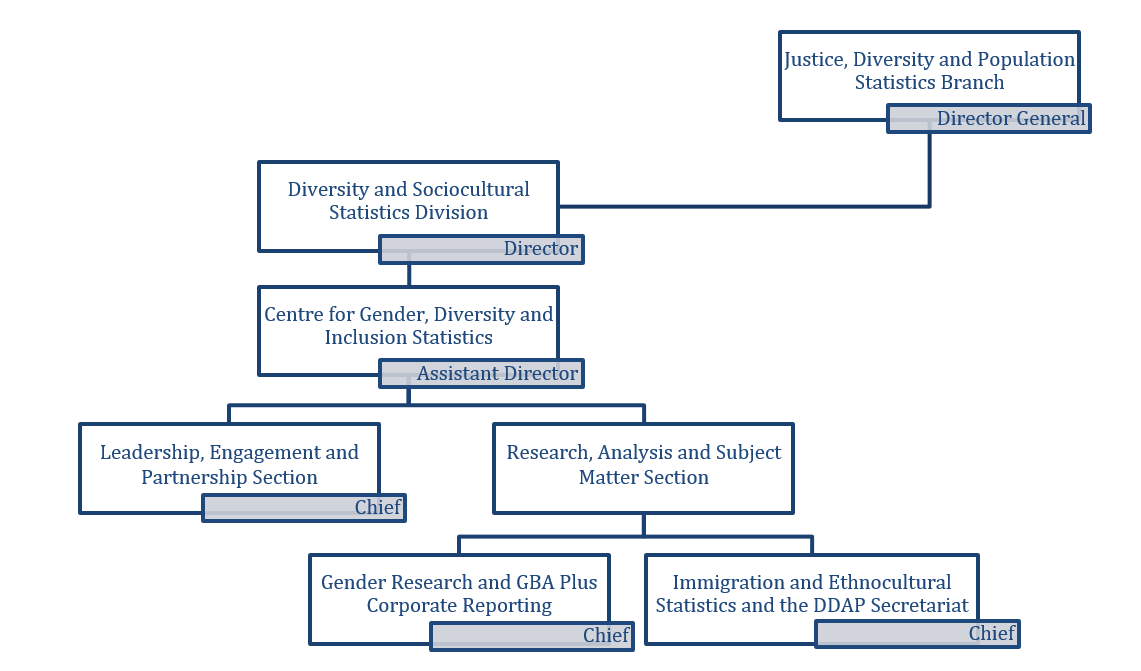
The figure 1 depicts the structure of the Centre for Gender, Diversity and Inclusion Statistics (CGDIS) at the time of the evaluation.
At the time of the evaluation, the CGDIS was comprised of the Leadership, Engagement and Partnership Section, which is led by a chief, as well as the Research, Analysis and Subject Matter Section, which consisted of the following two teams, each led by a chief:
The CGDIS is led by an assistant director who reports to the Director of the Diversity and Sociocultural Statistics Division. The division falls under the responsibility of the Director General of the Justice, Diversity and Population Statistics Branch.
The scope of the evaluation included the key activities of the CGDIS, which support its three objectives (namely, reporting to Canadians, generating new information and building statistical capacity). Nonetheless, activities undertaken by the CGDIS beyond the three objectives were also captured to provide a complete picture of the activities performed by the Centre.
The scope was established in consultation with CGDIS management.
The evaluation was conducted from January to November 2022. The three evaluation issues and questions that were identified for review are outlined in Table 2.
| Evaluation issues | Evaluation questions |
|---|---|
| 1. Effectiveness: Progress towards objectives |
To what extent is the Centre for Gender, Diversity and Inclusion Statistics (CGDIS) progressing towards the achievement of its three key objectives?
|
| 2. Effectiveness and relevance: Awareness and usefulness | To what extent are stakeholders aware of the CGDIS' key activities and to what extent are their needs met? |
| 3. Moving forward | To what extent is the CGDIS well positioned to fulfill its objectives and evolving role in the future (such as the Disaggregated Data Action Plan)? |
Guided by a utilization-focused evaluation approach, the data collection methods outlined in Figure 2 were used.
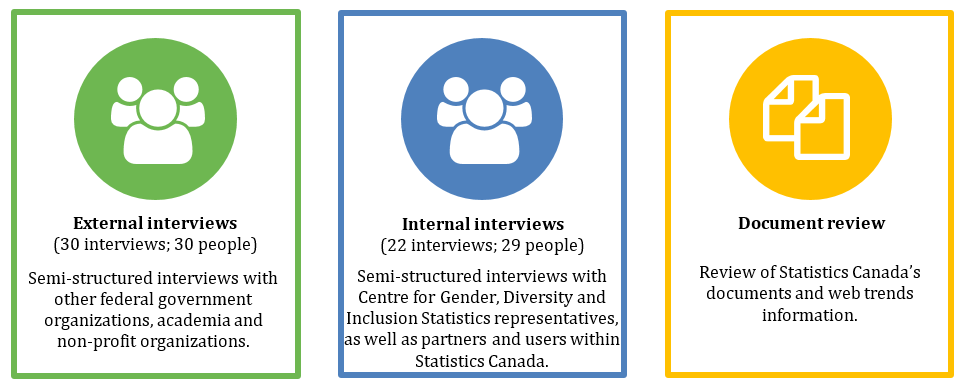
The figure 2 depicts the three collection methods used for the evaluation: external interviews, internal interviews, and document review.
The external interviews included semi-structured interviews with other federal government organizations, academia and non-profit organizations. There were 30 external interviews conducted with 30 people.
The internal interviews included semi-structured interviews with Centre for Gender, Diversity and Inclusion Statistics representatives, as well as partners and users within Statistics Canada. There were 22 internal interviews conducted with 29 people.
The document review included a review of Statistics Canada's documents and web trends information.
Three main limitations were identified, and mitigation strategies were employed, as outlined in Table 3.
| Limitations | Mitigation strategies |
|---|---|
| Given the wide range of products and services offered by the Centre for Gender, Diversity and Inclusion Statistics (CGDIS), the perspectives gathered through external interviews may not fully apply to the entire range of CGDIS products and services. |
Key deliverables were selected under each of the CGDIS' three key objectives using specific criteria to maximize the value of external input for the Centre. |
| Given the very broad nature of the subject areas covered by the CGDIS, the perspectives gathered through external interviews may not be fully representative of all those who have used CGDIS products or services. | External interviewees were selected using specific criteria to give as broad a range as possible, and attempts were made to pre-qualify potential interviewees. Those interviewees who never used CGDIS products or services were still able to provide information on the usefulness and relevance of the CGDIS' deliverables and awareness efforts. |
| Given that the proportion of the available lists of external stakeholders was largely skewed towards federal government organizations (FGOs), the perspectives gathered from external interviews may be heavily biased towards the needs and priorities of the federal government. | External interviewees were selected early and using specific criteria to maximize reach to non-FGO stakeholders. The CGDIS and evaluators were aware of the skew and its implications and, where possible, findings were presented separately for FGO and non-FGO stakeholders. |
Evaluation question
The CGDIS made progress on all three key objectives and has met the key deliverables outlined in its strategic proposal. The GDIS Hub was launched in September 2018, and the Centre delivered several products over the period. In addition, GBA Plus training materials were developed in collaboration with Women and Gender Equality Canada (WAGE) and the Canada School of Public Service, and hub tours were delivered.
When the CGDIS was first established, its key activities were set forth by senior management and guided by the original mandate of its strategic proposal, namely, to deliver the GDIS Hub and to provide GBA Plus information.
The GDIS Hub is a platform on the Statistics Canada website which brings together GDI-related data from several Statistics Canada sources and presents the information in a single interactive analytical environment. It provides users with consolidated access to research and detailed statistical information. It also includes links to recent releases, key indicators, a data visualization tool, infographics, information on the DDAP and engagement opportunities.
Subject-specific pages within the GDIS Hub include:
While the original scope was for the CGDIS to create a statistical hub that would present data and products on the topic of gender, the GDIS Hub has expanded to include the concepts of diversity and inclusion.
The planning and development of the GDIS Hub began during the summer of 2018, and the launch took place in September 2018. The CGDIS was required to launch the Hub six weeks after the Centre was first established; given the short turnaround, no formal consultations took place with stakeholders. However, a crowdsourcing consultation did take place soon after the launch to gather input from Canadians to inform continued development.
In addition to the creation, launch and upgrade of the GDIS Hub, the Centre has delivered many other products and services under each of its three objectives.
Under the Reporting to Canadians objective, the CGDIS launched the newly developed Sex, Gender and Sexual Orientation Statistics Hub; included a DDAP tile within the GDIS Hub; and tracked the 29 indicators for the Gender Results FrameworkFootnote 3.
Under Generating new information, the CGDIS delivered the portrait of Canada's Black population; developed products pertaining to definitions and addressing measurement issues with respect to racism and discrimination; undertook and released research and analytical products under letters of agreement with other federal government organizations (FGOs); and produced infographics to augment the presentation of related data.
Finally, under its Building statistical capacity objective, the CGDIS established Statistics Canada's GBA Plus Responsibility Network to further spread GBA Plus knowledge and awareness across the agency and to support timeliness with corporate requests with GBA Plus components (e.g., GBA Plus annexes in funding proposals). The CGDIS also provided GDIS Hub tours, which are training sessions that walk participants through the GDIS Hub's different features and information. It also developed GBA Plus training material in collaboration with WAGE and the Canada School of Public Service.
It was also noted that the CGDIS has met the key implementation milestones in its strategic proposal and that targets in its performance measurement framework were either being met or were under development. With the key deliverables from the proposal met, activities evolved to correspond with the Centre's expanding scope and mandate.
Evaluation question
The CGDIS' engagement strategy promoted the awareness and use of the GDIS Hub and related products but mainly among FGOs. Overall, the CGDIS met the needs of most FGOs, particularly those who were regular clients of the Centre. While the needs of non-FGOs were met to a lesser extent, most of them still supported the work of the CGDIS and underscored the importance of the GDIS Hub. Data needs varied across user groups, but they all expressed a desire to have more disaggregated data to better understand the intersectionality as opposed to binary interactions. Many opportunities for improvements were also noted for the presentation of data, overall functionality of the Hub and outreach efforts to non-FGOs.
The CGDIS engaged external stakeholders in various ways and leveraged many communication channels. This included the ongoing engagement of existing clients (e.g., WAGE, Canadian Heritage), where regular discussions took place to collaboratively identify research priorities to fill data gaps and create new GDI products. One of the various GDI initiatives the Centre is involved in is the Justice Data Modernization initiative, which is a data and research initiative led by the Department of Justice Canada and Statistics Canada to improve the collection and use of disaggregated data in view of addressing the over-representation of Indigenous, Black and racialized people in the criminal justice system.
The CGDIS also participates in various committees, networks and working groups, such as the Sexual Orientation Standards Working Group, which conducts consultations with various stakeholders, including 2SLGBTQI+ experts, academic groups and the general public. The CGDIS also engaged external stakeholders through Statistics Canada's regional representatives, who serve as a point of contact between the public and the agency. For example, the CGDIS delivered a series of webinars for the Library of Parliament through this channel. The Centre also maintains a social media presence reaching out to the public on several digital platforms.
Most external interviewees, especially users from FGOs who had worked directly with the CGDIS either as a client of the Centre, were aware of the GDIS Hub and the CGDIS' research and analytical products either through a letter of agreement/memorandum of understanding, or as a partner helping to develop analytical products or provide input. Most were made aware of the CGDIS through colleagues, or through the various official messages (e.g.: Budget 2018 or the email announcing the CGDIS' launch) or from the notifications from Statistics Canada's official release bulletin, The Daily. Some also discovered the GDIS Hub and the research and analytical products by navigating through Statistics Canada's website or via an Internet search engine, such as Google.
Nearly all of those who were aware of the GDIS Hub or the CGDIS' research and analytical products have used them. However, the frequency of use reported by users of the GDIS Hub varied greatly. Some used it daily, while others reported that they use it only occasionally. The few who did not use the Hub had access to other sources of data to conduct their work. A few interviewees mentioned that they were uncertain whether the research and analytical products they accessed were from the CGDIS.
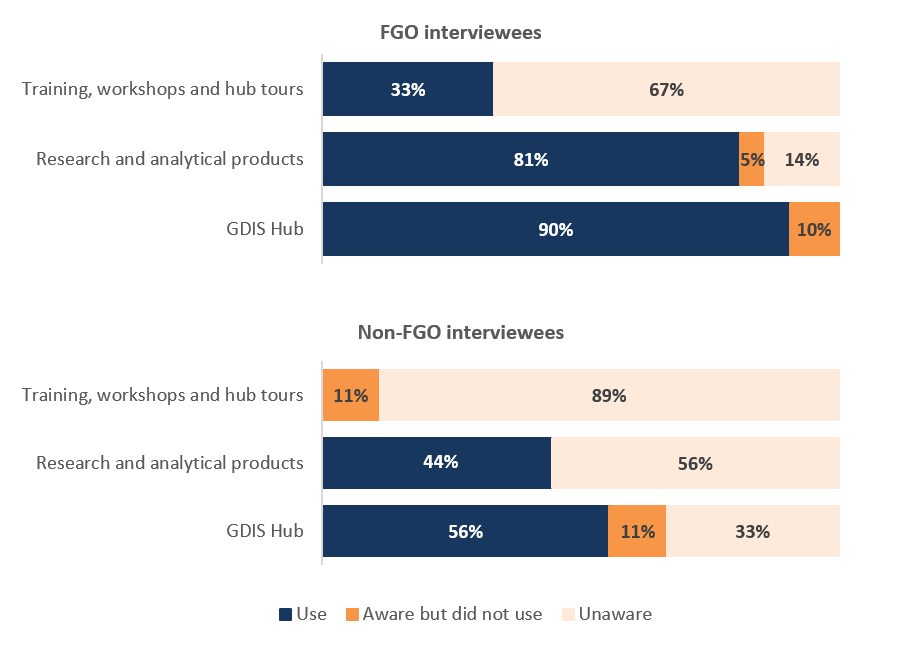
Notes: Among the external interviewees, 70% (n=30) were from federal government organizations (FGOs), who were the main target audience for the Gender, Diversity and Inclusion Statistics (GDIS) Hub.
The figure 3 depicts the awareness and use of the Centre for Gender, Diversity and Inclusion Statistics' (CGDIS') products and services by federal government organization and non-federal government organization interviewees.
Among the external interviewees, 70% (n=30) were from federal government organizations (FGOs), who were the main target audience for the Gender, Diversity and Inclusion Statistics (GDIS) Hub.
Out of these FGO interviewees:
Out of the external interviewees who were not from federal government organizations (i.e., non-FGO interviewees):
The CGDIS partnered with FGOs to build and enhance the statistical knowledge and literacy of policy analysts and researchers on GDI by contributing to various learning activities. These included collaborating with WAGE and the Canada School of Public Service to develop training material for GBA Plus courses, conducting GDIS Hub tours, delivering workshops (e.g., data interpretation workshops), and presenting to specific user groups (e.g., webinars to researchers of the Library of Parliament).
However, there was a gap in the awareness of the training and learning opportunities. Nearly all the interviewees from non-FGOs and 67% of the interviewees from FGOs were unaware of the GDIS Hub tours and learning activities provided by the CGDIS. All the interviewees who had participated in the hub tours were from FGOs who were either clients of the CGDIS or had partnered with it.
Furthermore, while the hub tours were offered to promote the GDIS Hub when it was launched, they were no longer promoted afterwards but were available upon request only. Many external interviewees, from both FGOs and non-FGOs, indicated that they and their teams would have benefitted from the hub tours, workshops and presentations.
Interviewees from FGOs used the GDIS Hub and the CGDIS' research and analytical products to support their work in advancing their organizational agenda on GDI. This work included meeting organizational requirements on GBA Plus, analyzing the implications of policies and programs through a GBA Plus or GDI lens, and informing various governmental initiatives on GDI-related matters.
Many of the interviewees from FGOs reported that without the GDIS Hub and the research and analytical products, their ability to carry out their work efficiently would have been greatly hindered. Those who participated in the hub tours or training provided by the CGDIS also reported that these sessions helped to reduce the learning curve on aspects of their work, such as finding specific GDI data.
Interviewees from non-FGOs, such as those from academia and not-for-profit organizations, also used the GDIS Hub and the research and analytical products to support their various GDI data needs. These needs included conducting research, monitoring GDI trends and related impacts on different groups, providing information for decision-making to their stakeholders, teaching and raising awareness, communicating with the media, and complementing other data sources.
Although the CGDIS did meet some of the needs of non-FGOs, it was to a lesser extent than for those from FGOs. Nonetheless, nearly all still supported the work of the CGDIS and underscored the importance of the GDIS Hub. Some noted that the GDIS Hub was particularly crucial for smaller not-for-profit organizations which lack the capacity to perform their own extensive analyses due to limited resources. For these organizations, the GDIS Hub provided quick access to some GDI data that supported their work.
Overall, despite some of its limitations, many interviewees noted that the GDIS Hub made GDI data more accessible to Canadians. For some interviewees, not having the GDIS Hub would be detrimental to their work in advancing GDI. One interviewee mentioned that without the Hub, Statistics Canada's reputation as a supporter of the Government of Canada's GDI priority could be undermined.
External interviewees identified data needs for at least the following six different population groups: gender groups, racialized groups, Indigenous peoples, immigrants and newcomers, persons with disabilities, and 2SLGBTQI+ groups.
For these population groups, external interviewees were mostly interested in having data on the following six dimensions: population and demography, including sexual orientation as a demographic variable; health and health care; labour and employment; income and wealth; housing and community; and violence and abuse.
Almost all external interviewees expressed a desire to better understand the intersectionality between these various dimensions and their impact on sub-population groups (for example, being able to make a statement such as the following: "The general population experience is […], which is amplified for populations who are also members of the 2SLGBTQI+ community, and further amplified for members who are Black and living with disabilities"). At the same time, some interviewees recognized that it would not always be possible to obtain their desired level of disaggregated data given the need for confidentiality to be protected by Statistics Canada. While Statistics Canada strives to produce more detailed information, it must also ensure confidentiality and privacy are maintained.
Table 4 in Appendix A provides examples of data needs on intersectionality identified by external interviewees.
While the GDIS Hub was initially launched in 2018 without client testing or consultation, it was later updated in 2021 to reflect the feedback gathered from a crowdsourcing consultation conducted in 2018, as well as the CGDIS' expanded scope. While some interviewees noted improvements to the GDIS Hub, they largely pertained to the quantity of information.
Many interviewees, particularly those from non-FGOs, identified opportunities for improvement regarding how data were presented in the GDIS Hub. One area for improvement was terminology. For example, many noted the need to have more clarity and consistency on terms such as "community," "ethnocultural group," "visible minority" and "racialized." Furthermore, it was mentioned that there are instances where the GDIS Hub's definitions are inconsistent with other parts of the Statistics Canada website. For example, "non-binary gender identities" is used in one area and "male or female" is used in another. Finally, some interviewees also pointed out the importance of not conflating certain GDI concepts, such as lumping "persons with disabilities" under "accessibility" or "sexual orientation" under "gender identities."
For many, timeliness is one of the GDIS Hub's main challenges, as nearly real-time data are what is desired. For example, labour market information that is one or two years old was viewed as being not useful for planning purposes. Interviewees also noted that some features or data in the Hub are not kept up to date, rendering the information unreliable or irrelevant.
Some interviewees noted that the data presented could be more useful if they were supplemented with contextual information, such as an introductory paragraph, background information or footnotes. Supporting information is deemed necessary to help users better understand the social and cultural dimensions of inequity issues for certain population groups. Data alone without this information could be misinterpreted or misused.
Many of the interviewees, particularly those from non-FGOs, did not find the GDIS Hub to be user-friendly. Most noted that it was difficult to find the information that they needed. As such, several opportunities were identified to enhance the user experience by improving the GDIS Hub's overall functionality. One of the areas for enhancement pertained to its design and layout, such as how the GDIS Hub is organized visually and its ease of navigation. Another area was improving the Hub's search function so that users could find the information they are looking for more easily. The final key enhancement was the use of more data visualization tools, such as infographics and charts.
Table 5 in Appendix B provides further examples of improvements to the GDIS Hub suggested by external interviewees.
It is important to note that many aspects of the Hub fall outside the control of the CGDIS; technically and functionally, the Hub (and more broadly the Statistics Canada website) is based on corporate solutions supported by corporate resources, and content from other parts of Statistics Canada falls under the responsibility of those groups. For example, the presentation of the data and the overall functionality of the Hub are dependent on the structure of the website and availability of information technology resources, which are factors beyond the control of the CGDIS. In addition, the current Statistics Canada website follows a subject structure that does not include the representative groups and the intersectional identity factors.
Most interviewees encouraged the CGDIS to enhance its outreach efforts to further promote awareness of the Hub and related products and services. Opportunities for improvement in this area included having more frequent communication on GDIS Hub updates. Having a sign-up option in the Hub for users to receive updates would help support this enhancement. Having a dedicated point of contact on the Hub for users to ask questions through a live chat function or general mailbox was also suggested.
Another opportunity is for the CGDIS to enhance its outreach efforts to non-FGOs. These non-FGOs include:
These organizations often work directly with local and diverse communities and have their own channels and networks that could be leveraged to help raise awareness of the CGDIS. For example, universities and social science associations such as the Canadian Sociological Association and the Canadian Population Society would be groups that could disseminate information about the CGDIS. Beyond outreach, the CGDIS could develop closer relationships with these organizations to leverage their expertise, experience, networks and ideas.
Evaluation question
The CGDIS has strategically transformed its organization to adapt and evolve. However, gaps in its overall program management, oversight and capacity are risks. Having robust planning and prioritization processes, relevant performance measurement, clearly defined roles and responsibilities, and proper governance are key considerations as the CGDIS moves forward. A more strategic targeted approach is also required to improve outreach and engagement with non-FGOs.
Given the broad mandate of the CGDIS and its prominence in the current social and political environment, the demands on the Centre are significant and growing. The Centre receives both external requests from stakeholders and internal requests from senior management and other program areas. It undertakes a vast array of activities, including:
Program areas work with the CGDIS on developing standards and concepts, conducting analyses, disseminating products and infographics, and actioning requests for information and support (both on an ad hoc basis and on an ongoing basis, such as through letters of agreement and memoranda of understanding).
Regarding ad hoc requests that the CGDIS receives, it should be noted that some fall outside of the Centre's three objectives. Examples include some corporate reporting responsibilities and speech and presentation materials for the field. Furthermore, the Centre also receives requests that are not related to its mandate, such as employment equity requests that pertain to human resources. These requests add to the overall burden the Centre faces.
The CGDIS has taken progressive steps to meet its objectives and mature as a Centre; this includes aligning its organizational structure, establishing a SWAT Team and a GBA Plus Corporate Reporting Team, incorporating the DDAP Secretariat, and updating its planning processes.
In exploring the Centre's readiness to meet upcoming challenges, several dimensions of its program management were examined: governance, planning and prioritization, roles and responsibilities, capacity, and connection to stakeholders.
The CGDIS follows Statistics Canada's regular governance structure (i.e., Tier 1 committees); the Centre falls under the responsibility of the Diversity and Sociocultural Statistics Division within the Justice, Diversity and Population Statistics Branch. There is no additional oversight, advisory or other formal governance body in place to provide guidance on areas such as priorities, accountabilities, and roles and responsibilities. While the Centre participated in working groups such as the Sexual Orientation Standards Working Group and the DDAP Engagement and Communications Working Group, managed the Advisory Committee on Ethnocultural and Immigration Statistics, and operated the GBA Plus Responsibility Network, none of these provide the Centre with organizational strategic-level guidance.
The process to identify and prioritize key activities takes place at the division, Centre and section levels. It includes a bottom-up approach whereby input is provided by the sections to management. All levels take similar information into consideration: Government of Canada, Statistics Canada and divisional priorities and objectives; emerging trends; input from clients and internal and external stakeholders; and obligations under letters of agreement and memoranda of understanding. For example, the Research, Analysis, and Subject Matter section has an annual unit research plan that is developed in consultation with its partners (e.g., Canadian Heritage, WAGE and others) and in alignment with Government of Canada and Statistics Canada priorities. At the section level, each section independently identifies and prioritizes its key activities according to its respective objectives and informs management. The sections are ultimately responsible for operationalizing activities.
As noted previously, the work of the CGDIS is often intertwined with other areas of Statistics Canada. Leadership, input and support from the CGDIS are viewed as invaluable by internal partners. CGDIS analysts are viewed as subject-matter experts and are often tasked with new requests and activities for cross-cutting work, which frequently overlaps with other program areas. Interviewees noted that this raises some challenges in terms of clarity around accountability, such as who should be the lead. In addition, it was also noted that operational discussions between the CGDIS and other program areas are generally informal in nature and occur at the working level. This may result in varying roles and relationships that are people-dependent; this is a risk given challenges around capacity and an increasing volume of requests.
Finally, while the CGDIS' mandate and objectives are aligned with the DDAP, many interviewees noted that the relationship between the two, including roles and responsibilities, lacked clarity.
A lack of capacity and resources to respond to significant and growing demands was a concern identified by many internal interviewees. There was a strong belief that as the scope and volume of work have increased for the CGDIS, capacity and resources have not increased correspondingly. The CGDIS has recognized this and is trying to build up its human resource capacityFootnote 4. However, many reported that it is challenging to find the right complement of individuals with the required skills, lived experiences and agile mindsets.
Some partners and stakeholders noted there were delays for some deliverables from the CGDIS. They also questioned whether the Centre could meet its many demands given its capacity challenges. Additionally, turnover and fatigue among staff were noted by many interviewees. In addition to establishing the SWAT Team, there are also efforts to leverage corporate resources, such as those from the Strategic Engagement Field and the Data Analytics as a Service Division, to help inform the CGDIS' external consultations and to assess the behavioural user experience of the GDIS Hub, respectively.
Overall, the CGDIS is meeting the needs of the FGOs it works with on a regular basis. Regular communication takes place with these stakeholders, and their needs are well understood and are considered in planning. For non-FGOs such as academia and not-for-profit organizations, their needs are being met to a lesser degree. However, the mandate and objectives of the CGDIS still resonated with them.
More recently, the CGDIS has moved to expand and formalize its consultations and engagements. For example, the CGDIS has had consultations on the standard on sexual orientation, and a communication plan on the standard for visible minorities is in development. Some other activities include giving presentations on the GDIS Hub organized through Statistics Canada regional representatives and formally gathering feedback from its training session.
The CGDIS recognizes its engagements and consultations need to be expanded and is currently developing a plan in consultation with the Stakeholder Relations and Engagement Division to identify gaps in addressing external stakeholders' needs, broaden the current pool of users, and inform the next iterations of the GDIS Hub and related CGDIS products and services.
As Statistics Canada's centre for expertise on GDI statistics, the CGDIS plays a vital role in leading, coordinating and supporting activities in a highly visible evolving domain. Current demands are significant and will increase further under the DDAP. Within this context, proper governance, robust formal planning and prioritization processes, and relevant performance indicators are imperative to efficiently and effectively deliver products and services that align with the needs and priorities of users and stakeholders.
As the CGDIS enhances its planning processes, it should consider establishing a recurring activity prioritization and decision-making process at the CGDIS level. This would allow priorities to be regularly reviewed and rebalanced. The process would include bottom-up input and top-down guidance and facilitate the examination of priorities across and between sections. Supporting the planning and prioritization processes would be a robust performance measurement framework (with indicators and operational metrics) to monitor progress and performance and to highlight areas of challenge, such as capacity.
Given the strong links to other program areas in Statistics Canada, a senior-level governance body to provide guidance on areas of priorities, roles and responsibilities, and accountabilities should be considered. The body should have broad representation so that a more holistic perspective is provided. For example, the new body could help establish accountabilities when requests or projects overlap between the CGDIS and other program areas (i.e., who leads and under what circumstances). In addition, the CGDIS should move to formalize its relationship with other areas to ensure roles and responsibilities are clear and appropriate.
While the CGDIS maintains strong relationships with its key FGOs, the outreach to and engagement of non-FGOs are recognized gaps. While recent activities have tended to be more encompassing, a more strategic targeted approach is required given that non-FGOs are a very diverse group.
The Assistant Chief Statistician, Social, Health and Labour Statistics Field (Field 8), should ensure that the CGDIS:
The Assistant Chief Statistician, Social, Health and Labour Statistics Field (Field 8), should ensure that the CGDIS:
The Assistant Chief Statistician, Social, Health and Labour Statistics Field (Field 8), should ensure that the CGDIS takes steps to broaden and enhance its outreach, consultation and engagement efforts to include external non-FGO stakeholders.
The Assistant Chief Statistician, Social, Health and Labour Statistics Field (Field 8), should ensure that the CGDIS:
Management agrees with the recommendation.
The Assistant Chief Statistician, Social, Health and Labour Statistics Field (Field 8), should ensure that the CGDIS:
Management agrees with the recommendation.
The Assistant Chief Statistician, Social, Health and Labour Statistics Field (Field 8), should ensure that the CGDIS takes steps to broaden and enhance its outreach, consultation and engagement efforts to include external non-FGO stakeholders.
Management agrees with the recommendation.
| Example of data needs on intersectionality identified by external interviewees | 2SLGBTQI+ groups | Gender groups | Indigenous groups | Persons with disabilities | Racialized groups | Immigrants and newcomers |
|---|---|---|---|---|---|---|
| Employment data (e.g., business ownership by sector, manufacturing data, labour market activity, inflation, wage gaps, skills and employment and tax filer data) by population group | 1, 3, 4 | 1, 3, 4 | 1, 3, 4 | 1, 3, 4 | 1, 3, 4 | 1, 3, 4 |
| Representation of population groups in an authoritative role in various public and private sector organizations (e.g., members of Parliament, boards of directors, chief executive officers, First Nations chiefs, federal judges) | 1, 3, 4 | 1, 3, 4 | 1, 3, 4 | 1, 3, 4 | 1, 3, 4 | 1, 3, 4 |
| Data on Indigenous youth (e.g., language, gender identity) living in northern and rural regions, on-reserve versus off-reserve | 1, 5 | 1, 5 | ||||
| Program and policy impacts on categories of newcomers related to access to health care, employment and social services; indicators of integration; overqualifications of newcomers relative to job type; labour market and other outcomes for newcomers by educational background, ethnic origin, ethnicity, language and other data points | 1, 2, 3, 4, 5 | 1, 2, 3, 4, 5 | ||||
| Data on persons with disabilities (e.g., labour market participation of persons with disabilities, abuse of persons with disabilities) | 3, 6 | |||||
| Data on housing, homelessness and poverty by population group, including sexual orientation and other sociodemographic factors | 1, 4, 5 | 1, 4, 5 | 1, 4, 5 | 1, 4, 5 | 1, 4, 5 | 1, 4, 5 |
| Community-based data, including qualitative data on the lived experiences of Indigenous and other racialized communities | 5 | 5 | ||||
| Violence against gender groups (e.g., women) and 2SLGBTQI+ groups | 6 | 6 | ||||
| Violence against racialized groups | 6 | 6 | ||||
|
Legend
|
||||||
| Design and layout |
|
|---|---|
| Search function |
|
| Data visualization tools |
|
Understanding how the COVID-19 pandemic has affected the health and well-being of Canadians is an important step toward Canada’s recovery. To support this goal, Statistics Canada and the Public Health Agency of Canada have partnered to conduct a follow-up to the Canadian COVID-19 Antibody and Health Survey (CCAHS – Follow-up Questionnaire, 2023).
The data from this survey will be combined with data from cycle 2 of the Canadian COVID-19 Antibody and Health Survey, which was conducted between April and August 2022, to produce the evidence needed for informed decision-making.
The follow-up will collect updated information about your health. The questions will touch on changes in vaccination status, reinfection with the virus that causes COVID-19, symptoms of COVID-19 and impact on daily life, health conditions and the use of health care services.
May 23, 2023 to June 12, 2023
Electronic questionnaire
Data are collected under the authority of the Statistics Act, Revised Statutes of Canada, 1985, Chapter S-19. Your information will be kept strictly confidential.
To avoid duplication of surveys, Statistics Canada may enter into agreements to share the data from this survey and from the Canadian COVID-19 Antibody and Health Survey you previously completed, including name, address, telephone number and health card number, with provincial and territorial ministries of health, Health Canada and the Public Health Agency of Canada. For Quebec residents, Statistics Canada may also enter into an agreement with the Institut de la statistique du Québec to share the same information.
The Institut de la statistique du Québec and provincial ministries of health may make this data available to local health authorities. Local health authorities will not receive any identifiers.
To enhance the data from this survey and to reduce the response burden, Statistics Canada will combine the information you provide with the Canadian COVID-19 Antibody and Health Survey (CCAHS) – Cycle 2. Statistics Canada may also combine the information you provide with other survey or administrative data sources.
This survey asks questions about
Statistics Canada publishes the results of its surveys in many formats. To find all the documents related to this survey, follow the links below and type the name of the survey in the search engine located at the left of your screen to filter the results.
Data: You will find tables, profiles of a community or region, thematic maps, public use microdata files, and data visualization tools.
Analysis: You will have direct access to Stats in brief (e.g., releases from The Daily, fact sheets), articles and reports, and journals and periodicals.
The Canadian COVID-19 Antibody and Health Survey – Follow-up Questionnaire, 2023 is an electronic questionnaire that aims to collect information on changes in vaccination against COVID-19, reinfection with the virus that causes COVID-19, symptoms of COVID-19 and impact on daily life, health conditions and the use of health care services.
This survey is limited to participants from the Canadian COVID-19 Antibody and Health Survey (CCAHS) cycle 2 who provided a valid email address while responding to the survey. The survey is administered through an electronic (online) questionnaire.
Developed in partnership with the Public Health Agency of Canada, the follow-up questionnaire aims to collect information about the prevalence of persistent health problems and symptoms following COVID-19. The purpose is to gather information on changes in vaccination against COVID-19, reinfection with the virus that causes COVID-19, symptoms of COVID-19 and impact on daily life, health conditions and the use of health care services.
By participating in this follow-up questionnaire, respondents play an important role in:
Even if you do not think you have been exposed to COVID-19, your participation is important as it will provide useful information about the virus that causes COVID-19, and insight into the overall health of Canadians. Questionnaire results will be used to develop programs and services to respond to needs related to the pandemic recovery.
Your participation in this survey is voluntary. However, your participation will help to ensure that questionnaire results are complete.
Health is an important part of everyone’s life. It is crucial that we have participation from a wide range of Canadians, including those in good health.
The data we collect from you and other participants will provide policy makers, provincial and territorial health departments, researchers and health professionals with a comprehensive source of information to assist them in addressing the health needs of all Canadians, now and in the future.
Yes. Even after having agreed to participate in the survey, you may choose not to answer specific questions you find sensitive or where you feel uncomfortable providing a response.
Please read the questions very carefully before answering and consider all your experience with COVID-19 as it relates to the question.
For example, if a question asks about a confirmed infection (an infection with a positive test result), answer the question considering everything you have experienced related to any confirmed infection you have had.
For more information on the Canadian COVID-19 Antibody and Health Survey – Follow-up Questionnaire, 2023, please visit: Canadian COVID-19 Antibody and Health Survey (CCAHS). For additional questions, call us at 1-866-498-8518 or 1-866-753-7083 (TTY). You can also email us at: statcan.ccahs-ecsac.statcan@statcan.gc.ca.
Under the Statistics Act, individuals’ information is collected, used and disseminated for statistical purposes only. Statistics Canada is prohibited in this legislation from disclosing personal information to any government, police agency or court of law, for any other purpose, without explicitly asking respondents for their consent in the survey itself.
Statistics Canada may combine the information you provided to this survey with your health data from your provincial health department, health registries or other recognized health organizations. This is known as data linkage and is only done for statistical purposes and to improve health research. Findings from projects based on linkage could be used by governments in health promotion and to monitor, evaluate and change policies related to health care and the use of health services. We will not provide your information to provincial and territorial health departments and any linkages would be conducted by Statistics Canada staff and access limited to a need-to-know basis.
For this follow-up questionnaire, we will link your information with its parent survey, the Canadian COVID-19 Antibody and Health Survey (CCAHS) – Cycle 2. This will reduce the number of questions that are asked as part of the follow-up.
If you provided your consent, Statistics Canada will share your data with Health Canada, the Public Health Agency of Canada, and provincial and territorial ministries of health under the data sharing agreements. The information shared will be used for statistical and research purposes only.
Only postal codes and questionnaire responses would be shared with federal partners, and identifiers may only be shared with provincial and territorial partners upon request.
Statistics Canada is also authorized by law to share information with another organization that wants to collect similar information to avoid duplication after obtaining the participants’ consent. Participants are informed at the time of collection of organizations that wish to have questionnaire responses and the purpose for which they want it. Participants may always decline any sharing request, in which case Statistics Canada will not share your information.
Objective statistical information is vital to researchers, analysts, and decision-makers across Canada. Results of this survey could be used by:
This survey is conducted under the authority of the Statistics Act, which ensures that the information you provide will be kept confidential. We do not release any information that could identify you or any member of your household unless you gave your consent or as permitted by the act.
It is a priority for the agency to protect information provided by the participants, because it is a fundamental part of the trust established between Statistics Canada and the participants of our surveys.
The Statistics Act ensures that any information you provide to us remains strictly confidential. Statistics Canada goes to extraordinary lengths to protect you. No unauthorized persons outside of Statistics Canada will ever be permitted to see your individual responses.
The purpose of this survey is to collect up-to-date information on the number of livestock on your agricultural operation. The data are used by agricultural industry analysts and producers to make production and marketing decisions, and by government analysts to monitor the livestock industry and develop agricultural policies in Canada.
Your information may also be used by Statistics Canada for other statistical and research purposes.
Your participation in this survey is required under the authority of the Statistics Act.
Authorization to collect this information
Data are collected under the authority of the Statistics Act, Revised Statutes of Canada, 1985, Chapter S-19.
Confidentiality
By law, Statistics Canada is prohibited from releasing any information it collects that could identify any person, business, or organization, unless consent has been given by the respondent, or as permitted by the Statistics Act. Statistics Canada will use the information from this survey for statistical purposes only.
Record linkages
To enhance the data from this survey and to reduce the response burden, Statistics Canada may combine the acquired data with information from other surveys or from administrative sources.
Data-sharing agreements
To reduce respondent burden, Statistics Canada has entered into data-sharing agreements with provincial and territorial statistical agencies and other government organizations, which have agreed to keep the data confidential and use them only for statistical purposes. Statistics Canada will only share data from this survey with those organizations that have demonstrated a requirement to use the data.
Section 11 of the Statistics Act provides for the sharing of information with provincial and territorial statistical agencies that meet certain conditions. These agencies must have the legislative authority to collect the same information, on a mandatory basis, and the legislation must provide substantially the same provisions for confidentiality and penalties for disclosure of confidential information as the Statistics Act. Because these agencies have the legal authority to compel businesses to provide the same information, consent is not requested and businesses may not object to the sharing of the data.
For this survey, there are Section 11 agreements with the provincial statistical agencies of Newfoundland and Labrador, Nova Scotia, New Brunswick, Quebec, Ontario, Manitoba, Saskatchewan, Alberta and British Columbia. The shared data will be limited to information pertaining to business establishments located within the jurisdiction of the respective province.
Section 12 of the Statistics Act provides for the sharing of information with federal, provincial or territorial government organizations. Under Section 12, you may refuse to share your information with any of these organizations by writing a letter of objection to the Chief Statistician, specifying the organizations with which you do not want Statistics Canada to share your data and mailing it to the following address:
Chief Statistician of Canada
Statistics Canada
Attention of Director, Enterprise Statistics Division
150 Tunney's Pasture Driveway
Ottawa, Ontario
K1A 0T6
You may also contact us by email at statcan.esdhelpdesk-dsebureaudedepannage.statcan@statcan.gc.ca or by fax at 613-951-6583.
For this survey, there are Section 12 agreements with the Prince Edward Island statistical agency, the Manitoba Agriculture and Resource Development as well as with the Ontario Ministry of Agriculture, Food and Rural Affairs.
For agreements with provincial and territorial government organizations, the shared data will be limited to information pertaining to business establishments located within the jurisdiction of the respective province or territory.
1. Verify or provide the business or organization's legal and operating name and correct where needed.
Note: Legal name modifications should only be done to correct a spelling error or typo.
Legal Name
The legal name is one recognized by law, thus it is the name liable for pursuit or for debts incurred by the business or organization. In the case of a corporation, it is the legal name as fixed by its charter or the statute by which the corporation was created.
Modifications to the legal name should only be done to correct a spelling error or typo.
To indicate a legal name of another legal entity you should instead indicate it in question 3 by selecting 'Not currently operational' and then choosing the applicable reason and providing the legal name of this other entity along with any other requested information.
Operating Name
The operating name is a name the business or organization is commonly known as if different from its legal name. The operating name is synonymous with trade name.
2. Verify or provide the contact information of the designated business or organization contact person for this questionnaire and correct where needed.
Note: The designated contact person is the person who should receive this questionnaire. The designated contact person may not always be the one who actually completes the questionnaire.
3. Verify or provide the current operational status of the business or organization identified by the legal and operating name above.
4. Verify or provide the current main activity of the business or organization identified by the legal and operating name above.
Note: The described activity was assigned using the North American Industry Classification System (NAICS).
This question verifies the business or organization's current main activity as classified by the North American Industry Classification System (NAICS). The North American Industry Classification System (NAICS) is an industry classification system developed by the statistical agencies of Canada, Mexico and the United States. Created against the background of the North American Free Trade Agreement, it is designed to provide common definitions of the industrial structure of the three countries and a common statistical framework to facilitate the analysis of the three economies. NAICS is based on supply-side or production-oriented principles, to ensure that industrial data, classified to NAICS, are suitable for the analysis of production-related issues such as industrial performance.
The target entity for which NAICS is designed are businesses and other organizations engaged in the production of goods and services. They include farms, incorporated and unincorporated businesses and government business enterprises. They also include government institutions and agencies engaged in the production of marketed and non-marketed services, as well as organizations such as professional associations and unions and charitable or non-profit organizations and the employees of households.
The associated NAICS should reflect those activities conducted by the business or organizational units targeted by this questionnaire only, as identified in the 'Answering this questionnaire' section and which can be identified by the specified legal and operating name. The main activity is the activity which most defines the targeted business or organization's main purpose or reason for existence. For a business or organization that is for-profit, it is normally the activity that generates the majority of the revenue for the entity.
The NAICS classification contains a limited number of activity classifications; the associated classification might be applicable for this business or organization even if it is not exactly how you would describe this business or organization's main activity.
Please note that any modifications to the main activity through your response to this question might not necessarily be reflected prior to the transmitting of subsequent questionnaires and as a result they may not contain this updated information.
The following is the detailed description including any applicable examples or exclusions for the classification currently associated with this business or organization.
Description and examples
5. You indicated that [NAICS code] is not the current main activity. Was this business or organization's main activity ever classified as[NAICS description]?
6. Search and select the industry activity classification that best corresponds to this business or organization's main activity.
Select this business or organization's activity sector (optional)
7. You have indicated that the current main activity of this business or organization is: Main activity. Are there any other activities that contribute significantly (at least 10%) to this business or organization's revenue?
8. Approximately what percentage of this business or organization's revenue is generated by each of the following activities?
When precise figures are not available, provide your best estimates.
| Percentage of revenue | |
|---|---|
| Main activity | |
| Secondary activity | |
| All other activities | |
| Total percentage |
1. On YYYY-MM-DD do you expect to have any cattle or calves on this operation?
Report all cattle and calves regardless of ownership.
Include:
Exclude all cattle and calves kept on a farm, ranch, or feedlot operated by someone else.
Inclusions and exclusions
When answering the livestock questions, please include:
Exclude livestock which are owned by you but kept on a farm, ranch, or feedlot operated by someone else.
Community pastures, grazing associations, Crown land: a community pasture or grazing reserve can be a federal, provincial or municipal land operated by a manager and rented to livestock producers for pasturing animals at a fixed fee per head. A co-operative grazing association is a group of people who usually incorporate and rent or lease land for a common grazing area.
Note: forest reserves fall under the category of grazing reserve. Crown land is land owned by the government (municipal, provincial or federal) and generally managed by the government. Crown land does not necessarily have to be used for the purpose of grazing livestock, although grazing does take place on Crown land, particularly in British Columbia.
Fed under contract / custom feeding: livestock are fed under a pre-arranged agreement with a company (for example, feed mill) or another producer to feed the cattle or hogs to market weight. Usually the "feed" operator owns the buildings and supplies the labour but does not own the livestock.
Feedlot (cattle): feedlots are operations where livestock are fattened for market. A feedlot operation may own the animals, or may feed them for other operators for a fee, or both.
Note: feedlots are more applicable to cattle.
Feeding and finishing operations (pigs): feeding and finishing operations are applicable to pigs. Hog feeding and finishing operations are operations in which hogs are fed to market weight. Usually there are no breeding sows or boars in these operations other than those culled from a breeding herd, being fattened for slaughter.
Slaughtered for own consumption: if there are any livestock (cattle, hogs, or sheep) which will be slaughtered for personal consumption, include that livestock in inventory counts. For example, if a dairy operator has one pig which will be slaughtered for personal consumption, include this pig in inventory counts.
2. How many of the following do you expect to have on this operation on YYYY-MM-DD?
Include all cattle and calves on this operation, regardless of ownership.
Exclude all cattle and calves kept on a farm, ranch, or feedlot operated by someone else.
Cattle and calves
Bulls: male cattle which have not been castrated, 1 year and over, which are or will be kept for breeding purposes or for slaughter.
Calves: cattle of either sex, under 1 year old.
Calving: a term used when referring to cattle, meaning to give birth.
Cow: female cattle which have calved at least once, being used for the production of dairy or for the reproduction of beef calves. Include "first calf heifers".
Heifers: female cattle over 1 year old which have never calved, used (or to be used) for breeding or fed for slaughter.
Steers: castrated male cattle, 1 year and over, being fed for slaughter.
| Number | |
|---|---|
| a. Bulls, one year and over | |
| b. Dairy cows | |
| c. Beef cows | |
| d. Calves, under one year | |
| e. Heifers, one year and over for dairy replacement heifers | |
| f. Heifers, one year and over for beef replacement heifers | |
| g. Heifers, one year and over for slaughter or feeder heifers | |
| h. Steers, one year and over | |
| Total inventory of cattle and calves |
3. How many calves were born alive on this operation in the last six months, between YYYY-MM-DD and YYYY-MM-DD?
Cattle and calves
Bulls: male cattle which have not been castrated, 1 year and over, which are or will be kept for breeding purposes or for slaughter.
Calves: cattle of either sex, under 1 year old.
Calving: a term used when referring to cattle, meaning to give birth.
Cow: female cattle which have calved at least once, being used for the production of dairy or for the reproduction of beef calves. Include "first calf heifers".
Heifers: female cattle over 1 year old which have never calved, used (or to be used) for breeding or fed for slaughter.
Steers: castrated male cattle, 1 year and over, being fed for slaughter.
Number of calves:
4. How many cows and heifers do you expect to calve on this operation in the next six months, between YYYY-MM-DD and YYYY-MM-DD?
Cattle and calves
Bulls: male cattle which have not been castrated, 1 year and over, which are or will be kept for breeding purposes or for slaughter.
Calves: cattle of either sex, under 1 year old.
Calving: a term used when referring to cattle, meaning to give birth.
Cow: female cattle which have calved at least once, being used for the production of dairy or for the reproduction of beef calves. Include "first calf heifers".
Heifers: female cattle over 1 year old which have never calved, used (or to be used) for breeding or fed for slaughter.
Steers: castrated male cattle, 1 year and over, being fed for slaughter.
Number of cows and heifers:
5. On YYYY-MM-DD do you expect to have any pigs on this operation?
Report all pigs regardless of ownership.
Include:
Exclude all pigs kept on a farm, ranch, or feedlot operated by someone else.
Inclusions and exclusions
When answering the livestock questions, please include:
Exclude livestock which are owned by you but kept on a farm, ranch, or feedlot operated by someone else.
Community pastures, grazing associations, Crown land: a community pasture or grazing reserve can be a federal, provincial or municipal land operated by a manager and rented to livestock producers for pasturing animals at a fixed fee per head. A co-operative grazing association is a group of people who usually incorporate and rent or lease land for a common grazing area.
Note: forest reserves fall under the category of grazing reserve. Crown land is land owned by the government (municipal, provincial or federal) and generally managed by the government. Crown land does not necessarily have to be used for the purpose of grazing livestock, although grazing does take place on Crown land, particularly in British Columbia.
Fed under contract / custom feeding: livestock are fed under a pre-arranged agreement with a company (for example, feed mill) or another producer to feed the cattle or hogs to market weight. Usually the "feed" operator owns the buildings and supplies the labour but does not own the livestock.
Feedlot (cattle): feedlots are operations where livestock are fattened for market. A feedlot operation may own the animals, or may feed them for other operators for a fee, or both.
Note: feedlots are more applicable to cattle.
Feeding and finishing operations (pigs): feeding and finishing operations are applicable to pigs. Hog feeding and finishing operations are operations in which hogs are fed to market weight. Usually there are no breeding sows or boars in these operations other than those culled from a breeding herd, being fattened for slaughter.
Slaughtered for own consumption: if there are any livestock (cattle, hogs, or sheep) which will be slaughtered for personal consumption, include that livestock in inventory counts. For example, if a dairy operator has one pig which will be slaughtered for personal consumption, include this pig in inventory counts.
6. How many of the following do you expect to have on this operation on YYYY-MM-DD?
Include all pigs on this operation, regardless of ownership.
Exclude all pigs kept on a farm, ranch, or feedlot operated by someone else.
Pigs
Boars: non-castrated male pigs, 6 months and older, used or to be used (or sold) for breeding purposes.
Bred gilts: female pigs which have never farrowed but which have been bred; they are intended for breeding purposes.
Farrowing: term used when referring to pigs, meaning "to give birth".
Feeders: market pigs that are 50 to 119 pounds (23 to 53 kilograms) or 120 to 179 pounds (54 to 81 kilograms).
Note: sometimes referred to as grower pigs.
Finishers: market pigs over 179 pounds (81 kilograms) which are being fed for slaughter.
Gilts: female pigs which have never farrowed and are intended for breeding. Gilts intended for breeding may or may not be bred.
Note: gilts are younger than bred gilts.
Hog: a general term used to describe any type of pig.
Market pigs: consists of "feeders (growers)" and "finishers" which are over 50 pounds (23 kilograms). The general term 'market pigs' is to differentiate from pigs for breeding.
Piglet: a general term used to describe a new born pig.
Slaughter hogs: pigs which are approximately 220 to 240 pounds (100 to 110 kilograms) and are ready to be sold or slaughtered.
Sows: female pigs which have farrowed at least once.
Stillborn: born dead.
Suckling pigs: young pigs under 15 pounds (7 kilograms), which have not been weaned.
Weaners, Weanling, Nursery or Starter: pigs of either sex, 15 to 49 pounds (7 to 22 kilograms), which have recently been weaned.
Weaning: switching a young animal from mother's milk to another source of food.
| Number | |
|---|---|
| Breeding stock, six months and over | |
| a. Sows and gilts kept for breeding | |
| b. Boars kept for breeding | |
| All other pigs | |
| c. Suckling pigs, less than 15 lb (7 kg) | |
| d. Weanling, nursery, or starter pigs, 15 to 49 lb (7 to 22 kg) | |
| e. Market pigs, 50 lb and over (23 kg and over) | |
| Total inventory of pigs |
7. How many of the [number] market pigs are in each of the following categories?
Pigs
Boars: non-castrated male pigs, 6 months and older, used or to be used (or sold) for breeding purposes.
Bred gilts: female pigs which have never farrowed but which have been bred; they are intended for breeding purposes.
Farrowing: term used when referring to pigs, meaning "to give birth".
Feeders: market pigs that are 50 to 119 pounds (23 to 53 kilograms) or 120 to 179 pounds (54 to 81 kilograms).
Note: sometimes referred to as grower pigs.
Finishers: market pigs over 179 pounds (81 kilograms) which are being fed for slaughter.
Gilts: female pigs which have never farrowed and are intended for breeding. Gilts intended for breeding may or may not be bred.
Note: gilts are younger than bred gilts.
Hog: a general term used to describe any type of pig.
Market pigs: consists of "feeders (growers)" and "finishers" which are over 50 pounds (23 kilograms). The general term 'market pigs' is to differentiate from pigs for breeding.
Piglet: a general term used to describe a new born pig.
Slaughter hogs: pigs which are approximately 220 to 240 pounds (100 to 110 kilograms) and are ready to be sold or slaughtered.
Sows: female pigs which have farrowed at least once.
Stillborn: born dead.
Suckling pigs: young pigs under 15 pounds (7 kilograms), which have not been weaned.
Weaners, Weanling, Nursery or Starter: pigs of either sex, 15 to 49 pounds (7 to 22 kilograms), which have recently been weaned.
Weaning: switching a young animal from mother's milk to another source of food.
| Number | |
|---|---|
| a. Over 179 lb (81 kg) | |
| b. Between 120 to 179 lb (54 to 81 kg) | |
| c. Between 50 and 120 lb (23 to 54 kg) Exclude weanling, nursery, or starter pigs. |
|
| Total inventory of pigs |
8. Please provide the total number of farrowings, the average number of piglets per litter and the total piglets born in the last six months between YYYY-MM-DD and YYYY-MM-DD.
Include pigs born alive and stillborn.
Total number of farrowings: this question is asking to report the total number of farrowings in the last 6 months. If a sow farrowed two times in the last 6 months this would be reported as two farrowings.
Average number of piglets born per litter: this question is asking to report the average number of piglets born per litter during the last 6 months. Some respondents interpret this to mean how many total piglets were born during the last six months. The data we are looking for is the average number of piglets born per sow. For example: If a respondent has 100 sows and each sow has 10 piglets born per litter. The correct response would be on average 10 piglets born per litter. Include piglets born alive and stillborn.
Total piglets born: this question is asking to report the total number of piglets born in the last 6 months. This question is autofilled if the total number of farrowings and the average number of piglets born per litter are reported. Total number of farrowings in the last 6 months multiplied by average number of piglets born per litter equals the total piglets born in the last 6 months. If the respondent is not able to report the total number of farrowings or average number of piglets born, the respondent should manually enter the total number of piglets born in the last 6 months. Include piglets born alive and stillborn.
Total number of farrowings X average number of piglets per litter.
| Number | |
|---|---|
| a. Total number of farrowings in last six months | |
| b. Average number of piglets born per litter | |
|
Total piglets born in last six months |
9. Compared with the last six months, do you expect the number of farrowings to increase, decrease, or stay the same in the next six months, between YYYY-MM-DD and YYYY-MM-DD?
Pigs
Boars: non-castrated male pigs, 6 months and older, used or to be used (or sold) for breeding purposes.
Bred gilts: female pigs which have never farrowed but which have been bred; they are intended for breeding purposes.
Farrowing: term used when referring to pigs, meaning "to give birth".
Feeders: market pigs that are 50 to 119 pounds (23 to 53 kilograms) or 120 to 179 pounds (54 to 81 kilograms).
Note: sometimes referred to as grower pigs.
Finishers: market pigs over 179 pounds (81 kilograms) which are being fed for slaughter.
Gilts: female pigs which have never farrowed and are intended for breeding. Gilts intended for breeding may or may not be bred.
Note: gilts are younger than bred gilts.
Hog: a general term used to describe any type of pig.
Market pigs: consists of "feeders (growers)" and "finishers" which are over 50 pounds (23 kilograms). The general term 'market pigs' is to differentiate from pigs for breeding.
Piglet: a general term used to describe a new born pig.
Slaughter hogs: pigs which are approximately 220 to 240 pounds (100 to 110 kilograms) and are ready to be sold or slaughtered.
Sows: female pigs which have farrowed at least once.
Stillborn: born dead.
Suckling pigs: young pigs under 15 pounds (7 kilograms), which have not been weaned.
Weaners, Weanling, Nursery or Starter: pigs of either sex, 15 to 49 pounds (7 to 22 kilograms), which have recently been weaned.
Weaning: switching a young animal from mother's milk to another source of food.
10. Of the [number] piglets born during the last six months, between YYYY-MM-DD and YYYY-MM-DD, what percentage were stillborn, died or were destroyed before weaning?
Pigs
Boars: non-castrated male pigs, 6 months and older, used or to be used (or sold) for breeding purposes.
Bred gilts: female pigs which have never farrowed but which have been bred; they are intended for breeding purposes.
Farrowing: term used when referring to pigs, meaning "to give birth".
Feeders: market pigs that are 50 to 119 pounds (23 to 53 kilograms) or 120 to 179 pounds (54 to 81 kilograms).
Note: sometimes referred to as grower pigs.
Finishers: market pigs over 179 pounds (81 kilograms) which are being fed for slaughter.
Gilts: female pigs which have never farrowed and are intended for breeding. Gilts intended for breeding may or may not be bred.
Note: gilts are younger than bred gilts.
Hog: a general term used to describe any type of pig.
Market pigs: consists of "feeders (growers)" and "finishers" which are over 50 pounds (23 kilograms). The general term 'market pigs' is to differentiate from pigs for breeding.
Piglet: a general term used to describe a new born pig.
Slaughter hogs: pigs which are approximately 220 to 240 pounds (100 to 110 kilograms) and are ready to be sold or slaughtered.
Sows: female pigs which have farrowed at least once.
Stillborn: born dead.
Suckling pigs: young pigs under 15 pounds (7 kilograms), which have not been weaned.
Weaners, Weanling, Nursery or Starter: pigs of either sex, 15 to 49 pounds (7 to 22 kilograms), which have recently been weaned.
Weaning: switching a young animal from mother's milk to another source of food.
Percentage:
11. On YYYY-MM-DD do you expect to have any sheep or lambs on this operation?
Report all sheep or lambs regardless of ownership.
Include:
Exclude all sheep and lambs kept on a farm, ranch, or feedlot operated by someone else.
Inclusions and exclusions
When answering the livestock questions, please include:
Exclude livestock which are owned by you but kept on a farm, ranch, or feedlot operated by someone else.
Community pastures, grazing associations, Crown land: a community pasture or grazing reserve can be a federal, provincial or municipal land operated by a manager and rented to livestock producers for pasturing animals at a fixed fee per head. A co-operative grazing association is a group of people who usually incorporate and rent or lease land for a common grazing area.
Note: forest reserves fall under the category of grazing reserve. Crown land is land owned by the government (municipal, provincial or federal) and generally managed by the government. Crown land does not necessarily have to be used for the purpose of grazing livestock, although grazing does take place on Crown land, particularly in British Columbia.
Fed under contract / custom feeding: livestock are fed under a pre-arranged agreement with a company (for example, feed mill) or another producer to feed the cattle or hogs to market weight. Usually the "feed" operator owns the buildings and supplies the labour but does not own the livestock.
Feedlot (cattle): feedlots are operations where livestock are fattened for market. A feedlot operation may own the animals, or may feed them for other operators for a fee, or both.
Note: feedlots are more applicable to cattle.
Feeding and finishing operations (pigs): feeding and finishing operations are applicable to pigs. Hog feeding and finishing operations are operations in which hogs are fed to market weight. Usually there are no breeding sows or boars in these operations other than those culled from a breeding herd, being fattened for slaughter.
Slaughtered for own consumption: if there are any livestock (cattle, hogs, or sheep) which will be slaughtered for personal consumption, include that livestock in inventory counts. For example, if a dairy operator has one pig which will be slaughtered for personal consumption, include this pig in inventory counts.
12. How many of the following do you expect to have on this operation on YYYY-MM-DD?
Include all sheep or lambs on this operation, regardless of ownership.
Exclude all sheep and lambs kept on a farm, ranch, or feedlot operated by someone else.
Sheep and lambs
Rams: non-castrated male sheep kept for breeding.
Ewes: female sheep kept for breeding.
Replacement lambs: replacement lambs are lambs that are being kept for breeding purposes. Include lambs born on the operation and lambs purchased from other sources. Also include lambs born and still located on the operation that will eventually be sold to other farms for breeding purposes.
Market lambs: market lambs are male or female lambs that are raised with the intent for slaughter.
| Number | |
|---|---|
| a. Rams, one year and over | |
| b. Ewes | |
| c. Replacement lambs | |
| d. Market lambs | |
| Total inventory of sheep and lambs |
13. How many lambs were born on this operation in the last six months, between YYYY-MM-DD and YYYY-MM-DD?
Include lambs born alive and stillborn.
Sheep and lambs
Rams: non-castrated male sheep kept for breeding.
Ewes: female sheep kept for breeding.
Replacement lambs: replacement lambs are lambs that are being kept for breeding purposes. Include lambs born on the operation and lambs purchased from other sources. Also include lambs born and still located on the operation that will eventually be sold to other farms for breeding purposes.
Market lambs: market lambs are male or female lambs that are raised with the intent for slaughter.
Number of lambs:
14. How many sheep and lambs died on this operation, including those killed by disease or predators, in the last six months, between YYYY-MM-DD and YYYY-MM-DD?
Exclude those slaughtered for meat.
Sheep and lambs
Rams: non-castrated male sheep kept for breeding.
Ewes: female sheep kept for breeding.
Replacement lambs: replacement lambs are lambs that are being kept for breeding purposes. Include lambs born on the operation and lambs purchased from other sources. Also include lambs born and still located on the operation that will eventually be sold to other farms for breeding purposes.
Market lambs: market lambs are male or female lambs that are raised with the intent for slaughter.
Number of sheep and lambs:
15. How many lambs do you expect to be born on this operation in the next six months, between YYYY-MM-DD and YYYY-MM-DD?
Sheep and lambs
Rams: non-castrated male sheep kept for breeding.
Ewes: female sheep kept for breeding.
Replacement lambs: replacement lambs are lambs that are being kept for breeding purposes. Include lambs born on the operation and lambs purchased from other sources. Also include lambs born and still located on the operation that will eventually be sold to other farms for breeding purposes.
Market lambs: market lambs are male or female lambs that are raised with the intent for slaughter.
Number of lambs:
16. Which of the following agricultural products are currently being produced on this operation?
Select all that apply.
17. What area of this operation is used for the following crops?
Report the areas only once, even if used for more than one crop type.
Exclude land used by others.
| Area | Unit of measure | |
|---|---|---|
| a. Field crops | ||
| b. Hay | ||
| c. Summerfallow | ||
| d. Potatoes | ||
| e. Fruit, berries and nuts | ||
| f. Vegetables | ||
| g. Sod | ||
| h. Nursery products |
18. What is the total area under glass, plastic or other protection used for growing plants?
Total area:
Unit of measure:
19. How many of the following animals are on this operation?
Report all animals on this operation, regardless of ownership, including those that are boarded, custom-fed or fed under contract.
Include all animals kept by this operation, regardless of ownership, that are pastured on a community pasture, grazing co-op or public land.
Exclude animals owned but kept on a farm, ranch or feedlot operated by someone else.
| Number | |
|---|---|
| a. Cattle and calves | |
| b. Pigs | |
| c. Sheep and lambs | |
| d. Mink | |
| e. Fox |
20. How many of the following birds are on this operation?
Report all poultry on this operation, regardless of ownership, including those grown under contract.
Include poultry for sale and poultry for personal use.
Exclude poultry owned but kept on an operation operated by someone else.
| Number | |
|---|---|
| a. Hens and chickens | |
| b. Turkeys |
21. What was the total number of taps made on maple trees last spring?
Total number of taps:
22. How many live colonies of honey bees (used for honey production or pollination) are owned by this operation?
Include bees owned, regardless of location.
Number of colonies:
23. What is the total mushroom growing area (standing footage) on this operation?
Include mushrooms grown using beds, trays, tunnels or logs.
Total area:
Unit of measure:
1. Indicate any changes or events that affected the reported values for this business or organization, compared with the last reporting period.
Select all that apply.
1. Statistics Canada may need to contact the person who completed this questionnaire for further information.
Is [Provided Given Names], [Provided Family Name] the best person to contact?
Who is the best person to contact about this questionnaire?
1. How long did it take to complete this questionnaire?
Include the time spent gathering the necessary information.
2. Do you have any comments about this questionnaire?
Deflation of wholesale sales
With the November 2018 release of the Monthly Wholesale Trade Survey (MWTS) results (reference month September 2018), the base year and reference year of the deflated wholesale sales have been updated from 2007 to 2012.
The purpose of this document is to present an overview of the deflation methodology used for producing the volume measures of sales from the MWTS.
Changes in the value of sales collected at current prices (i.e. at the time the sales took place) may be attributable to changes in prices or quantities sold, or both. To study the activity of the wholesale sector, it is often desirable to remove the variations due to price changes from the values at current prices in order to obtain an indicator of the changes in the quantities sold, i.e. an indicator of the volume of sales. This process is known as deflation.
The main price indices used to deflate wholesale sales are the selling price indices obtained from the Wholesale Services Price Index (WSPI) program. However, the WSPI data are not available in time to deflate the most recent observations of wholesale sales as the WSPI program produces monthly data that are released on a quarterly basis with about a four-month lag.
It is thus necessary to use derived price indices to extend the WSPI-based ones for the most current months, until the WSPI data become available, at which time the derived price indices are replaced by the WSPI-based ones.
In what follows, we describe how price indices, with base year 2012, are computed for the deflation of wholesale sales. We first describe how the WSPI data are used, and then how the derived price indices are constructed.
From the WSPI program, monthly selling price indices are available at the five-digit North American Industry Classification System (NAICS) industry level. These selling price indices are weighted together using the Paasche formula to obtain a sale price index for each of the wholesale trade industries published by the MWTS.
The weights used to combine the selling price indices into an industry price index are the proportions of the sales of the five-digit NAICS industries within each industry. These weights are obtained from the Annual Wholesale Trade Survey (AWTS). They vary from year to year; i.e. the 2012 proportions of sales are used in 2012, those of 2013 in 2013, and so on. For the two most recent years, the last available annual data from the AWTS are used.
To extend the WSPI-based price indices, a derived price index for each industry had to be constructed based on assumptions that capture the main elements thought to affect wholesalers' selling prices. These derived price indices are based on the prices of the NAPCS which are a part of each of the 5-digit NAICS (in the AWTS commodity file) that are normally collected from the WSPI, and on the proportion of the fluctuations in the exchange rate of the dollar that is immediately passed on to the trade group's customers.
a) Main assumptions
Wholesalers trade a portion of the total supply of a commodity in Canada. The total supply is the sum of domestic production and imports. For the products whose prices are determined by the IPPI, a wholesale price index is obtained by combining a domestic production price index with an import price index from IATD.
Wholesalers sell domestically and on export markets with perhaps differentiated prices. It is assumed, however, that they set their prices according to the changes in the prices of the commodities that they trade whether the commodities are exported or not.
It is also assumed that the variations in the price of a commodity are the same across wholesale industries. This means that a commodity sold by various industries has the same price index, but the weight of that commodity will vary across industries.
b) Wholesale commodity prices
A wholesale price index for each commodity is obtained by a weighted combination of a domestic production price index with an import price index.
Most of the domestic production prices are taken from the Industrial Product Price Index program. The Raw Materials Price Index, Commercial Software Price Index, and Consumer Price Index are used to fill in the data-gaps for products where the IPPI lacks coverage.
For the import components, the current-weighted (Paasche) import price indices on a customs basis from the International Trade Price Index program are used.
c) Industry prices
The commodity price indices are then weighted together using the Paasche formula to obtain a sale price index for each industry. The weights used are based on the proportion of the industry total sales accounted by each commodity according to the AWTS.
d) Adjustment for the exchange rate of the dollar
Many of the import prices used in the derivation of the wholesale commodity price indices fully and immediately reflect the exchange rate fluctuations of the dollar. However, wholesalers do not necessarily adjust their prices immediately to compensate for those fluctuations; generally, they will change their prices to reflect only a proportion of them, and maybe with a lag.
A comparison of the industry's price indices with the selling price indices from the WSPI program showed that the price indices for many industries required an adjustment to account for the incomplete pass-through of the fluctuations in the exchange rate of the dollar.
These pass-through adjustments were evaluated and applied, when necessary, to the industry price indices.
These adjusted industry price indices are the derived price indices.
Two measures of the total volume of wholesale sales are computed. One is the volume of sales at constant prices, the other is the volume of sales in chained dollars. Both are seasonally adjusted.
The volume of sales at constant prices uses the relative importance of the products' prices in a previous period, currently the year 2012, to evaluate the change in the quantities sold. This year is called the base year. The resulting deflated values are said to be "at 2012 prices". Using the prices of a previous period to measure current activity provides a representative measurement of the current volume of activity with respect to that period.
The price indices used to obtain the volume of sales at constant prices are the extended price indices, i.e. the WSPI-based price indices extended with the derived price indices described earlier.
The nominal (current dollars) sales of each industry are divided by their respective extended WSPI-based price index, and then the total volume of sales at constant prices is obtained by adding the volume of sales across the 28 industries covered by the MWTS.
The chained index of the volume of total sales is the geometric mean of two evaluations of the change in the quantities sold between two consecutive months. One evaluation uses the prices of the previous month to evaluate the change; the other uses the prices of the current month.
Since the general tendency for commodity prices is to increase, the evaluation based on the prices of the previous month tends to overstate the change in quantities; i.e. as price increases, buyers tend to buy more of a cheaper commodity. Therefore, using the prices of a previous period to value the quantities bought currently may lead to an overstatement of the change in quantities.
Similarly, the evaluation of the change in the quantities sold using the prices of the current month will tend to understate the change in quantities as this approach gives more weight to the lower priced commodities than to the higher priced ones.
Hence, the geometric average of the two evaluations of the monthly change in quantities (with the previous and current monthly prices) mitigates these under- and over-statements. The chained index of the volume of total sales thus captures the effect of the most recent price changes in the change in volume, as it combines the changes in volume measured with respect to both the current and previous month's prices.
The geometric average of the changes in volume of total sales is computed monthly, and then the monthly variations are chained to provide a time series of the changes in volumes. The time series is then scaled to be equal to the total value of wholesale sales in current dollars for the year 2012.
As the only monthly price and quantity information available are the price and volume data for the 28 industries covered by the MWTS, the chained volume index of sales is only computed for the Wholesale Trade sector as a whole.
Above, we described how the volume of wholesale sales at 2012 prices was obtained for the period starting with January 2012. But the MWTS data based on NAICS begin in January 2004.
In order to provide an as long as possible time series of the volume of wholesale sales, we linked the data for the period 2004 to 2011 at 2007 constant prices (for the Laspeyres series), and at 2007 prices (for the Fisher chained series), to the current period starting in 2012.
This linking preserves the monthly growth rates of the data published at 2007 prices.
The correspondence of the North American Industry Classification System (NAICS) Canada 2022 Version 1.0 to the International Standard Industrial Classification of all Economic Activities Revision 4 (ISIC Rev. 4) is shown in the table below. The table shows the Canadian interpretation of the relationships between the two classifications.
The correspondence is shown at the lowest level of both classifications, namely at the 6-digit level in NAICS and the 4-digit level in ISIC except in the three cases where the link is to a 3-digit ISIC code, where more precise links to ISIC are not possible.
The relationships between the two classifications can be simple or complex. The following examples are presented to illustrate how the table should be read.
In the first example, a NAICS class links exactly to one ISIC class, their coverage of activities being the same. All of the activities in NAICS 212210 are found in ISIC B0710.
| NAICS Canada 2022 Version 1.0 | ISIC Rev. 4 | ||
|---|---|---|---|
| 212210 | Iron ore mining | B0710 | Mining of iron ores |
In the second example, each NAICS class links to a portion of the same ISIC. Each of NAICS 311340, 311351 and 311352 is a subset of ISIC C1073. The last column contains explanatory notes.
An asterisk attached to the ISIC alpha-numeric code indicates that a NAICS class is equal to a portion of an ISIC class. The explanatory note provides a short description of the nature of the overlap between the NAICS and ISIC classes.
| NAICS Canada 2022 Version 1.0 | ISIC Rev. 4 | Explanatory notes | ||
|---|---|---|---|---|
| 311340 | Non-chocolate confectionery manufacturing | C1073* | Manufacture of cocoa, chocolate and sugar confectionery | Non-chocolate confectionery (e.g., lozenges, gum), manufacturing |
| 311351 | Chocolate and chocolate confectionery manufacturing from cacao beans | C1073* | Manufacture of cocoa, chocolate and sugar confectionery | Chocolate and chocolate confectionery, manufactured from cacao beans |
| 311352 | Confectionery manufacturing from purchased chocolate | C1073* | Manufacture of cocoa, chocolate and sugar confectionery | Confectionery, manufactured from purchased chocolate |
In the third example, a NAICS class is equivalent to more than one ISIC class. NAICS 115210 is equal to ISIC A0162 plus a portion of ISIC M7500. The last column contains explanatory notes.
| NAICS Canada 2022 Version 1.0 | ISIC Rev. 4 | Explanatory notes | ||
|---|---|---|---|---|
| 115210 | Support activities for animal production | A0162 | Support activities for animal production | |
| M7500* | Veterinary activities | Vaccinating livestock and pets (except by veterinarians | ||