
This infographic examines the early child care experiences of children with long-term conditions or disabilities using data from the 2023 Survey on Early Learning and Child Care arrangements – Children with Long-term Conditions and Disabilities (SELCCA – CLCD). It explores the types of extra support needed while in child care, the common difficulties they experienced as well as the impacts on the parent or guardian having difficulty finding a child care arrangement.
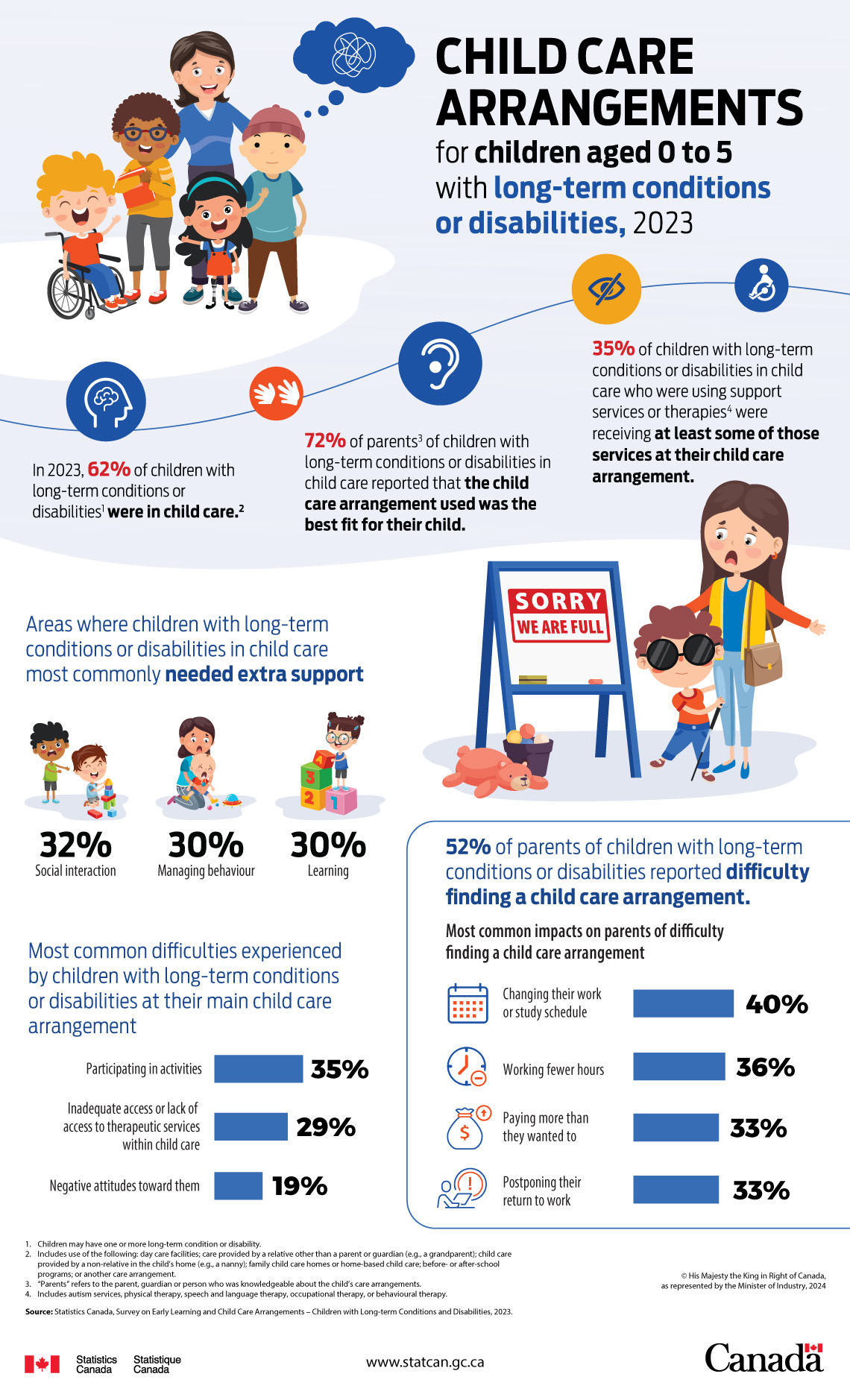
Description - Child care arrangements for children aged 0 to 5 with long-term conditions or disabilities, 2023
In 2023, 62% of children with long-term conditions or disabilities1 were in child care.2
72% of parents3 of children with long-term conditions or disabilities in child care reported that the child care arrangement used was the best fit for their child.
35% of children with long-term conditions or disabilities in child care who were using support services or therapies4 were receiving at least some of those services at their child care arrangement.
Areas where children with long-term conditions or disabilities in child care most commonly needed extra support
- Social interaction: 32%
- Managing behaviour: 30%
- Learning: 30%
52% of parents of children with long-term conditions or disabilities reported difficulty finding a child care arrangement.
Most common impacts on parents of difficulty finding a child care arrangement
- Changing their work or study schedule: 40%
- Working fewer hours: 36%
- Paying more than they wanted to: 33%
- Postponing their return to work: 33%
Most common difficulties experienced by children with long-term conditions or disabilities at their main child care arrangement
- Participating in activities: 35%
- Inadequate access or lack of access to therapeutic services within child care: 29%
- Negative attitudes toward them: 19%
Source: Statistics Canada, Survey on Early Learning and Child Care Arrangements – Children with Long-term Conditions and Disabilities, 2023.
Notes
- Children may have one or more long-term condition or disability.
- Includes use of the following: day care facilities; care provided by a relative other than a parent or guardian (e.g., a grandparent); child care provided by a non-relative in the child’s home (e.g., a nanny); family child care homes or home-based child care; before- or after-school programs; or another care arrangement.
- “Parents” refers to the parent, guardian or person who was knowledgeable about the child’s care arrangements.
- Includes autism services, physical therapy, speech and language therapy, occupational therapy, or behavioural therapy.
Contact information
For more information, or to enquire about the concepts, methods or data quality of this release, contact us (toll-free 1-800-263-1136; 514-283-8300; infostats@statcan.gc.ca) or Media Relations (statcan.mediahotline-ligneinfomedias.statcan@statcan.gc.ca).