

Utilizing data from the 2022 Canadian Survey on Disability, this infographic highlights the trends and experiences of persons with developmental disabilities. This release is part of a series of infographics that focus on specific disability types.
Description - Developmental disabilities, 2022
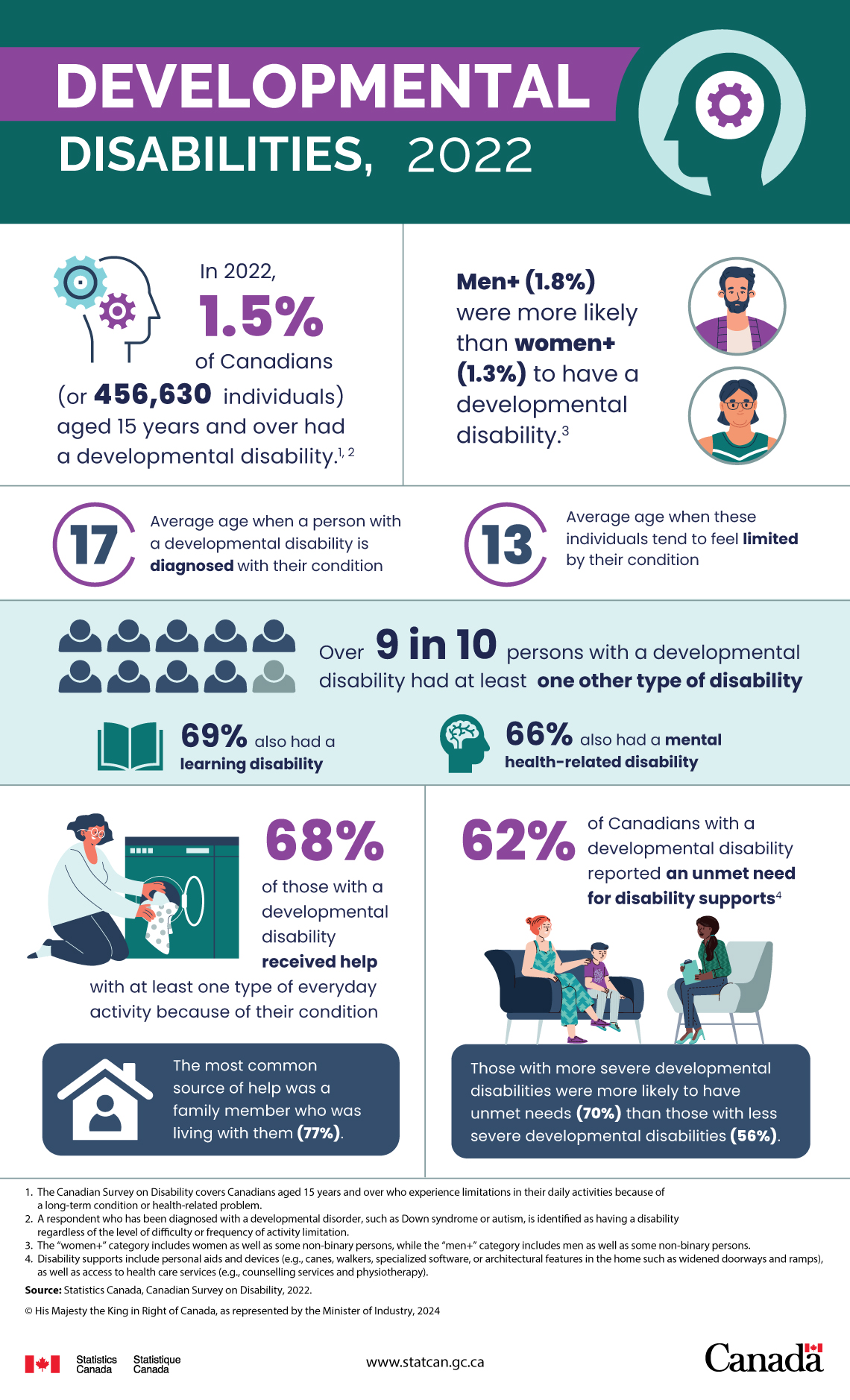
In 2022, 1.5% of Canadians (or 456,630 individuals) aged 15 years and over had a developmental disability. 1, 2.
Men+ (1.8%) were more likely than women+ (1.3%) to have a developmental disability.3
17: Average age when a person with a developmental disability is diagnosed with their condition
13: Average age when these individuals tend to feel limited by their condition
Over 9 in 10 persons with a developmental disability had at least one other type of disability
- 69% also had a learning disability
- 66% also had a mental health-related disability
68% of those with a developmental disability received help with at least one type of everyday activity because of their condition
- The most common source of help was a family member who was living with them (77%).
62% of Canadians with a developmental disability reported an unmet need for disability supports4.
- Those with more severe developmental disabilities were more likely to have unmet needs (70%) than those with less severe developmental disabilities (56%).
Source: Statistics Canada, Canadian Survey on Disability, 2022
Notes
1 The Canadian Survey on Disability covers Canadians aged 15 years and over who experience limitations in their daily activities because of a long-term condition or health-related problem.
2 A respondent who has been diagnosed with a developmental disorder, such as Down syndrome or autism, is identified as having a disability regardless of the level of difficulty or frequency of the activity limitation.
3 The “women+” category includes women as well as some non-binary persons while the “men+” category includes men as well as some non-binary persons.
4 Disability supports include personal aids and devices (e.g., canes, walkers, specialized software, or architectural features in the home such as widened doorways and ramps), as well as access to health care services (e.g., counselling services and physiotherapy).
Contact information
For more information, or to enquire about the concepts, methods or data quality of this release, contact us (toll-free 1-800-263-1136; 514-283-8300; infostats@statcan.gc.ca) or Media Relations (statcan.mediahotline-ligneinfomedias.statcan@statcan.gc.ca).