

Today, we celebrate International Day of Persons with Disabilities. It is a time to reflect on how people living with a disability culturally enrich our society and make contributions to Canada’s development. This day also presents an opportunity to take notice of the areas in which progress towards removing and preventing barriers to accessibility, which have a disproportionate impact on persons with disabilities, can be made.
In recognition of International Day of Persons with Disabilities and in support of the Accessible Canada Act, Statistics Canada is releasing a series of products, using the 2022 Canadian Survey on Disability, to highlight the experiences of persons with disabilities. Follow along as we publish these products in the app today!
This infographic highlights the trends and experiences of persons with pain-related disabilities.
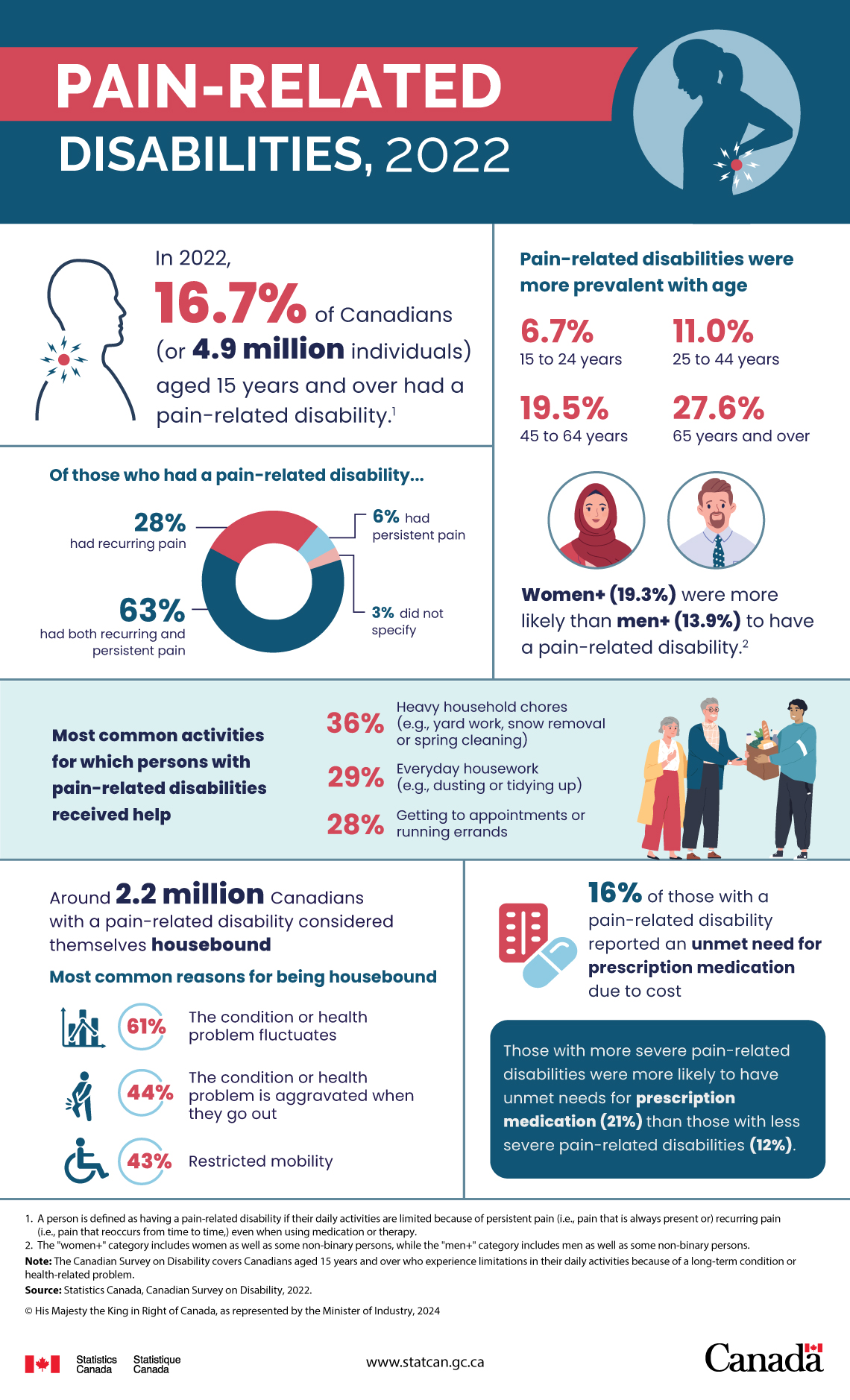
Description - Pain-related disabilities, 2022
In 2022, 16.7% of Canadians (or 4.9 million individuals) aged 15 years and over had a pain-related disability.1
Pain-related disabilities were more prevalent with age:
- 15 to 24 years (6.7%)
- 25 to 44 years (11.0%)
- 45 to 64 years (19.5%)
- 65 years and over (27.6%)
Women+ (19.3%) were more likely than men+ (13.9%) to have a pain-related disability.2
Of those who had a pain-related disability…
- 6% had persistent pain
- 28% had recurring pain
- 63% had both recurring and persistent pain
- 3% did not specify
Most common activities for which persons with pain-related disabilities received help
- Heavy household chores (e.g., yard work, snow removal or spring cleaning) (36%)
- Everyday housework (e.g., dusting or tidying up) (29%)
- Getting to appointments or running errands (28%)
Around 2.2 million Canadians with a pain-related disability considered themselves housebound
Most common reasons for being housebound
- The condition or health problem fluctuates (61%)
- The condition or health problem is aggravated when they go out (44%)
- Restricted mobility (43%)
16% of those with a pain-related disability reported an unmet need for prescription medication due to cost
Those with more severe pain-related disabilities were more likely to have unmet needs for prescription medication (21%) than those with less severe pain-related disabilities (12%).
Source: Statistics Canada, Canadian Survey on Disability, 2022.
Notes
1 A person is defined as having a pain-related disability if their daily activities are limited because of persistent pain (i.e., pain that is always present or) recurring pain (i.e., pain that reoccurs from time to time,) even when using medication or therapy.
2 The “women+” category includes women as well as some non-binary persons, while the “men+” category includes men as well as some non-binary persons.
Contact information
For more information, or to enquire about the concepts, methods or data quality of this release, contact us (toll-free 1-800-263-1136; 514-283-8300; infostats@statcan.gc.ca) or Media Relations (statcan.mediahotline-ligneinfomedias.statcan@statcan.gc.ca).