

Utilizing data from the 2022 Canadian Survey on Disability, this infographic highlights the trends and experiences of persons with mobility disabilities. This release is part of a series of infographics that focus on specific disability types.
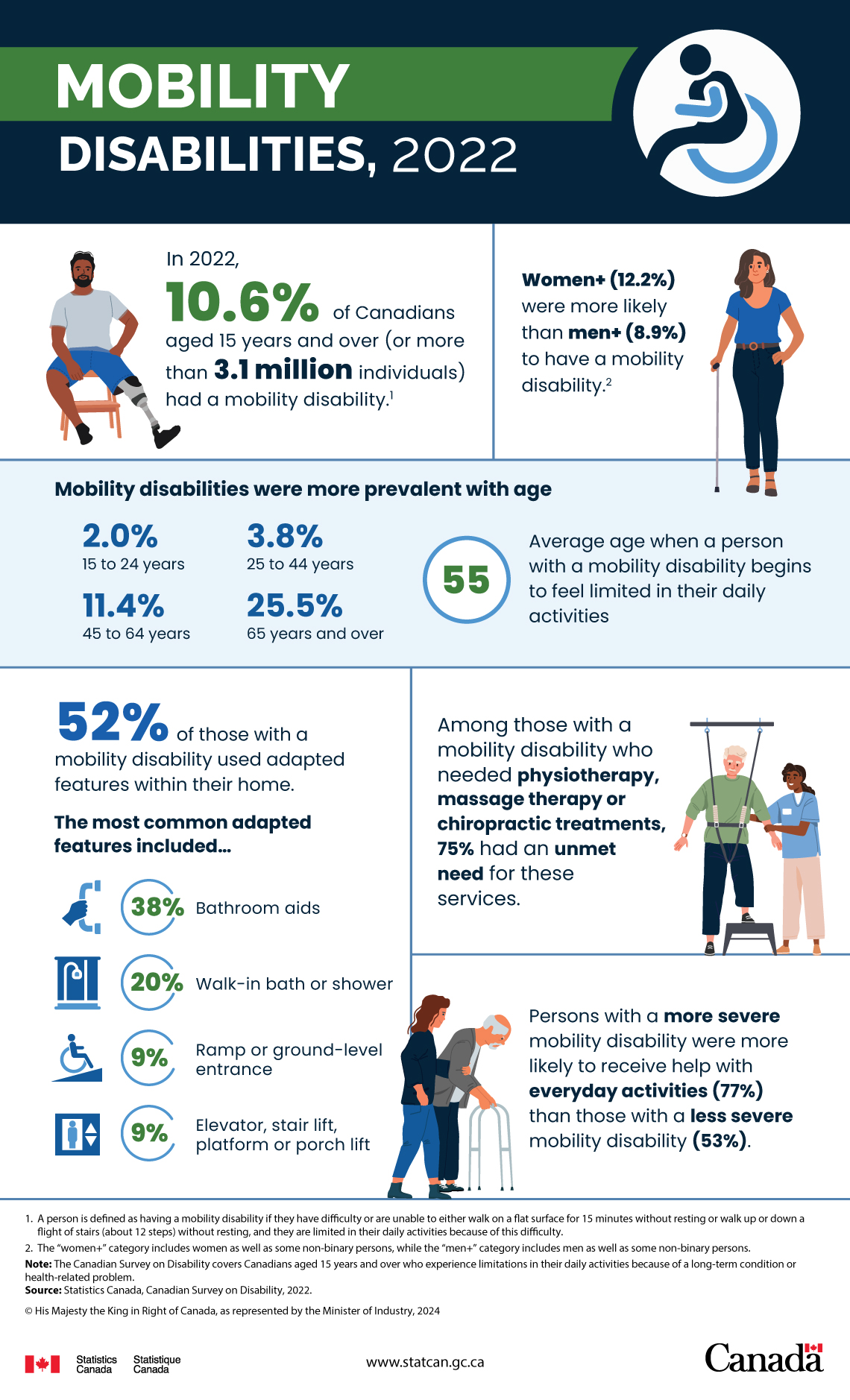
Description - Mobility disabilities, 2022
In 2022, 10.6% of Canadians aged 15 years and over (or more than 3.1 million individuals) had a mobility disability.1
Women+ (12.2%) were more likely than men+ (8.9%) to have a mobility disability.2
Mobility disabilities were more prevalent with age:
- 15 to 24 years: 2.0%
- 25 to 44 years: 3.8%
- 45 to 64 years: 11.4%
- 65 years and over: 25.5%
55: Average age when a person with a mobility disability begins to feel limited in their daily activities.
52% of those with a mobility disability used adapted features within their home.
- The most common adapted features included…
- 38%: Bathroom aids
- 20%: Walk-in bath or shower
- 9%: Ramp or ground-level entrance
- 9%: Elevator, stair lift, platform or porch lift
Among those with a mobility disability who needed physiotherapy, massage therapy or chiropractic treatments, 75% had an unmet need for these services.
Persons with a more severe mobility disability were more likely to receive help with everyday activities (77%) than those with a less severe mobility disability (53%).
Note: The Canadian Survey on Disability covers Canadians aged 15 years and over who experience limitations in their daily activities because of a long-term condition or health-related problem.
Source: Statistics Canada, Canadian Survey on Disability, 2022.
Notes
1A person is defined as having a mobility disability if they have difficulty or are unable to either walk on a flat surface for 15 minutes without resting or walk up or down a flight of stairs (about 12 steps) without resting, and they are limited in their daily activities because of this difficulty.
2The “women+” category includes women as well as some non-binary persons, while the “men+” category includes men as well as some non-binary persons.
Contact information
For more information, or to enquire about the concepts, methods or data quality of this release, contact us (toll-free 1-800-263-1136; 514-283-8300; infostats@statcan.gc.ca) or Media Relations (statcan.mediahotline-ligneinfomedias.statcan@statcan.gc.ca).