
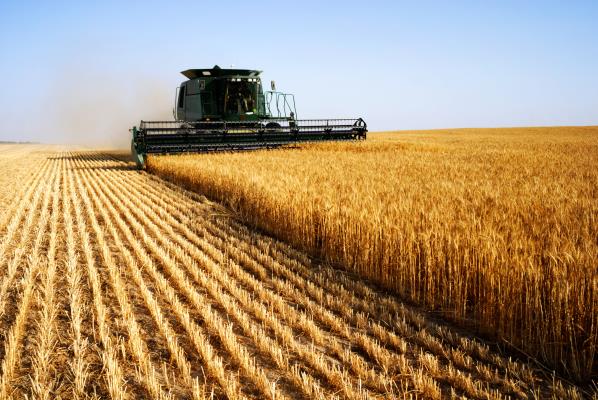
Canadian farmers reported growing more wheat, oats, soybeans, dry peas and lentils, but less canola, corn for grain and barley in 2024. In general, yields were higher this year compared with 2023. However, there were some areas, particularly in Western Canada, where farmers continued to face issues related to dry conditions.
Western Canada had a promising start to the 2024 growing season. Much of the Prairies received timely precipitation during seeding, although cool conditions delayed crop development in some areas. A lack of rain as the summer progressed, coupled with hot weather, resulted in lower yields in some areas compared with 2023. Good field conditions throughout fall 2024 gave operators an opportunity to complete harvest ahead of schedule, with most crops being off the field before data collection for the November Field Crop Survey.
Above-average rainfall in Ontario and western Quebec, combined with summer heat, resulted in higher yields in 2024.
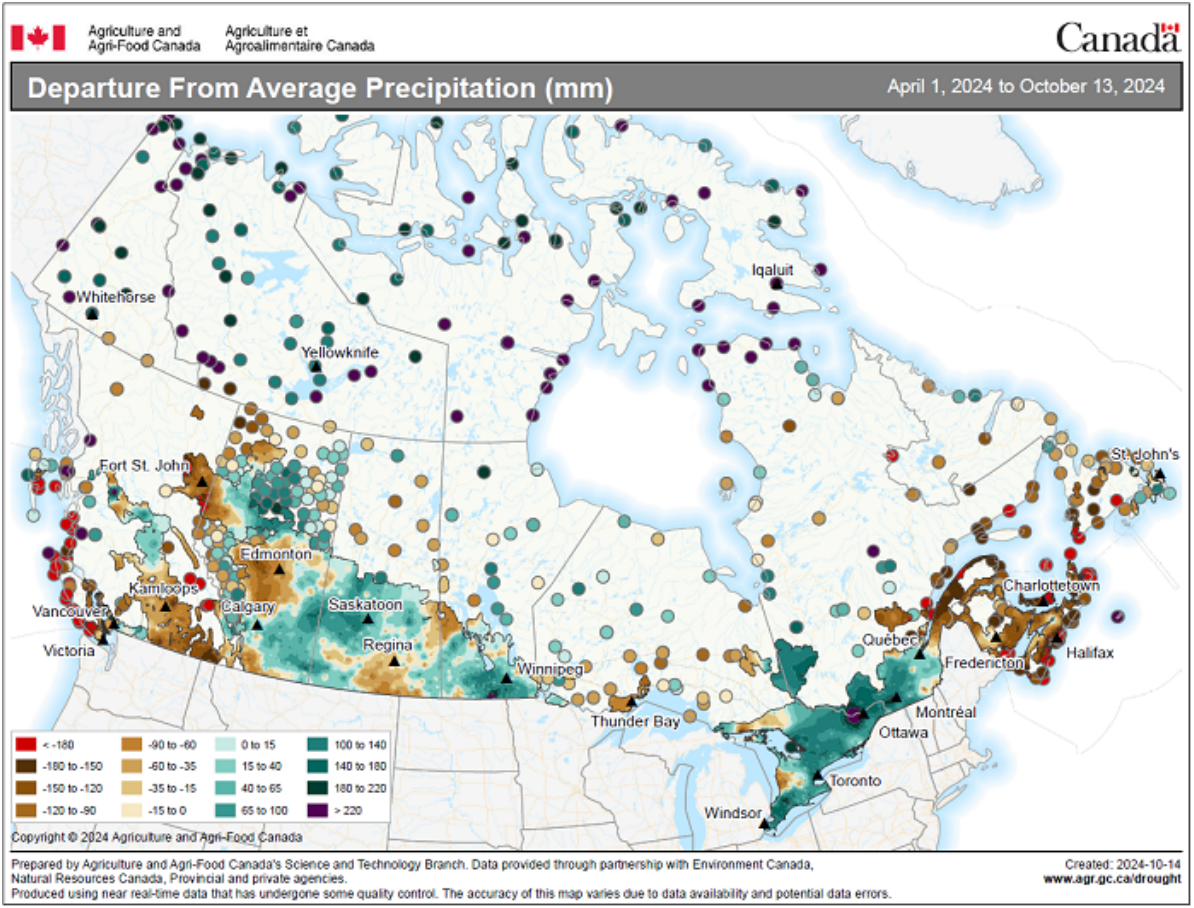
Map 1: Departure from average precipitation (in millimetres) from April 1 to October 13, 2024 (during the growing season), compared with annual average, by province
Description - Map 1
The title of the map is "Departure from average precipitation (in millimetres) from April 1 to October 13, 2024 (during the growing season), compared with annual average, by province"
This map shows precipitation well below average in British Columbia, central Alberta, parts of southern Saskatchewan, eastern Quebec and Atlantic Canada. Precipitation was above average in parts of northern and southern Alberta, central Saskatchewan, most of Manitoba, Ontario and western Quebec.
Note: Produced using near real-time data that have undergone some quality control. The accuracy of this map varies due to data availability and potential data errors.
Source: Prepared by Agriculture and Agri-Food Canada's Science and Technology Branch. Data provided through partnership with Environment Canada, Natural Resources Canada and provincial and private agencies.
Wheat production up on higher yields
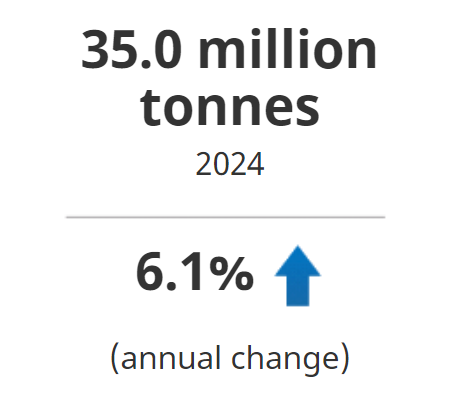
Total wheat production rose 6.1% year over year to 35.0 million tonnes in 2024. The increase was driven by durum wheat (+43.6% to 5.9 million tonnes), on higher harvested area (+8.0% to 6.3 million acres) and yield (+32.8% to 34.0 bushels per acre).
Wheat production
Source: Table 32-10-0359-01.
Spring wheat production rose 2.2% to 26.1 million tonnes in 2024, with higher yields (+4.9% to 51.3 bushels per acre) offsetting lower harvested area (-2.5% to 18.7 million acres).
At the provincial level, Saskatchewan wheat production rose 12.2% to 16.5 million tonnes in 2024. Yields increased 11.1% to 43.0 bushels per acre, while harvested area rose 1.1% to 14.1 million acres.
In Alberta, higher wheat yields (+7.2% to 47.9 bushels per acre) in 2024, combined with lower harvested area (-0.8% to 7.6 million acres), resulted in a 6.4% increase in wheat production to 9.9 million tonnes.
Wheat production in Manitoba edged up 0.7% to 5.5 million tonnes, with higher yields (+2.4% to 62.8 bushels per acre) offsetting lower harvested area (-1.6% to 3.2 million acres).
Canola production falls on lower harvested area and yield
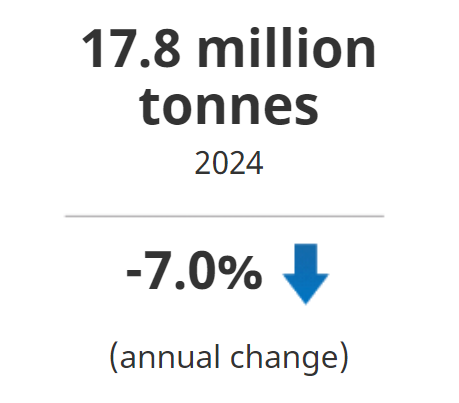
Canola production decreased 7.0% nationally to 17.8 million tonnes in 2024, driven by lower yields (-7.0% to 36.0 bushels per acre) and harvested area (-0.1% to 21.9 million acres). Lower yields were likely the result of hot and dry conditions in parts of Western Canada in July and August.
Canola production
Source: Table 32-10-0359-01.
Canola yields in Saskatchewan declined 3.0% to 35.9 bushels per acre in 2024, while harvested area fell 2.2% to 12.0 million acres, resulting in a 5.1% production decrease to 9.8 million tonnes.
In Alberta, canola production fell 8.5% to 5.1 million tonnes in 2024 due to lower yields (-9.0% to 35.6 bushels per acre). Harvested area rose 0.6% to 6.3 million acres.
Despite higher harvested area (+6.2% to 3.3 million acres), farmers in Manitoba reported producing less canola in 2024. Production fell 11.1% to 2.8 million tonnes on lower yields, which fell 16.3% to 37.1 bushels per acre, possibly because of challenging conditions early in the growing season.
Lower harvested area pushes corn for grain production down
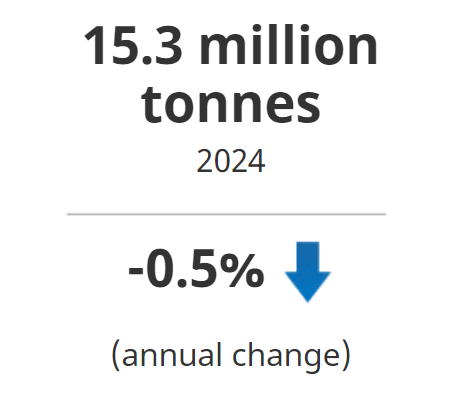
Nationally, total corn for grain production fell 0.5% to 15.3 million tonnes in 2024. Harvested area fell 4.6% to 3.6 million acres, offsetting a 4.3% increase in yields to 168.7 bushels per acre.
Corn for grain production
Source: Table 32-10-0359-01.
Ontario farmers, who grow almost two-thirds of Canada's corn, reported having lower production in 2024, down 3.5% to 9.6 million tonnes. Yields increased 1.7% to a record high of 180.0 bushels per acre as a result of good growing conditions, while harvested area fell 5.1% to 2.1 million acres.
Corn for grain production in Quebec rose 7.9% from 2023 to 3.6 million tonnes in 2024. While harvested area fell 1.4% to 875,900 acres, this was more than offset by higher yields, up 9.5% to 162.1 bushels per acre.
Manitoba farmers reported growing 1.0% less corn for grain, at 1.8 million tonnes in 2024, because of lower harvested area (-8.9% to 498,900 acres). Yields rose 8.6% to 139.4 bushels per acre.
Soybean production rises on strong yields
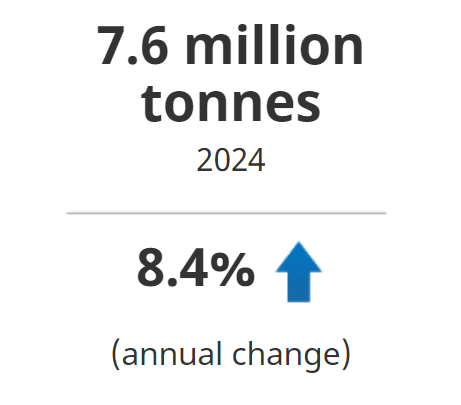
Soybean production increased 8.4% nationally to 7.6 million tonnes in 2024. The increase in production was the result of higher yields, which rose 7.0% to 49.1 bushels per acre, while harvested area increased 1.3% to 5.7 million acres.
Soybeans production
Source: Table 32-10-0359-01.
Barley production down and oats production up
Barley production fell 8.6% to 8.1 million tonnes in 2024 because of lower harvested area (-11.4% to 5.9 million acres). The decrease in harvested area was partially offset by a 3.3% increase in yields to 63.2 bushels per acre nationally.
Total oat production increased by over one-quarter (+27.0% to 3.4 million tonnes), as both harvested area (+20.3% to 2.5 million acres) and yields (+5.7% to 88.7 bushels per acre) increased in 2024.
Note to readers
The November 2024 Field Crop Survey about crop production is sent to approximately 27,200 Canadian farms and was conducted from October 4 to November 7, 2024. Farmers were asked to report their estimated seeded and harvested areas, yields and production of grains, oilseeds and special crops. This survey collected data from every province.
The crop reporting cycle comprises several occasions published throughout the year. The cycle begins with seeding intentions, which are collected directly from producers before spring seeding, followed by the June Field Crop Survey, which collects seeded area estimates from producers in all provinces in the spring. The July and August releases use a model-based approach that relies on remote sensing and agroclimatic data to produce preliminary yield and production estimates. The November Field Crop Survey provides the final production estimates for 2024, which are subject to revision for two years, based on results of supply and disposition exercises which produce estimates of stocks of principal field crops.
Release calendar
The dates for the upcoming releases on the stocks, areas and production of principal field crops are available online. Please note that spring seeding intentions for the 2025 calendar year is currently scheduled for release on March 12, 2025.
In this release, percentage changes are calculated using unrounded data.
An easy-to-print chart, Crop Reporting Survey at a Glance, which provides an overview of our survey cycle, is now available.
Reference
Data tables: 32-10-0042-01 and 32-10-0359-01.
- Note: some data tables may best be viewed on desktop.
Definitions, data sources and methods: survey number 3401.
Previous release: Production of principal field crops, November 2023
Contact information
For more information, or to enquire about the concepts, methods or data quality of this release, contact us (toll-free 1-800-263-1136; 514-283-8300; infostats@statcan.gc.ca) or Media Relations (statcan.mediahotline-ligneinfomedias.statcan@statcan.gc.ca).