

Utilizing data from the 2022 Canadian Survey on Disability, this infographic highlights the trends and experiences of persons with mental health-related disabilities. This release is part of a series of infographics that focus on specific disability types.
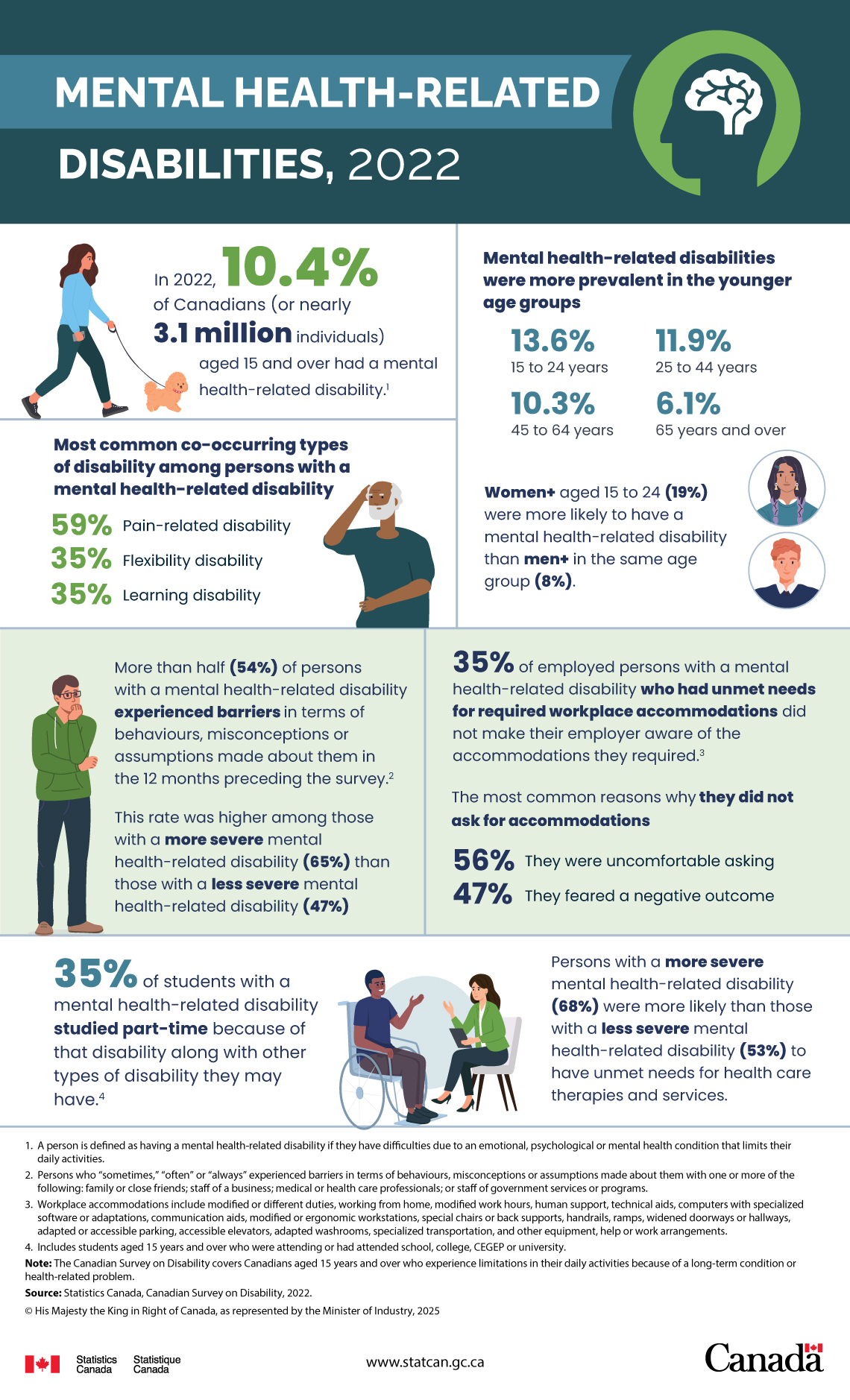
Description - Mental health-related disabilities, 2022
In 2022, 10.4% of Canadians (or nearly 3.1 million individuals) aged 15 and over had a mental health-related disability.1
Mental health-related disabilities were more prevalent in the younger age groups
- 15 to 24 years: 13.6%
- 25 to 44 years: 11.9%
- 45 to 64 years: 10.3%
- 65 years and over: 6.1%
Women+ aged 15 to 24 (19%) were more likely to have a mental health-related disability than men+ in the same age group (8%).
Most common co-occurring types of disability among persons with a mental health-related disability:
- Pain-related disability (59%)
- Flexibility disability (35%)
- Learning disability (35%)
More than half (54%) of persons with a mental health-related disability experienced barriers in terms of behaviours, misconceptions or assumptions made about them in the 12 months preceding the survey.2
This rate was higher among those with a more severe mental health-related disability (65%) than those with a less severe mental health-related disability (47%)
35% of employed persons with a mental health-related disability who had unmet needs for required workplace accommodations did not make their employer aware of the accommodations they required.3
The most common reasons why they did not ask for accommodations
- They were uncomfortable asking (56%)
- They feared a negative outcome (47%)
35% of students with a mental health-related disability studied part-time because of that disability along with other types of disability they may have.4
Persons with a more severe mental health-related disability (68%) were more likely than those with a less severe mental health-related disability (53%) to have unmet needs for health care therapies and services.
Note: The Canadian Survey on Disability covers Canadians aged 15 years and over who experience limitations in their daily activities because of a long-term condition or health-related problem.
Source: Statistics Canada, Canadian Survey on Disability, 2022.
Notes
-
1 A person is defined as having a mental health-related disability if they have difficulties due to an emotional, psychological or mental health condition that limits their daily activities.
-
2 Persons who “sometimes,” “often” or “always” experienced barriers in terms of behaviours, misconceptions or assumptions made about them with one or more of the following: family or close friends; staff of a business; medical or health care professionals; or staff of government services or programs.
-
3 Workplace accommodations include modified or different duties, working from home, modified work hours, human support, technical aids, computers with specialized software or adaptations, communication aids, modified or ergonomic workstations, special chairs or back supports, handrails, ramps, widened doorways or hallways, adapted or accessible parking, accessible elevators, adapted washrooms, specialized transportation, and other equipment, help or work arrangements.
-
4 Includes students aged 15 years and over who were attending or had attended school, college, CEGEP or university.
Contact information
For more information, or to enquire about the concepts, methods or data quality of this release, contact us (toll-free 1-800-263-1136; 514-283-8300; infostats@statcan.gc.ca) or Media Relations (statcan.mediahotline-ligneinfomedias.statcan@statcan.gc.ca).