
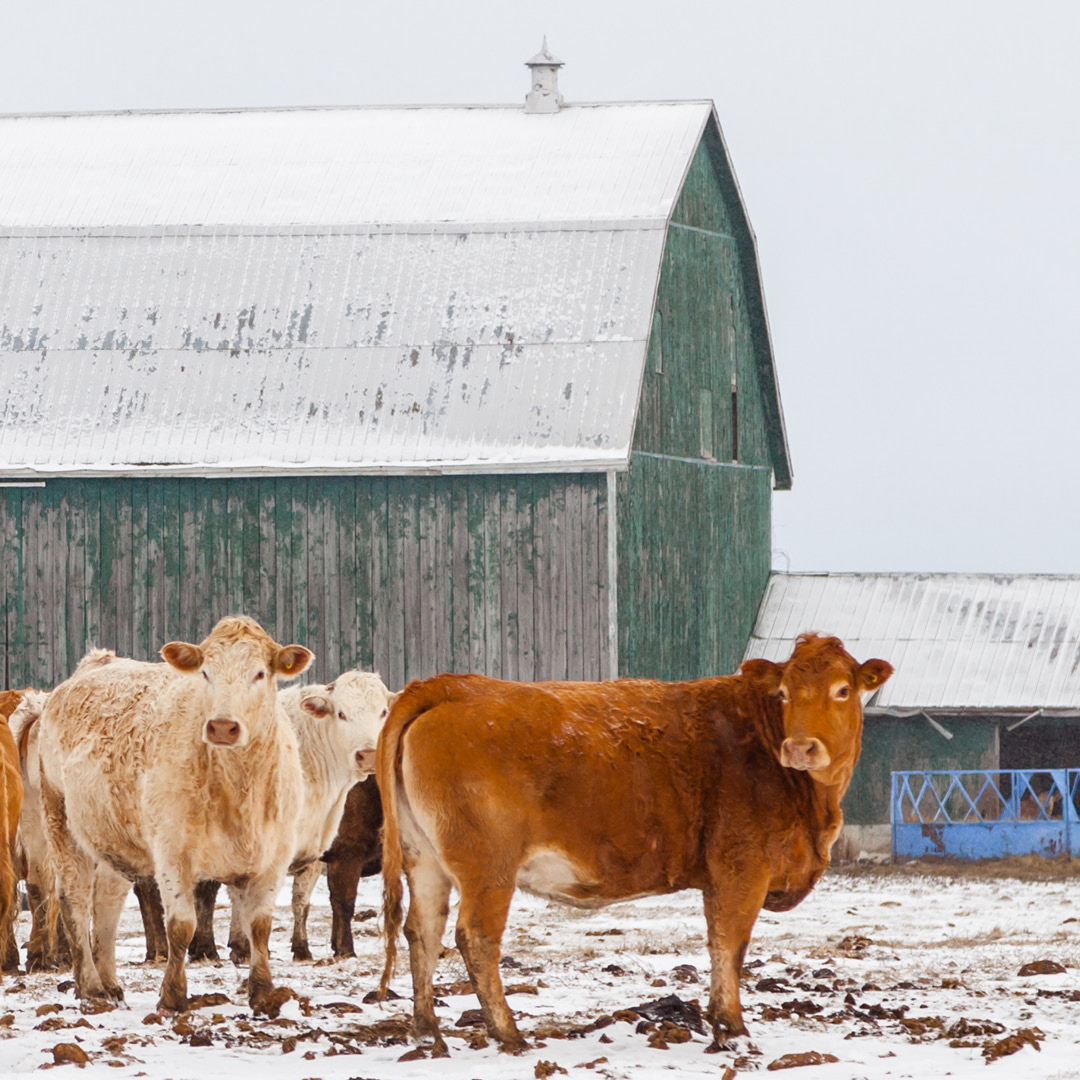
On January 1, 2025, Canadian cattle, hog and sheep inventories were down compared with the same date one year earlier.
The Canadian cattle herd fell on January 1 for the third consecutive year. However, this latest decline was smaller than those observed on the same date in 2023 and 2024, following improvements in western Canadian feed and drought conditions over the past year.
On January 1, 2025, Canadian hog inventories decreased despite declines in both international exports and slaughter. Smaller pig crops were observed in both Eastern and Western Canada in response to processing reductions.
Canadian sheep inventories declined on January 1 for the second consecutive year. Average producer prices of slaughter lambs for July to December 2024 fell well below those received over the previous six months (January to June 2024), following lower demand for both feeder and slaughter lambs.
Cattle and calves
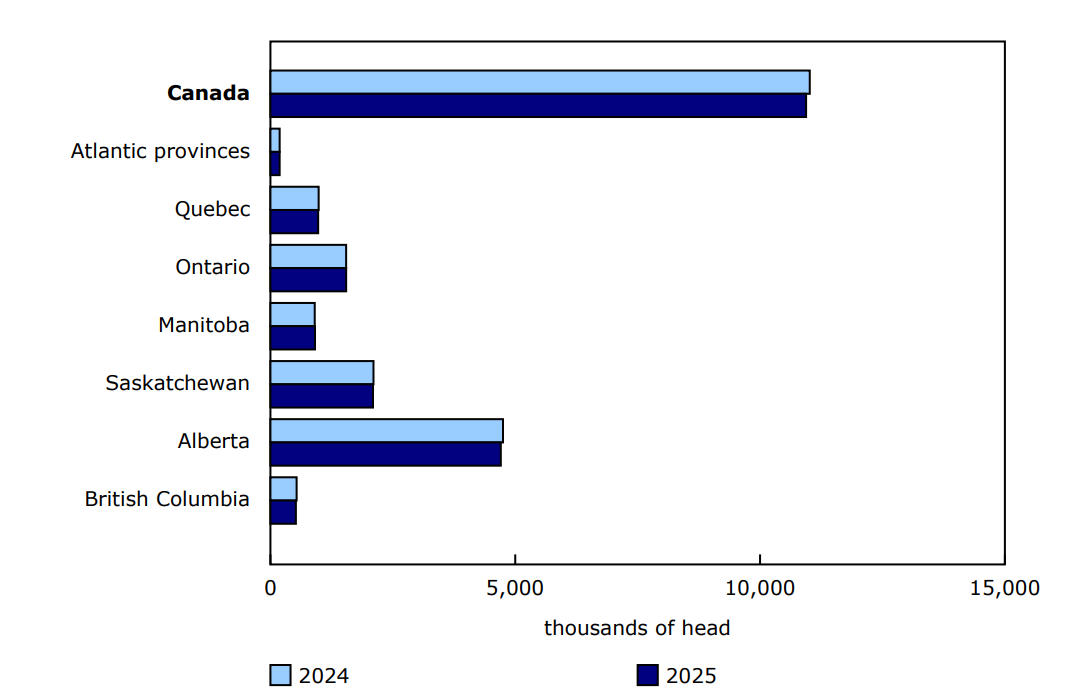
Canadian farmers held 10.9 million cattle and calves on their farms on January 1, 2025, down 0.7% from the same date the previous year. This represents the smallest year-over-year decline since January 1, 2022, as feed supplies were more abundant in 2024.
Chart 1: Total cattle inventories, January 1, 2024, and January 1, 2025
Description - Chart 1
Data table: Total cattle inventories, January 1, 2024, and January 1, 2025
Source: Table 32-10-0130-01.
Canadian cattle producers retained less breeding stock on January 1, 2025. Year-over-year decreases were observed for bulls (-1.8%) and beef cows (-1.2%), while dairy cows were virtually unchanged. Conversely, beef heifers for breeding rose 0.8%, lending support to the beef cow herd. Producers also held fewer steers (-1.8%), heifers (-0.5%) and calves (-0.2%) compared with January 1, 2024.
Slaughter of cattle and calves for July to December 2024 fell 4.6% year over year to 1.7 million head. Meanwhile, international demand for live cattle and calves remained high, as exports rose 1.9% to 396,500 head over the same period, contributing to strong prices for feeder cattle.
Hogs
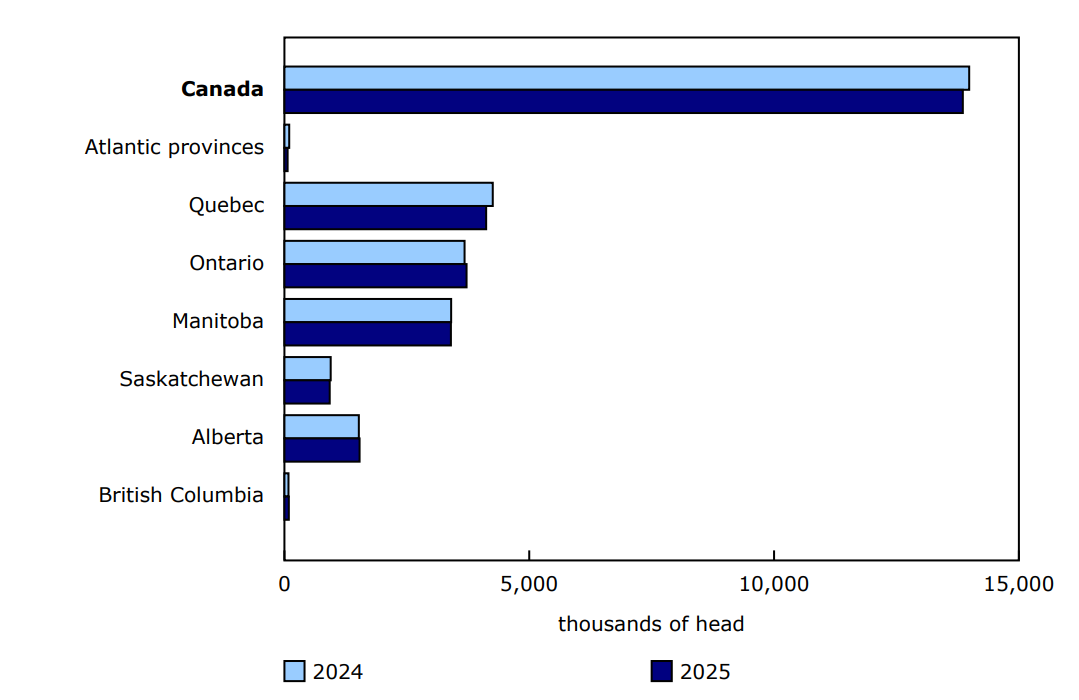
Canadian hog producers reported having 13.9 million hogs on their farms on January 1, 2025, down 0.9% from the same date one year earlier. Quebec, which held the largest proportion of hogs among the provinces, recorded a 3.2% year-over-year decline in hog inventories, following the implementation of the province's herd reduction program.
Chart 2: Total hog inventories, January 1, 2024, and January 1, 2025
Description - Chart 2
Data table: Total hog inventories, January 1, 2024, and January 1, 2025
Source: Table 32-10-0160-01.
On January 1, hog producers recorded a 1.6% decline in sows and gilts to 1.2 million head, while boars were down 2.6% year over year to 15,200 head.
From July to December 2024, the total hog slaughter decreased 1.0% to 10.7 million head, while international exports of live hogs were down 3.6% to 3.3 million head. The pig crop fell 3.6% to 14.6 million head compared with July to December 2023, as production declined following reductions in processing in both Eastern and Western Canada.
Sheep and lambs
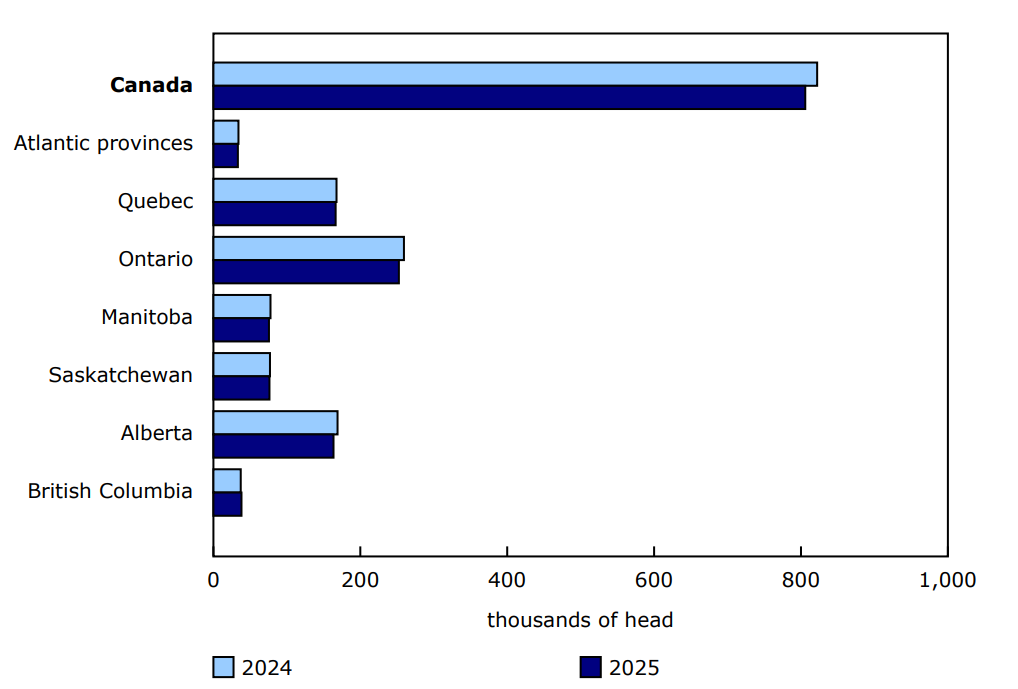
On January 1, 2025, Canadian inventories of sheep and lambs were down 2.0% year over year to 805,800 head.
Chart 3: Total sheep inventories, January 1, 2024, and January 1, 2025
Description - Chart 3
Data table: Total sheep inventories, January 1, 2024, and January 1, 2025
Source: Table 32-10-0129-01.
The sheep breeding herd declined 1.4% year over year on January 1 to 587,100 head, as inventories of ewes (-1.0%) and replacement lambs (-3.8%) decreased, while rams were virtually unchanged. The number of market lambs was down 3.4% to 218,700 head over the same period.
For the July to December 2024 period, sheep and lamb slaughter decreased 0.7% year over year to 385,400 head, as prices for slaughter lambs weakened in the latter half of 2024. Over the same period, international exports of live sheep and lambs fell by almost half (-48.8%) year over year, totalling 4,100 head.
Note to readers
Livestock estimates are available for Canada and the provinces, as well as for the United States.
Adjustments to hog slaughter data
Data published by Statistics Canada on the number of hogs slaughtered in Canada and the provinces include the number of head slaughtered at federally and provincially inspected facilities. These data are collected from Agriculture and Agri-Food Canada (AAFC). AAFC's data on hog slaughter at federally inspected facilities currently reflect the animal's province of origin, which may differ from the province of slaughter. Data published by AAFC on hog slaughter at provincially inspected facilities are only available by province of slaughter.
As of the July 1, 2022, reference period for inventories, and the July to December 2021 reference period for supply and disposition, the provincially inspected hog slaughter data published by Statistics Canada have been adjusted using administrative data collected by the Canadian Pork Council's PigTRACE program to more accurately reflect the province of origin. This approach is in line with Statistics Canada's AgZero initiative, which aims to produce high-quality estimates using models, administrative data and other non-traditional survey-based approaches.
For the latest information on the Census of Agriculture, visit the Census of Agriculture portal.
For more information on agriculture and food, visit the Agriculture and food statistics portal.
Reference
Data tables: Access the latest tables.
- Note: some data tables may best be viewed on desktop.
Definitions, data sources and methods: survey number 3460.
Previous release: Livestock estimates, July 1, 2024.
Contact information
For more information, or to enquire about the concepts, methods or data quality of this release, contact us (toll-free 1-800-263-1136; 514-283-8300; infostats@statcan.gc.ca) or Media Relations (statcan.mediahotline-ligneinfomedias.statcan@statcan.gc.ca).