
Utilizing data from the 2022 Canadian Survey on Disability, this infographic highlights the trends and experiences of persons with hearing disabilities. This release is part of a series of infographics that focus on specific disability types.
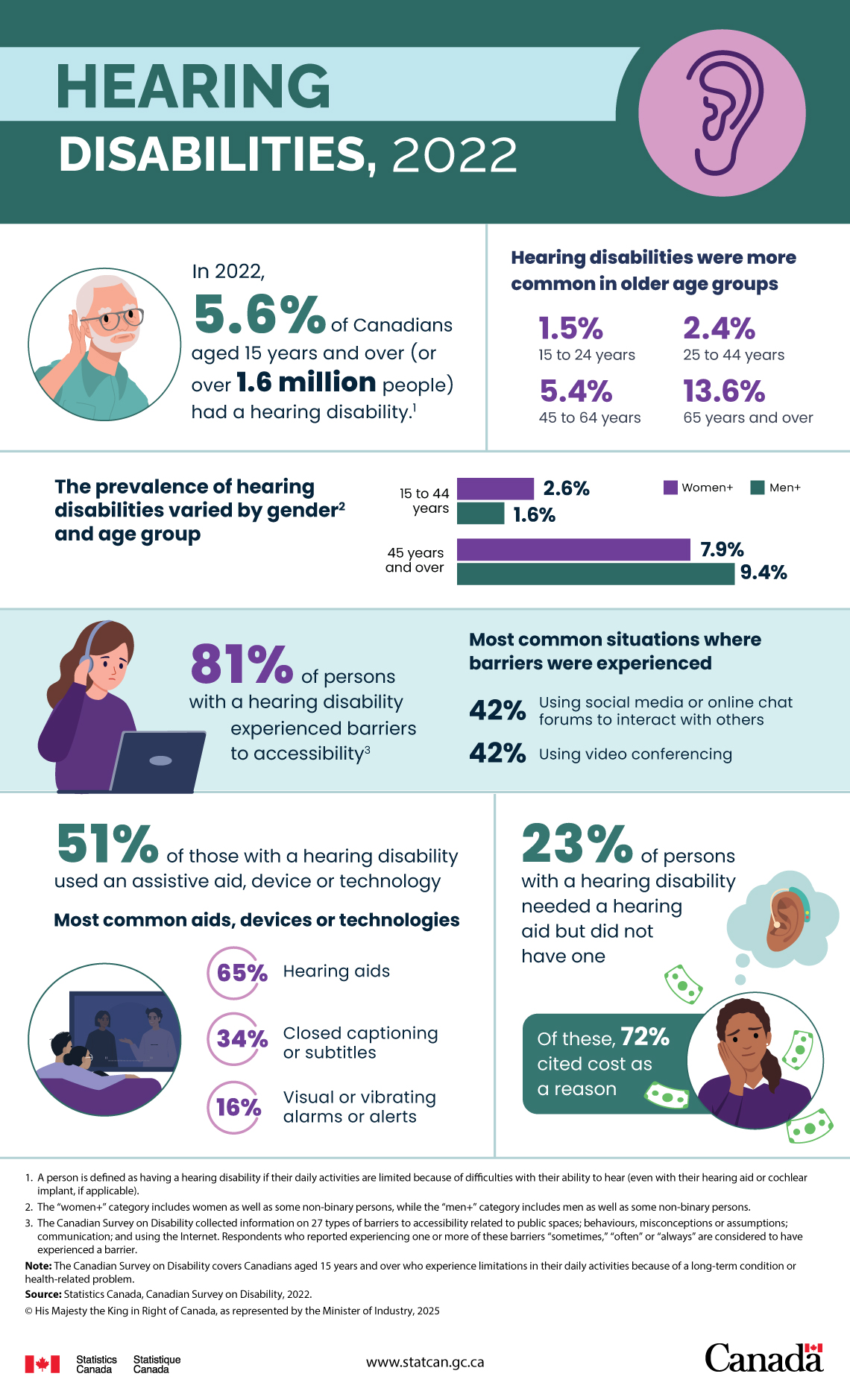
Description - Hearing disabilities, 2022
- In 2022, 5.6% of Canadians aged 15 years and over (or over 1.6 million people) had a hearing disability.1
- Hearing disabilities were more common in older age groups:
- 15 to 24 years: 1.5%
- 25 to 44 years: 2.4%
- 45 to 64 years: 5.4%
- 65 years and over: 13.6%
- The prevalence of hearing disabilities varied by gender2 and age group:
- Women+, 15 to 44 years: 2.6%
- Men+, 15 to 44 years: 1.6%
- Women+, 45 years and over: 7.9%
- Men+, 45 years and over: 9.4%
- 81% of persons with a hearing disability experienced barriers to accessibility3
- Most common situations where barriers were experienced:
- Using social media or online chat forums to interact with others (42%)
- Using video conferencing (42%)
- Most common situations where barriers were experienced:
- 51% of those with a hearing disability used an assistive aid, device or technology
- Most common aids, devices or technologies:
- Hearing aids (65%)
- Closed captioning or subtitles (34%)
- Visual or vibrating alarms or alerts (16%)
- Most common aids, devices or technologies:
- 23% of persons with a hearing disability needed a hearing aid but did not have one
- Of these, 72% cited cost as a reason
Note: The Canadian Survey on Disability covers Canadians aged 15 years and over who experience limitations in their daily activities because of a long-term condition or health-related problem.
Sources: Statistics Canada, Canadian Survey on Disability, 2022.
Notes
1 A person is defined as having a hearing disability if their daily activities are limited because of difficulties with their ability to hear (even with their hearing aid or cochlear implant, if applicable).
2 The “women+” category includes women as well as some non-binary persons, while the “men+” category includes men as well as some non-binary persons.
3 The Canadian Survey on Disability collected information on 27 types of barriers to accessibility related to public spaces; behaviours, misconceptions or assumptions; communication; and using the Internet. Respondents who reported experiencing one or more of these barriers “sometimes,” “often” or “always” are considered to have experienced a barrier.
Contact information
For more information, or to enquire about the concepts, methods or data quality of this release, contact us (toll-free 1-800-263-1136; 514-283-8300; infostats@statcan.gc.ca) or Media Relations (statcan.mediahotline-ligneinfomedias.statcan@statcan.gc.ca).