
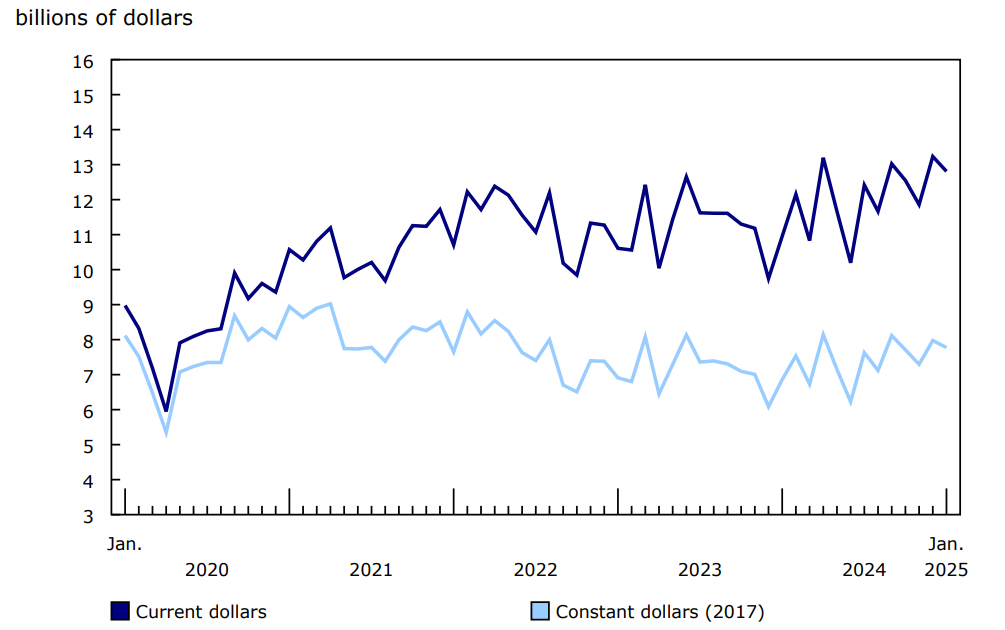
In January, the total value of building permits issued in Canada decreased by $425.8 million (-3.2%) from the previous month to $12.8 billion. Ontario (-$771.1 million) led the decline, while New Brunswick (+$356.8 million) tempered it the most.
On a constant dollar basis (2017=100), the total value of building permits issued in January declined 2.5% from the previous month, while it was up 13.4% on a year-over-year basis.
Chart 1: Total value of building permits, seasonally adjusted
Description - Chart 1
Data table: Total value of building permits, seasonally adjusted
Source: Table 34-10-0285-01.
Figure 1: Month-to-month change in total value of building permits (seasonally adjusted, current dollars)
Description - Figure 1
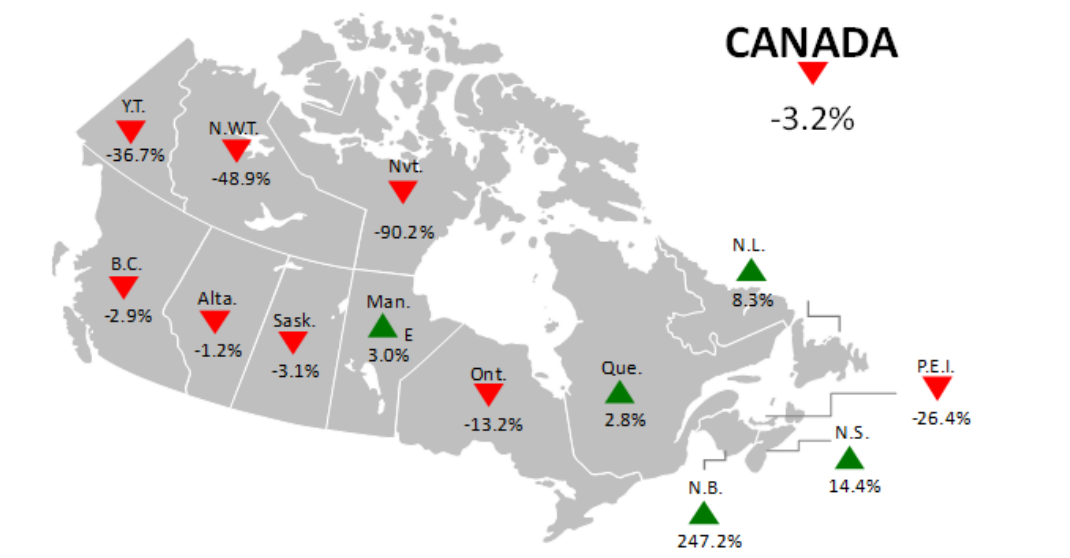
This is a map of Canada by province and territory that shows the month-to-month percentage changes of the total building permits value. Green arrows represent an increase, while red arrows represent a decrease.
Building permit values in Canada down 3.2% in January compared with December. Newfoundland and Labrador up 8.3%, Prince Edward Island down 26.4%, Nova Scotia up 14.4%, New Brunswick up 247.2%, Quebec up 2.8%, Ontario down 13.2%, Manitoba up 3.0% E (use with caution), Saskatchewan down 3.1%, Alberta down 1.2%, British Columbia down 2.9%, Yukon down 36.7%, Northwest Territories down 48.9%, Nunavut down 90.2%.
Source: Table 34-10-0285-01.
Figure 2: Building permits for residential and non-residential construction in Canada (seasonally adjusted, current dollars)
Description - Figure 2
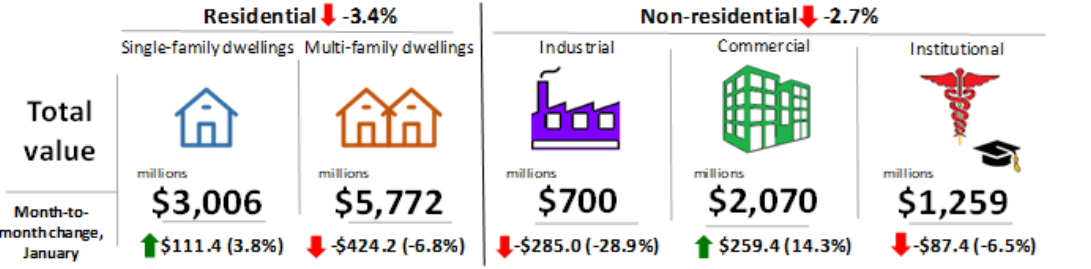
Residential: The total value was down 3.4% month over month.
Non-residential: The total value was down 2.7% month over month.
Single-family dwellings: the total value was $3,006 million, representing a month-over-month increase of 3.8% or $111.4 million.
Multi-family dwellings: the total value was $5,772 million, representing a month-over-month decrease of 6.8% or $424.2 million.
Industrial: the total value was $700 million, representing a month-over-month decrease of 28.9% or $285.0 million.
Commercial: the total value was $2,070 million, representing a month-over-month increase of 14.3% or $259.4 million.
Institutional: the total value was $1,259 million, representing a month-over-month decrease of 6.5% or $87.4 million.
Source: Table 34-10-0285-01.
Ontario's multi-family component leads residential sector decline
Residential construction intentions decreased by $312.7 million (-3.4%) to $8.8 billion in January after increasing by $1.7 billion in December 2024. Overall, the multi-family component declined by $424.2 million in January 2025, while the single-family component increased by $111.4 million.
Ontario's multi-family component (-$738.5 million) led the decline in January, after being a significant contributor to residential sector gains in the previous month.
New Brunswick (+$195.9 million) and Quebec (+$186.3 million) partially offset residential sector losses in January. The monthly gains in New Brunswick's residential sector were due to the multi-family component (+$199.7 million) and were concentrated in the Fredericton census metropolitan area (CMA) (+$83.9 million) and in the Moncton CMA (+$78.5 million). Quebec's residential sector growth was also driven by the multi-family component (+$139.8 million), fuelled by gains in the Montréal CMA (+$160.2 million), and supported by the province's single-family component (+$46.5 million).
Across Canada, 23,500 multi-family dwellings and 4,900 single-family dwellings were authorized in January, down 3.7% from the previous month, but up 37.4% on a year-over-year basis.
Chart 2: Value of building permits for the single-family and multi-family components
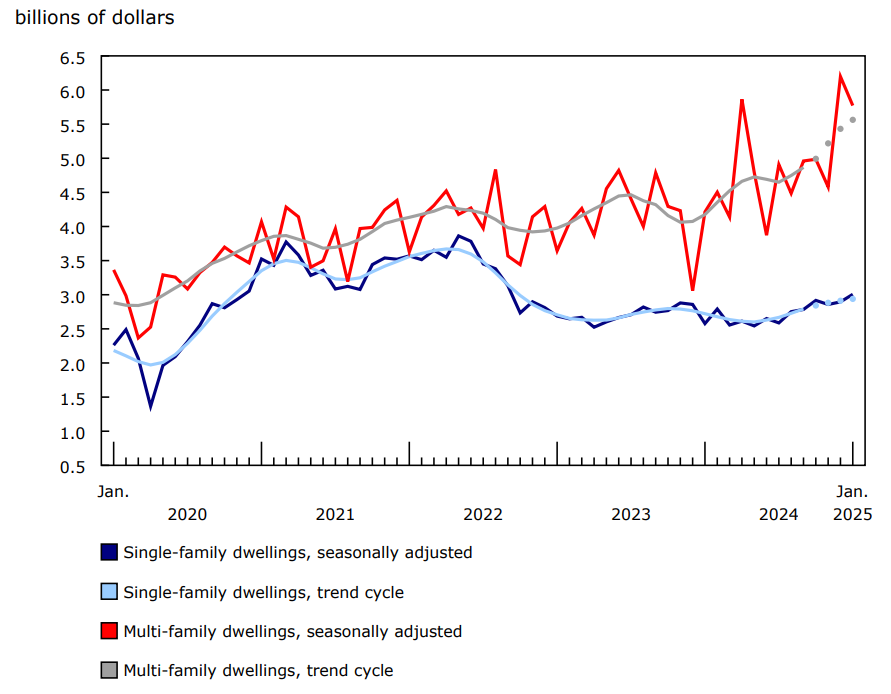
Description - Chart 2
Data table: Value of building permits for the single-family and multi-family components
Note: The higher variability associated with the trend-cycle estimates is indicated with a dotted line on the chart for the current reference month and the previous three months. For more information, see the Note to readers.
Source: Table 34-10-0285-01.
Chart 3: Value of building permits for the residential and non-residential sectors
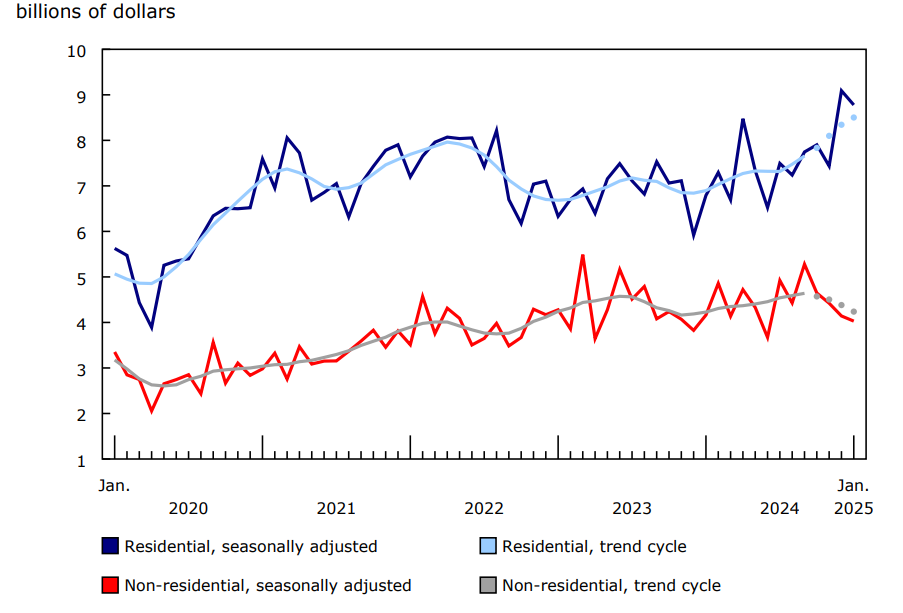
Description - Chart 3
Data table: Value of building permits for the residential and non-residential sectors
Note: The higher variability associated with the trend-cycle estimates is indicated with a dotted line on the chart for the current reference month and the previous three months. For more information, see the Note to readers.
Source: Table 34-10-0285-01.
Industrial construction intentions push down the non-residential sector
The value of non-residential building permits decreased by $113.0 million (-2.7%) to $4.0 billion in January, a fourth consecutive monthly decrease. The industrial component (-$285.0 million) drove the decline, followed by the institutional component (-$87.4 million). The commercial component (+$259.4 million) mitigated the decline in the non-residential sector.
January declines in the industrial component were led by Ontario (-$204.7 million) and Alberta (-$74.6 million).
The decrease in the institutional component in January was driven by British Columbia (-$136.7 million) and Alberta (-$74.9 million), while New Brunswick (+$70.9 million) and Nova Scotia (+$62.0 million) mitigated the decline.
Gains in commercial construction intentions in January were led by Alberta (+$153.3 million) and New Brunswick (+$95.4 million).
To explore data using an interactive user interface, visit the Building permits: Interactive Dashboard.
For more information on construction, please visit the Construction statistics portal.
For more information on housing, please visit the Housing statistics portal.
Note to readers
Unless otherwise stated, this release presents seasonally adjusted data with current dollar values, which facilitate month-to-month and quarter-to-quarter comparisons by removing the effects of seasonal variations. For information on seasonal adjustment, see Seasonally adjusted data – Frequently asked questions.
For information on trend-cycle data, see the page Trend-cycle estimates – Frequently asked questions.
Data may not add up to totals as a result of rounding.
Building components
- Single-family dwellings: Residential buildings containing only one dwelling unit (e.g., single-detached house, bungalow, linked home [linked at the foundation]).
- Multi-family dwellings: Residential buildings containing multiple dwelling units (e.g., apartment, apartment condominium, row house, semi-detached house).
- Industrial buildings: Buildings used in the processing or production of goods or related to transportation and communication.
- Commercial buildings: Buildings used in the trade or distribution of goods and services, including office buildings.
- Institutional and government buildings: Buildings used to house public and semi-public services, such as those related to health and welfare, education or public administration, and buildings used for religious services.
Revision
Data are subject to revisions based on late responses, methodological changes and classification updates. Unadjusted data have been revised for the previous month. Seasonally adjusted data have been revised for the previous three months.
Reference
Data table: 34-10-0285-01.
- Note: some data tables may best be viewed on desktop.
Definitions, data sources and methods: survey number 2802.
Previous release: Building permits, December 2024.
Next release: April 10, 2025.
Contact information
For more information, or to enquire about the concepts, methods or data quality of this release, contact us (toll-free 1-800-263-1136; 514-283-8300; infostats@statcan.gc.ca) or Media Relations (statcan.mediahotline-ligneinfomedias.statcan@statcan.gc.ca).