
On July 1, Canadian cattle and sheep inventories were up compared with the same date one year earlier, while hog inventories were down.
The Canadian cattle herd rose on July 1, the first year-over-year increase since 2021, mainly due to lower slaughter. Inventories rose in all breeding stock categories on July 1, 2025, lending support to the beef and dairy herds.
On July 1, Canadian hog inventories decreased on account of higher slaughter in both Eastern Canada and Western Canada.
Canadian sheep supply remained tight relative to demand, despite inventories rising on July 1, following two years of decline.
Cattle and calves
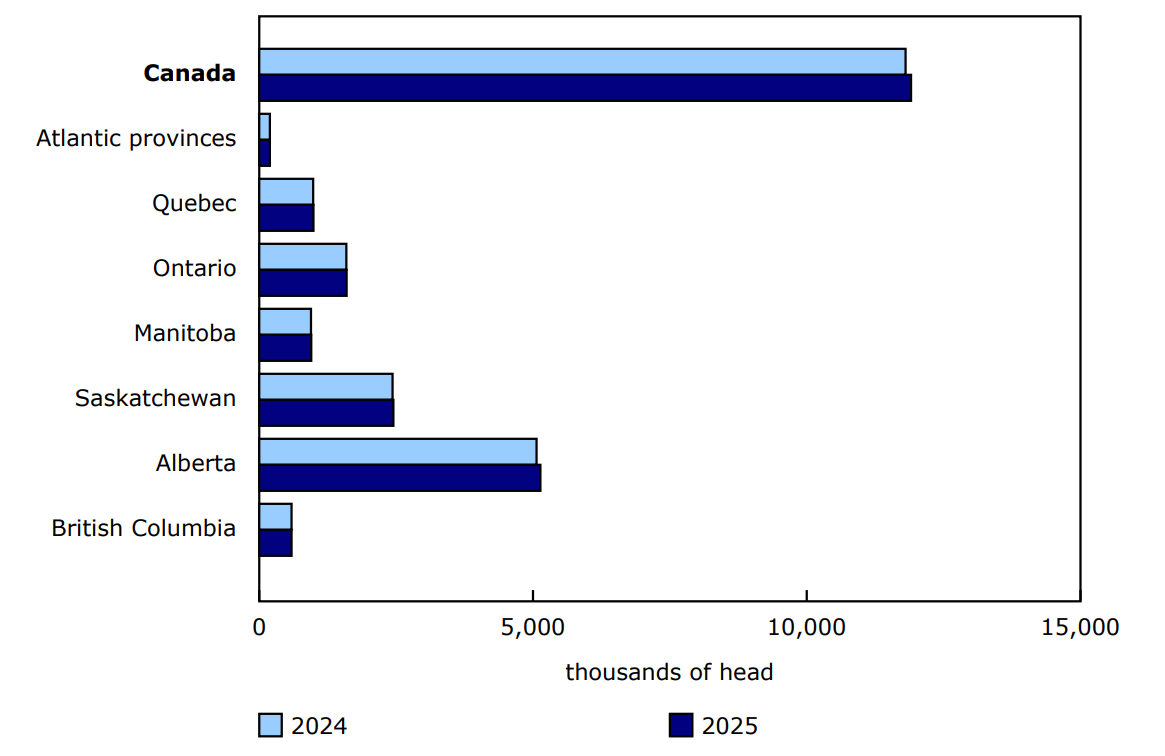
Canadian cattle producers held 11.9 million cattle and calves on their farms on July 1, up 0.8% from one year earlier.
Chart 1: Total cattle inventories, July 1, 2024, and July 1, 2025
Description - Chart 1
Data table: Total cattle inventories, July 1, 2024, and July 1, 2025
Source: Table 32-10-0130-01.
On July 1, Canadian cattle producers retained more beef heifers for breeding (+2.0%), bulls (+0.5%) and beef cows (+0.4%), while inventories of dairy heifers for breeding (+0.5%) and dairy cows (+0.4%) were also up from the same date the previous year. Higher breeding stock retention, coupled with a 1.8% year-over-year increase in births from January to June, helped support cattle herd inventories. Meanwhile, producers held fewer steers (-1.8%) and feeder heifers (-1.5%) on July 1, compared with the same date one year earlier. Producers also held 3.8 million calves, a 3.0% increase year over year.
Cattle and calves slaughter for January to June fell 5.0% year over year to 1.6 million head, while international exports of live cattle and calves decreased to 390,400 head (-2.7%) over the same period. Feeder and slaughter cattle prices reached record highs over the first half of 2025, as global demand for beef remained elevated.
Hogs
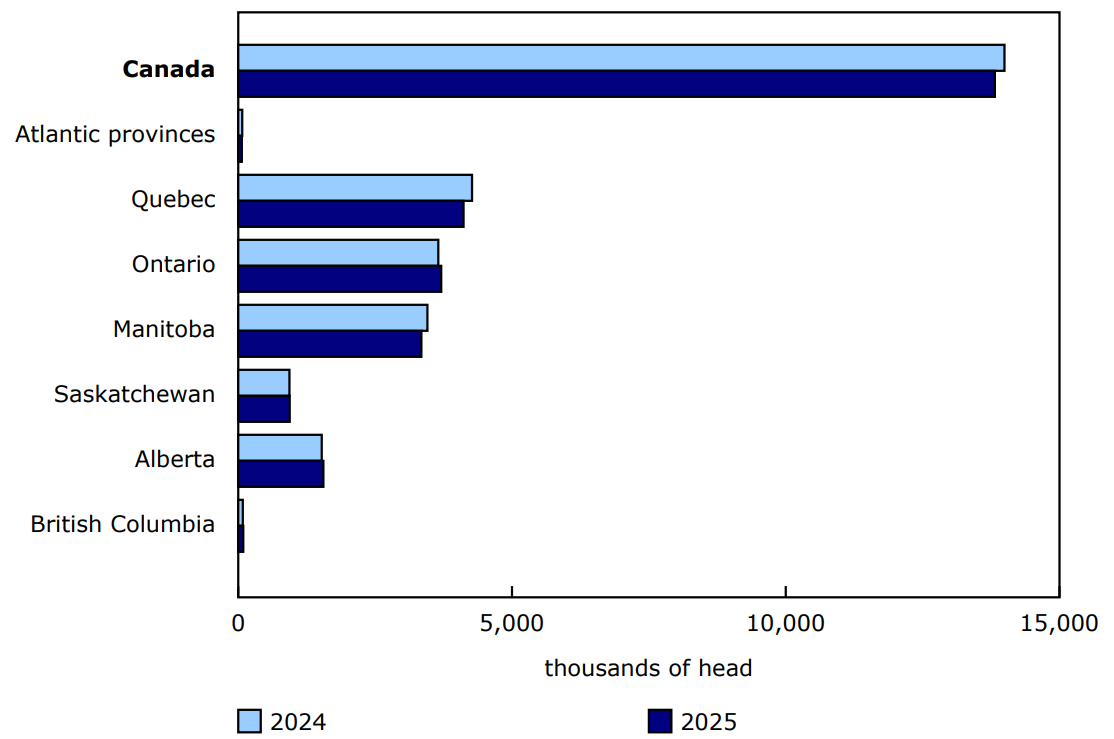
Canadian hog producers reported having 13.8 million hogs on their farms on July 1, down 1.3% from the same date in 2024.
Chart 2: Total hog inventories, July 1, 2024, and July 1, 2025
Description - Chart 2
Data table: Total hog inventories, July 1, 2024, and July 1, 2025
Source: Table 32-10-0160-01.
Canadian hog producers reported having 1.2 million sows and gilts (-0.4%) on July 1, 2025, while the number of boars was down 0.6% year over year to 15,400 head. Meanwhile, the pig crop for the first half of 2025 rose to 15.1 million, a 1.4% year-over-year increase.
From January to June, international exports of live hogs were down 1.0% year over year to 3.5 million head, while total hog slaughter rose 3.3% to 11.0 million head, supported by strong demand for pork exports.
Sheep and lambs
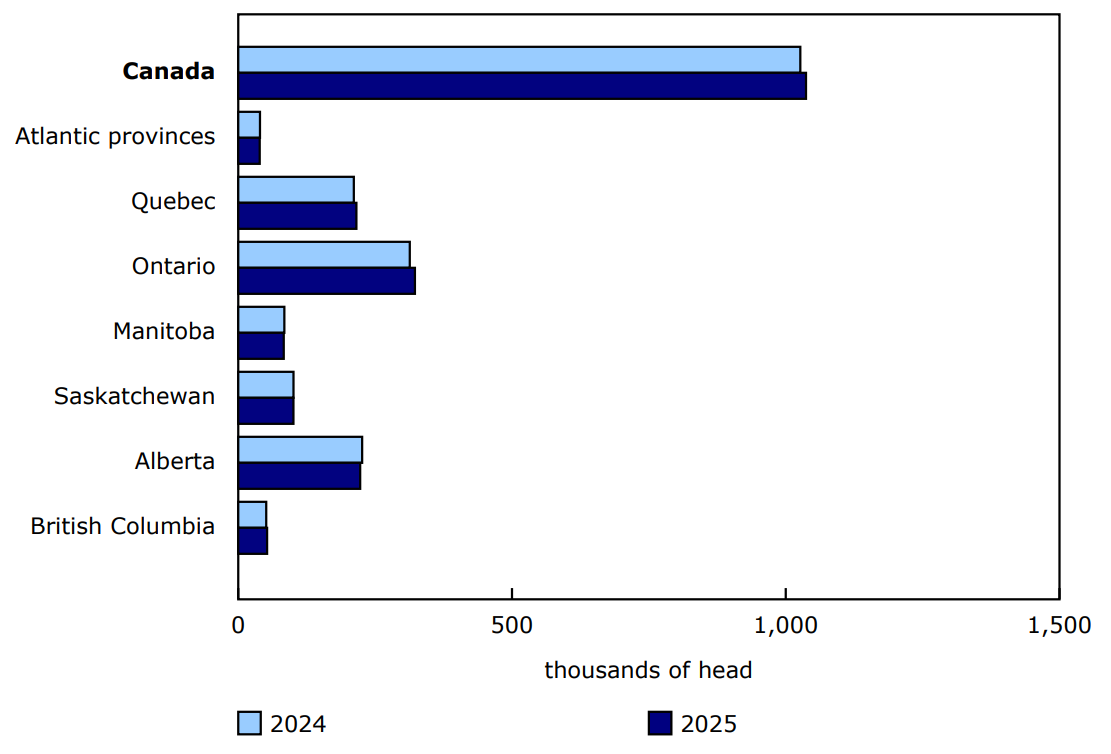
On July 1, Canadian inventories of sheep and lambs were up 1.0% year over year to 1.0 million head.
Chart 3: Total sheep inventories, July 1, 2024, and July 1, 2025
Description - Chart 3
Data table: Total sheep inventories, July 1, 2024, and July 1, 2025
Source: Table 32-10-0129-01.
The sheep breeding herd rose 0.1% year over year on July 1 to 627,000 head, as increased inventories of rams (+1.7%) and replacement lambs (+1.5%) more than offset a 0.2% decrease in ewes. The number of market lambs was up 2.4% to 410,000 head over the same period.
From January to June, sheep and lamb slaughter dropped 5.3% year over year to 362,900 head, while international exports of live sheep and lambs fell 82.3%, totalling 1,100 head. Prices for both feeder and slaughter lambs reached record highs over the January to June period, as supplies remained tight.
Sheep producers in Western Canada recorded a 6.1% year-over-year rise in lamb deaths from January to June, in part reflecting the impact of the Cache Valley virus on gestating ewes.
Note to readers
Livestock estimates are available for Canada and the provinces, as well as for the United States.
For more information on agriculture and food, visit the Agriculture and food statistics portal.
Contact information
For more information, or to enquire about the concepts, methods or data quality of this release, contact us (toll-free 1-800-263-1136; 514-283-8300; infostats@statcan.gc.ca) or Media Relations (statcan.mediahotline-ligneinfomedias.statcan@statcan.gc.ca).