

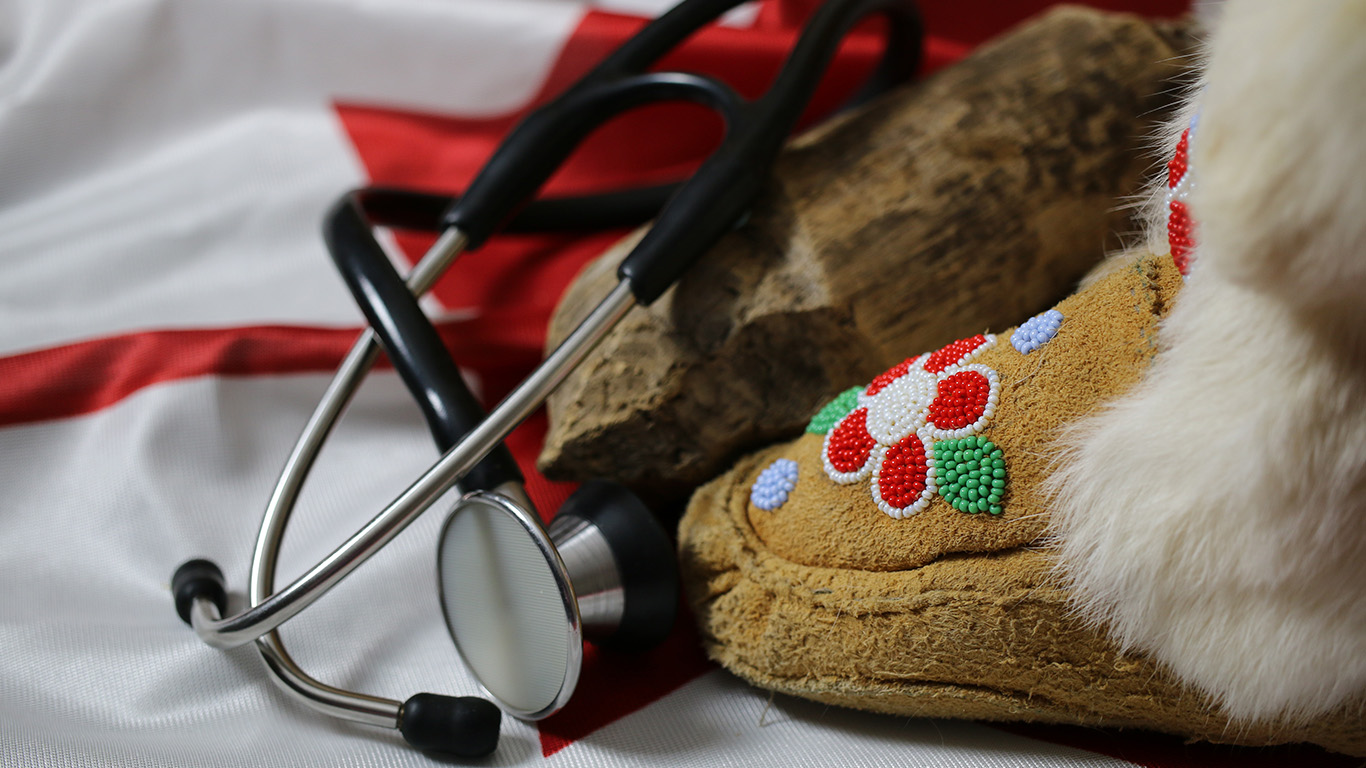
September 30 marks the National Day for Truth and Reconciliation in Canada. The day recognizes atrocities and long-lasting harms of the Indian Residential School System and honours the children who never returned home and Survivors of residential schools, as well as their families and communities.
In 2015, The Truth and Reconciliation Commission (TRC) released its final report detailing 94 calls to action to redress the legacy of residential schools and advance the process of reconciliation in Canada. TRC Calls 18 through 24 relate to health.
Health disparities continue to exist between Indigenous and non-Indigenous people in Canada
The disparities in outcomes, including health outcomes, between Indigenous and non-Indigenous people are deeply rooted in the legacy of colonial policies. The forced displacement, residential schooling, the suppression of languages and cultural practices, systemic violence and neglect, and the disruption of traditional societies have undermined the well-being of Indigenous people across generations. Indigenous children have also been overrepresented in the child welfare system, which continues to this day. This overrepresentation has been linked to negative health outcomes in adulthood. Furthermore, Indigenous people who were under the legal responsibility of the government as children face higher rates of disability and lower levels of self-rated health than their non-Indigenous counterparts.
The TRC Call to Action 19 urges the federal government to identify and bridge the gap in health disparities between Indigenous and non-Indigenous people. It also calls for yearly updates and tracking of long-term trends.
Reports, such as Statistics Canada’s Health of Canadians, and health survey data help to shed light on continuing disparities and trends, such as Indigenous adults being more likely to experience chronic health conditions. From 2019 to 2022, approximately half of First Nations adults living off reserve (50.1%), Métis (49.3%) and Inuit (50.3%) reported having at least one chronic condition such as asthma, arthritis or high blood pressure—compared with 40.6% of non-Indigenous adults.
Access to health care remains a challenge for many Indigenous people
Inadequate health care access is an issue faced by many Indigenous people. For example, in 2024, Inuit adults (54.3%) were less likely to have a regular health care provider than non-Indigenous adults (85.7%).
Many Indigenous people must travel far to access health care. In 2024, 40% of Inuit, 18% of First Nations people living off reserve and 16% of Métis reported travelling outside their communities for health care in the previous 12 months. Among Inuit who travelled for health care in the previous 12 months, over half had to travel more than 1,500 kilometres for services—distances that would be unimaginable to many Canadians seeking basic health care.
Satisfaction with health care remains mixed. In 2024, approximately half of First Nations people living off reserve (50%), Métis (52%) and Inuit (57%) said they were satisfied with wait times. Furthermore, over one-quarter of Indigenous people reported unmet health care needs, and this was more pronounced among First Nations women (38.6%).
Together, inadequate health care access and disparities in health outcomes are expected to contribute to lower life expectancies among Indigenous peoples. From 2016 to 2021, life expectancy was 74.0 years for First Nations people with Registered or Treaty Indian status, 80.5 years for Métis, and 71.9 years for Inuit, all significantly below the 85.0 years for non-Indigenous people.
Traditional medicine and healing practices important for a large majority of Indigenous people
Many Indigenous people still experience discrimination or a lack of culturally safe care in mainstream health settings. In 2024, 24% of First Nations people living off reserve, 18% of Métis and 23% of Inuit reported that they experienced some form of unfair treatment, racism or discrimination from a health care professional in the previous 12 months.
The TRC Call to Action 22 urges the recognition of the value of Indigenous healing practices and their incorporation in the treatment of Indigenous patients. In 2024, a majority of First Nations people living off reserve (86%), Métis (70%) and Inuit (82%) expressed that it is important for health services to support Indigenous traditional medicines, healing and wellness practices. Of those who stated that culturally appropriate services were important, over three in five First Nations people living off reserve (68%), Métis (61%) and Inuit (67%) reported that such services would make them feel respected for their culture, beliefs and identity. In addition, approximately half of First Nations people living off reserve (49%) and Inuit (50%) reported that such services would make them more likely to seek health care. These findings reflect a desire for self-determination in health and wellness.
The TRC reminds us that reconciliation is a journey, not a final destination. To build a fair and inclusive society, health gaps between Indigenous and non-Indigenous people need to be addressed. Indigenous communities, leaders and researchers are already working on solutions, like creating health care partnerships led by Indigenous people. Tracking the progress of health and well-being of First Nations people, Métis and Inuit through accurate and timely reporting is a key part of moving forward.
Learn more
More information is available on Statistics Canada’s Statistics on Indigenous Peoples portal, a central location where users can find links to data and information products related to First Nations people, Métis and Inuit.
Visit The National Centre for Truth and Reconciliation, where Survivors, their families, educators, researchers and the public can examine the residential school system more deeply with the goal of fostering reconciliation and healing.
📲 Looking for more? Staying informed has never been easier!
Follow the “Indigenous peoples” subject in the StatsCAN app to receive personalized updates and stay connected with the most recent articles, reports and analyses.
Contact information
For more information, contact the Statistical Information Service (toll-free 1-800-263-1136; 514-283-8300; infostats@statcan.gc.ca) or Media Relations (statcan.mediahotline-ligneinfomedias.statcan@statcan.gc.ca).