
Police-reported dating violence in Canada, 2008

Archived Content
Information identified as archived is provided for reference, research or recordkeeping purposes. It is not subject to the Government of Canada Web Standards and has not been altered or updated since it was archived. Please "contact us" to request a format other than those available.
by Tina Hotton Mahony
Prevalence of police-reported dating violence
Victims of dating violence most likely to be female
Differences in rates of dating violence between the sexes decline with age
Increase in police-reported rates of dating violence
Common assault most likely offence in dating violence
Similar proportion of male and female victims of dating violence sustained injuries
More than 4 in 10 incidents of dating violence occur in the victim's home
Dating violence involving female victims more likely to lead to charges
Homicides perpetrated in dating relationships
Summary
Methodology
Detailed data tables
References
Notes
According to results of the National Longitudinal Survey of Children and Youth (NLSCY), approximately 71%1 of youth in Canada report being in a dating relationship by the age of 15. Among those that have engaged in a dating relationship, 55% had their first dating relationship by the age of 12. Although dating violence occurs at any stage of life, most of the Canadian research published to date has focused on high school, college or university students (Wekerle et al., 2009)(Ellis et al., 2009)(Straus, 2004)(DeKeseredy & Kelly, 1993). The prevalence of dating violence varies by study, depending on the definition of violence used and the age of respondents. The 1993 Violence Against Women Survey (VAWS) found that 16% of women had experienced physical or sexual violence in a dating relationship since the age of 16. Estimates of physical and sexual coercion among college students are even higher, ranging from 20% to 30% (Wekerle et al., 1999). Like spousal violence, the consequences of dating violence victimization are many, and include lower psychological well-being as well as physical health problems (Cornelius et al., 2009).
This report examines the prevalence and characteristics of incidents of police-reported dating violence in Canada. This study focuses on the population 15 years of age and older. This sample was selected to draw comparisons between the characteristics of dating violence incidents with previous analyses of police-reported spousal violence in Canada. Incidents of dating violence involving younger victims between the ages of 12 and 14 are examined separately (see Text Box 3).
Text Box 1
How this study measures dating violence
This Juristat article defines dating relationships as those between current or former boyfriends and girlfriends as well as "other intimate relationships".2 For the purpose of this analysis, incidents involving boyfriends and girlfriends living with the suspect at the time of the offence were removed from the sample since these may be considered common-law relationships3 rather than dating relationships.
As with spousal violence, the Criminal Code does not have specific offences pertaining to dating violence. However, the Incident based Uniform Crime Reporting (UCR2) Survey and the Homicide Survey collect annual data on incidents of violence that were reported to police as well as detailed information about their victims and offenders. Using both of these data sources, it is possible to examine incidents of violence perpetrated by dating partners by identifying the relationship between the victim and the accused. In this study, violence includes physical violence (such as homicide, assault, sexual assault, threats) as well as harassment.
Disclosing intimate relationship violence can be difficult for many victims. Results of the 2004 General Social Survey (GSS) found that most victims of spousal violence (72%) did not report the abuse to police. In fact, only 36% of female victims and 17% of male victims had contact with police as a result of the abuse (Mihorean, 2005). Therefore, this study only a portion of incidents of violence perpetrated in dating relationships.
Prevalence of police-reported dating violence
Close to 23,000 incidents of dating violence were reported to police in 2008. Dating violence represented 7% of total violent crimes in 2008, and about one quarter of all intimate partner violence (28%) (Table 1).4 Similar to incidents of spousal violence, a large proportion of dating violence occurs once the relationship has ended. More than half (57%) of dating violence incidents in 2008 were perpetrated by a former partner (Table 2).
Victims of dating violence most likely to be female
As is the case for spousal violence (Taylor-Butts, 2009; Bressan, 2008), females accounted for the majority of victims of police-reported dating violence in 2008. Over 8 in 10 victims of violence in dating relationships were female. This rate was similar for both current and former boyfriend/girlfriend relationships. The ratio of female to male victims was lower for "other intimate relationships" with females accounting for nearly two-thirds (62%) of victims (Chart 1). This difference may be attributed in part to the relatively high proportion of same-sex relationships classified as other intimate relationships (see Text Box 2).
Chart 1
Females most likely victims of dating violence, 2008

1. Includes a person with whom the victim had a sexual relationship or a mutual sexual attraction but to which none of the other relationship options apply.
Note: Percentages may not total 100% due to rounding. Excludes incidents where the sex and/or age of the victim was unknown. The 2008 data are based upon information reported by police services covering 98% of the population of Canada.
Source: Statistics Canada, Canadian Centre for Justice Statistics, Incident-based Uniform Crime Reporting (UCR2) Survey.
Differences in rates of dating violence between the sexes decline with age
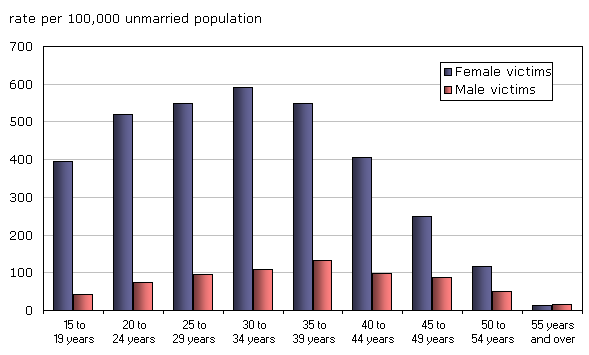
According to police-reported data, those between 30 and 39 years of age were at highest risk of being victims of dating violence and these rates declined steadily with age (Chart 2).5 Among female victims, the highest rates of dating violence involved victims between the ages of 30 and 34 (591 per 100,000 unmarried population), while for males it was 35 to 39 years of age (132 per 100,000 unmarried population).
Chart 2
For females the highest rates of dating violence involved victims aged 30 to 34, and those aged 35 to 39 for males, 2008
Note: Percentages may not add up to 100% due to rounding. Excludes incidents where the sex and/or the age of the victim was unknown. Includes victims aged 15 to 98. Dating violence refers to violence committed by current and former boyfriends/girlfriends and other intimate partners. The 2008 data are based upon information reported by police services covering 98% of the population of Canada.
Source: Statistics Canada, Canadian Centre for Justice Statistics, Incident-based Uniform Crime Reporting (UCR2) Survey.
Most studies of self-reported dating violence (see Archer, 2000) indicate that young people between the ages of 15 and 24 have the highest risk of dating violence. Police-reported statistics confirm that out of the total population, the number of dating violence victims is highest among this age group (representing 43% of incidents). This reflects the fact that dating relationships are highest among young people, and decline with age, as more individuals marry or move into common-law relationships.6 Consequently, when rates of dating violence for this study were calculated based on the unmarried population instead of the total population, per capita rates were higher among people in their 30s than their 20s.
The rate of dating violence experienced by females during the teenage years was relatively high in comparison to young male victims. Rates of dating violence were higher for female than male victims at a margin of nearly 10 to 1 for those 15 to 19 years of age, and decline with age, with near parity in rates for individuals 55 years of age and older (Chart 2).
Increase in police-reported rates of dating violence
From 2004 to 2008, there has been a steady increase in rates of police-reported dating violence (Chart 3).7 Rates of dating violence for females have increased 40%, from 2004 to 2008.8 Rates for male victims followed a similar pattern, increasing 47% over this time period. Increases in dating violence over the 5-year reference period were found across all age groups.9
Chart 3
Increase in rates of dating violence for male and female victims, 2004 to 2008

Note: Excludes incidents where the sex of the victim was unknown. Includes victims aged 15 to 98. Dating violence refers to violence committed by current and former boyfriends/girlfriends and other intimate partners. Incident-based trend data are reported by a subset of police services that have been consistently reporting to the UCR2 Survey since 1999.
Source: Statistics Canada, Canadian Centre for Justice Statistics, Incident-based Uniform Crime Reporting (UCR2) Trend Database.
Trends in dating violence vary considerably from those of spousal violence, where a steady decrease in police-reported violence has been recorded for female victims since 1998 (Taylor-Butts, 2009; Bressan, 2008). It is unclear if the rise in police-reported dating violence reflects an actual increase in violence perpetrated in dating relationships. Alternative explanations may include a greater willingness among victims of dating violence to contact police, and/or a shift among police to lay criminal charges in incidents of dating violence as was documented for spousal violence in the 1990's (Johnson and Hotton, 2001; Federal-Provincial-Territorial Working Group, 2003).
Common assault most likely offence in dating violence
According to 2008 police-reported data, the most frequently committed violent offence in dating relationships was common assault (level 1) (50%), the least serious form of physical assault. Following common assault, other offences included criminal harassment (14%), uttering threats (12%), major assault involving a weapon and/or causing bodily harm (level 2 or 3) (11%), indecent and harassing phone calls (6%), forcible confinement and related offences (3%), and sexual assault10 (3%) (Table 3). The types of offences committed in dating relationships were similar to those in spousal relationships (see Taylor-Butts, 2009). The only notable differences were that criminal harassment, uttering threats and indecent or harassing phone calls made up a larger share of dating violence than spousal violence incidents. These stalking type offences may be more likely to transpire in dating relationships than in current spousal relationships (AuCoin, 2005) due to the fact that the victim and the offender do not live together.
While the types of criminal offences committed against female and male victims of dating violence were similar, there were a few exceptions. For example, almost all sexual assaults as well as forcible confinement and related offences involved female victims. Similar to studies of spousal violence (Taylor-Butts, 2009; Brzozowski, 2004), major assaults made up a larger proportion of incidents involving male victims (17%) than female victims (9%). This may be due to the fact that male victims were more likely to have a weapon used against them leading to charges of assault with a weapon (Table 5).
It is important to note that even though male victims of dating violence reported a higher proportion of incidents involving major assault, overall, female victims continue to have higher rates of major assault. Female victims of dating violence reported major assault at a rate that was more than double the rate for male victims (27 per 100,000 population for female victims compared to 11 per 100,000 for male victims).
Similar proportion of male and female victims of dating violence sustained injuries
The majority of victims of dating violence reported to police did not sustain injury (52%). No significant differences were found between male and female victims when injuries were reported, with 41% suffering a minor physical injury, and 1% to 2% experiencing a major physical injury or death (Table 4).
According to police-reported data, a higher proportion of male than female victims of dating violence had a weapon used against them (12% versus 4%) (Table 5). A possible explanation is that females may be more inclined to rely on weapons in the absence of equal physical strength relative to their male counterparts (Brzozowski, 2004).
Approximately 1 in 10 incidents of dating violence reported to police involved more than one victim. It is not possible to identify from the UCR2 the relationship of the other victims to the accused, but previous research has shown that children, other family members and acquaintances (such as a new dating partner) are common secondary victims in intimate relationship homicide (Aston & Pottie Bunge, 2005).
More than 4 in 10 incidents of dating violence occur in the victim's home
Three quarters of police-reported incidents of dating violence occurred in a private dwelling. The most common location was the victim's home (45%), followed by a non-residential place (21%), residence occupied by someone other than the victim or the accused (14%), and the residence of the accused (12%) (Table 6). Younger victims, between the ages of 15 and 19 were somewhat more likely to be victimized in a location outside a private residence, such as a street or other open area, school or college campus.
Dating violence involving female victims more likely to lead to charges
Overall, more than two-thirds (69%) of dating violence incidents that were reported to police resulted in charges being laid or recommended (Table 7). Rates of police charging for incidents of dating violence were slightly lower than for spousal violence, where 78% of incidents resulted in charges being laid or recommended by police in 2007 and 77% in 2006 (Taylor-Butts, 2009; Bressan, 2008).
Incidents involving female victims (71%) were more likely to result in charges being laid than those involving male victims (57%).11 Some of this difference can be explained by the higher proportion of charges "cleared otherwise". The most common reasons not to lay a charge included: the complainant declined to lay charges (accounting for 12% and 7% of incidents involving male and female victims respectively) and the use of departmental discretion (accounting for 10% of incidents for male victims compared to 6% for female victims).
Sex differences in charging were particularly salient for victims between the ages of 15 and 19 (where 71% of incidents led to charges for female victims and 54% for male victims). This difference narrowed by age group, with similar proportions of incidents leading to charges (60% and 57%) for female and male victims 55 years of age and older.
Homicides perpetrated in dating relationships
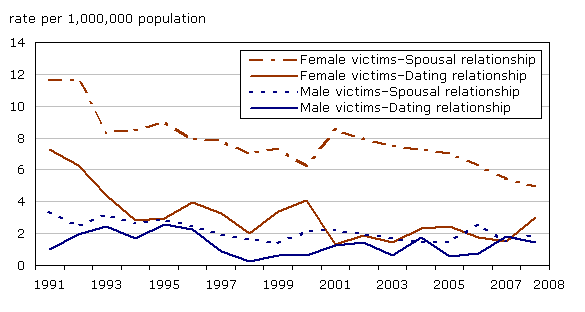
Homicides in dating relationships accounted for almost one-third (30%) of all homicides committed by intimate partners in 2008, with spousal and common-law relationships accounting for the rest (70%). Rates of homicide perpetrated in dating relationships have fluctuated over time, but generally followed a downward trend for female victims (Chart 4).12 From 199113 to 2008, rates of homicide perpetrated in dating relationships dropped 59% for female victims. Trends involving male victims of dating homicide were less clear, with rates rising in the early 1990's, followed by a sharp decline from 1995 to 1998, and subsequent rise again. It is important to note that homicide in dating relationships is a relatively rare event (accounting for an average of 22 homicides per year over this period). Consequently, small changes in the number of homicides from one year to the next can cause considerable variation in rates.
Chart 4
Decline in rates of homicide for female victims
Note: Similar data on homicides between dating partners is not available prior to 1991. The Homicide Survey was revised and expanded in 1991, in an effort to respond to changing information needs. Additional changes were incorporated in 1997. As such, there are some variables for which historical data are unavailable.
Source: Statistics Canada, Canadian Centre for Justice Statistics, Homicide Survey.
Text Box 2
Dating violence in same-sex relationships14
According to 2008 police-reported data, approximately 10% of male victims (265) and 1% of female victims (179) of dating violence involved same-sex relationships. Male victims accounted for 60% of these incidents, and female victims 40%. The types of offences perpetrated in same-sex and opposite-sex dating relationships were similar, predominantly involving common assault (representing 49% and 54% of incidents respectively), followed by uttering threats (16% and 10%), major assault (14% and 11%), and criminal harassment (12% and 14%).
Police charging rates were lower on average for incidents involving same-sex compared to heterosexual dating relationships. Approximately 65% of violent incidents involving same-sex dating relationships and 81% of violent incidents involving heterosexual dating relationships resulted in charges being laid or recommended by police.15 This difference is statistically significant after controlling for other factors known to be associated with the probability of police charging, such as the severity of the offence, use of weapons, and sex of the victim among other factors.16 Rates of charging were lower for incidents involving same-sex relationships across relationship categories (current dating, former dating and other intimate relationships), but the difference was most pronounced in former dating relationships (with 53% of incidents cleared by charge in homosexual relationships compared to 75% in heterosexual relationships).
Text Box 3
Young adolescent victims of dating violence
Adolescents between the ages of 12 and 14 accounted for less than 2% of victims of dating violence reported to police. The vast majority of these victims were female, representing nearly 92% of incidents. Rates of dating violence were almost ten times higher for adolescent females (38 per 100,000 population) than adolescent males (4 per 100,000 population). Unlike older victims, the most common offences perpetrated against adolescent victims of dating violence were sexual assault and related offences such as sexual interference17 (representing 45% of all incidents, compared to 3% for older teenagers and adults). Similar to older victims, other common offences committed against adolescents in dating relationships included common assault (27%) and uttering threats (12%).
The relatively high proportion of female as compared to male adolescent victims may appear at odds with recent research in Canada and the United States that have documented similar rates of dating violence between males and females (Ellis et al., 2009; Straus, 2004; Archer, 2000; Foshee, 1996; White and Koss, 1991). However, these differences may be a reflection of wide variation in the definitions of violence across studies (Lewis & Fremouw, 2001). Most published work to date has used very broad definitions of adolescent dating violence, which include forms of emotional and verbal abuse. With some exceptions (see Wekerle et al., 2009), most school-based studies in Canada have not examined sexual offences along with other forms of physical and emotional abuse. However, even when sexual offences were removed from the current analysis, rates of police-reported dating violence were 3 times higher for female than male adolescents. Consequently, these results should be interpreted in terms of a continuum of abuse, ranging from emotional, psychological, financial and physical abuse, with police-reported physical and sexual violence representing the severe end of the spectrum.
According to UCR2 data, for the majority of incidents (88%) involving adolescent victims of dating violence, the suspect was older than the victim.18 Approximately 30% of incidents involved an accused one to two years older, 40% were three to five years older, 13% were six to ten years older, and 6% involved an accused who was eleven or more years older than the victim. Most incidents involving 12- to 14-year-old victims of dating violence occurred in a single home or other dwelling unit (64%), followed by on the street or other open areas (13%), schools (12%), and commercial and non-commercial corporate places (4%).19
Incidents involving adolescent victims were least likely to lead to formal charges. Less than half (47%) of incidents involving victims 12 to 14 years of age led to formal charges, compared to 69% for those 15 and over. This difference may be attributed in part to the fact that some of the suspects were likely under the age of 18 (making them eligible for diversion programs).
Summary
Results of this study show the importance of exploring violence in all types of intimate relationships. In 2008, dating relationships accounted for one-quarter of all violent incidents and one-third of homicides committed by intimate partners.
The characteristics of police-reported dating violence have largely mirrored those of spousal violence (see Taylor-Butts, 2009; Bressan, 2008). In 2008, the vast majority of victims of dating violence were female, with rates of violence highest among those 30 to 39 years of age. But, violence in dating relationships occurs at all stages of life.
Research suggests that young victims and perpetrators of dating violence may be at increased risk of continuing this cycle in their adult intimate and family relationships. Recognizing the value of early intervention, much of the response to dating violence in Canada has focused on school-based education and awareness programs in secondary schools, college and university campuses (Department of Justice Canada, 2003). Prevention efforts have focused on teaching adolescents problem-solving and conflict management skills to help them develop healthy relationships (Wolfe et al., 2005; Wolfe et al, 2009).
Methodology
Incident-Based Uniform Crime Reporting (UCR2) Survey
Data from the 2008 UCR2 survey reflects information collected from 155 police services covering 98% of the Canadian population. Coverage of the Incident-based Uniform Crime Reporting (UCR2) survey for each jurisdiction in 2008 is 100% for all of the provinces and territories except Nova Scotia (99.5%), Quebec (98.7%), Ontario (99.0%), Manitoba (96.6%), Alberta (99.4%), British Columbia (91.9%), and Northwest Territories (99.7%).
UCR2 Trend Database
The UCR2 Trend Database (1999 to 2008) includes 63 police services that have reported to the UCR2 Survey consistently since 1999. With the exception of Quebec, the data are primarily from urban police departments. These respondents accounted for 54% of the population of Canada in 2008. Provincially, this database accounts for 36% of the population of Newfoundland and Labrador, 18% of the population of New Brunswick, 99% of the population of Quebec, 52% of the population of Ontario, 47% of the population of Saskatchewan, 55% of the population of Alberta and 14% of the population of British Columbia.
Homicide Survey
The Homicide Survey began collecting police reported data on homicide incidents, victims and accused persons in Canada in 1961, and began collecting data on family-related homicides in 1974. When the police become aware of a homicide, the investigating police department completes a survey questionnaire, which is then forwarded to the Canadian Centre for Justice Statistics. The count for a particular year represents all homicides reported in that year, regardless of when the death actually occurred. In 1991 and 1997, the survey was revised and expanded to include additional variables, such as previous conviction histories or the accused and victims, employment of the accused and victims, victim's use of force at the time of the incident, and Shaken Baby Syndrome as a cause of death.
Detailed data tables
Table 1 Number of violent crimes by sex of victim and relationship to accused, 2008
Table 3 Victims of dating violence by offence type and sex of victim, 2008
Table 4 Level of injury sustained against victims of dating violence by sex of victim, 2008
Table 6 Location of dating violence incidents by age of the victim, 2008
Table 7 Incident clearance status of dating violence cases by sex of victim, 2008
References
Archer, J. 2000. "Sex differences in aggression between heterosexual partners: A metaanalytic review." Psychological Bulletin, 126, 651–680.
Aston, C. and V. Pottie-Bunge. 2005. "Family homicides-suicides." Family Violence in Canada: A Statistical Profile, 2005. AuCoin, K. (ed.). Statistics Canada Catalogue no. 85-224-XIE. Ottawa.
AuCoin, K. 2005. "Stalking–criminal harassment." Family Violence in Canada: A Statistical Profile, 2005. AuCoin, K. (ed.). Statistics Canada Catalogue no. 85-224-XIE. Ottawa.
Bressan, A. 2008. "Spousal violence in Canada's provinces and territories." Family Violence in Canada: A Statistical Profile, 2008. Ogrodnik, L. (ed.). Statistics Canada Catalogue no. 85-224-XIE. Ottawa.
Brzozowski, J. 2004. "Family violence against children and youth." Family Violence in Canada: A Statistical Profile, 2004. Brzozowski, J. (ed.). Statistics Canada Catalogue no. 85-224-XIE. Ottawa.
Canada Revenue Agency. 2010. Marital Status Home Page.
www.cra-arc.gc.ca/tx/ndvdls/tpcs/ncm-tx/rtrn/cmpltng/prsnl-nf/mrtl-eng.html
(accessed March 31, 2010)
Cornelius, T.L., R.C. Shorey, and A. Kunde. 2009. "Legal consequences of dating violence: a critical review and directions for improved behavioral contingencies". Aggression and Violent Behavior, 14: 194–204.
DeKeseredy, W., and K. Kelly. 1993. "The incidence and prevalence of woman abuse in Canadian university and college dating relationships". Canadian Journal of Sociology 18(2): 137-159.
Department of Justice Canada. 2003. Fact Sheet on Dating Violence.
www.justice.gc.ca/eng/pi/fv-vf/facts-info/dati-freq.html
(accessed April 14, 2010).
Eitle, D. 2005. "Probability of Arrest in Domestic Violence Cases". Crime and Delinquency, 51(4): 573-597.
Ellis, W.E., C.V. Crooks, and D.A. Wolfe. 2009. "Relational Aggression in Peer and Dating Relationships: Links to Psychological and Behavioral Adjustment." Social Development, 18(2): 253-269.
Foshee, V. 1996. "Gender differences in adolescent dating abuse prevalence, types, and injuries." Health Education Research, 11, 275-286.
Federal-Provincial-Territorial Working Group Reviewing Spousal Abuse Policies and Legislation. 2003. Spousal Abuse Policies and Legislation. Prepared for Federal-Provincial-Territorial Ministers Responsible for Justice. Ottawa: Justice Canada. www.justice.gc.ca/eng/pi/fv-vf/rep-rap/spous-conju.html (accessed May 26, 2010).
Johnson, H. and T. Hotton. 2001. "Spousal Violence." Family Violence in Canada: A Statistical Profile, 2001. Trainor, C. and Mihorean, K. (eds.). Statistics Canada Catalogue no. 85-224-XPE. Ottawa.
Lewis, S.F., and W. Fremouw. 2001. "Dating Violence: A critical review of the literature." Clinical Psychology Review, 21, 105-127.
Mihorean, K. 2005. "Trends in self-reported spousal violence." Family Violence in Canada: A Statistical Profile, 2005. AuCoin, K. (ed.). Statistics Canada Catalogue no. 85-224-X. Ottawa.
www.statcan.gc.ca/pub/85-224-x/85-224-x2005000-eng.pdf
Straus, M.A. 2004. "Prevalence of Violence Against Dating Partners by Male and Female University Students Worldwide". Violence Against Women. Vol. 10(7): 790-811.
Taylor-Butts, A. 2009. "Fact sheet–Police-reported spousal violence in Canada". Family Violence in Canada: A Statistical Profile, 2009. Statistics Canada Catalogue no. 85-224-XIE. Ottawa.
www.statcan.gc.ca/pub/85-224-x/2009000/part-partie2-eng.htm
(accessed March 31, 2010).
Wekerle, C. and D. Wolfe. 1999. "Dating Violence in Mid-Adolescence: Theory, Significance, and Emerging Prevention Initiatives." Clinical Psychology Review, 19(4):435-456.
Wekerle, C., E. Leung, A. Wall, H. MacMillan, M. Boyle, N. Trocme and R. Waechter. 2009. "The contribution of childhood emotional abuse to teen dating violence among child protective services-involved youth." Child Abuse & Neglect, 33, 45-58.
White, J. and Koss, M. 1991. "Courtship Violence: Incidence in a national sample of higher education students." Violence and Victims. Vol. 6: 247-256.
Wolfe, D., C. Crooks, P. Jaffe, D. Chiodo, R. Hughes, W. Ellis, L. Stitt, and A. Donner. 2009. "A School-Based Program to Prevent Adolescent Dating Violence: A Cluster Randomized Trial". Archives of Pediatric Adolescent Medicine. Vol 163(8): 692-699.
Wolfe, D., K. Scott, and C. Crooks. 2005. "Abuse and violence in adolescent girls' dating relationships. Handbook of Behavioral and Emotional Problems in Girls: Issues in Clinical Child Psychology. Bell D., S. Foster, and E. Mash (eds.). New York, NY: Kluwer Academic/Plenum Publishers.
Notes
- Figure based on the 1998-1999 cycle of the National Longitudinal Survey of Children and Youth (NLSCY) and is reported for youth 15 years of age.
- Current or former boyfriends/girlfriends are defined in the UCR2 as a close, or former close, and affectionate relationship with another person and include same-sex relationships. Other intimate relationships are defined as "a person with whom the victim had a sexual relationship or a mutual sexual attraction but to which none of the other relationship options apply.
- One challenge in trying to isolate incidents of dating violence is determining when a relationship shifts from dating to common-law. According to the Canada Revenue Agency, "a common-law partner applies to a person who is not your spouse, with whom (a) you are living in a conjugal relationship for at least 12 continuous months; b) is the parent of your child by birth or adoption; or c) has custody and control of your child and your child is wholly dependent on that person for support". The UCR2 does not contain details about the length of time that the victim and offender have lived together and whether or not they have children in common. Consequently, incidents involving dating partners where the victim and the suspect were living together at the time of the offence were removed from the analysis since these may be considered common-law relationships.
- Intimate partners include current and former spouses (legally married or common law), boyfriends and girlfriends (current or former), living together or separately, and other intimate relationships. Same sex relationships are included.
- Rates were calculated using 2008 Census population estimates for those 15 years of age and older. Normally the population representing the 2% of police jurisdictions that did not participate in the UCR2 in 2008 would be removed from these estimates. However, in this case, it was important to remove the married and common-law population from the age specific estimates to have a more accurate "at-risk" population. Consequently, the age-specific rates will be slightly lower than would be expected if the population living in non-participating police jurisdictions were removed from the denominators.
- According to 2008 demographic population estimates, 90% of people 15 to 24 years of age were not in a marital or common-law relationship, compared to 45% of those aged 25 to 34 and 27% of 35–to 44–year-olds.
- Toronto police service is excluded from the trend analysis due to data quality issues with the victim-accused relationship variable. When the Toronto police service is excluded, the remaining respondents to the UCR2 Trend Database accounted for 40% of the population of Canada in 2008. Rates were calculated using 2008 Census population estimates for those 15 years of age and older. Police jurisdictions that did not participate in the UCR2 in 1999 (the year the trend data started) were removed from these population estimates.
- Although the UCR2 Trend data are available from 1999 to 2008, due to data quality issues prior to 2003, this analysis focused on 5-year trends from 2004 and 2008. Annual rates of dating violence based on UCR2 trend data were considerably lower than those based on 2008 UCR2 data. This is due to the fact that the denominators used to calculate the rates were based on the total population instead of the unmarried population 15 years of age and older. Estimates of the unmarried population for participating police jurisdictions were not available for this reference period.
- Although increases in dating violence were found across age groups, there was no evidence to suggest that the age composition of victims has changed. The average age of victims was 29 for females and 33 for males, and this remained stable over the 2004 to 2008 reference period.
- The majority of sexual assaults in dating relationships that were reported to police in 2008 (612 of 648) involved sexual assault level 1.
- This difference was statistically significant after controlling for other factors known to be associated with the probability of police charging, such as the type and severity of the offence. See note 14.
- Rates were calculated using 1991 to 2008 Census population estimates by marital status for those 15 years of age and older.
- Similar data on homicides between dating partners is not available prior to 1991. The Homicide Survey was revised and expanded in 1991, in an effort to respond to changing information needs. Additional changes were incorporated in 1997. As such, there are some variables for which historical data are unavailable.
- This section of the analysis used a smaller subset of incidents from the UCR2 involving one victim and one accused. This was necessary to determine the sex of both the accused and the victim of the offence. Consequently, results for this section will not necessarily match those in the main analysis, which included incidents involving multiple victims. As in the rest of the report, incidents involving cohabitating same-sex dating relationships were removed from the analysis as it could not be determined if these were current or former common-law unions.
- Rates of police charging were notably higher when estimates were drawn from the single victim, single accused sample (as compared to the sample that included multiple victim incidents). The reason for this disparity is that in approximately 12% of incidents in which no charges were laid or recommended by police, there was an incident and victim report, but no accused record present in the UCR2 file. To identify incidents involving same-sex relationships it was necessary to have information on the accused. While it is still possible to explore differences in charging practices within this sample, readers are cautioned from comparing estimates between samples.
- Differences in the probability of policing charging were tested using logistic regression modeling techniques. It is important to note that previous research shows there are many other factors known to influence the decision to charge. These include the history of the violence in the relationship, criminal record of the accused, the demeanor and cooperativeness of the victim and accused at the time of the offence among others.
- Sexual interference (s.151)–refers to the direct or indirect touching (for a sexual purpose) of a person under the age of 14 years using a part of the body or an object.
- For the purpose of calculating age differences between the victim and accused, a smaller subset of incidents involving a single victim and single accused was used. This was necessary to determine the age of both the accused and the victim of the offence.
- The location of the incident was unknown in approximately 8% of incidents.
- Date modified: