

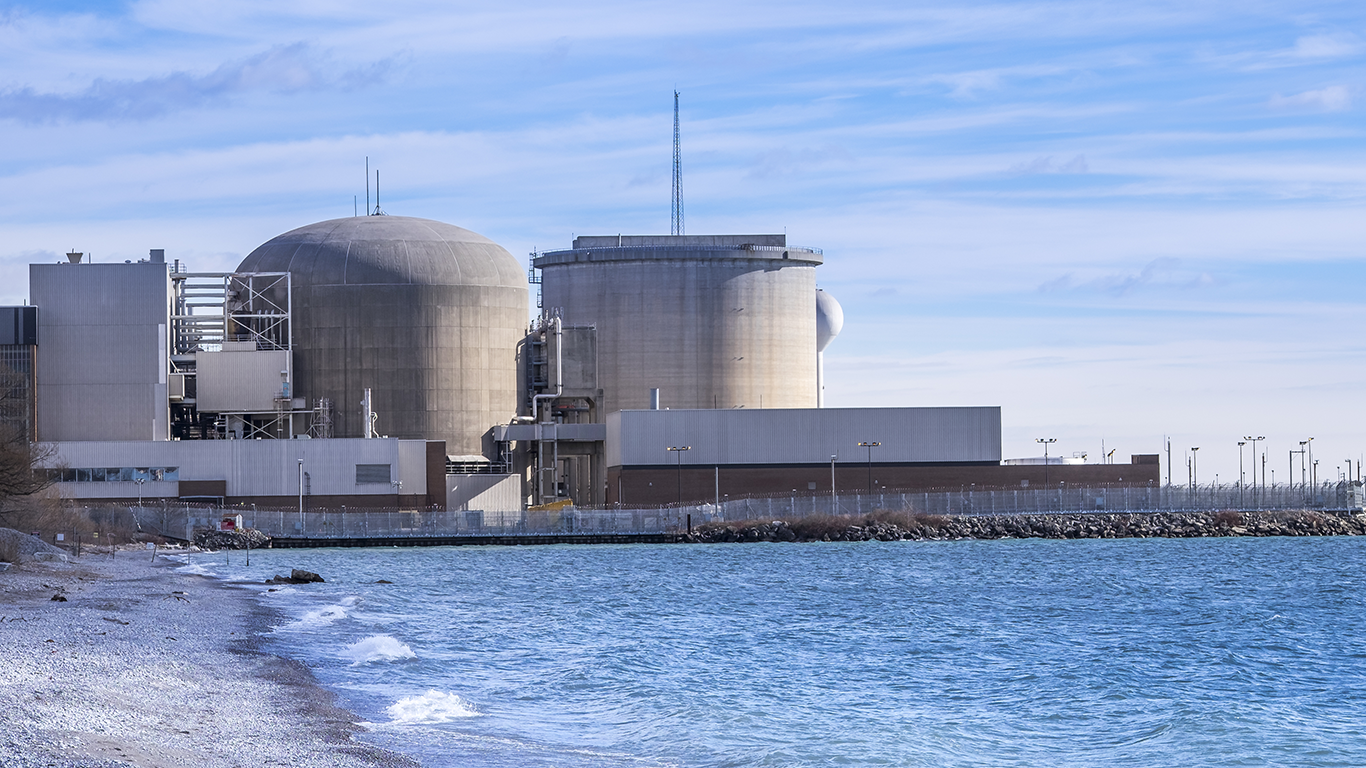
Nuclear generation has been an important part of the Canadian energy mix for decades. Notably, Canada is one of the few countries to possess domestic nuclear technology. With the recent news that Ontario Power Generation will begin construction on the first Small Modular Reactor (SMR) of its kind in the G7 (Group of Seven), let’s look back at how Canada’s nuclear energy sector has evolved, and where it is headed next.
From postwar beginnings to reactors in the 1960s
Following the Second World War, Canada, like many other countries, sought peaceful ways to make use of nascent nuclear technology. Notably, when the Zero Energy Experimental Pile reactor came online in Chalk River, Ontario, in 1945, it was the first time a controlled nuclear chain reaction had occurred outside the United States. Two years later, the National Research Experimental (NRX) reactor, another research reactor, began operation. Also located in Chalk River, the NRX reactor was used for nuclear physics research and it tested different nuclear fuels and materials.
Canada leveraged its wartime research and development experience to develop its own nuclear technology, the Canadian deuterium uranium (CANDU) reactor. CANDU technology is fuelled by unenriched uranium, which is mined in Saskatchewan. The first reactor to generate electricity in Canada was a CANDU prototype at the Nuclear Power Demonstration site in Rolphton, Ontario. This site operated from 1962 to 1987 and was a critical training environment for the workers who would eventually run Canada’s future nuclear stations. In 1968, the Douglas Point nuclear generating station in Kincardine, Ontario, began operation as Canada’s first commercial-scale CANDU reactor.
The 1980s to present: Expanding into other provinces
By 1983, nuclear reactors were generating electricity in New Brunswick, Quebec and Ontario. The Gentilly-2 Nuclear Generating Station in Bécancour, Quebec, ceased operation in 2012, leaving four stations still generating electricity in Canada today: the Point Lepreau station in New Brunswick and the Bruce, Pickering and Darlington stations in Ontario. Point Lepreau has one reactor, Bruce has eight and Pickering and Darlington each have four.
Nuclear energy generation peaks in 2017 and ongoing refurbishments partly explain the decline since then
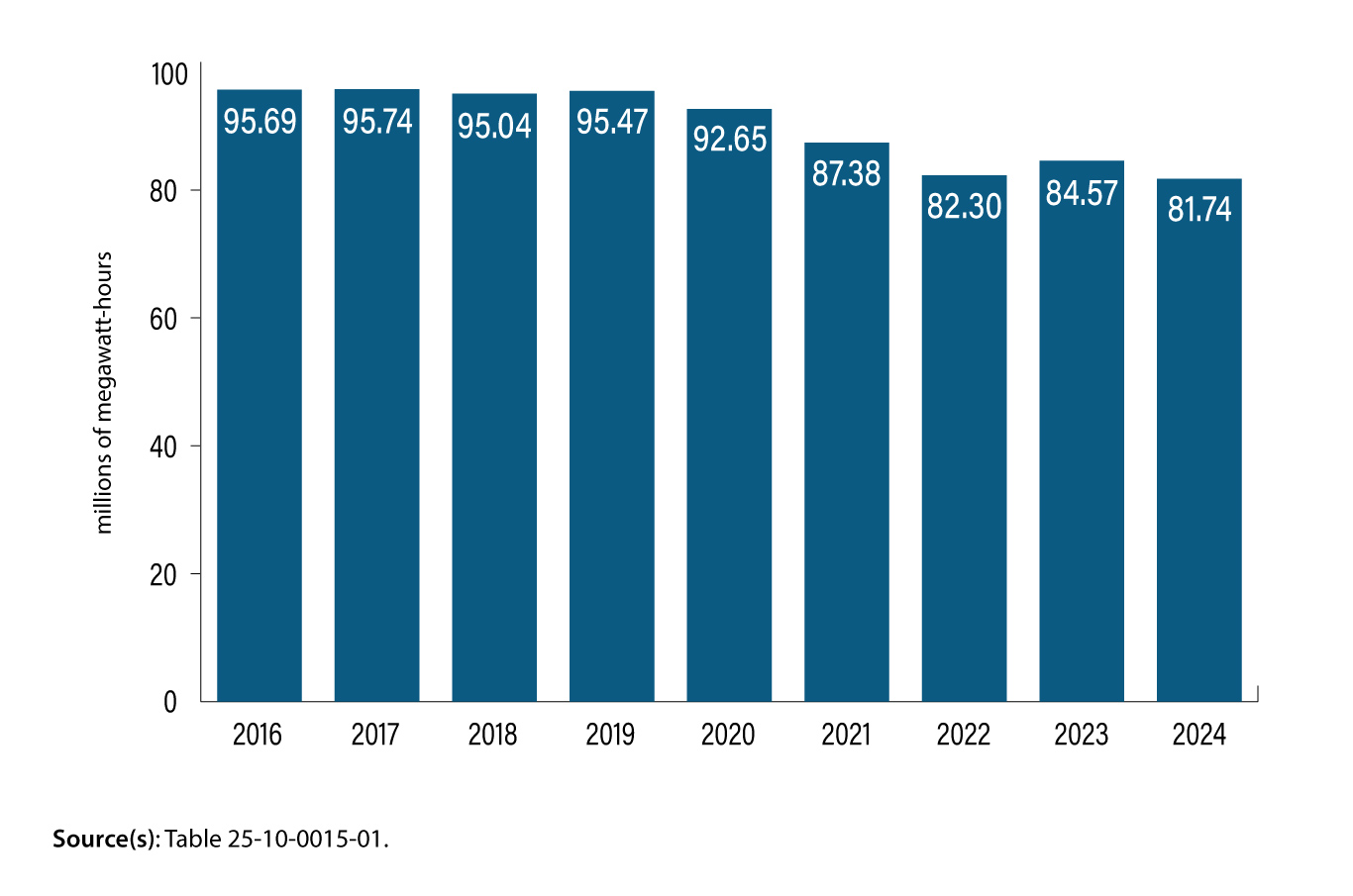
Nuclear electricity generation reached 95.7 million megawatt-hours (MWh) in 2017, the highest level on record since Statistics Canada started tracking the current data series in 2016. In 2017, nuclear represented 14.7% of the total national electricity generation. Nuclear generation has been lower since then, in part due to refurbishments.
Refurbishment is a lengthy process during which a reactor is shut down for maintenance, so that key parts can be replaced to extend the reactor’s lifetime and ensure it can continue to operate safely. Refurbishment activities are currently being undertaken or are planned at Bruce, Pickering and Darlington stations, each of which will have one reactor out of service during the refurbishment process.
Globally, in 2023, Canada generated the sixth-highest amount of electricity from nuclear energy, behind the United States, China, France, Russia and South Korea. The CANDU reactor has been exported to six countries: Argentina, China, India, Pakistan, Romania and South Korea.
In 2024, electricity generated at Canada’s four nuclear stations totalled 81.7 million MWh, down 3.3% from 2023, largely due to a a prolonged shutdown at Point Lepreau, which lasted from April to December 2024.
By province, nuclear represented almost half (48.7%) of the total electricity generation in Ontario and 15.4% of that in New Brunswick in 2024. By comparison, nuclear represented 30.0% of New Brunswick’s total electricity generation in 2023, before the shutdown at Point Lepreau. Overall, nuclear represented more than one-seventh (13.4%) of Canada’s total electricity generation in 2024.
Chart 1: Total nuclear electricity generation in Canada, 2016 to 2024
Description - Chart 1: Total nuclear electricity generation in Canada, 2016 to 2024
The title of the chart is “Total nuclear electricity generation in Canada, 2016 to 2024.”
This is a vertical bar chart.
The vertical axis shows millions of gigawatt-hours of nuclear energy from 0 to 120, by increments of 20.
The years 2016 to 2024 are shown in chronological order from left to right, and there is one bar for each year.
For 2016, there were 95.69 million gigawatt-hours of nuclear energy generated.
For 2017, there were 95.74 million gigawatt-hours of nuclear energy generated.
For 2018, there were 95.04 million gigawatt-hours of nuclear energy generated.
For 2019, there were 95.47 million gigawatt-hours of nuclear energy generated.
For 2020, there were 92.65 million gigawatt-hours of nuclear energy generated.
For 2021, there were 87.38 million gigawatt-hours of nuclear energy generated.
For 2022, there were 82.30 million gigawatt-hours of nuclear energy generated.
For 2023, there were 84.57 million gigawatt-hours of nuclear energy generated.
For 2024, there were 81.74 million gigawatt-hours of nuclear energy generated.
Source(s): Table 25-10-0015-01.
Looking to the future: Expanding current sites and planning for new ones
In recent years, increasing demand for electricity and advancements in SMRs have brought nuclear electricity back into focus. As they are smaller than conventional nuclear reactors, SMRs can be shipped to their final site, opening nuclear electricity to a wider array of locations and applications. There are now many new nuclear projects in various stages of development in Canada.
Currently, work is ongoing at Darlington to prepare a site where three new SMRs are planned, which is expected to boost the station’s generation capacity by 1,200 megawatts (MW). For reference, the current facility has a capacity of 3,512 MW. There are also plans in the works to install an SMR alongside the existing reactor at Point Lepreau, while a proposed expansion at Bruce could include SMRs or conventional reactors.
Saskatchewan is studying sites to determine where a potential SMR could be built. Ontario Power Generation, which operates the Darlington and Pickering sites, partnered with another company in 2024 to examine the feasibility of SMRs in Alberta. Another private company has proposed building a conventional nuclear generating station with two to four reactors in Alberta.
The Darlington project is expected to be Canada’s first functional SMR and is projected to be completed and connected to the grid by the end of 2030. SMRs have also been proposed for use in Canada’s Far North to provide both industrial and domestic electricity, as generation there is currently primarily fossil fuel-based. Recent developments in both SMR and conventional nuclear reactors have the potential to help Canada consolidate its energy grid and transition to non-emitting energy sources.

📲 Looking for more? Staying informed has never been easier!
Follow the “Energy” subject in the StatsCAN app to receive personalized updates and stay connected with the most recent articles, reports and analyses.
Contact information
For more information, contact the Statistical Information Service (toll-free 1-800-263-1136; 514-283-8300; infostats@statcan.gc.ca) or Media Relations (statcan.mediahotline-ligneinfomedias.statcan@statcan.gc.ca).