


No, we’re not talking about the pop. The kind of coke we’re talking about today is an energy source which, among other uses, is an important element in some of Canada’s major industries, including oil refining and steelmaking.
What is coke?
There are two different energy products known as coke: coal coke and petroleum coke. Coal coke is produced when the highest quality type of coal, known as bituminous or metallurgical coal, is cooked in an oven without any air. This process removes any impurities such as water or organic matter, resulting in coke—a greyish, porous residue that is composed mostly of carbon.
Petroleum coke is the result of “cracking.” When crude bitumen or oil is heated and pressurized, its molecular chains “crack” into smaller chains and separate into different petroleum products, such as gasoline. Petroleum coke is a byproduct of this process and contains the residual carbon from the bitumen or oil.
Coal coke production falls while petroleum coke climbs
In 2024, Canada produced 1.9 million tonnes of coal coke, down 9.6% compared with 2023 and down more than one-quarter (-26.3%) since 2018.
Canada also produced 4.9 million cubic metres of marketable petroleum coke in 2024, up 10.1% year over year and 17.4% higher compared with 2019.
Increases in production of petroleum coke in the last few years coincide with an overall increase in production of crude oil and refined petroleum products.
To put the two types of coke into a common unit of measure, in 2024, Canada produced 53 539 terajoules of coal coke and 187 428 terajoules of petroleum coke. Terajoules are a measure of actual energy content, rather than volume (cubic metres) or mass (tonnes).
Chart 1: Supply and demand of primary and secondary energy in terajoules
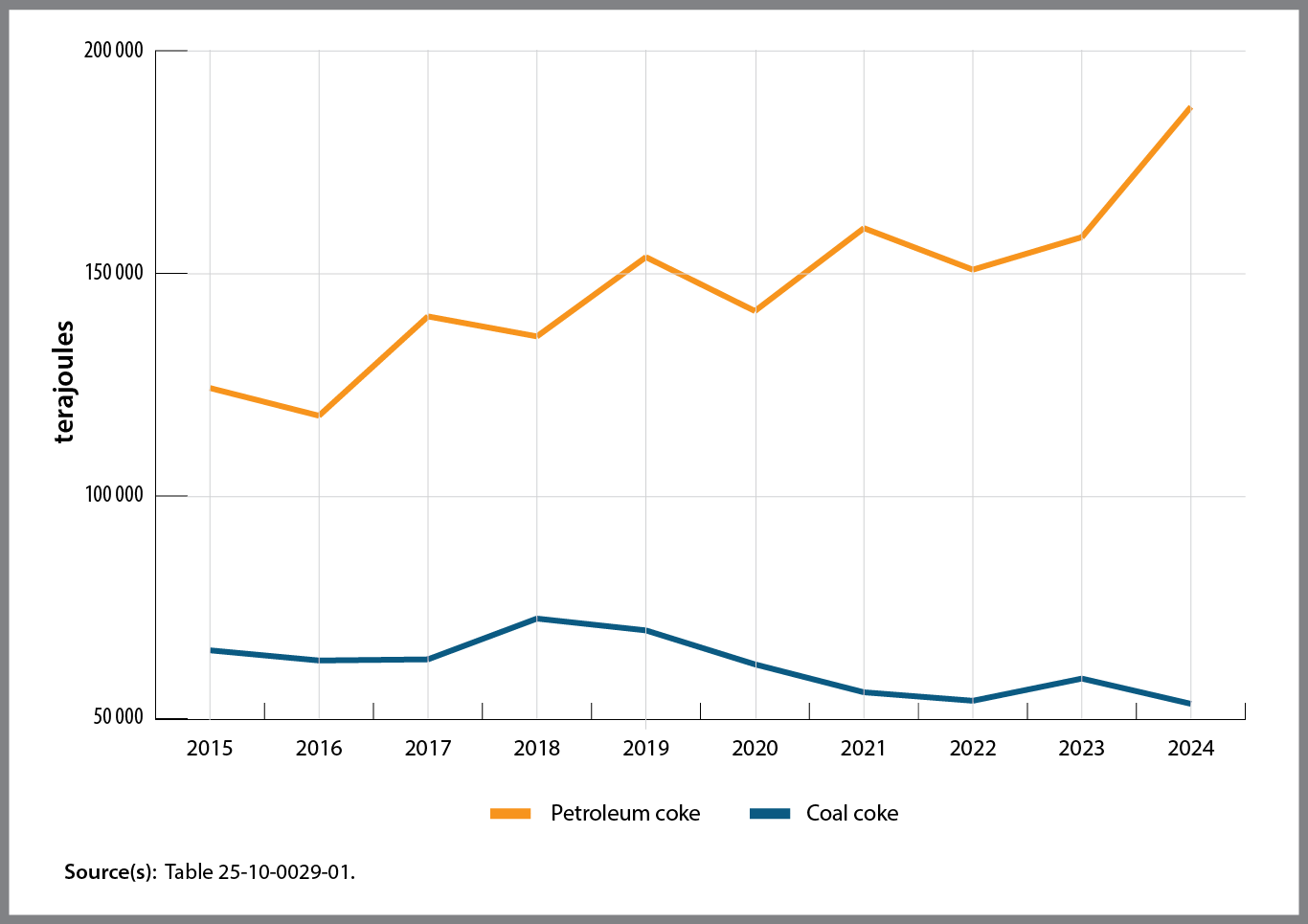
Description - Chart 1: Supply and demand of primary and secondary energy in terajoules
The title of this chart is “Supply and demand of primary and secondary energy in terajoules, annual.”
This is a grouped line chart. The first line represents the supply and demand energy in terajoules of petroleum coke second line represents the supply and demand of energy in terajoules of coal coke.
The horizontal axis represents years, beginning in 2015 and ending in 2024, in chronological order from left to right.
The vertical axis represents the supply and demand of primary and secondary energy in terajoules, from 50,000 to 200,000, in increments of 50,000.
In 2015, petroleum coke was 124 370 and coal coke 65 536.
In 2016, petroleum coke was 118 166 and coal coke 63 256.
In 2017, petroleum coke was 140 442 and coal coke 63 513.
In 2018, petroleum coke was 135 956 and coal coke 72 659.
In 2019, petroleum coke was 153 746 and coal coke 70 010.
In 2020, petroleum coke was 141 653 and coal coke 62 393.
In 2021, petroleum coke was 160 238 and coal coke 56 128.
In 2022, petroleum coke was 150 927 and coal coke 54 221.
In 2023, petroleum coke was 168 219 and coal coke 59 201.
In 2024, petroleum coke was 187 428 and coal coke 53 539.
Source(s): Table 25-10-0029-01.
Canada imports coal coke to meet demand
The steelmaking industry is the main user of coal coke, where it is used both as a heat source in a blast furnace to melt iron ore, and as a refining agent to reduce the amount of oxygen in that ore. This results in pig iron, which can be further refined into iron or steel.
In 2024, 75 505 terajoules of coal coke were used in metal manufacturing while 6 936 terajoules were used in mining and oil and gas extraction. Canada uses more coal coke than it produces, and in 2024 it imported 35 624 terajoules to meet demand.
Petroleum coke used in many manufacturing processes
Petroleum coke has more industrial applications than does coal coke, but mainly it is fed back into the petroleum industry as a carbon-rich fuel source for the cracking process. In 2024, 94 282 terajoules of petroleum coke were used in the petroleum refineries that produced it, while smaller amounts were used in cement manufacturing (12 911 terajoules), other manufacturing (1 303 terajoules), and iron and steel manufacturing (135 terajoules).
Petroleum coke used to generate electricity in two provinces
Additionally, in 2024, 370 287 metric tonnes of petroleum coke were burned to generate a total of 1.1 million megawatt-hours of electricity in Canada. Petroleum coke represented 5.0% of the total electricity generation in Nova Scotia and 5.6% in New Brunswick, the two provinces that generated electricity from petroleum coke.
Cleaner alternatives to coke under consideration
As high-carbon energy products, both coal coke and petroleum coke release emissions when burned, and for this reason alternatives are being considered. For coal coke, some steelmakers are opting to replace their blast furnaces with electric arc furnaces. Similarly, in many applications, petroleum coke could be replaced by less carbon-intensive energy sources such as electricity or natural gas.

Contact information
For more information, contact the Statistical Information Service (toll-free 1-800-263-1136; 514-283-8300; infostats@statcan.gc.ca) or Media Relations (statcan.mediahotline-ligneinfomedias.statcan@statcan.gc.ca).