


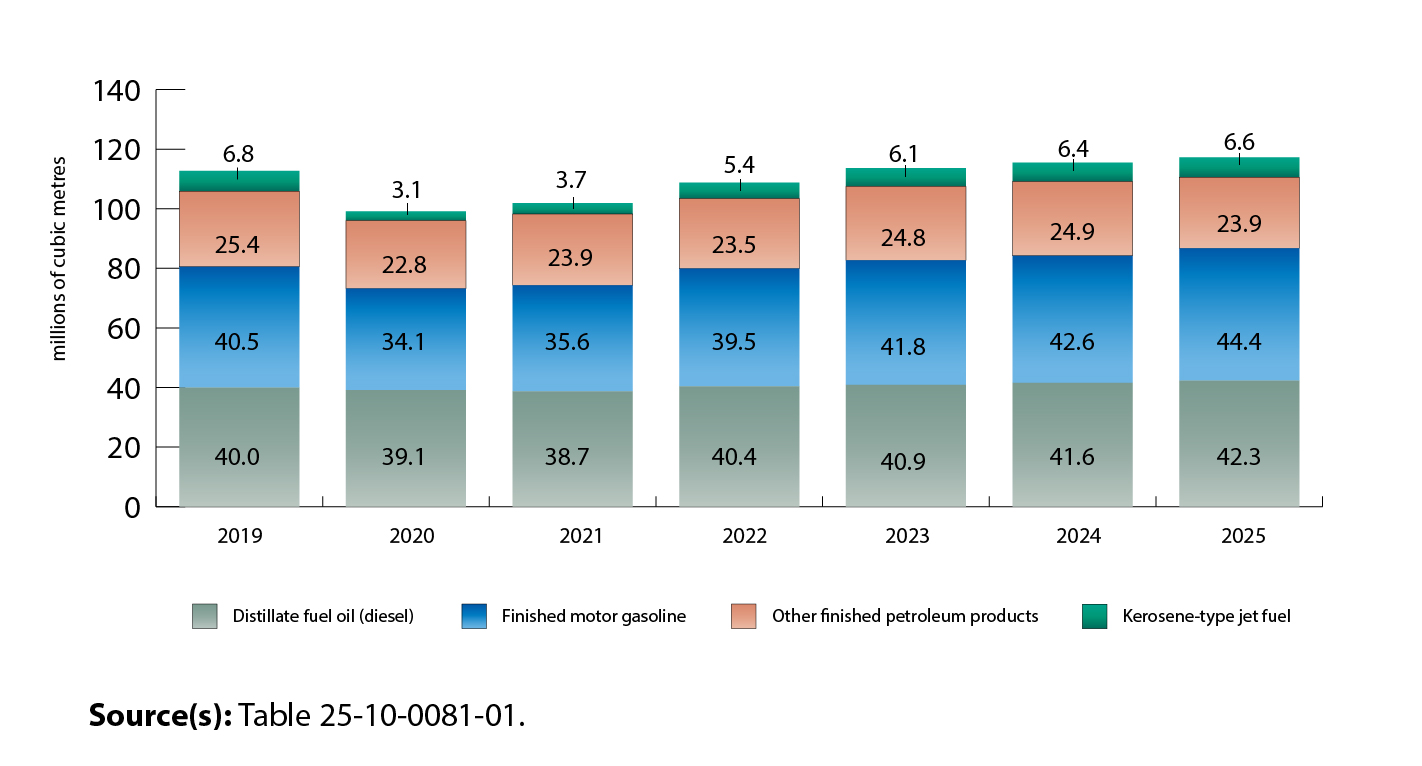
Tariffs, trade and geopolitical events dominated the energy landscape in 2025. Despite external pressures, Canada’s refined petroleum sector posted another record year, as production of finished petroleum products rose 1.4% from the previous record set in 2024 to 117.1 million cubic metres in 2025.
While several products make up the category of refined (finished) petroleum, two products accounted for nearly three‑quarters of total production in 2025: finished motor gasoline (37.9%) and distillate fuel oil (36.1%), for a combined production total of 86.6 million cubic metres. Production for both products reached new monthly highs during the year: motor gasoline in July (4.0 million cubic metres) and distillate fuel oil in December (3.6 million cubic metres).
In contrast, kerosene‑type jet fuel—the most common type of fuel used in commercial aviation—had not fully returned to pre-COVID-19 pandemic levels; in 2025, production was 2.5% below the 2019 level of 6.8 million cubic metres.
Chart 1: Production of major transportation fuels
Description - Chart 1: Production of major transportation fuels
The title of this chart is “Production of major transportation fuels”.
This is a vertical stacked bar chart. There is one bar for each year. There are four series in each bar, from bottom to top. The first series refers to distillate fuel oil, the second series refers to finished motor gasoline, the third series refers to other finished petroleum products and the fourth series refers to kerosene-type jet fuel.
The horizontal axis represents the years from 2019 to 2025, in chronological order from left to right.
The vertical axis represents volume in millions of cubic metres, from 0 to 140, by increments of 20.
In 2019, distillate fuel oil is at 40.0, finished motor gasoline is at 40.5, other finished petroleum products is at 25.4 and kerosene-type jet fuel is at 6.8.
In 2020, distillate fuel oil is at 39.1, finished motor gasoline is at 34.1, other finished petroleum products is at 22.8 and kerosene-type jet fuel is at 3.1.
In 2021, distillate fuel oil is at 38.7, finished motor gasoline is at 35.6, other finished petroleum products is at 23.9 and kerosene-type jet fuel is at 3.7.
In 2022, distillate fuel oil is at 40.4, finished motor gasoline is at 39.5, other finished petroleum products is at 23.5 and kerosene-type jet fuel is at 5.4.
In 2023, distillate fuel oil is at 40.9, finished motor gasoline is at 41.8, other finished petroleum products is at 24.8 and kerosene-type jet fuel is at 6.1.
In 2024, distillate fuel oil is at 41.6, finished motor gasoline is at 42.6, other finished petroleum products is at 24.9 and kerosene-type jet fuel is at 6.4.
In 2025, distillate fuel oil is at 42.3, finished motor gasoline is at 44.4, other finished petroleum products is at 23.9 and kerosene-type jet fuel is at 6.6.
Source(s): 25-10-0081-01.
New consumption highs for three main transportation fuels
Consumption of finished petroleum products, as approximated by the amount of each product supplied to customers, has been trending upwards over the last five years, except in 2024, which saw a slight decrease of 0.5% from 2023.
In 2025, consumption of the three major transportation fuels reached new highs: finished motor gasoline (+2.7%), distillate fuel oil (+2.2%) and kerosene-type jet fuel (+8.0%) experienced growth over 2024, as well as an overall combined gain of 0.6% from 2019 to 2025. Despite this, overall consumption of finished petroleum products (105.0 million cubic metres) was 3.1% lower than in 2019.
The removal of the consumer carbon price in April coincided with changes in some energy prices and likely contributed to the increase in consumption for 2025. On an annual average basis, prices for energy declined 5.7% in 2025, following a 0.6% decrease in 2024. The largest contributor to the decline was an 8.6% decrease in the price of motor gasoline.
Trade balance remains strong for finished petroleum products
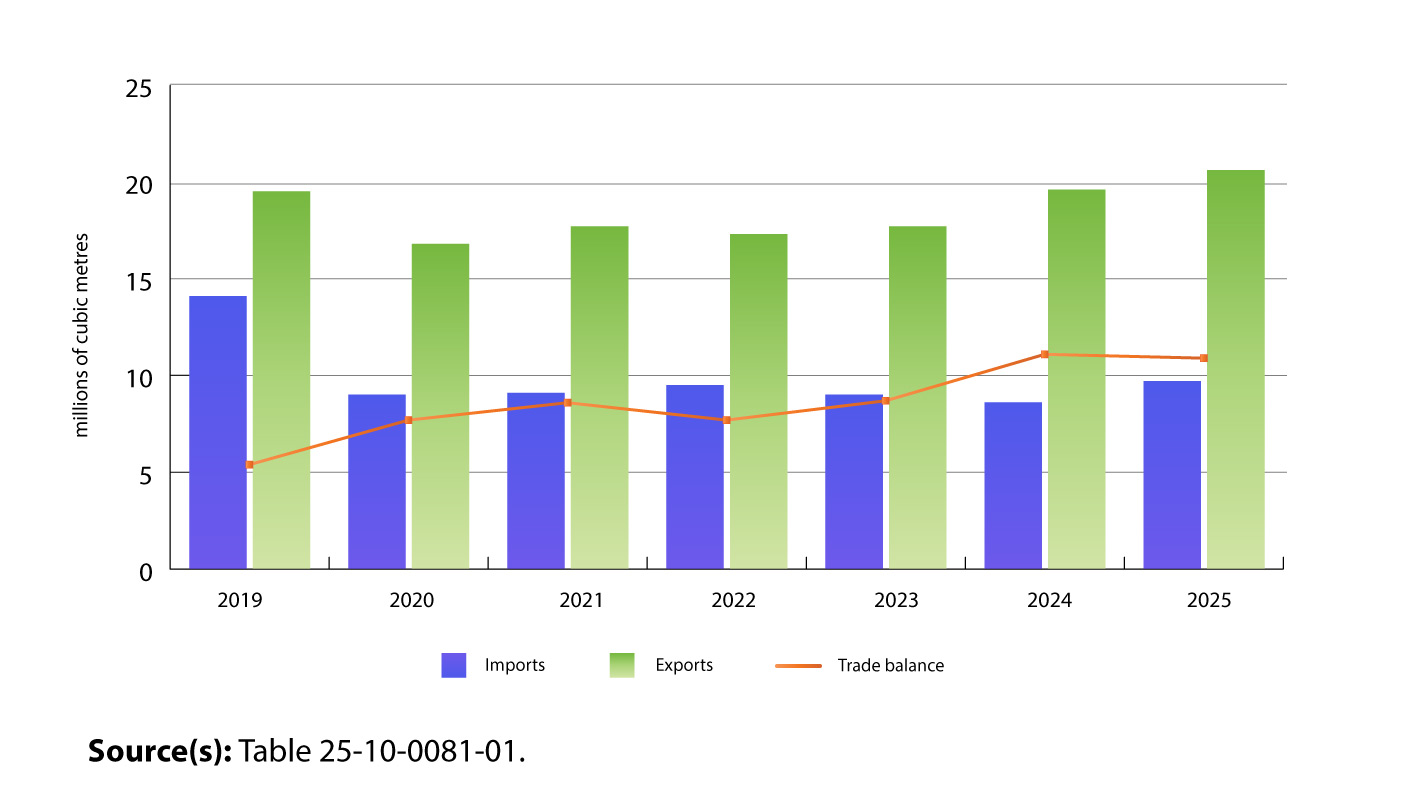
On an annual basis, both imports (+12.9%) and exports (+4.9%) of finished petroleum products increased in 2025 compared with the previous year, resulting in a trade surplus of 10.9 million cubic metres (-1.3% from 2024). In contrast, comparing 2019 with 2025, imports decreased 31.5%, while exports rose 5.5%. Lower finished motor gasoline imports (-52.9%) and higher distillate fuel oil exports (+17.4%) were the key contributors to the trade surplus over this period.
While Canada has generally been the second-largest destination for US gasoline exports after Mexico, it received an average of 22,000 barrels per day in 2025, an annual volume that represents about 2.0% of US gasoline exports—the lowest rate since 2009.
Chart 2: Finished petroleum products, trade balance
Description - Chart 2: Finished petroleum products, trade balance
The title of this chart is “Finished petroleum products, trade balance.”
This is a bar chart, with a horizontal line over top of the bars.
The vertical axis represents volume in millions of cubic metres, from 0 to 25, by increments of 5.
The horizontal axis represents the years from 2019 to 2025, in chronological order from left to right.
There are two bars for each year. The first bar represents imports, and the second bar represents exports.
The line over top of the bars represents the trade balance between imports and exports.
In 2019, imports are at 14.1, exports are at 19.5 and the trade balance is 5.4.
In 2020, imports are at 9.0, exports are at 16.8 and the trade balance is 7.7.
In 2021, imports are at 9.1, exports are at 17.7 and the trade balance is 8.6.
In 2022, imports are at 9.5, exports are at 17.3 and the trade balance is 7.7.
In 2023, imports are at 9.0, exports are at 17.7 and the trade balance is 8.7.
In 2024, imports are at 8.6, exports are at 19.6 and the trade balance is 11.1.
In 2025, imports are at 9.7, exports are at 20.6 and the trade balance is 10.9.
Source(s): 25-10-0081-01.
The 2019-to-2025 period represented a full-circle cycle for Canada’s refined petroleum sector—from disruption in 2020, to recovery in 2021 and 2022, to expansion and stabilization from 2023 to 2025. The data suggest this is an industry in equilibrium, demonstrating the resilience of the broader petroleum industry during this period.
Did you know? Statistics Canada also publishes down-to-the-minute electricity data through the High-frequency electricity data visualization tool.
For more information on energy in Canada, including production, consumption, international trade and much more, visit the Canadian Centre for Energy Information portal and follow #energynews on social media.
Other energy 2025 year-in-review articles
- Electricity generation from combustibles and renewables sharply increase amid another dry year: Electricity year in review 2025 (March 31, 2026)
- Natural gas in 2025: Record production, rising consumption and expanding exports (April 8, 2026)
- Canadian crude oil reaches new heights in 2025 (June 2, 2026)
Contact information
For more information, contact the Statistical Information Service (toll-free 1-800-263-1136; 514-283-8300; infostats@statcan.gc.ca) or Media Relations (statcan.mediahotline-ligneinfomedias.statcan@statcan.gc.ca).