

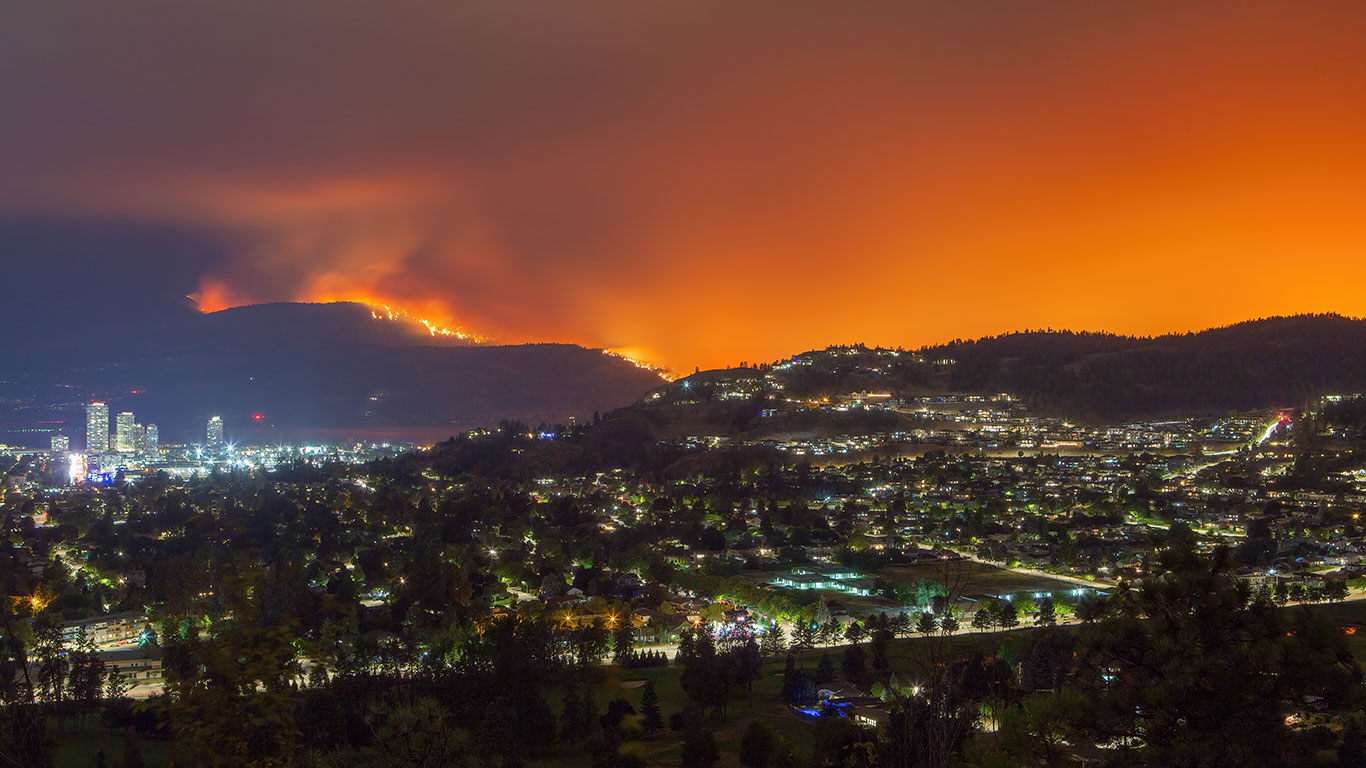
It’s the middle of summer in Canada, which means wildfire season has been underway for many weeks across the country.
Ahead of this year’s wildfire season, two experts appeared on the Eh Sayers podcast to discuss both the science and the economic impacts. This week, Statistics Canada released an analysis of the effects of wildfires on Indigenous communities.
Let’s have a look at some of the main takeaways, along with some data on the effects of weather emergencies on households.
Lightning, climate change and human-caused incidents are behind wildfires
Dr. Mike Flannigan is the British Columbia Innovation Research Chair in Predictive Services, Emergency Management and Fire Science at Thompson Rivers University. He has also taken international leadership roles with organizations researching wildfires.
“A fire a thousand kilometres away can make your life miserable for weeks,” said Flannigan, about the reach of wildfire smoke. “So as the Earth continues to warm, we expect to see more and more fire in Canada and other places around the globe. So yeah, you’re going to see more smoke, unfortunately.”
Flannigan also broke down what causes them. “In Canada, just over half of our fires are started by lightning, but they’re responsible for over 90% of the area burned.”
He explained that summer fires are mostly lightning-caused, contrasted with spring fires, which are largely human-caused, and mostly accidental—even a hot muffler over dry grass can be enough to ignite a fire.
“In Canada, we’ve seen almost a quadrupling of area burned since the 1970s, and my colleagues and I attribute this largely, not solely, to human-caused climate change,” he added.
Economic impact
Mark Brown is a principal researcher here at StatCan who has assessed how much of the economy has been potentially impacted by wildfires, which is something that is harder than it sounds but, with investment in building up local measures of the economy, is a growing capability.
“The one thing that kind of surprised me a little bit about the numbers is when we looked at the national scale—I saw less than 1% of GDP,” said Brown, referencing an analysis he co-authored that estimated how much gross domestic product (GDP) in 2023 and 2024 is potentially impacted by wildfires.
“I’m not sure if that’s a misconception per se, but it’s sort of just highlighting to me just how obviously localized these impacts can be,” he added. At the regional scale, far larger proportions of economies are affected by wildfires than when national or provincial analysis is made.
Brown added that it’s on his and his fellow researchers’ agenda to help decision-makers be better informed by developing a consistent set of local measures that integrate GDP with indicators spanning demographics, health and the environment.
Indigenous Peoples affected by wildfires
StatCan analysis released this week found that in 2024, 13% of First Nations people, 10% of Métis and 8% of Inuit reported that a wildfire was the extreme weather event or natural disaster that had caused the most severe disruption to their daily activities in their lifetime.
The analysis also mapped out the areas burned during the 2023 wildfire season and compared it with data on Indigenous identity and population by census subdivision (CSD) from the 2021 Census. For example, 83% of the total area of Fox Lake 162 reserve, Alberta, was burned by wildfire; with an Indigenous population of 2,245 First Nations people and 15 Métis residents, it had the highest Indigenous population among the top 15 CSDs with a large proportion of land burned in 2023.
As well, First Nations people living in Hay Lake 209 reserve, Alberta, and Métis living in Rainbow Lake, in northern Alberta, were exposed to 137 days in 2023 when air quality posed a high or very high health risk. These two CSDs had the highest number of days of poor air quality that year.
Air quality and fires affecting many households
The most recent data from the Households and the Environment Survey are also from the record-breaking wildfire season of 2023. That year, almost one in four households (23%) reported being affected by an extreme weather event or natural disaster in the past 12 months.
Of those households, almost three in five (58%) reported being affected by smoke or smog, while 14% of households said it was a forest fire, wildfire or grass fire, and some reported both.
Responses varied by geography. For example, of those households affected by an extreme weather event or natural disaster, Alberta households (85%) were most likely to cite poor air quality, followed by those in Saskatchewan (76%), British Columbia (70%), Manitoba (57%), Ontario (56%), Quebec (45%) and Nova Scotia (16%).
British Columbia (31%) and Alberta (26%) households were most likely to cite a forest fire, wildfire or grass fire as the nature of the event.
When asked about the impact of an extreme weather event or natural disaster, nearly three in five affected households (58%) cited poor air quality, the most common nationwide response.
To learn more
For more information on current wildfire conditions and forecasts, visit FireSmoke Canada.
Visit Environment and Climate Change Canada’s Local Air Quality Health Index web page for air quality conditions near you.

Contact information
For more information, contact the Statistical Information Service (toll-free 1-800-263-1136; 514-283-8300; infostats@statcan.gc.ca) or Media Relations (statcan.mediahotline-ligneinfomedias.statcan@statcan.gc.ca).